
The kōdōkalabs
AI Capability Academy
Every Engagement Should Make The Client Stronger
Most agency relationships are structured so that the agency’s expertise stays inside the agency. That’s not necessarily bad faith — it’s the natural result of a business model built around ongoing execution retainers rather than capability transfer. But it means the client organization can spend years and significant budget on an outside vendor and end up no more capable of running its own AI-assisted marketing operation than when it started.
The AI Capability Academy exists to make the opposite true. It’s kōdōkalabs’ training and certification program, built specifically to transfer the ability to run a governed AI Marketing Operating System to your internal team — not generic AI literacy content, but hands-on certification tied to the actual workflows, governance structure, and tools built during your engagement. It’s the clearest way kōdōkalabs’ model differs from a traditional agency: the goal of this solution, explicitly, is for your organization to need it less over time.
This is also, deliberately, the solution most likely to make a prospective client’s next agency conversation a lot shorter. Once your team can point to certified, independent ownership of a governed AI marketing operation, the pitch for an ongoing execution retainer from a different vendor becomes much harder to justify — which is exactly the outcome kōdōkalabs is optimizing for, even though it runs counter to how most vendors in this market are incentivized to operate.
The Academy is not an add-on training module bundled in as a courtesy. It’s treated internally with the same rigor as the Architect and Build phases it follows — with its own defined deliverables, its own success criteria, and its own accountability for whether real capability transfer actually happened, not just whether sessions were attended.
Why Most AI Training Doesn't Create Real Capability
Generic AI training has become common, and it rarely produces lasting organizational capability, for a few consistent reasons:
- It’s decoupled from real workflows. A course on “prompt engineering fundamentals” teaches a skill in the abstract; it doesn’t teach someone how to run your organization’s specific content workflow, governed by your specific quality standards, using your specific knowledge base.
- It’s one-directional and passive. Watching a training video or attending a workshop builds awareness, not the muscle memory of actually running a workflow independently, catching its edge cases, and making judgment calls under your organization’s specific governance rules.
- It has no accountability mechanism. Without certification tied to demonstrated ownership, there’s no clear signal for who can actually run a workflow unsupervised versus who still needs support — so organizations default to assuming everyone who attended the training is equally capable, which is rarely true.
- It happens once, disconnected from ongoing practice. Skills that aren’t reinforced through real use decay quickly, especially for tools and workflows that are still new enough that habits haven’t fully formed.
The AI Capability Academy is designed specifically against these failure modes: training tied to your real workflows, hands-on ownership rather than passive instruction, certification tied to demonstrated capability, and delivery timed to overlap with Build so skills get reinforced through immediate real use.
Programs
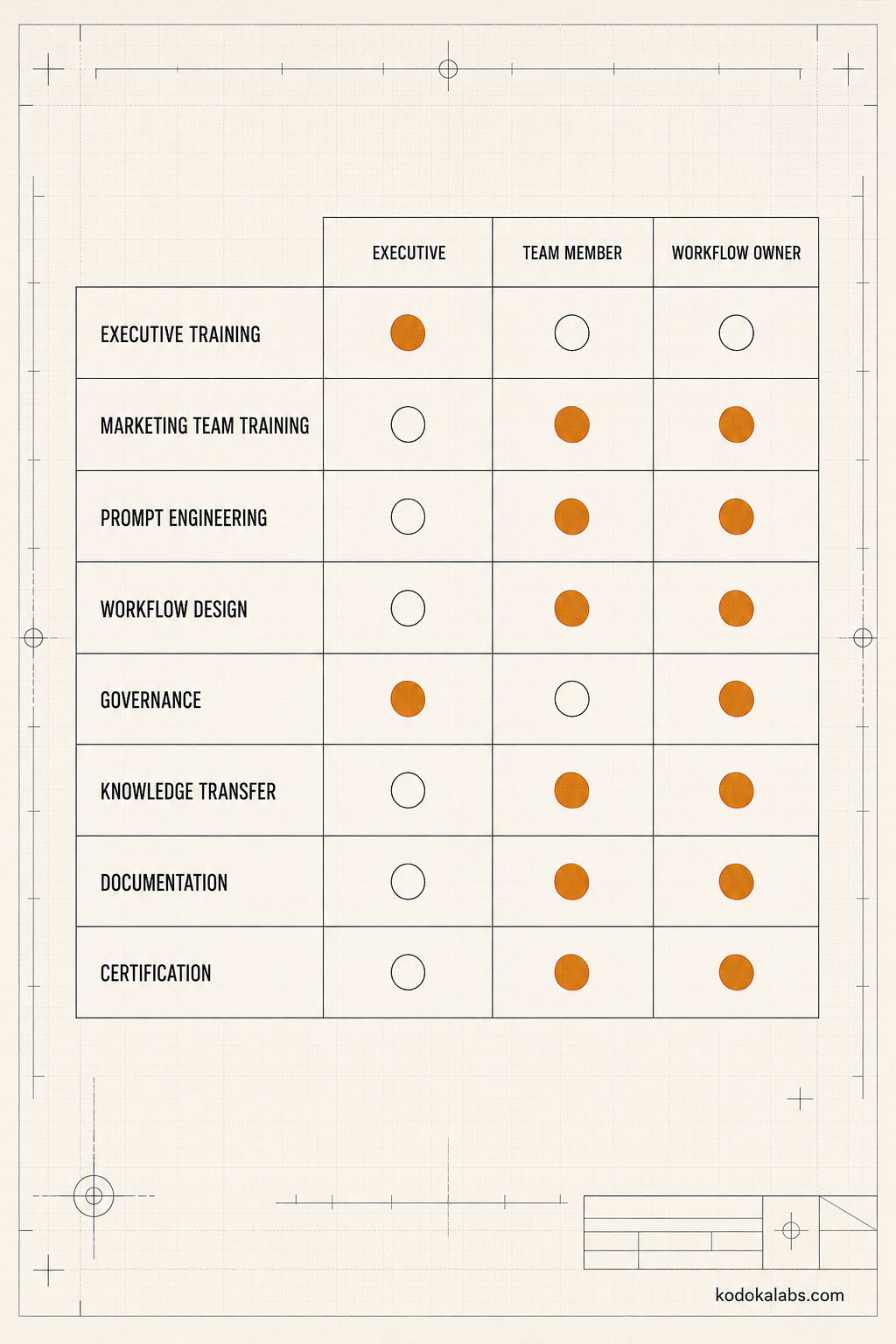
- Executive Training — for CMOs, VPs of Marketing, and other leaders, focused on governance literacy, strategic oversight of AI-assisted work, and how to read and act on the KPI dashboard, rather than hands-on execution skills. This track exists because executives who can’t evaluate whether the operating system is working, beyond trusting a dashboard summary, end up either micromanaging execution details they don’t need to or disengaging from oversight entirely — neither of which is the goal.
- Marketing Team Training — for the individuals who will run day-to-day workflows, covering the specific tools, prompts, and quality standards built during your Architect and Build phases, delivered against the real content types your team produces rather than illustrative examples.
- Prompt Engineering — practical, workflow-specific prompt design and refinement, taught against your organization’s actual content types and brand voice rather than generic examples, so team members learn to iterate on prompts that already work rather than starting from a blank page each time.
- Workflow Design — training your team to design and document new workflows themselves, extending the operating system to new content or campaign types without depending on kōdōkalabs to do it for them. This is one of the more advanced tracks, typically reserved for team members who have already achieved Certified status on existing workflows.
- Governance — how to apply The AI Governance Matrix in practice: recognizing which content categories require which level of review, and how to escalate edge cases appropriately, including scenarios the original governance design didn’t explicitly anticipate.
- Knowledge Transfer — how to maintain and extend the knowledge base your team inherits, so it keeps compounding in value rather than going stale after the engagement ends. A knowledge base that stops being updated loses value quickly, so this track specifically covers the discipline of keeping it current.
- Documentation — training your team to document new workflows and governance decisions to the same standard kōdōkalabs used during Build, so documentation quality doesn’t degrade once ownership transfers and future additions remain as usable as what was originally delivered.
- Certification — structured assessment of hands-on workflow ownership, described in full below, and the mechanism that ties every other track back to a verifiable outcome.
Deliverables
- Playbooks — step-by-step operational guides for each core workflow, written to the standard your team can reference independently, without needing kōdōkalabs’ involvement to interpret them.
- Templates — reusable structures for common content and campaign types, built from what actually worked during Build rather than generic industry templates.
- Prompt Library — a curated, organized collection of prompts proven to work for your organization’s specific workflows and brand voice, maintained as a living asset your team can extend.
- Operating Manuals — comprehensive documentation of the full operating system: workflows, governance, technology stack, and escalation paths, serving as the reference of record for how your marketing organization runs.
- Training — live and self-paced training sessions across all eight program tracks, scoped to the relevant roles in your organization.
- Assessments — the certification instruments used to verify hands-on workflow ownership, described in the next section.
How Certification Works
Certification in the AI Capability Academy is deliberately tied to demonstrated workflow ownership, not passing a written test. A team member becomes certified on a given workflow by running it independently — producing real output, applying the correct governance checkpoints, and meeting the quality bar defined during Build — under observation, with feedback, until they can do so consistently without support.
This matters because the goal of certification isn’t credentialing for its own sake; it’s a genuine, verifiable signal that a specific person can be trusted to own a specific workflow unsupervised. That signal is what makes the Capability Transfer Framework’s handoff timeline credible — kōdōkalabs steps back from a workflow specifically because certified ownership has been demonstrated, not because a training calendar reached its end date.
Level
Full-Time Executive
Trained
Practicing
Certified
has demonstrated independent, unsupervised ownership meeting the defined quality bar
Workflow Owner
certified plus authorized to train and certify others on the same workflow, extending capability further into the organization
The Capability Transfer Framework
The Academy is the primary delivery mechanism for kōdōkalabs’ Capability Transfer Framework — the model governing how ownership of documentation, training, and governance moves from kōdōkalabs to your internal team on a defined timeline. The framework specifies not just what gets transferred, but how transfer is verified (through the certification levels above) and when kōdōkalabs’ active involvement in a given workflow formally ends.
This is a meaningfully different structure than how most consulting or agency engagements handle “knowledge transfer” — often an informal, undocumented handoff meeting near the end of a project, with no verification that the receiving team can actually operate independently. The Capability Transfer Framework treats transfer as a first-class deliverable with its own timeline, milestones, and success criteria, not an afterthought squeezed in before the engagement closes.
kōdōkalabs also tracks capability transfer as one of the five core business outcomes across every engagement — measured specifically as the percentage of workflows with certified, independent internal ownership. This means progress toward reducing dependency on kōdōkalabs is a number your leadership team can see on the same dashboard used to track execution velocity and content performance, not an informal impression.
What "Stronger" Actually Means, Measured
Common Objections
01 Won't training our team just take them away from their day-to-day work?
Training is scoped to overlap with Build and delivered against real workflows your team is already using, not as a separate curriculum requiring dedicated time away from execution. The certification process itself happens through doing the actual work, with feedback, rather than through a classroom setting.
02 What if the people we train leave the company?
This is exactly why documentation, playbooks, and operating manuals are treated as first-class deliverables, not a byproduct of training — capability is captured in written form, not solely in individual people's heads, so a departure doesn't erase the organization's progress. The Workflow Owner certification level also specifically builds in the ability for certified individuals to train and certify their own replacements.
03 Do we really need a formal certification process, or can we just have people learn as they go?
Informal, unverified "learning as you go" is precisely the pattern that leaves organizations with inconsistent quality and no clear picture of who can actually be trusted to run a workflow unsupervised. Certification exists to replace that ambiguity with a verifiable standard — useful not just for kōdōkalabs' handoff, but for your own internal hiring, promotion, and cross-training decisions going forward.
Who Delivers It
Academy training is delivered by the same senior consulting team involved in your Assessment and Operating System engagement, ensuring training is grounded in your organization’s actual workflows rather than generic curriculum.
Frequently Asked Questions (FAQ)
01 How long does a typical Academy engagement take?
Training and certification for a given set of workflows typically runs alongside the final weeks of Build and continues for several weeks afterward, as team members move from Practicing to Certified status. Full timelines depend on how many workflows and how many team members are in scope.
02 Can we certify new hires after the engagement ends?
Yes — Workflow Owner-level certification specifically includes the ability to train and certify others, so your organization can extend certification to new hires without kōdōkalabs' ongoing involvement, using the playbooks and operating manuals delivered during the engagement.
03 Is the Academy available as a standalone engagement, without the full Operating System build?
The Academy is most effective when training against real workflows built during an AI Marketing Operating System engagement, since generic training without a governed system to apply it to tends to produce the same shallow results as any other AI literacy course.
04 What happens if someone fails to reach certification?
Certification is iterative — team members move through Practicing status with feedback until they meet the defined quality bar, rather than a pass/fail test with one attempt. In cases where a specific individual isn't the right long-term owner for a workflow, that's useful information for internal role planning, surfaced early rather than discovered after full handoff.
05 Do executives need to go through the same certification as the marketing team?
No — Executive Training is scoped differently, focused on governance literacy and strategic oversight rather than hands-on workflow execution, since executives typically aren't the ones running day-to-day workflows.
The Latest News and Updates
From the kōdōkalabs
Intelligence Hub




Book An
Assessment
The fastest way to find out where your marketing organization stands is a structured assessment, not a sales call.
In a 90-minute Executive AI Marketing Assessment, we evaluate current maturity, technology, processes, team, content, search, and governance against the AI Marketing Maturity Model, and leave you with a prioritized roadmap — whether or not you engage kōdōkalabs further.