
The
kōdōkalabs
AI Marketing Workflow Optimization with Data-Led Iteration
Data-Led Iteration: Improve AI Marketing Workflows with Evidence
Executive Summary
Data-Led Iteration exists because AI-enabled workflows don’t stay static — models, data, teams, policies, markets, and business priorities all shift over time, and a workflow that passed its initial Pilot Review can quietly degrade or drift out of alignment with what the business actually needs. Organizations tend toward one of two failure patterns in response: leaving a workflow untouched until it fails visibly, or making frequent, undocumented changes with no baseline, no hypothesis, no control group, no approval, and no version history to trace what changed and why. Data-Led Iteration is kōdōkalabs’ answer to both patterns — an eight-step loop that converts validated signals into controlled, documented, reversible changes, rather than either neglect or unstructured tinkering. This page covers the Iteration Evidence Loop, the Signal Taxonomy that classifies what should trigger review, how changes are tested safely and rolled back if needed, and when a signal should route back to Diagnose or Architect instead of a simple workflow tweak.
Key takeaways:
- Data-led iteration is hypothesis-led, evidence-proportionate, governed, and reversible where possible – the goal is a more reliable relationship between the workflow and its context, not constant change for its own sake.
- The Iteration Evidence Loop has eight steps, from observing a signal through monitoring the effect of an approved change.
- The Signal Taxonomy classifies ten types of signal, each warranting a different kind of response.
- Every change is documented in a Change Record with a hypothesis, expected effect, risk, approver, result, and rollback plan.
- Not every signal calls for a workflow tweak — some indicate the organization needs to return to Diagnose or Architect instead.
What Is Data-Led Iteration?
Data-Led Iteration takes the signals a workflow generates once it’s operating — performance data, quality evidence, human feedback, risk events, cost, and commercial outcomes — and runs them through a defined process to decide whether, how, and when to change the workflow. It’s the delivery method that keeps a workflow aligned with a changing operating context after it has moved past Pilot Review, rather than leaving it frozen at whatever state it was validated in or subjecting it to constant, undisciplined adjustment.
Data-Led Iteration Versus the Measure Phase
Data-Led Iteration and the Measure framework phase are closely related but answer different questions, and conflating them tends to leave organizations either measuring without acting or acting without measuring.
| Dimension | Measure Phase | Data-Led Iteration Methodology |
|---|---|---|
| Question it answers | Is this workflow creating organizational value? | Should this specific workflow change, and how? |
| Scope | The organization’s value and decision system across the AI Marketing Value Scorecard’s seven dimensions | The repeatable method for converting validated signals into a controlled workflow change |
| Frequency | A defined measurement cadence producing a Scale Decision Record | Ongoing, triggered by signals as they arise |
| Output | A decision: improve, stop, contain, or scale | A tested, approved, documented, and monitored change (or a decision not to change) |
The Eight-Step Iteration Evidence Loop

kōdōkalabs’ Iteration Evidence Loop structures every workflow change through eight steps.
| # | Step | What Happens |
|---|---|---|
| 1 | Observe | A signal is noticed – from monitoring, feedback, or a measurement cycle |
| 2 | Classify the signal | The signal is categorized per the Signal Taxonomy below |
| 3 | Validate the evidence | The signal is checked to confirm it’s real and not noise, before any change is considered |
| 4 | Form a change hypothesis | A specific, testable hypothesis about what change would address the signal |
| 5 | Prioritize | The hypothesis is weighed by value, risk, effort, and confidence against other candidate changes |
| 6 | Test within an approved scope | The change is tested in a controlled, limited scope, not deployed broadly on first attempt |
| 7 | Decide and document | A decision is made and recorded in the Change Record |
| 8 | Monitor and feed forward | The change’s effect is monitored, and findings feed into Diagnose, Architect, or Scale as relevant |
1. Observe
2. Classify the signal
Observation happens continuously through ordinary operation — a practitioner noticing something off, a monitoring alert, or a scheduled Measure review can all be the origin of a signal worth classifying.
3. Validate the evidence
4. Form a change hypothesis
5. Prioritize
Observation happens continuously through ordinary operation — a practitioner noticing something off, a monitoring alert, or a scheduled Measure review can all be the origin of a signal worth classifying.
6. Test within an approved scope
7. Decide and document
8. Monitor and feed forward
Signals That Should Trigger Review
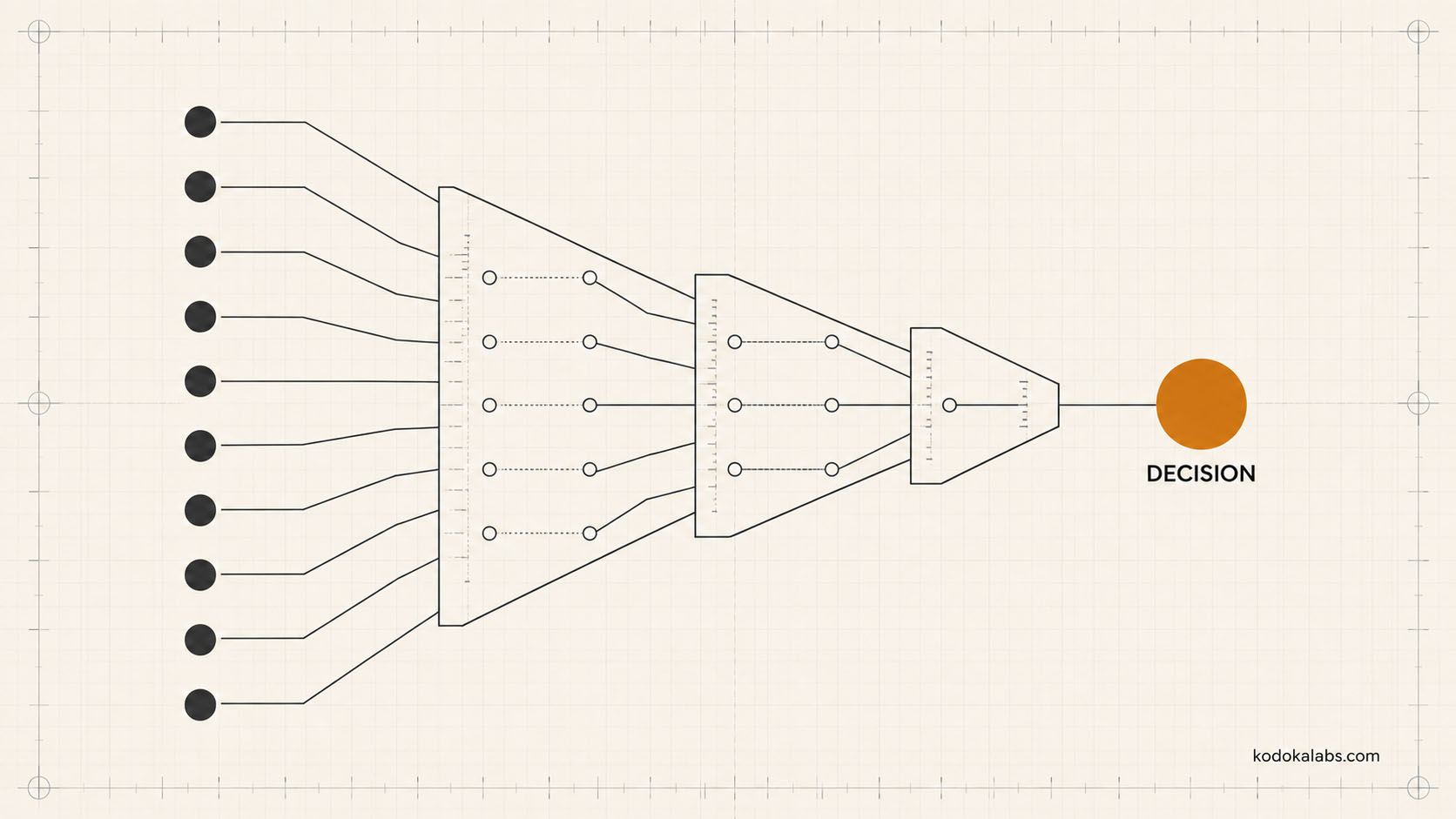
kōdōkalabs’ Signal Taxonomy classifies ten types of signal that can trigger the Iteration Evidence Loop.
| Signal Type | Example |
|---|---|
| Functional failure | The workflow stops producing usable output under certain conditions |
| Factual or source-quality issue | Claims in output are increasingly inaccurate or poorly sourced |
| Brand or editorial issue | Output drifts from approved tone or standards |
| User or customer friction | The intended audience responds negatively or disengages |
| Human workload or exception burden | Review and correction time is rising unexpectedly |
| Governance, privacy, security, or IP event | A control failure, near-miss, or compliance concern occurs |
| Adoption or capability issue | The operating team’s demonstrated capability is regressing |
| Cost or performance change | Operating cost or speed shifts meaningfully |
| Commercial signal | A change in the workflow’s connection to business outcomes |
| External change | A model, platform, policy, law, market, or knowledge-base change affecting the workflow |
Validating Evidence Before Changing the Workflow
Forming and Prioritizing Change Hypotheses
Testing Changes Safely
Version Control, Approval, and Rollback
Monitoring Quality, Cost, Capability, Risk, and Commercial Effects
When to Return to Diagnose or Architect
Not every signal calls for a workflow-level tweak. A pattern of signals suggesting the underlying business process, risk profile, or operating model itself has changed – not just the workflow’s execution of it – indicates the organization needs to return to Diagnose for a fresh assessment or Architect to redesign the target operating model, rather than attempting to patch a structural misalignment through incremental workflow changes. Recognizing this distinction – and being willing to route a signal back to an earlier phase rather than forcing it into an iteration cycle it doesn’t fit – is part of what keeps Data-Led Iteration honest.
When a Workflow Is Ready to Scale
Common Data-Led Iteration Failure Modes
- Vanity metrics
Iterating toward a metric that looks good without connection to genuine business value. - Correlation treated as causation
Attributing an observed improvement to a specific change without controlling for other factors that shifted at the same time. - Changing multiple variables without traceability
Altering several things at once, making it impossible to know which change produced which effect. - Invisible human work
A change that appears to improve a metric while quietly increasing uncompensated human correction effort behind the scenes. - Benchmark chasing
Changing a workflow to match an external benchmark or competitor claim rather than the organization’s own validated evidence. - Model switching without problem definition
Swapping the underlying AI model or tool as a first response to a signal, without first understanding what’s actually driving the problem. - Undocumented changes
Modifying a workflow without a Change Record, losing the ability to trace what changed, why, and with what result. - Ignoring negative or null results
Treating a test that didn’t confirm the hypothesis as a failure to hide rather than a valid, useful finding.
Frequently Asked Questions around Data-Led Iteration (FAQ)
How does kōdōkalabs continuously improve AI marketing workflows after they're live?
Through Data-Led Iteration — an eight-step loop that classifies and validates signals, forms and prioritizes change hypotheses, tests changes in a controlled scope, and documents every change in a Change Record with a rollback plan.
How is Data-Led Iteration different from the Measure phase?
Measure is the organizational decision system determining whether a workflow creates value, evaluated on a defined cadence; Data-Led Iteration is the ongoing delivery method that acts on signals — including Measure's "improve" decisions — to produce specific, tested, documented workflow changes.
What are the eight steps of the Iteration Evidence Loop?
Observe, classify the signal, validate the evidence, form a change hypothesis, prioritize, test within an approved scope, decide and document, and monitor and feed forward. See the table above.
What kinds of signals should trigger a review?
Ten types, from functional failures and quality issues to governance events and external changes like a model or policy update — see the Signal Taxonomy table above.
Why does evidence need to be validated before a change is made?
Because a single anecdote or one-time metric shift isn't reliable grounds for a change — validating that a signal reflects a genuine, reproducible pattern prevents iteration from becoming reaction to noise.
How are competing changes prioritized?
Using a matrix that weighs expected value, risk, implementation effort, and confidence in the underlying hypothesis, rather than addressing whichever signal was raised most recently or loudly.
How are changes tested safely?
Within an approved, limited scope — a controlled comparison or phased rollout with monitoring — before broader deployment, mirroring the discipline established in Pilot Review.
What is a Change Record?
A documented record of every change: the triggering signal, evidence, affected version, hypothesis, expected effect, risk, test design, owner, approver, result, decision, deployment date, rollback plan, and review date.
When should an organization return to Diagnose or Architect instead of iterating?
When signals indicate the underlying business process or operating model itself has shifted, not just the workflow's execution — patching a structural misalignment through incremental changes tends not to resolve it.
How does Data-Led Iteration relate to Scale readiness?
A workflow with a history of successful, evidenced iteration cycles is stronger scale-readiness evidence than one that has never been tested against changing conditions.