
The
kōdōkalabs
AI Marketing Operating Systems
Intelligence Hub
An AI marketing operating system is the documented workflow, governance, knowledge, and measurement infrastructure that determines whether AI-assisted marketing produces consistent, governed output or fragmented, unpredictable results. It is not a single tool or platform — it’s the operating layer that sits above whatever specific AI tools an organization uses, and it’s what separates organizations getting compounding value from AI from organizations accumulating disconnected pilots. This guide covers what an operating system consists of, why marketing organizations need one, how to build one, and the common ways attempts at building one fail.
Definition
An AI marketing operating system is the combination of documented workflows, a shared knowledge base, configured automation, defined governance, a content engine, and measurement infrastructure that together determine how AI-assisted marketing work actually gets done inside an organization. It’s the layer between “we have access to AI tools” and “our marketing organization reliably produces governed, high-quality output using AI” — and the gap between those two states is almost entirely a function of whether this operating layer exists and is documented, not which specific AI tools are in use.
The term deliberately borrows “operating system” from computing: just as an operating system manages resources and provides a consistent environment for applications to run reliably, a marketing operating system manages workflows, governance, and knowledge so that individual AI tools and campaigns run reliably and consistently, rather than each operating on its own ad hoc logic.
Latest AI Marketing Operating System Content










Why Marketing Needs An Operating System, Not More Tools
The most common mistake in AI marketing adoption is treating the problem as a tooling gap. An organization identifies a need — faster content production, better research synthesis, more consistent campaign execution — and responds by purchasing a tool built to address that specific need. This works, briefly, for the specific use case the tool was purchased for. It doesn’t create compounding organizational capability, for a few structural reasons:
Tools don’t define governance. A tool can execute a task; it can’t tell you who should review the output, what the quality bar is, or when human judgment is required. Without an operating system layer defining these things, governance defaults to whatever the individual using the tool decides, inconsistently, case by case — which is precisely how organizations end up with wildly inconsistent quality across teams using the identical tool.
Tools don’t share knowledge across the organization. Each tool typically operates with its own context, disconnected from what other teams or tools have already learned. A shared knowledge base is what allows institutional knowledge to compound instead of being siloed inside individual tool instances — without it, the same research gets redone and the same mistakes get repeated by different people, months apart.
Tools accumulate without coordination. Different teams evaluating and purchasing tools independently produces the fragmented technology stack described on the AI Marketing Transformation pillar — redundant capability, inconsistent standards, and rising cost without a proportional increase in organizational capability. It’s common to find three or four tools solving overlapping problems, purchased by different people who never coordinated with each other.
Tools don’t measure organizational capability. Usage metrics for a specific tool say nothing about whether the broader organization is more capable of producing governed, high-quality AI-assisted work than it was previously. A dashboard showing high tool adoption can coexist with declining content quality if nothing is tracking the outcomes that actually matter.
This is why organizations that lead with tool selection consistently underperform organizations that lead with operating-system design, even when the tool-first organizations spend considerably more on technology. The tool is rarely the constraint; the surrounding system that governs how it’s used is.
An operating system solves the actual problem underneath the symptom: not “we need a better tool for X,” but “we need a consistent, governed way of deciding how AI gets used across everything the marketing organization does.”
The Core Components
An AI marketing operating system consists of eight interconnected components:
- Workflow Design — documented, end-to-end processes for each core content and campaign type, specifying exactly where AI drafts and where a human reviews. A well-designed workflow makes the handoff points explicit enough that two different people running it produce comparably consistent results.
- Knowledge Base — a structured, searchable repository of brand guidelines, prior research, approved messaging, and campaign learnings that every workflow draws from. This is what allows a new hire or a new AI tool to inherit institutional context immediately rather than starting from zero.
- Automation — configured automation scoped specifically to tasks classified as safe for AI to execute unsupervised, with defined review checkpoints for everything else. Effective automation is deliberately narrow — reliable automation of well-understood tasks, not maximizing the automated percentage of work for its own sake.
- Governance — a formal structure (The AI Governance Matrix) defining approval paths by content category and risk level. This is the component most commonly left informal, and the one most likely to create real exposure once output volume scales.
- Content Engine — the operational system turning the knowledge base and workflows into a repeatable production capability, covered further on the Content Operations pillar and Search Intelligence pillar.
- Measurement — a KPI dashboard tracking execution velocity, governance maturity, content and search performance, internal capability, and cost per output, tied to a documented maturity baseline rather than tracked in isolation.
- Training — role-specific training and certification for the team members who run the system, covered in depth as part of the AI Capability Academy solution, tied to demonstrated workflow ownership rather than passive attendance.
- Documentation — complete written documentation of every workflow, governance rule, and system component, so the operating system survives team turnover instead of depending on any single person’s memory.
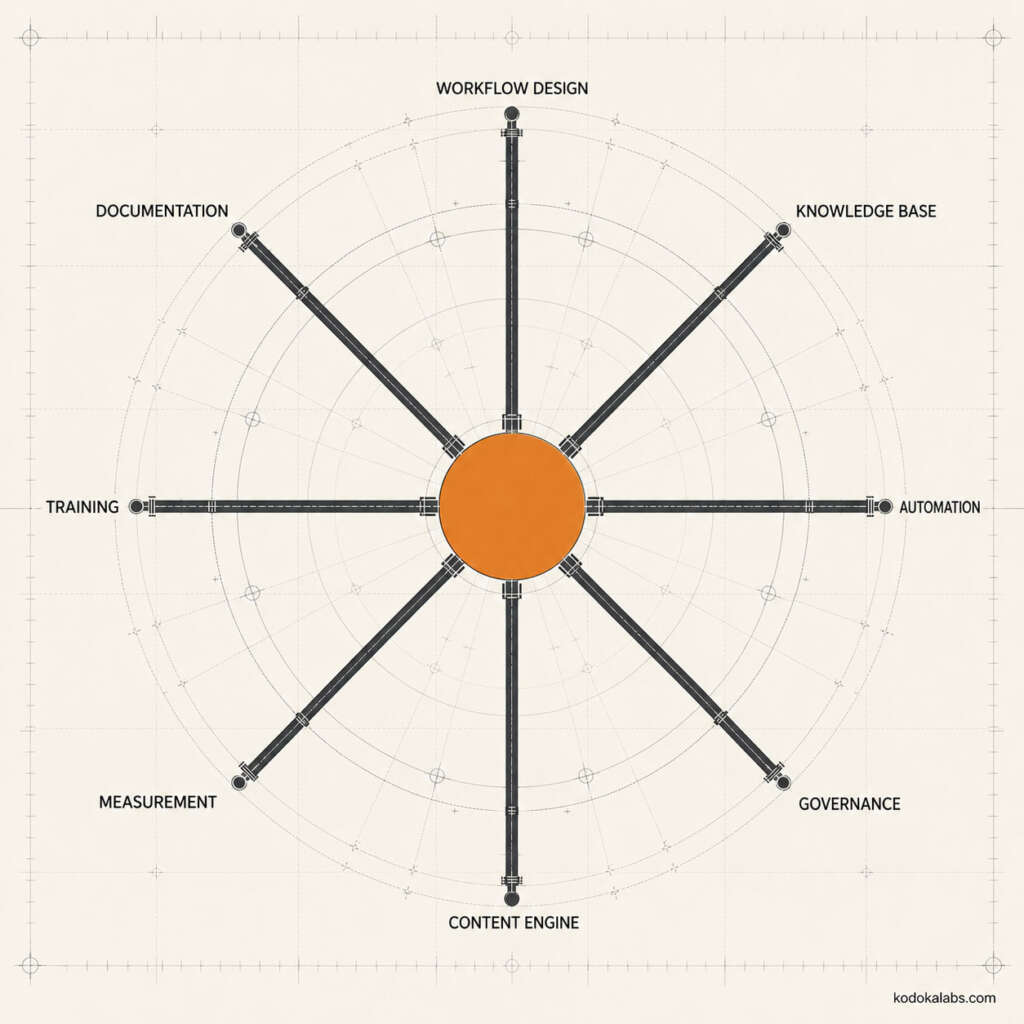
The AI Marketing Operating System Framework
The framework organizes these eight components into three connected layers, each changing at a different pace:
The Three Layers
| Layer | Contains | Rate of Change |
|---|---|---|
| Execution Layer | workflows, automation, content engine | changes frequently through iteration |
| Governance Layer | Governance Matrix, approval paths | changes slowly, requires leadership sign-off |
| Knowledge Layer | knowledge base, documentation, measurement | durable, accumulates value over years |

Governance Inside The Operating System
Sample AI Governance Matrix
| Content Category | AI Involvement | Required Review | Accountable Owner |
|---|---|---|---|
| Routine social copy | AI may draft, adapt, and format posts using approved messaging, brand guidelines, and verified source material. It may not introduce unsupported claims or new corporate positions. | Low risk: No additional review for pre-approved templates and evergreen content. Single human review if the post contains new claims, commentary, statistics, or references to current events. | Social Media Lead |
| Templated email and lifecycle copy | AI may personalize approved templates, generate subject-line variants, summarize existing offers, and adapt copy for defined audience segments. | Single human review before a new template or campaign enters automation. Approved templates may then run without reviewing every individual message. | CRM or Lifecycle Marketing Lead |
| SEO and educational content | AI may support research, outlining, drafting, optimization, and repurposing. All factual statements must be traceable to approved internal knowledge or credible external sources. | Single human review by a qualified editor or subject-matter expert before publication. Additional review is required for legal, financial, medical, or regulated claims. | Content Lead |
| Paid campaign copy | AI may generate variants based on approved value propositions, product information, targeting criteria, and brand rules. It may not invent performance claims, offers, prices, or urgency. | Single human review for standard campaigns. Marketing and legal review for comparative, promotional, performance, or regulated claims. | Paid Media Lead |
| Product and service pages | AI may structure and draft content using approved product documentation, positioning, proof points, and customer research. | Multi-stakeholder sign-off from marketing and the relevant product or service owner. Legal review is required where contractual, comparative, or regulated claims appear. | Product Marketing Lead |
| Customer case studies | AI may organize interviews, summarize transcripts, identify themes, and draft the narrative. It may not create quotations, results, customer statements, or missing data. | Multi-stakeholder sign-off from the account owner, customer representative, and marketing. Legal review is required where confidentiality or usage rights apply. | Customer Marketing Lead |
| Executive-authored thought leadership | AI may support research, structure arguments, challenge assumptions, and prepare drafts. The final position, judgment, and personal experience must come from the named executive. | Executive-author approval required before publication. Communications or legal review is added for sensitive corporate, political, regulatory, or market statements. | Named Executive Author |
| Regulated-industry claims | AI may retrieve, organize, or rewrite claims that already exist in an approved claims repository. It may not independently interpret regulations, generate new claims, or infer product outcomes. | Mandatory multi-stakeholder sign-off from a subject-matter expert and legal or compliance. No unsupervised publication. | Compliance or Legal Lead |
| Crisis and reputation communication | AI may assist with monitoring, internal summarization, scenario development, and drafting internal options. It may not publish, respond publicly, or make decisions autonomously. | Mandatory leadership and communications sign-off, with legal review where appropriate. Every external response requires explicit human approval. | Communications Director |
| Legal, privacy, and policy content | AI may compare documents, identify inconsistencies, and prepare working drafts based on approved source material. AI output must not be treated as authoritative legal guidance. | Mandatory review and approval by legal, privacy, or compliance personnel before publication or operational use. | Legal or Data Protection Lead |
Good governance design specifically avoids two failure modes: too little structure, which leaves quality dependent on whoever happens to be producing the work, and too much structure, which slows execution to the point that teams route around the governance process entirely rather than following it. Calibrating the right level of review for each content category, based on actual risk rather than uniform caution, is one of the more nuanced parts of Architect-phase design.
Governance also isn’t set once and left alone — it’s re-evaluated as content categories evolve, as new AI capabilities become available, and as the organization’s own risk tolerance shifts. Treating governance design as a living practice rather than a one-time policy document is one of the clearer differences between organizations whose operating systems stay effective over time and organizations whose governance quietly erodes within a year of implementation.
Why This Differs From A Generic AI Policy Document
Many organizations already have some version of an “AI usage policy” — a short document, often produced quickly in response to a specific concern, listing broad dos and don’ts. This is a meaningfully different artifact from the Governance Layer of an operating system. A policy document typically states principles (“use AI responsibly,” “always fact-check AI output”) without specifying how those principles apply to specific content categories, specific workflows, or specific approval paths. The AI Governance Matrix, by contrast, is operational: it maps concrete content categories to concrete review requirements and named accountable owners, so a team member facing a real decision has a specific, actionable answer rather than a general principle to interpret on their own. Organizations that mistake a policy document for an operating governance layer often discover the gap only after an inconsistency or a real mistake surfaces the difference.
Human + AI Execution Model In Practice
Where the Governance Matrix defines review requirements by content category, the Human + AI Execution Model defines the division of labor within a workflow, task by task: research synthesis and first-draft generation are commonly AI-executed; final brand-voice review, factual verification on sensitive claims, and strategic prioritization are commonly reserved for human judgment. Making this division explicit and specific to an organization’s risk tolerance is what allows a team to answer “should AI be doing this” consistently, rather than person by person and case by case.
Architect And Build, Phase By Phase
Building an operating system corresponds to Phases 2 and 3 of The kōdōkalabs Transformation System:
Architect — Design the target operating model: workflow diagrams, governance structure, role definitions, and technology stack recommendations, mapped to the organization’s specific goals and the gaps identified in a prior Diagnose phase. This phase typically produces multiple viable design options where genuine tradeoffs exist between rollout speed and scope breadth.
Build — Implement iteratively, using a Strategic Architecture → Agentic Drafting → Pilot Review → Data-Led Iteration loop for each workflow: design it, implement it with AI-assisted drafting, review real output against the governance-defined quality bar, then refine based on what the review surfaces. Each loop typically covers one workflow or workflow family, so a full Build phase might run through it several times before the operating system covers the organization’s full content and campaign surface.
Full detail on both phases, including objectives, inputs, outputs, deliverables, KPIs, and required AI/human roles, is available on the Framework page.
Common Failure Patterns
- Building the execution layer without the governance layer. Automating workflows before defining approval paths produces faster output at unmanaged risk.
- Treating the knowledge base as a one-time setup task. A knowledge base that isn’t actively maintained loses value quickly as it goes stale relative to current brand positioning and campaign learnings.
- Skipping Pilot Review to move faster. Rolling out a workflow broadly before testing it against real output on a small scope tends to surface quality problems at a much larger, more expensive scale.
- No defined ownership after go-live. An operating system without an accountable owner for ongoing maintenance tends to drift back toward the fragmentation it was built to fix.
Maturity Benchmarks
Operating-System Maturity Levels
| Level | What It Looks Like |
|---|---|
| Level 1 | individual tools, no shared workflow documentation |
| Level 2 | some documented workflows, inconsistent governance |
| Level 3 | defined workflows and governance for core use cases |
| Level 4 | consistent workflows, governance, and measurement organization-wide |
| Level 5 | new capability absorbed without re-litigating standards |
Frequently Asked Questions (FAQ)
What's the difference between an AI marketing operating system and a marketing technology stack?
A technology stack is the set of tools an organization uses. An operating system is the workflow, governance, and knowledge layer that determines how those tools get used consistently. The same technology stack can produce very different results depending on whether an operating system governs it.
Do we need to replace our existing tools to build an operating system?
Not necessarily. Architect-phase design evaluates the existing stack and recommends changes only where there's a genuine gap or redundancy — the goal is a governed system, not technology replacement for its own sake.
How long does it take to build one?
Architect typically takes two to four weeks; Build is iterative and workflow-by-workflow, commonly spanning two to four months depending on how many workflows are in scope.
Can a small team build one, or is this only for larger organizations?
The same components apply regardless of team size, though a smaller team typically needs proportionally more emphasis on documentation, since there's less redundancy if only one or two people hold institutional knowledge.
Who should own the operating system once it's built?
Internal marketing operations ownership is typical, with executive-level governance oversight — often the same person who owns the broader AI marketing transformation effort, described on the AI Marketing Transformation pillar.
The Latest News and Updates
From the kōdōkalabs
Intelligence Hub






Book An
Assessment
The fastest way to find out where your marketing organization stands is a structured assessment, not a sales call.
In a 90-minute Executive AI Marketing Assessment, we evaluate current maturity, technology, processes, team, content, search, and governance against the AI Marketing Maturity Model, and leave you with a prioritized roadmap — whether or not you engage kōdōkalabs further.