Multi-Agent Marketing Systems: Architecture and Governance

Multi-Agent Marketing Systems: Architecture, Governance, and Evaluation

A multi-agent marketing system coordinates two or more bounded AI components or agents that perform distinct roles within a defined workflow, using shared context, explicit handoffs, permissions, evaluation, and human decision rights. A multi-agent system is not necessarily autonomous, and it is not always preferable to one controlled workflow – the right architecture depends on whether the added complexity actually earns its cost.

Executive Summary

Teams increasingly describe any chain of prompts as a “multi-agent system,” or add agents to a workflow before defining the shared state, permissions, evaluation approach, and human ownership those agents will need – and complexity increases while evidence of additional value stays thin. Multi-agent architecture is valuable only when role separation creates measurable operational benefit greater than the added coordination, evaluation, security, and maintenance cost it introduces. This guide covers when multiple agents are actually justified versus when one controlled workflow performs better, the common architecture patterns, the Agent Contract that governs every bounded agent, and how evaluation, observability, and human decision gates need to scale alongside the system’s complexity.

Key Takeaways:

  • Not every chain of AI-assisted steps is a multi-agent system, and not every task benefits from becoming one.
  • Multi-agent architecture is justified only when specialization creates measurable benefit exceeding its coordination and maintenance cost.
  • Every agent in a bounded system operates under an Agent Contract – the same governance instrument kōdōkalabs uses for individual AI-assisted tasks in Agentic Drafting, applied here at the agent-component level.
  • Evaluation needs to happen at both the individual-agent level and the whole-system level – a system can fail even when every component passes its own test.
  • More agents and more autonomy are not inherently better – the right architecture is the one that matches the task’s actual requirements.
Table of contents

What Is a Multi-Agent Marketing System?

A multi-agent marketing system is a defined workflow in which two or more bounded AI components, each with a distinct role, coordinate through shared context, explicit handoffs, and defined permissions to produce an outcome – with human decision rights built in at appropriate points, not assumed away. The word “bounded” matters: each agent has a specific, limited scope of responsibility, tools, and authority, rather than an open-ended mandate to do whatever seems helpful.

Multi-Agent vs. Workflow Automation vs. Single-Agent Systems

These three approaches are often conflated, but they represent genuinely different architectures with different trade-offs.
Approach
Description
Best Suited For

Workflow automation

A defined sequence of steps, some automated, without independent AI decision-making at each stage
Predictable, well-standardized processes

Single-agent system

One AI component handling a task end-to-end, possibly using multiple tools
Tasks that don’t benefit from role specialization

Multi-agent system

Multiple specialized, bounded AI components coordinating on a shared task
Tasks where distinct specialized roles create genuine value
A system doesn’t become “multi-agent” simply because it calls a model more than once in sequence – that’s often just a multi-step single-agent workflow. The meaningful distinction is whether the system has genuinely distinct, bounded roles with their own contracts, tools, and evaluation, coordinating with each other.

When Multiple Agents Are Justified

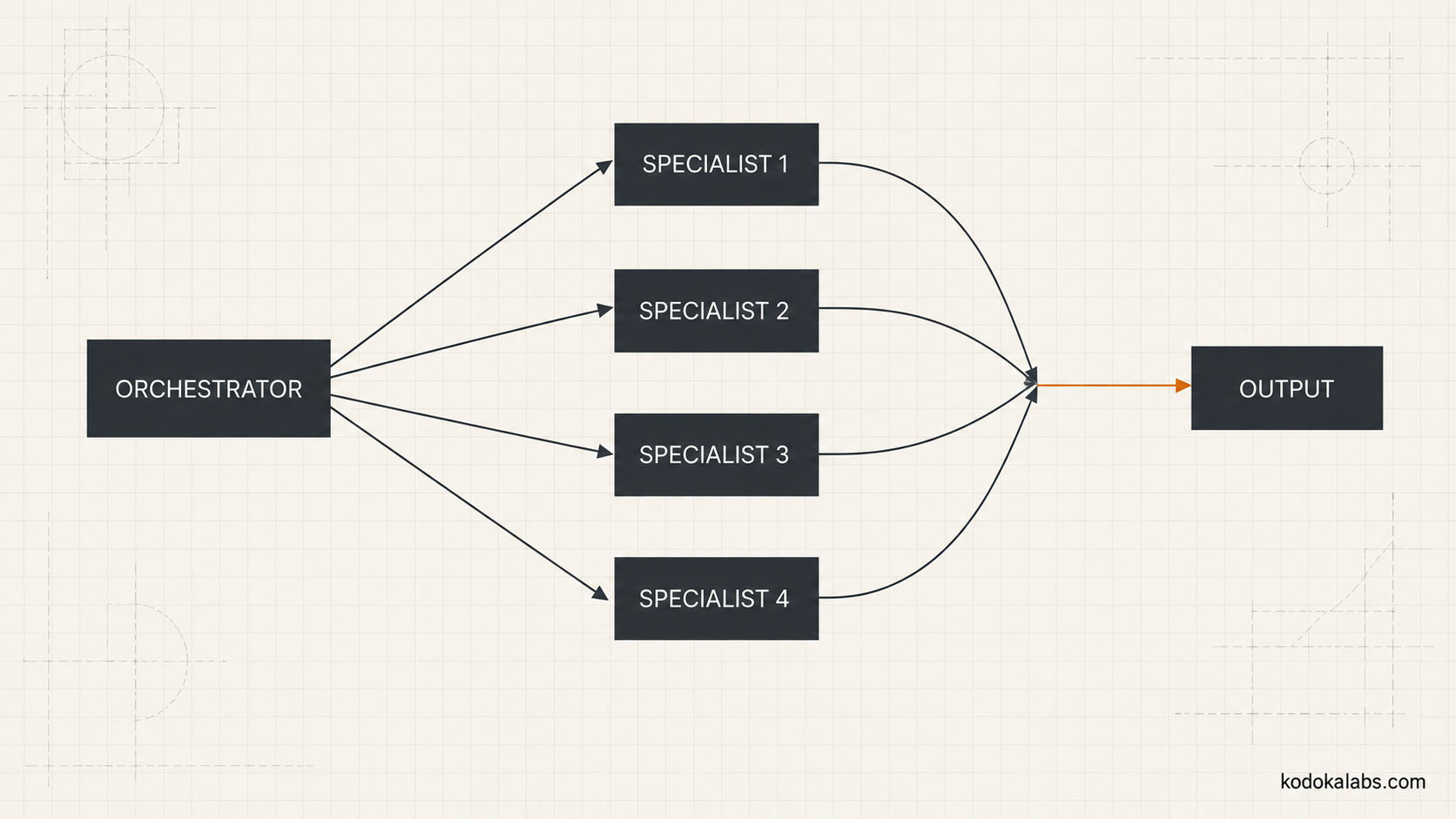
kōdōkalabs - intelligence hub - AI Marketing Operating Systems - AI Multi Agent Marketing System - Orchestrator and Specialists Architecture
AI Multi Agent Marketing System - Orchestrator and Specialists Architecture
kōdōkalabs’ Agent Architecture Decision Test evaluates whether a multi-agent approach is actually justified for a given task, across eight factors.
Factor
What It Assesses

Task separability

Whether the task naturally divides into distinct, independent sub-tasks

Specialization benefit

Whether a specialized agent genuinely outperforms a generalist one on its sub-task

Tool boundaries

Whether different sub-tasks require access to different, separable tools

Context size

Whether the full task’s context would overwhelm a single agent’s effective working context

Parallelism

Whether sub-tasks can run concurrently rather than only sequentially

Independent evaluation

Whether each sub-task’s output can be evaluated on its own merits

Failure isolation

Whether isolating one sub-task’s failure prevents it from corrupting the whole system

Maintenance cost

Whether the ongoing cost of maintaining multiple coordinated components is justified by the benefit

A task that scores well across most of these factors is a reasonable multi-agent candidate. A task that scores poorly on most of them – for instance, a task that doesn’t naturally separate, doesn’t benefit from specialization, and doesn’t need parallelism – is very likely better served by one well-designed workflow.

It’s worth applying this test explicitly rather than relying on intuition, because the intuitive signal often points the wrong way. A task that feels complex enough to “need” multiple agents frequently turns out, on closer examination, to be a single complex task that one well-specified workflow can handle in sequence – complexity in the task itself doesn’t automatically imply that splitting it across multiple bounded agents is the right response to that complexity. The test exists specifically to separate “this task is hard” from “this task has genuinely separable roles that benefit from specialization,” which are different properties that get conflated surprisingly often.

When One Controlled Workflow Is Better

The most common multi-agent architecture mistake in marketing is adding agents to a task that would be better served by a single, well-specified workflow with clear stages. Multi-agent systems introduce real coordination overhead: shared state has to be managed, handoffs have to be designed and tested, permissions have to be scoped per agent, and evaluation has to happen at multiple levels. For a task that’s well-standardized, doesn’t require genuinely distinct specialized roles, and doesn’t need parallel execution, this overhead is pure cost with no corresponding benefit – a single controlled workflow, potentially still AI-assisted, is simpler to build, easier to maintain, and easier to reason about when something goes wrong.

There’s also a less obvious cost worth naming: organizational complexity. A multi-agent system typically needs more people to understand and maintain it over time – someone has to own each agent’s contract, someone has to interpret cross-agent evaluation results, and someone has to be able to reason about how a change to one agent might ripple through to the others. A single workflow, by contrast, can often be understood, maintained, and improved by one capable owner. Teams evaluating whether to build a multi-agent system should weigh not just the technical coordination cost described in the decision test, but this organizational cost of having built something that now requires more specialized institutional knowledge to keep running well.

Common Multi-Agent Architecture Patterns

Several recurring patterns cover most legitimate multi-agent use cases in marketing.
Pattern
Description

Sequential chain

Agents operate one after another, each building on the previous agent’s output

Router-and-specialists

A router agent classifies the task and directs it to the appropriate specialist agent

Planner-executor

A planning agent breaks a task into steps; an executor agent (or agents) carries them out

Researcher-writer-reviewer

Distinct agents handle research, drafting, and review as separable roles

Parallel specialists with synthesis

Multiple agents work concurrently on different aspects; a synthesis step combines their output

Evaluator loop

An evaluator agent checks another agent’s output and requests revision if it doesn’t meet criteria
Choosing a pattern should follow directly from the Agent Architecture Decision Test’s findings – a task with strong parallelism potential fits the parallel-specialists pattern; a task requiring escalating refinement fits the evaluator loop.

The Agent Contract

Every agent in a bounded multi-agent system operates under an Agent Contract – the same governance instrument kōdōkalabs canonically defines on its Agentic Drafting methodology page, applied here at the level of an individual agent within a larger architecture rather than an individual drafting task. Rather than defining a separate, competing concept, this page uses the same fields: purpose, permitted and prohibited inputs, tools and permissions, required sources, output schema, validation rules, confidence and uncertainty signaling, failure and escalation behavior (including retry limits and stop conditions), handoff rules to the next agent in sequence, a named human owner, version, and logging requirements.

Applying one consistent Agent Contract across both single-task AI-assisted drafting and multi-agent architectures has a practical benefit beyond consistency: it means the governance discipline a team builds for one context transfers directly to the other, rather than requiring two parallel systems of rules to learn and maintain.

Shared Knowledge, State, and Memory

Multi-agent systems need a defined approach to what context is shared across agents versus scoped to one agent alone – an agent with unrestricted access to everything every other agent has produced loses the isolation benefits that justified separating roles in the first place, while an agent with too little shared context may duplicate work or contradict a decision another agent already made. Shared state should draw from the organization’s governed AI Marketing Knowledge Base rather than an ad hoc mechanism specific to the multi-agent system, so the same authority and freshness rules apply consistently.

Tool Access and Permission Boundaries

Each agent should have access only to the tools its specific role requires – a research agent doesn’t need publishing access; a drafting agent doesn’t need the ability to modify production systems. Scoping permissions tightly per agent, rather than granting a broad set of permissions to every agent in the system for convenience, limits the damage any single agent’s malfunction or manipulation can cause, and makes the system’s behavior easier to reason about during review.

Handoffs, Output Schemas, and Termination Conditions

A handoff between agents needs a defined output schema – what exactly the receiving agent expects to receive – so information doesn’t degrade or get misinterpreted as it passes between components. Termination conditions specify when the system should stop: successful completion, a defined failure state, or a retry limit reached without success. A multi-agent system with no clear termination conditions risks looping indefinitely or handing off an incomplete result as if it were finished.

Human Decision Gates

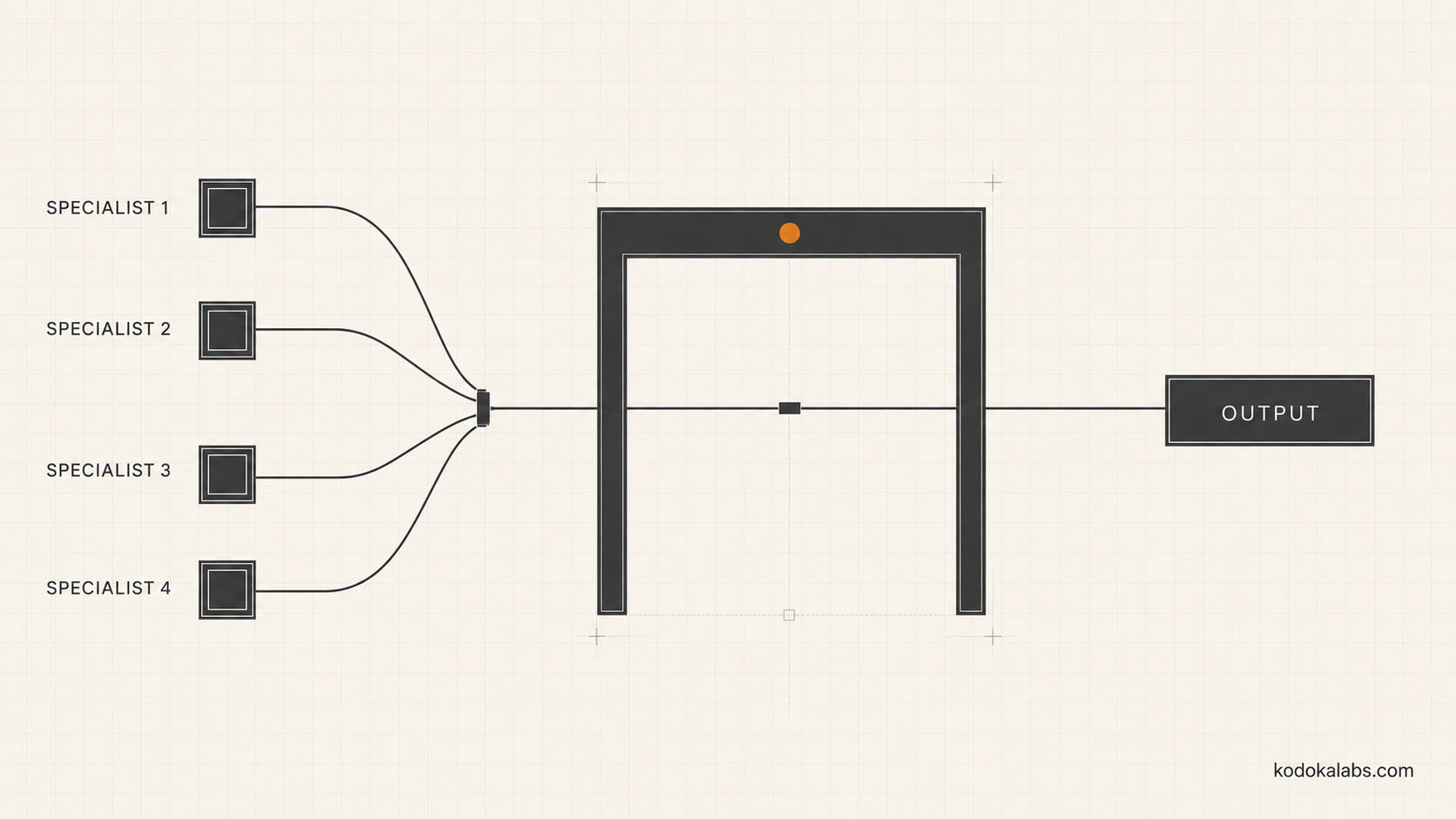
kōdōkalabs - intelligence hub - AI Marketing Operating Systems - AI Multi Agent Marketing System - Human Gate Overlay
AI Multi Agent Marketing System - Human Gate Overlay
Multi-agent systems don’t eliminate the need for human decision gates described in Human-in-the-Loop AI – if anything, the added complexity of a multi-agent architecture makes deliberate placement of human gates more important, not less. A gate after the final synthesis step, before any high-consequence output moves forward, remains essential regardless of how many specialized agents contributed to producing it.

Evaluation at Agent and System Level

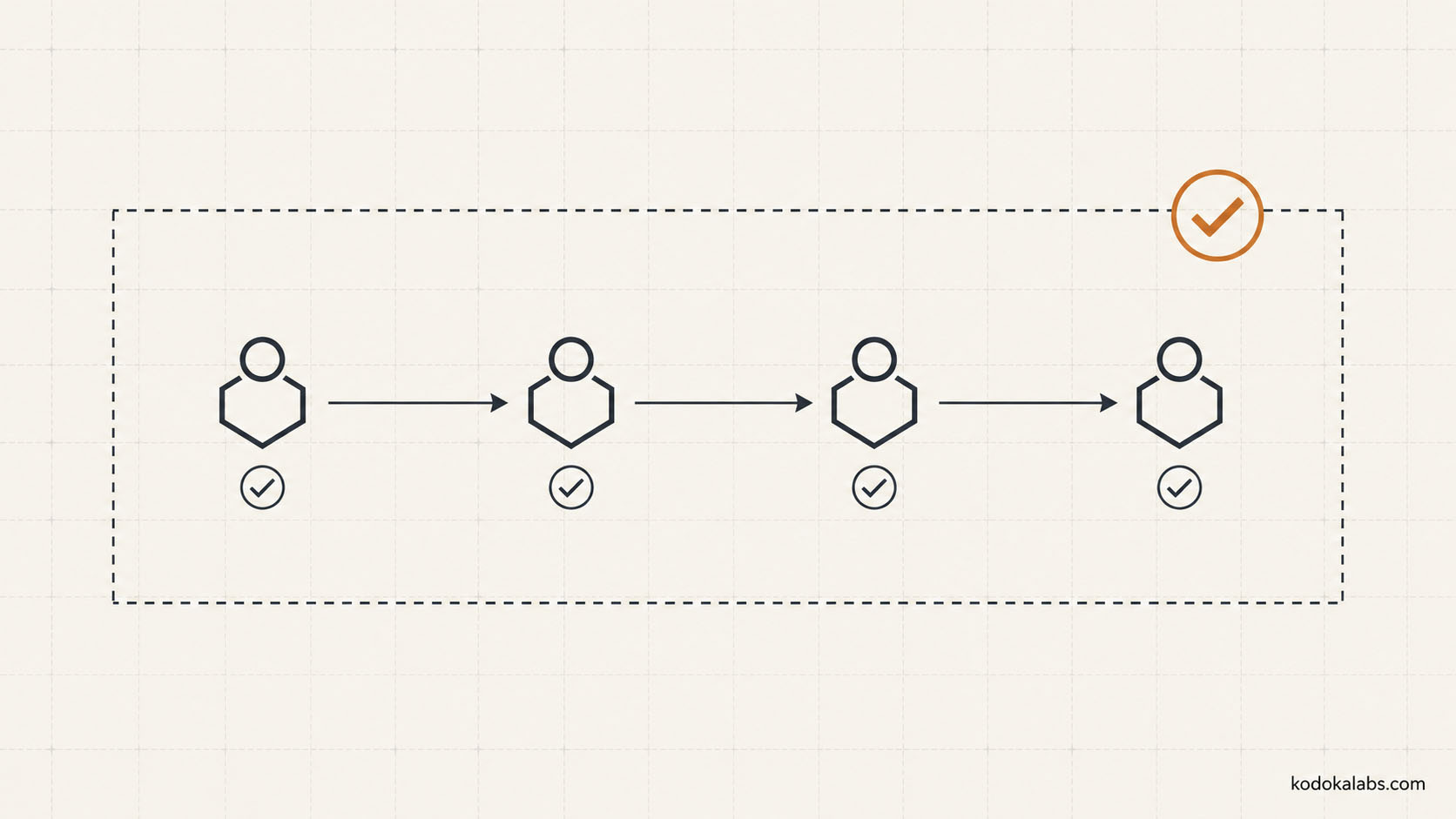
kōdōkalabs - intelligence hub - AI Marketing Operating Systems - AI Multi Agent Marketing System - Evaluation Layers
AI Multi Agent Marketing System - Evaluation Layers
Evaluating only the final output of a multi-agent system misses failures that occur mid-pipeline – an agent that occasionally produces subtly flawed output can have that flaw propagate through several downstream agents before surfacing in a way the final evaluation catches, by which point diagnosing the actual source of the problem is much harder. Effective evaluation happens at both levels: each agent is evaluated against its own Agent Contract’s validation rules, and the system as a whole is evaluated against the end-to-end task’s success criteria. A system that passes end-to-end evaluation despite one agent silently underperforming is fragile – it’s likely to fail more visibly the next time conditions shift slightly.

Observability, Logs, and Incident Investigation

Multi-agent systems need logging detailed enough to reconstruct what each agent did, in what order, with what inputs and outputs, so that when something goes wrong, the investigation can identify which specific agent and which specific step introduced the problem – rather than only knowing that the final output was flawed. This observability requirement scales with the number of agents involved; a five-agent system with no per-agent logging is considerably harder to debug than a single-agent workflow with the same gap, simply because there are more places the problem could have originated.

Cost, Latency, Reliability, and Maintenance Trade-offs

Multi-agent architectures typically cost more to run than a single well-designed workflow – more model calls, more coordination overhead, and often higher latency as agents hand off sequentially rather than a single pass completing the task. Reliability can improve through failure isolation (one agent’s failure doesn’t necessarily take down the whole system) or worsen through added complexity (more components mean more potential failure points). Maintenance cost rises with the number of agents, since each one needs its own contract, tests, and periodic re-validation. These trade-offs should be weighed explicitly against the Agent Architecture Decision Test’s assessment of specialization benefit – added cost is only worth paying when the benefit is real and measurable.

Example Marketing Use Cases

Research and briefing

A researcher agent gathers and validates source material; a briefing agent synthesizes it into a structured brief for human review – separable roles with genuinely different tool needs (search and retrieval versus structured writing).

Content production

A planning agent structures a content piece; a drafting agent produces the text; a fact-checking agent cross-references claims against the Claim Register described in Agentic Drafting – distinct specialized roles with independent evaluation criteria.

Search intelligence

An entity-research agent gathers structured data about a topic; an analysis agent identifies patterns or gaps relative to competitors – roles that benefit from parallel execution across many topics at once.

Campaign operations

A scheduling agent handles logistics and timing; a compliance-check agent reviews outputs against approved constraints before they’re released – separable both by tool access and by the risk profile of what each is responsible for catching.

Reporting and analysis

A data-retrieval agent gathers performance figures from systems of record; a narrative agent turns validated figures into a written summary – a natural division between structured data handling and prose generation.

Not every one of these use cases requires a multi-agent architecture in every organization – the same tasks can often be handled well by a single well-designed workflow, particularly at lower volume or complexity. These are illustrations of where role separation tends to create genuine value, not a prescription that every marketing team needs a multi-agent system for each of them.

Pilot and Production Readiness

Before a multi-agent system moves toward production use, it should pass through Pilot Review with test cases specifically designed to probe multi-agent-specific failure modes: what happens when one agent produces malformed output another agent depends on, what happens when a handoff fails partway through, and whether the system’s observability is sufficient to diagnose a failure after the fact. A multi-agent system that performs well in a clean demonstration but hasn’t been tested against these conditions has not been meaningfully validated for production use.

Common Failure Modes

  • Complexity without justification – building a multi-agent system for a task that a single controlled workflow would handle just as well, at lower cost.
  • Unbounded agent scope – an agent with an open-ended mandate rather than a defined contract limiting its purpose and tools.
  • Excessive shared context – every agent having access to everything, eliminating the isolation benefits role separation was meant to provide.
  • No termination conditions – a system that can loop or hand off an incomplete result with no defined stopping point.
  • Output-only evaluation – checking only the final result, missing mid-pipeline failures that later surface unpredictably.
  • Insufficient observability – logging too coarse to identify which agent or step caused a given problem.
  • Assuming more agents equals more reliability – treating additional specialization as inherently safer, without evidence that it actually reduces failure rates for the specific task.

Architecture Checklist

Before building a multi-agent marketing system, confirm: the Agent Architecture Decision Test genuinely supports a multi-agent approach over a single workflow; every agent has a complete Agent Contract; shared knowledge and state draw from the governed knowledge base; tool access is scoped tightly per agent; handoffs have defined output schemas; termination conditions are explicit; human decision gates are placed appropriately; evaluation happens at both agent and system level; observability supports incident investigation; and the system has passed Pilot Review against multi-agent-specific failure conditions.

Frequently Asked Questions

Only when the Agent Architecture Decision Test's factors - task separability, specialization benefit, tool boundaries, context size, parallelism, independent evaluation, failure isolation, and maintenance cost - genuinely favor it. Many tasks are better served by one well-designed controlled workflow.
A multi-agent system has genuinely distinct, bounded roles with their own contracts, tools, and evaluation, coordinating with each other - a multi-step workflow calling a model repeatedly in sequence, without that separation, is not the same thing even if it superficially resembles one.
Not automatically - added agents introduce coordination overhead and more potential failure points. Reliability improves only when role separation and failure isolation are genuinely well-designed, not simply because more agents are involved.
Sequential chain, router-and-specialists, planner-executor, researcher-writer-reviewer, parallel specialists with synthesis, and evaluator loop - see the pattern table above.
A governance specification for a bounded agent's purpose, permitted inputs, tools, output schema, validation rules, failure behavior, and human owner - the same instrument kōdōkalabs uses for individual AI-assisted tasks in Agentic Drafting, applied here per agent.
By drawing from the organization's governed knowledge base rather than an ad hoc mechanism, and scoping what's shared versus agent-specific deliberately rather than defaulting to full visibility for every agent.
At both the individual-agent level, against each agent's own Agent Contract, and the whole-system level, against the end-to-end task's success criteria - evaluating only the final output can miss mid-pipeline failures.
Logging detailed enough to reconstruct which agent did what, in what order, with what inputs and outputs - sufficient to identify the specific source of a failure, not just that a failure occurred.
Multi-agent-specific failure conditions through Pilot Review - malformed handoffs, partial failures mid-pipeline, and whether observability actually supports diagnosing a problem after the fact.
No. Autonomy should increase only as evidence demonstrates the system, its controls, and its evaluation can support it reliably - the same evidence-based principle that governs automation maturity generally.

Conclusion

Multi-agent architecture is a powerful tool for genuinely separable, specialized marketing tasks – and an expensive complication for tasks that don’t need it. The discipline this guide describes, from the Agent Architecture Decision Test through the shared Agent Contract, is what separates a multi-agent system that earns its complexity from one that merely adds it.

Are you ready to
Architect Your AI Marketing System?