
The
kōdōkalabs
AI Marketing Pilot Review and Production Readiness
Pilot Review: Validate AI Marketing Work Before Deployment
Executive Summary
Pilot Review exists because pilots frequently fail to produce decision-quality evidence — success criteria are vague, the test uses unrealistically clean inputs, reviewers get selected too late to shape the test design, failures go unlogged, and scaling is assumed as the default outcome from the outset rather than treated as one of several legitimate decisions. kōdōkalabs treats Pilot Review as a genuine decision gate, supported by evidence gathered specifically to reveal limitations and failure modes, not a demonstration engineered to confirm what the team already hoped was true, and not a cosmetic proofreading pass performed just before launch. This page covers the eight Pilot Review dimensions, how representative test cases are designed to include edge and adversarial conditions, how human workload and cost are measured honestly, and the five legitimate decision outcomes a pilot can produce.
Key takeaways:
- A demonstration confirming a workflow can produce output is not the same as a validated pilot — a real pilot is designed to reveal limitations, not just showcase capability.
- The Pilot Review Gate evaluates eight dimensions, from business relevance through documentation and ownership readiness.
- Representative test cases deliberately include edge, failure, adversarial, and high-risk conditions, not only clean, favorable inputs.
- Human correction, rework, and workload are measured and disclosed, not hidden behind an impressive-looking output.
- Five decision outcomes are equally legitimate: proceed to production, revise and retest, contain to current scope, pause pending evidence, or stop.
What Is Pilot Review?
Pilot Review takes a limited-scope AI-assisted workflow, system component, content asset, or operational process that has cleared Agentic Drafting and evaluates it against eight defined dimensions — using test cases specifically designed to surface limitations — before deciding whether it’s ready for production, needs revision, should stay contained to its current scope, needs to pause, or should stop altogether.
Why a Demonstration Is Not a Validated Pilot
A demonstration shows that a workflow can produce a good result under favorable, often hand-picked conditions — and that’s a genuinely different thing from evidence that the workflow performs reliably under the actual range of conditions it will encounter in production. A pilot that only ever runs against clean, representative-of-the-best-case inputs, reviewed by someone already inclined to approve it, will almost always look successful — which is precisely why that design produces very little decision-quality evidence. A validated pilot is designed from the outset to try to find where the workflow breaks, not to confirm that it doesn’t.
This distinction is easy to state and surprisingly hard to maintain in practice, because the people running a pilot are usually the same people who built the workflow and want it to succeed. That’s not a character flaw — it’s a structural incentive worth designing around rather than relying on individual objectivity to overcome. Assigning reviewers who weren’t involved in building the workflow, defining test cases before anyone has seen how the workflow performs, and committing to stop criteria in advance are all ways of building that objectivity into the process itself, rather than hoping for it after the fact.
Inputs Required Before Pilot Review
Pilot Review requires, at minimum, a completed Agentic Drafting output with its Claim Register and human approval record, the original Strategic Architecture specification’s acceptance criteria, and named reviewers assigned before testing begins — reviewer selection made only after results are already in hand tends to bias review toward confirming those results rather than evaluating them independently.
The Eight Pilot Review Dimensions
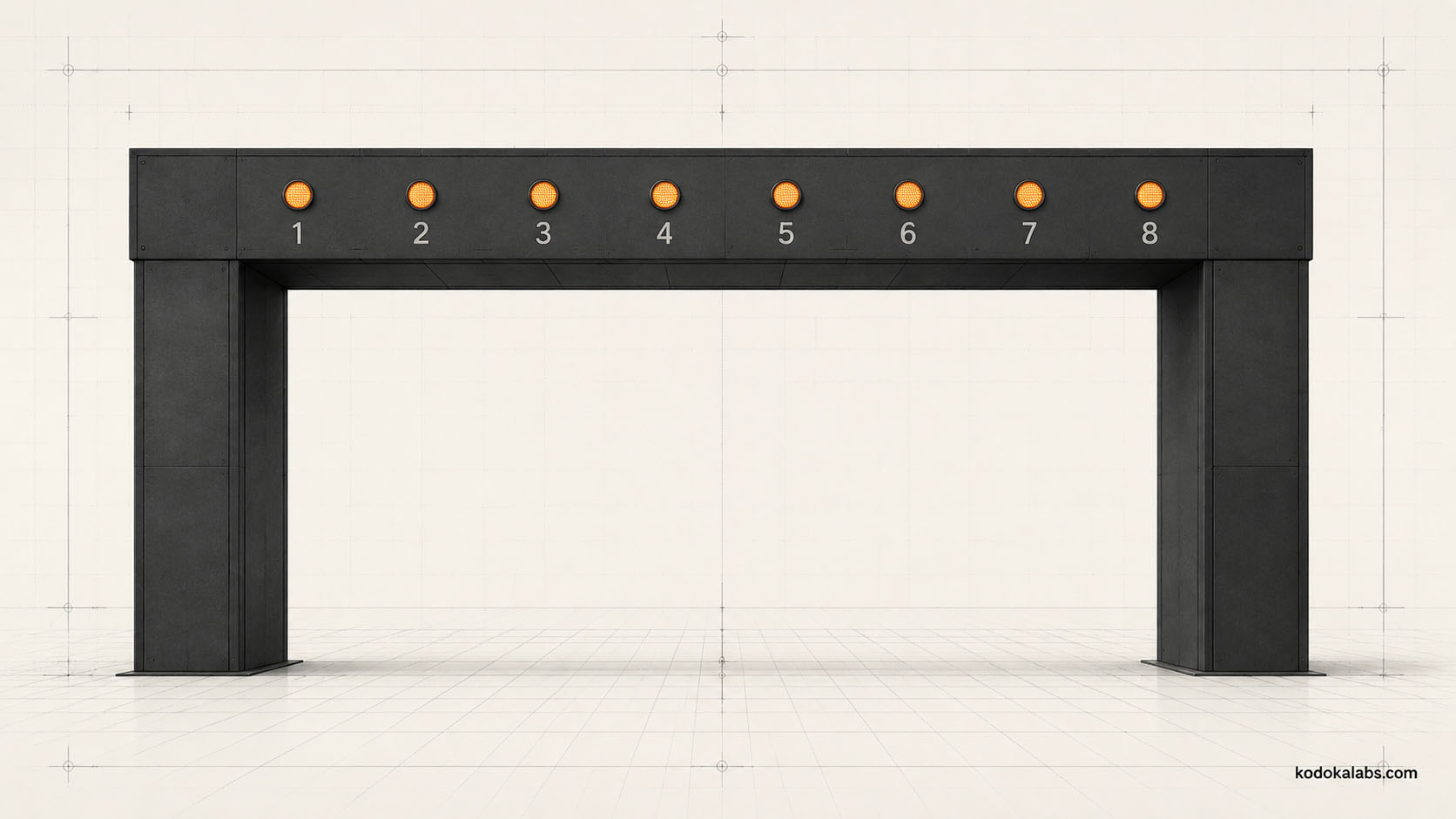
kōdōkalabs’ Pilot Review Gate evaluates a pilot across eight dimensions before any deployment decision is made.
| # | Dimension | What It Evaluates |
|---|---|---|
| 1 | Business relevance | Whether the pilot actually addresses the business decision it was meant to support |
| 2 | Functional performance | Whether the workflow does what it was specified to do |
| 3 | Evidence and factual quality | Whether claims in the output are accurate and properly sourced |
| 4 | Brand, editorial, and user quality | Whether output meets brand and editorial standards and is genuinely usable |
| 5 | Governance, privacy, security, and IP | Whether the workflow complies with applicable governance and legal constraints |
| 6 | Human workload and exception handling | How much human correction and handling the workflow actually required |
| 7 | Measurement, cost, and operational viability | Whether the full cost and measured performance support continuing |
| 8 | Documentation, ownership, and enablement readiness | Whether the workflow is ready to be handed to an accountable operating team |
Business relevance
Functional performance
Evidence and factual quality
Brand, editorial, and user quality
Whether output meets brand and editorial standards and is genuinely usable
Governance, privacy, security, and IP
Human workload and exception handling
How much human correction and handling the workflow actually required
Measurement, cost, and operational viability
Documentation, ownership, and enablement readiness
Designing Representative Test Cases
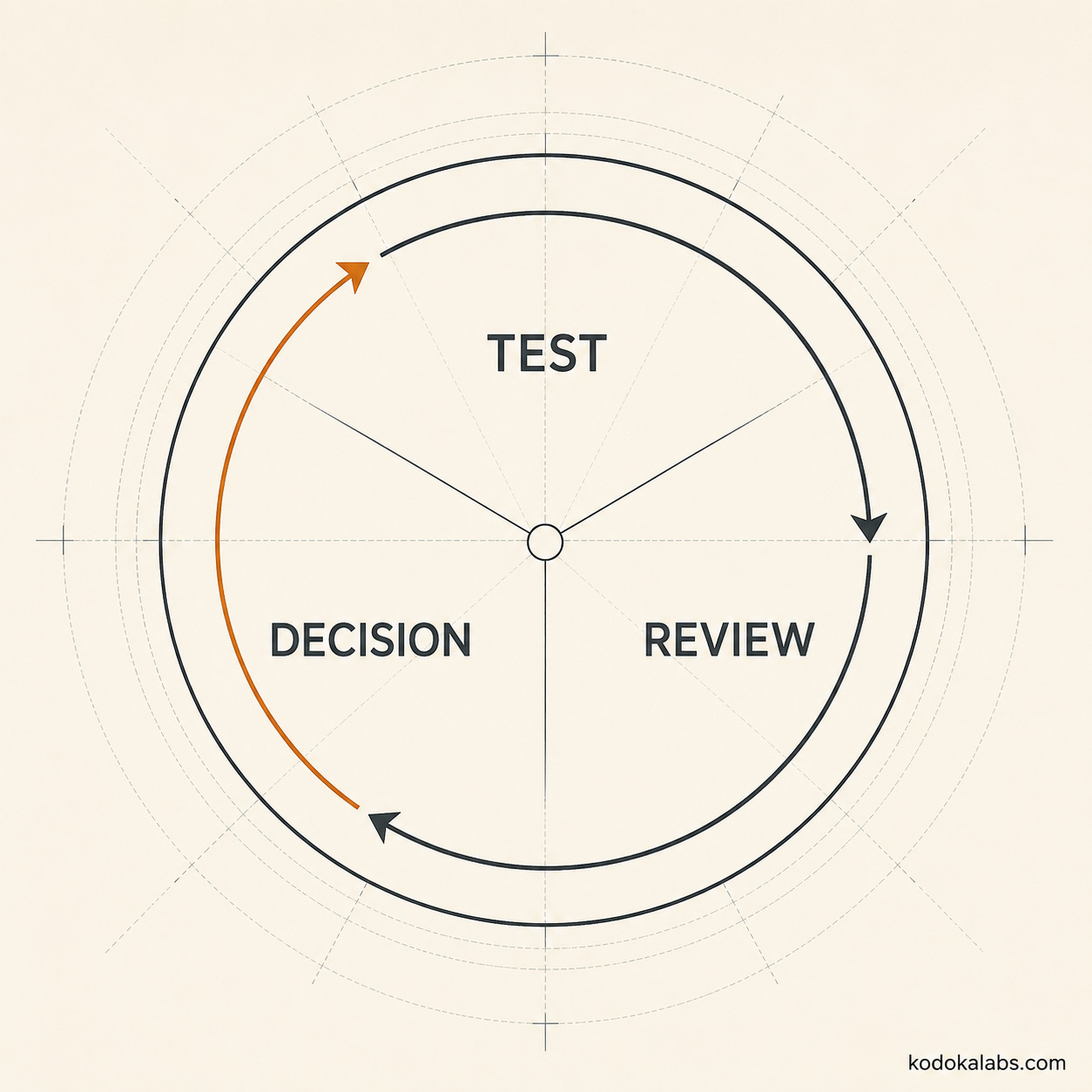
A pilot’s test cases should deliberately include conditions beyond the clean, expected case.
| Test Case Type | Purpose |
|---|---|
| Normal cases | Confirm the workflow performs correctly under expected conditions |
| Edge cases | Reveal how the workflow handles unusual but plausible inputs |
| Failure cases | Test what happens when an input the workflow can’t handle is provided |
| Adversarial cases | Test resistance to inputs designed to manipulate or mislead the workflow |
| Missing-data cases | Test behavior when expected information isn’t available |
| Conflicting-source cases | Test how the workflow handles contradictory evidence |
| High-risk cases | Test the workflow’s performance on its highest-consequence use cases specifically |
A pilot tested only against normal cases has, at best, demonstrated that the workflow works when everything goes as planned – which is the condition least likely to reveal a problem worth knowing about before wider deployment.
The proportion of test cases devoted to each category should scale with the workflow’s risk classification: a low-risk internal workflow may reasonably spend most of its test budget on normal and edge cases, while a customer-facing or high-risk workflow warrants deliberate investment in adversarial and high-risk case testing specifically, even though those cases are less pleasant to design and less flattering when they surface a problem. Skipping adversarial testing on a high-risk workflow because “it probably won’t come up” is precisely the reasoning Pilot Review exists to override.
Human Review Roles and Decision Rights
Capturing Errors, Rework, and Exceptions
Every error, correction, and exception encountered during Pilot Review is recorded in a Failure Log: the event, the input that triggered it, the expected behavior, the actual behavior, its impact, how easily it was detected, a root-cause hypothesis, the immediate action taken, an owner, whether a retest is required, and its current resolution status. A pilot with zero recorded failures is far more likely to indicate the test wasn’t looking hard enough than a workflow that’s genuinely flawless — Pilot Review treats a healthy Failure Log as a sign the process is working, not as evidence the pilot failed.
Measuring Pilot Cost and Human Workload
Pilot Decision Outcomes
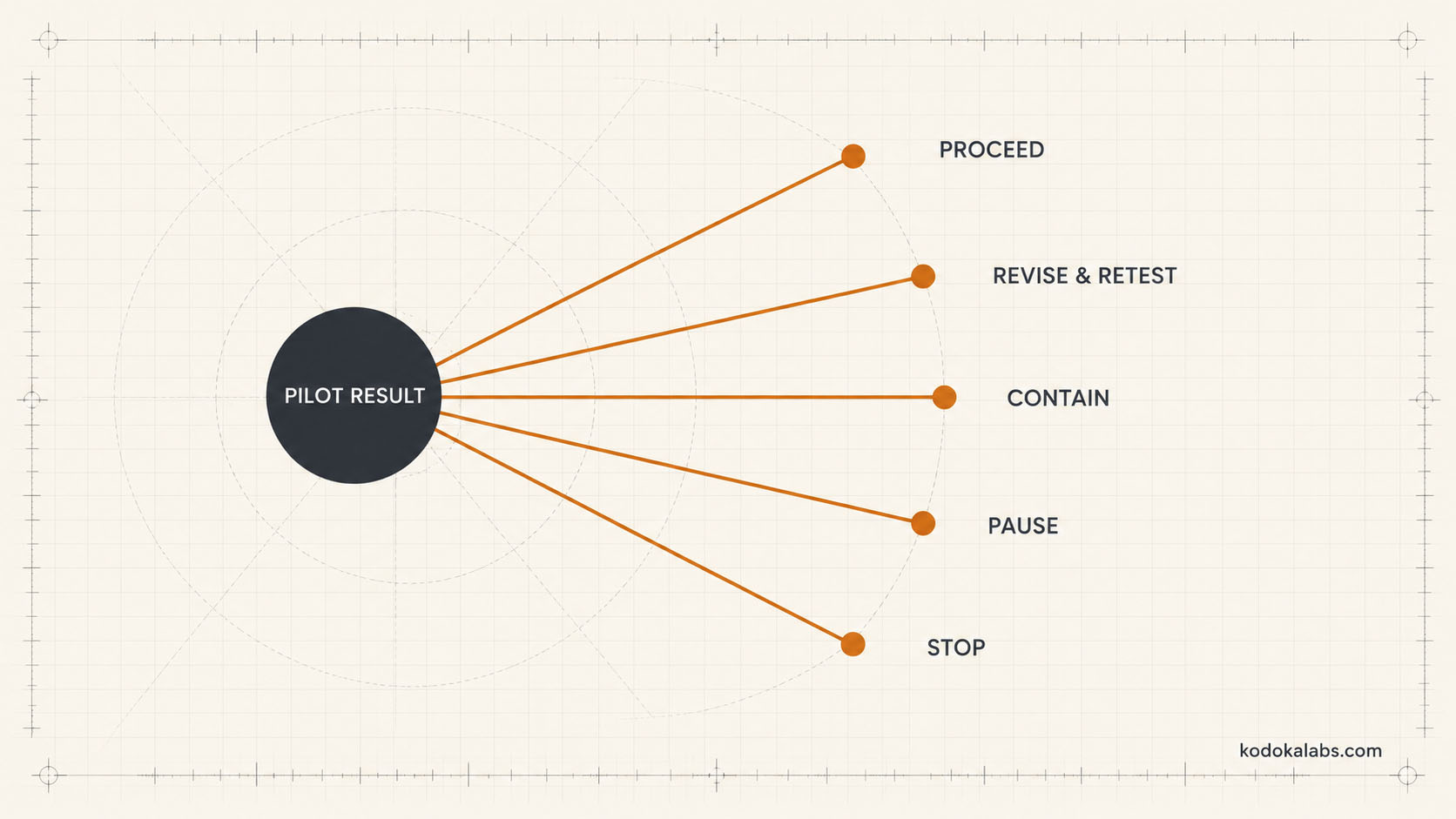
kōdōkalabs’ Pilot Decision Outcomes framework treats five outcomes as equally legitimate results of a well-run pilot.
| Outcome | When It Applies |
|---|---|
| Proceed to production | The pilot meets all eight review dimensions at an acceptable level |
| Revise and retest | Specific, addressable issues were found; another test cycle is warranted |
| Contain to current scope | The pilot works within its tested scope but shouldn’t yet extend further |
| Pause pending evidence or control | A specific gap needs to be closed – more evidence, a missing control – before a decision can be made |
| Stop | The pilot doesn’t justify continuing, based on the evidence gathered |
Production Readiness and Handover
- Confirmation bias – designing the pilot test, consciously or not, to confirm the outcome the team already expected or wanted.
- Unrealistic test data – testing only against clean, favorable inputs that don’t reflect real production conditions.
- Reviewer absence – running the pilot without engaged, qualified reviewers assigned before testing begins.
- Unrecorded human correction – quietly fixing output before presenting it as a pilot result, hiding the actual workload involved.
- Cherry-picked examples – showcasing the pilot’s best outputs rather than a representative sample.
- No rollback plan – proceeding to production without a defined way to reverse course if problems emerge.
- No stop criteria – never having defined, in advance, what result would justify stopping the pilot.
- Scaling from output quality alone – deciding to scale based only on how good the output looked, without evaluating cost, workload, governance, and ownership readiness.
From Pilot Review to Data-Led Iteration
Whatever decision Pilot Review produces, its evidence — the Failure Log, the eight-dimension review, and the workload and cost data gathered — feeds directly into Data-Led Iteration, kōdōkalabs’ method for using operating evidence to continuously refine a workflow, whether it proceeded to production, was contained, or is being revised for another test cycle.
Frequently Asked Questions (FAQ)
How does kōdōkalabs validate AI-assisted marketing work before it's deployed at scale?
Through Pilot Review — testing a limited-scope workflow against eight review dimensions, using representative test cases that deliberately include edge and failure conditions, and reaching one of five explicit decision outcomes.
How is a pilot different from a demonstration?
A demonstration shows a workflow can produce a good result under favorable conditions; a validated pilot is specifically designed to reveal where the workflow breaks, using realistic and adversarial test cases and independent review.
What are the eight Pilot Review dimensions?
Business relevance, functional performance, evidence and factual quality, brand and editorial quality, governance and compliance, human workload, measurement and cost, and documentation/ownership readiness. See the table above.
What kinds of test cases should a pilot include?
Normal, edge, failure, adversarial, missing-data, conflicting-source, and high-risk cases — not only the clean, expected scenario.
How is human workload measured during a pilot?
Directly — tracking correction volume, review time, and escalations — rather than relying on an impression of how smooth the process felt.
What happens when a pilot reveals errors?
Every error is logged in a Failure Log with its cause, impact, and resolution status — a healthy Failure Log is a sign the review process is working, not a sign the pilot failed.
What outcomes can a pilot produce?
Five equally legitimate outcomes: proceed to production, revise and retest, contain to current scope, pause pending evidence, or stop.
Is "proceed to production" the expected default outcome?
No - stopping or containing a pilot based on honest evidence is a legitimate and valuable result, not a failure of the pilot process.
What does production readiness require beyond a good pilot result?
Complete documentation, named ownership per Enable's Ownership Transfer Record, confirmed governance controls, and an understood cost and workload profile.
How does Pilot Review connect to Data-Led Iteration?
The evidence a pilot produces — its Failure Log, dimension review, and cost/workload data — becomes direct input to Data-Led Iteration's ongoing refinement process.