
kōdōkalabs
AI Marketing Architecture and Operating Model Design
Architect: Design the AI Marketing Operating Model
Executive Summary
Architect exists because most organizations that fail at AI marketing transformation don’t fail at Diagnose — they fail in the gap between knowing what’s wrong and building something that actually works. That gap gets filled with tool configuration when it should be filled with design: explicit decisions about operating model, decision rights, workflow responsibility, knowledge architecture, technology integration, governance, measurement, and ownership transfer. Architecture is decision infrastructure, not a slide deck. This page covers the eight design layers that make up a complete architecture, how human and AI responsibilities get allocated within it, what Architect must deliver before Build can begin, and the failure modes that turn architecture into an expensive documentation exercise nobody actually uses.
Key Takeaways
- Architecture is a set of explicit design decisions, not a future-state diagram.
- Eight connected layers span business scope through ownership transfer — skipping any layer leaves a gap Build will discover the hard way.
- Every material decision gets documented with its rationale, not just its conclusion.
- A Minimum Viable Architecture exists for controlled pilots — not every organization needs enterprise-scale documentation from day one.
- Architect is distinct from the Strategic Architecture delivery methodology, which specifies individual workstreams within the operating model Architect defines.
What Is the Architect Phase?
Why Architecture Comes Before Automation
Inputs Required from Diagnose
The Eight Layers of AI Marketing Architecture
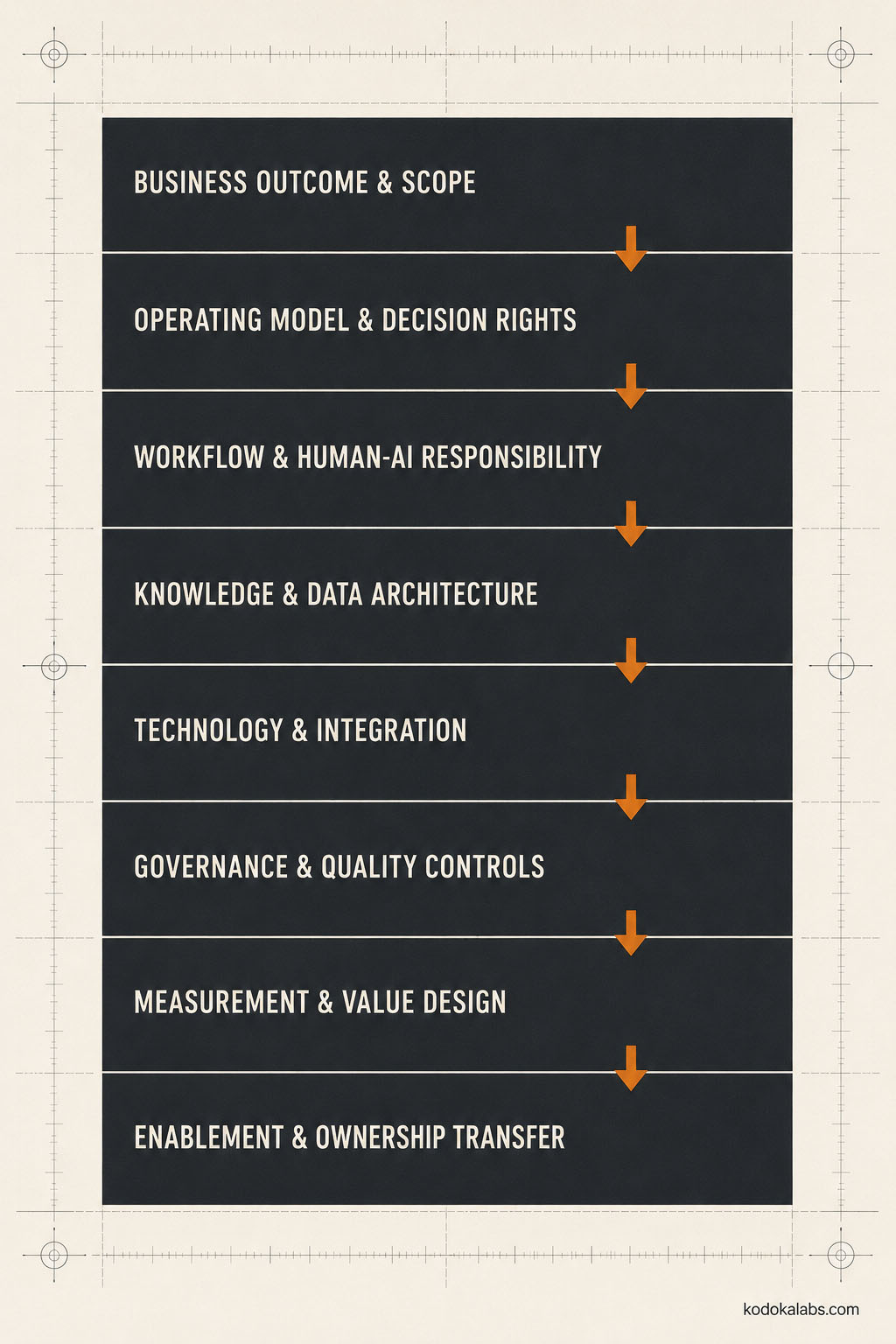
kōdōkalabs’ Architecture Decision Stack organizes design work into eight connected layers. This is kōdōkalabs’ own methodology, not an externally standardized architecture framework. For every layer, the design work specifies required inputs, the actual design decisions, outputs, approvers, and what Build depends on from that layer.
Business outcome and scope
Operating model and decision rights
Workflow and human–AI responsibility
Knowledge and data architecture
Technology and integration architecture
Governance, privacy, security, and quality controls
Measurement and value design
Enablement, documentation, and ownership transfer
How Human and AI Responsibilities Are Designed
Within the workflow and human-AI responsibility layer, Architect applies the Human + AI Execution Model and risk-based review logic established earlier in the Transformation System: work gets allocated across human-owned, AI-assisted, AI-executed-under-supervision, and prohibited-or-restricted categories based on risk, reversibility, factual sensitivity, brand exposure, and financial consequence — not based on what’s technically possible to automate. A task being automatable doesn’t make automating it the right design decision; that determination depends on the risk profile Architect assesses for each specific workflow.
Workflow Architecture Requirements
Each workflow specification produced during Architect covers: triggers (what starts this workflow), inputs (what it needs to run), steps (the actual sequence of work), owners (who’s accountable at each step), systems (what tools are involved), knowledge (what information the workflow draws on), exceptions (what happens when the normal path doesn’t apply), approvals (where human sign-off is required), outputs (what the workflow produces), evidence (how quality and accuracy get verified), and metrics (how performance gets measured). A workflow specification missing any of these fields is incomplete, regardless of how detailed the parts that are present may be — exceptions and approvals in particular are the fields most often skipped, and the ones whose absence causes the most trouble once a workflow reaches real-world use.
Knowledge and Context Architecture
Governance by Design
Measurement Before Implementation
Architecture Deliverables
Architecture Review and Approval Gates
Architect Exit Criteria
Common Architecture Failure Mode
- Tool-led design – designing around a specific tool’s capabilities rather than around the business outcome and workflow requirements, then working backward to justify the tool choice. This is the most direct route back into the pattern Architect exists to prevent – the same tool-first thinking Diagnose was meant to interrupt reappearing one phase later under the label of “architecture.”
- Undefined ownership – a design that specifies what should happen without specifying who’s accountable when it doesn’t. Ownership gaps are usually invisible in the architecture document itself and only become visible the first time a workflow produces an unexpected result and nobody is clearly the person who resolves it.
- Overengineering – building enterprise-scale documentation and governance for a workflow that only needed a Minimum Viable Architecture for a controlled pilot. Overengineering tends to slow delivery without proportionally reducing risk, since the added documentation rarely covers scenarios the lighter-weight version would have missed.
- Missing exception handling – a workflow specification that covers the normal path in detail but never addresses what happens when something falls outside it. In practice, a meaningful share of a workflow’s real-world volume tends to be exceptions, not the documented happy path – architecture that only specifies the happy path leaves the highest-friction cases entirely undesigned.
- Hidden data movement – knowledge or data flowing between systems in ways the architecture doesn’t document, which governance review then can’t actually evaluate. This is particularly common with AI tools that quietly send context to a third-party API as part of normal operation, in a way the workflow specification never explicitly names.
- Weak evidence – design decisions justified by assertion rather than by the evidence Diagnose actually produced. A design decision that can’t be traced back to a Diagnose finding, or to a clearly labeled assumption pending validation, is a decision made on the architect’s preference rather than on evidence.
- No measurement baseline – proceeding to Build without having defined how the resulting workflow’s performance will be measured, which reliably produces the same after-the-fact metrics problem Diagnose was designed to avoid at the organizational level.
- A design the client team can’t operate – architecture that’s technically sound but assumes a level of ongoing technical sophistication the client’s actual team doesn’t have and Enable hasn’t been scoped to build. An elegant design nobody on the client side can maintain independently isn’t a successful architecture by kōdōkalabs’ standard, regardless of how well it performs on day one.
From Architect to Build
Architect hands Build the complete deliverable set: target operating model, workflow specifications, responsibility matrix, knowledge map, integration blueprint, governance matrix, measurement plan, prioritized backlog, pilot definition, documentation plan, and capability-transfer plan. Build implements what Architect specified — it isn’t the place where missing design decisions get made for the first time.