
The
kōdōkalabs
Fractional AI Growth Director
For CEOs and boards at mid-market B2B companies who have concluded they don’t need another agency — they need executive leadership: a Fractional AI Growth Director gives your marketing organization ongoing senior leadership over strategy, governance, and measurement, at a fraction of the cost and hiring risk of a full-time executive hire.
Companies Don't Need Another Agency. They Need Executive Leadership.
Most of the marketing problems that get blamed on execution are actually leadership gaps. Campaigns lack a coherent strategy not because the team can’t execute, but because nobody with sufficient seniority and context is prioritizing what to build next. Vendors accumulate without coordination because nobody owns the vendor portfolio as a whole. Governance stays informal because nobody has both the authority and the bandwidth to make it formal. A talented team without senior direction produces a lot of activity and inconsistent results — and hiring another execution-focused agency doesn’t fix that, because agencies are built to execute, not to lead.
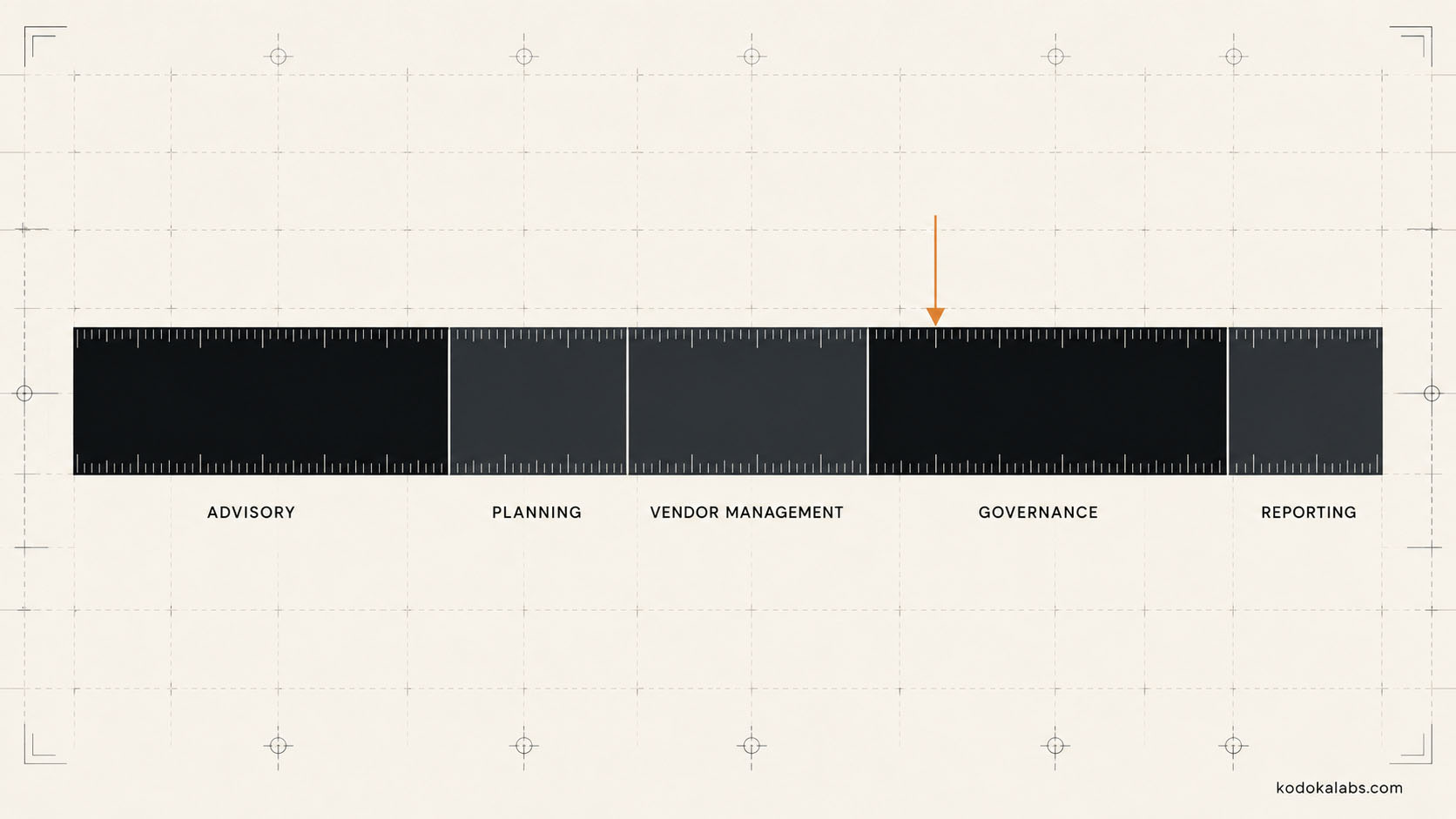
A Fractional AI Growth Director is kōdōkalabs’ answer to this gap: ongoing, senior marketing leadership — advisory, roadmap-setting, governance oversight, vendor management, and board reporting — delivered fractionally, so organizations get executive judgment without the cost, hiring risk, and ramp-up time of a full-time executive search.
This isn’t a rebranded consulting retainer, and it isn’t a part-time version of a traditional CMO role. It’s a specific response to a specific gap that shows up consistently at mid-market B2B companies navigating AI marketing transformation: the organization has, or is building, the operating capability to execute well, but lacks a senior person with both the AI-marketing expertise and the standing to own strategy, governance, and board accountability for it. A generalist marketing executive often doesn’t have deep AI-governance expertise; an AI specialist often doesn’t have the executive standing to own a board relationship. A Fractional AI Growth Director is built to hold both.
The role also reflects a broader shift in how senior marketing talent is being deployed across the market. As AI collapses the cost of execution, the scarce resource shifts from execution capacity to judgment — knowing what to prioritize, what to govern, and what to say no to. That’s inherently a leadership function, and increasingly, companies are recognizing that leadership function doesn’t require a full-time hire to be delivered well, particularly at the mid-market scale where a full executive team for every function isn’t always the right structural choice.
When This Is The Right Solution
This solution fits a specific set of situations, and it’s worth being direct about when it’s the right fit versus when a different kōdōkalabs solution serves better:
- You have execution capacity but not enough senior direction. Your team can produce good work; nobody is prioritizing what to build, evaluating whether it’s working, or making the call on what to stop doing. This is common in organizations that scaled their marketing team faster than they scaled marketing leadership, leaving a capable team reporting into a generalist executive with limited bandwidth for AI-specific strategy.
- You’re not ready for — or don’t need — a full-time marketing executive. Whether due to budget, uncertainty about the right permanent hire, or a genuine belief that fractional leadership fits the organization’s stage better long-term. Some organizations never need a full-time version of this role; others use the fractional relationship as a deliberate step toward eventually making a full-time hire with much clearer requirements.
- You’ve completed (or are completing) an AI Marketing Operating System engagement and need ongoing stewardship. Someone needs to own Measure and Scale — the phases of The kōdōkalabs Transformation System that continue indefinitely rather than ending at a delivery date. Without an accountable owner, even a well-built operating system tends to drift back toward the fragmentation it was designed to fix, simply because nobody senior is actively maintaining it.
- Your board or leadership wants senior accountability for AI marketing strategy specifically, distinct from general marketing leadership, because the governance, vendor, and capability questions around AI require judgment most existing executives haven’t yet built. Boards increasingly ask direct questions about AI governance and risk exposure, and having someone who can answer those questions with real operating detail, not a prepared summary, changes the quality of that conversation.
If instead you’re looking for hands-on implementation of workflows and governance, that’s the AI Marketing Operating System. If you’re looking for a diagnostic starting point, that’s the Executive AI Marketing Assessment.
What's Included
- Executive Advisory — regular strategic counsel to the CEO or CMO on marketing direction, priorities, and tradeoffs, informed by hands-on visibility into how the organization is actually operating, not a quarterly check-in from the outside. This includes being a direct sounding board on decisions that don’t have an obvious right answer — where to invest the next quarter’s incremental budget, whether to pursue a new channel, how to respond to a competitor’s move.
- Roadmaps — an actively maintained strategic roadmap connecting marketing activity to business outcomes, revisited and adjusted as circumstances change rather than set once a year and left untouched. The roadmap stays connected to the KPI dashboard, so priorities shift based on what the data is actually showing, not just on whoever raised the loudest concern that month.
- Quarterly Planning — structured planning cycles that translate the roadmap into specific priorities, resourcing decisions, and success metrics for the coming quarter, run as a defined process rather than an informal conversation that produces no documented commitments.
- Vendor Management — consolidated oversight of the marketing vendor and tooling portfolio, evaluating what’s earning its keep, what’s redundant, and what’s missing, rather than each tool being evaluated in isolation by whoever originally purchased it. This frequently surfaces meaningful cost savings in the first quarter alone, simply from having one accountable owner reviewing the full portfolio together.
- Leadership — direct leadership presence for the marketing team on strategic and AI-governance questions, filling the seniority gap that leaves talented teams without clear direction. This includes being available for the judgment calls that come up between formal planning cycles — an edge case the Governance Matrix didn’t anticipate, a request from another department that needs prioritization against existing commitments.
- Governance — ongoing ownership and evolution of The AI Governance Matrix as the organization’s AI usage grows and circumstances change, including updating approval paths as new content categories or new AI capabilities get introduced.
- Board Reporting — regular, structured reporting to the board or executive leadership on marketing performance, AI maturity progress, and strategic recommendations, delivered by someone with the standing to answer hard questions directly rather than relaying answers secondhand from the marketing team.
- Measurement — ownership of the KPI dashboard established during the Assessment and Operating System phases, ensuring metrics stay connected to business outcomes rather than drifting toward vanity reporting as reporting cadences repeat quarter after quarter.
- Transformation — ongoing stewardship of Phases 5 and 6 of The kōdōkalabs Transformation System — Measure and Scale — the phases that continue for as long as the organization keeps growing and evolving, distinct from the fixed-duration Diagnose, Architect, Build, and Enable phases that precede them.
How The Engagement Runs
Fractional AI Growth Director engagements run on a recurring cadence rather than a fixed project timeline, typically structured as:
- Weekly or biweekly working sessions with marketing leadership and key team members, covering active priorities, blockers, and decisions that need executive judgment.
- Monthly performance reviews, tying execution velocity, governance maturity, content and search performance, internal capability, and cost per output back to the baseline established in the Assessment.
- Quarterly planning cycles, setting priorities for the coming quarter and adjusting the roadmap based on the previous quarter’s results.
- Board or leadership reporting, on whatever cadence your organization’s governance structure requires, with the Fractional AI Growth Director presenting directly rather than through an intermediary
How The Engagement Runs In Detail
| Activity | Frequency | Primary Output |
|---|---|---|
| Working sessions | weekly | prioritization and decisions |
| Performance review | monthly | KPI dashboard update |
| Vendor review | quarterly | vendor portfolio recommendation |
| Board reporting | per board cadence | executive report |
The Leadership Operating Model
kōdōkalabs’ Fractional AI Growth Directors operate against a defined Leadership Operating Model and Decision Framework, rather than an open-ended advisory retainer with no structure. The Decision Framework specifies which categories of decisions the Fractional AI Growth Director is empowered to make directly (day-to-day prioritization, vendor evaluation recommendations, workflow adjustments within the existing Governance Matrix) versus which require executive or board sign-off (budget changes above a defined threshold, changes to the Governance Matrix itself, new strategic direction).
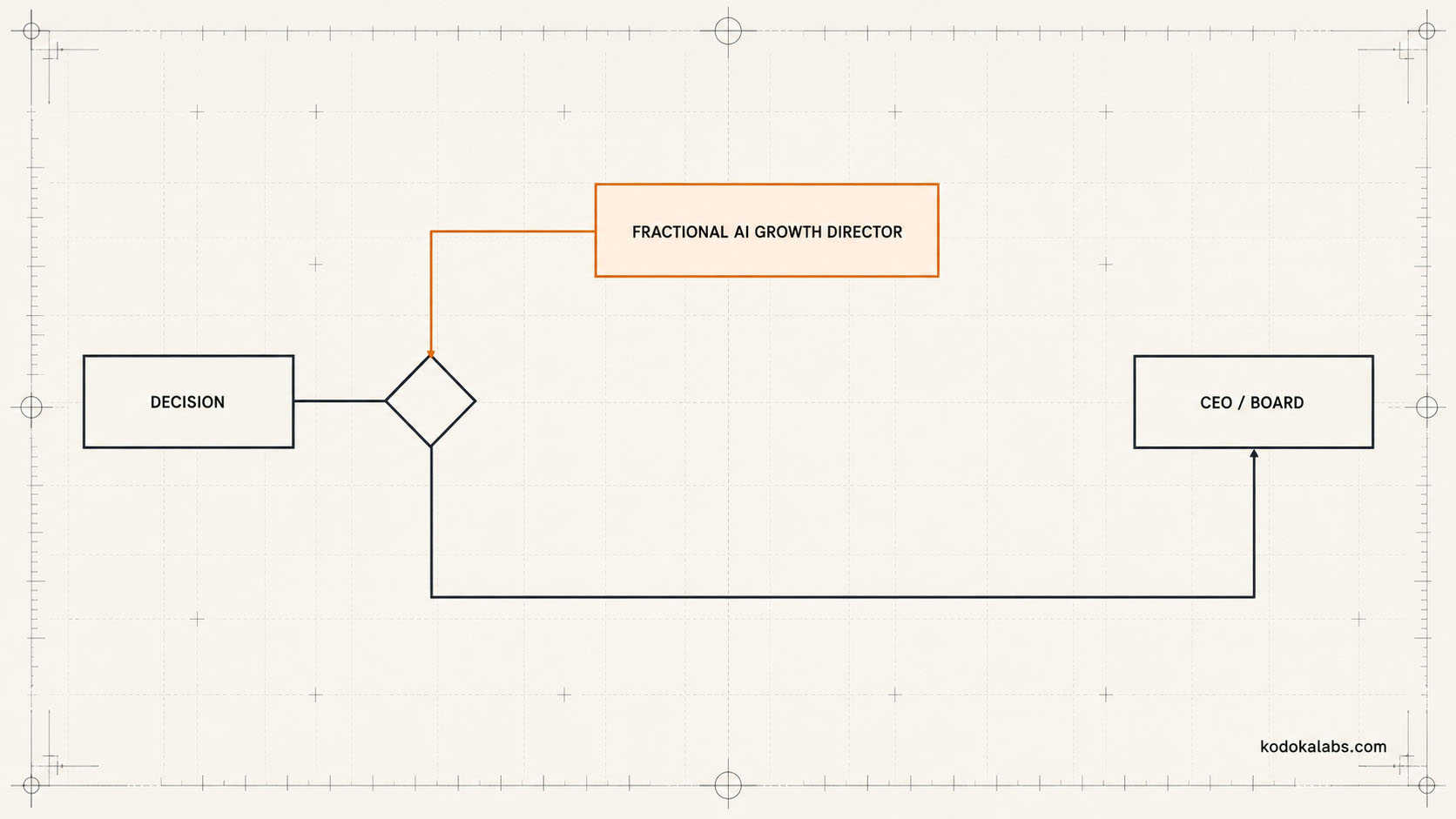

This structure exists because the biggest risk in any fractional executive relationship is ambiguity about authority — without a defined framework, a fractional leader either has too little authority to actually move things forward, or operates with undefined authority that creates friction with the rest of the leadership team. Making the decision rights explicit from the start avoids both failure modes.
The Leadership Operating Model is reviewed and adjusted at each quarterly planning cycle, since the right level of delegated authority typically changes as trust builds and as the organization’s own governance maturity increases. An early-stage engagement might route more decisions through executive sign-off than a mature one, six quarters in, where the Fractional AI Growth Director has an established track record and the Governance Matrix itself has been tested against real situations.
Time Commitment And How Work Gets Structured
How This Fits The kōdōkalabs Transformation System
Fractional vs. Full-Time vs. Agency
Fractional engagements are structured around a defined, predictable time commitment rather than open-ended availability — typically a set number of days per month, split between the recurring working sessions, hands-on involvement in specific priorities from the roadmap, and reporting. This predictability matters on both sides: your team knows when and how to bring decisions to the Fractional AI Growth Director, and the engagement scope stays bounded rather than expanding informally over time.
| Dimension | Full-Time Executive | Agency | Fractional AI Growth Director |
|---|---|---|---|
| Cost | highest, plus benefits and hiring risk | ongoing retainer, execution-focused | fraction of full-time cost, leadership-focused |
| Ramp-up time | months, including search | weeks | days to weeks, immediate context from prior kōdōkalabs engagement phases |
| Governance ownership | yes, but building capability from scratch | no, execution only | yes, building on existing Governance Matrix |
| Incentive alignment | aligned with company, but single point of failure | incentivized toward retainer continuation | incentivized toward capability transfer, per the Capability Transfer Framework |
| Board credibility | high | limited, rarely presents directly | high, presents directly with full context |
Common Objections
Can a fractional leader really have enough context to make good decisions?
Most Fractional AI Growth Director engagements follow a kōdōkalabs Assessment and Operating System engagement, meaning the fractional leader already has deep, hands-on context on your organization's maturity, workflows, and governance — not a cold start. Even when this is the first engagement, the recurring weekly/biweekly cadence is specifically designed to build the operating context a purely advisory, low-touch relationship wouldn't provide.
Isn't this just an expensive consulting retainer with a different name?
The distinction is in scope and authority. A consulting retainer typically provides recommendations; a Fractional AI Growth Director operates within a defined Decision Framework with real authority over a bounded set of decisions, reports to the board directly, and is accountable for outcomes tracked against the same KPI dashboard used throughout the engagement.
What happens if we eventually want to hire a full-time executive?
That's a common and expected transition, not a failure of the fractional model. Many clients use a Fractional AI Growth Director specifically to build organizational maturity and clarity about what a full-time role should own, making a subsequent full-time hire faster and lower-risk because the operating model, governance, and roadmap are already established for that person to inherit.
Will our team actually respect the authority of someone who isn't here full-time?
Authority in this role comes from the Decision Framework and demonstrated track record, not from physical presence. Teams that have been through an Assessment and Operating System engagement with the same person typically have already seen firsthand judgment and follow-through before the Fractional relationship formally begins, which does more to establish credibility than time-in-office ever would.
How This Role Evolves Over A Typical Year
The scope of a Fractional AI Growth Director engagement tends to shift over its first year. In the early months, most of the work is stabilization: making sure the operating system built during Architect and Build is holding up under real usage, catching governance gaps the initial design didn’t anticipate, and building the working rhythm with the team. By the middle of the year, the focus typically shifts toward optimization — refining workflows based on Data-Led Iteration, expanding automation where the data supports it, and tightening the KPI dashboard around what’s actually predictive of business outcomes. By the back half of the year, conversations increasingly turn toward Scale — new channels, new content types, or new markets the operating system should extend to, informed by a full cycle of Measure-phase data.
This natural progression is also why most engagements are structured as ongoing relationships rather than fixed-term projects: the value of the role compounds as institutional context builds, and restarting that context with a new person on a fixed annual cycle would undo much of what makes the fractional model work.
Who Delivers It
Fractional AI Growth Director engagements are staffed by kōdōkalabs’ senior consulting team, typically continuing from the same team that led your Assessment and Operating System engagement, preserving full context rather than starting a new relationship from scratch.
Frequently Asked Questions (FAQ)
How much time does a Fractional AI Growth Director typically commit per week?
Architect typically takes two to four weeks depending on organizational complexity. Build is iterative and workflow-by-workflow, usually spanning two to four months depending on how many workflows are in scope and team size.
Do we need to have completed the AI Marketing Operating System engagement first?
It's not strictly required, but it's the most common path, because the fractional leader inherits full context from that engagement rather than starting cold. Organizations with an existing, reasonably mature operating model can engage a Fractional AI Growth Director directly.
Can the Fractional AI Growth Director make final decisions, or only recommend?
Within the Decision Framework established at the start of the engagement, the Fractional AI Growth Director has real decision authority over a defined set of day-to-day and tactical questions. Budget changes above an agreed threshold, changes to governance policy itself, and new strategic direction typically route to the CEO or board.
How long do clients typically stay in this engagement?
There's no fixed term — this is designed as an ongoing relationship for as long as the organization values the leadership function, with the option to transition to a full-time hire or step back to a lighter-touch advisory relationship as circumstances change.
Does this replace our need for a CMO?
For many organizations, a Fractional AI Growth Director functions as the senior marketing leadership the organization needs at its current stage. Organizations that already have a CMO more commonly use this solution as a specialized complement focused specifically on AI strategy, governance, and transformation, working alongside existing leadership rather than replacing it.
The Latest News and Updates
From the kōdōkalabs
Intelligence Hub






Book An
Assessment
The fastest way to find out where your marketing organization stands is a structured assessment, not a sales call.
In a 90-minute Executive AI Marketing Assessment, we evaluate current maturity, technology, processes, team, content, search, and governance against the AI Marketing Maturity Model, and leave you with a prioritized roadmap — whether or not you engage kōdōkalabs further.