
Build Internal AI Capability Without Agency Dependency
Building Internal AI Capability Without Permanent Agency Dependency
Executive Summary
Organizations frequently buy AI marketing services without receiving the architecture documentation, prompt specifications, workflow ownership, access rights, training, governance standards, source files, maintenance procedures, model-change processes, measurement frameworks, or handover criteria that would let them actually run and improve the system themselves, leaving them dependent on the provider for everyday operation and every future decision. External expertise should accelerate transformation, not replace the client’s own capability indefinitely. This guide sets out the Install–Enable–Transfer Model, a Capability Transfer Scorecard, a Dependency Risk Matrix, and a Minimum Transfer Package, the concrete artifacts that distinguish a capability-building engagement from a dependency-creating one.
Key Takeaways:
- Internal AI capability means people, knowledge, processes, governance, documentation, and ownership, not just access to a working system.
- The Install–Enable–Transfer Model structures an engagement so ownership deliberately moves toward the client over time, rather than staying with the provider by default.
- A Minimum Transfer Package of specific artifacts, architecture diagrams, workflow documentation, prompt specifications, access, and more, should be a contractual deliverable, not an afterthought.
- Dependency should be assessed across six distinct types: operational, knowledge, technology, data, commercial, and governance.
- Contract language addressing capability transfer should be treated as an issue list for qualified legal review, not copied as legal advice.
What Does Internal AI Capability Mean?
Why Dependency Is a Transformation Risk
Dependency is one of the largest trust barriers in agency and consulting selection, and for good reason, an organization that can’t operate, govern, or modify its own AI-enabled workflows has effectively outsourced a strategic capability, not just a set of tasks. This creates risk beyond cost: it limits the organization’s ability to respond quickly to a new opportunity, makes it vulnerable if the provider relationship ends on short notice, and quietly transfers institutional knowledge about the organization’s own marketing operation to an outside party. Executives who want transformation without losing internal control need a partner whose commercial model rewards building the client’s capability, not one whose model depends on the client staying dependent.
This risk is easy to underestimate while an engagement is going well, because dependency rarely announces itself as a single obvious moment, it accumulates through a series of individually reasonable decisions. A workflow gets built using the provider’s preferred tooling because it was faster to set up that way. A prompt gets refined iteratively during live delivery without anyone writing down the final version anywhere the client can access. A key piece of institutional knowledge about why a workflow handles an edge case a certain way lives only in the provider team’s collective memory. None of these decisions looks like a problem in isolation, but together they can leave an organization with a workflow it depends on daily and understands only superficially, a position that becomes acutely visible, and expensive, at exactly the moment the provider relationship needs to change.
The Install–Enable–Transfer Model
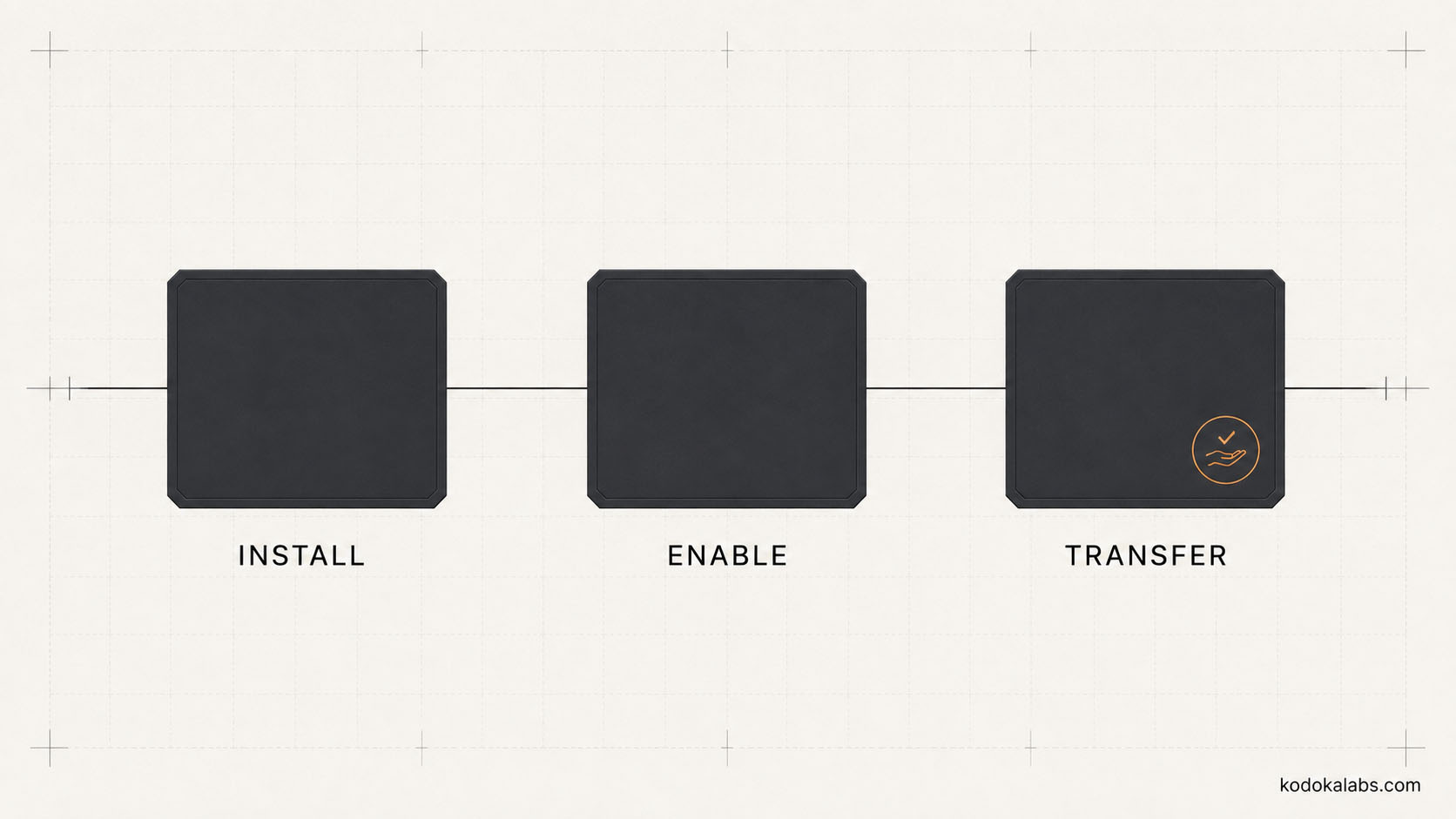
Install
Enable
Transfer
Ownership, access, documentation, decision rights, maintenance capability, and the improvement process itself move formally to the client, with the partner’s role shifting from operator to advisor available on an as-needed basis.
An engagement that never progresses past Install has built a working system, not internal capability, Enable and Transfer are where the actual capability transfer happens, and both require deliberate design rather than happening automatically as a byproduct of a successful Install phase.
The Capability Transfer Scorecard
Dimension
What It Assesses
Strategic understanding
Workflow ownership
Prompt ownership
Technical access
Documentation quality
Governance capability
Quality assurance
Measurement
Maintenance
Training coverage
Succession
Vendor independence
The Dependency Risk Matrix
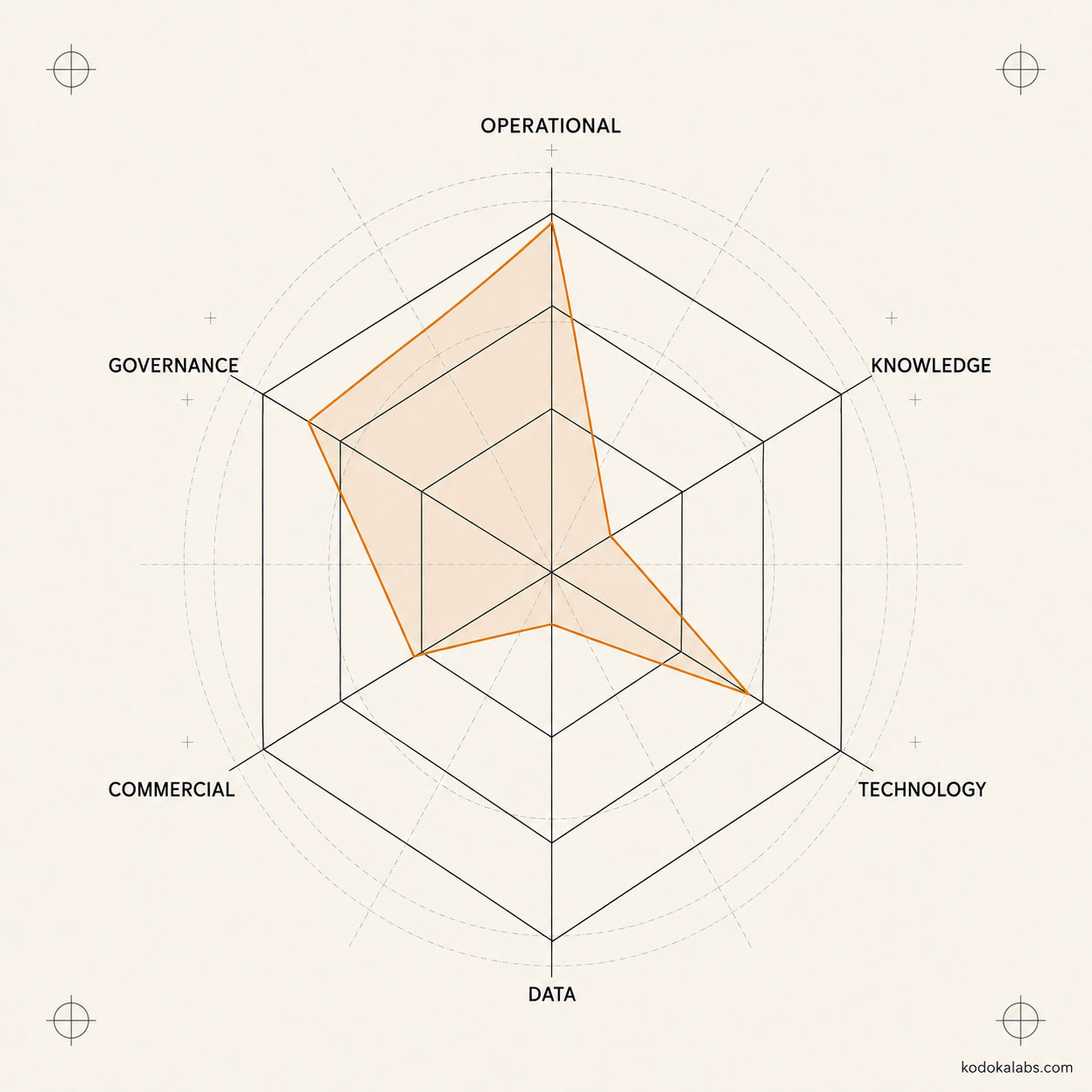
Dependency Type
What to Evaluate
Operational
Knowledge
Technology
Data
Commercial
Governance
The Minimum Transfer Package
What Should Be Owned by the Client vs. the Partner
The client should own the workflow itself, the data it depends on, the prompt and configuration assets, the documentation, and the decision rights over how the workflow evolves. The partner’s ongoing role, once transfer is complete, is best understood as strategic advisory and specialist support for problems that exceed the client’s internal capability, not operational control retained by default because no one formally handed it over. Where a partner retains proprietary tooling the client can’t access directly, that dependency should be named explicitly and weighed against the value the tooling provides, rather than left implicit.
This split is worth stating explicitly at the start of an engagement rather than inferring it later from how things happen to end up, because the default trajectory of most consulting relationships tends toward the provider retaining more control than either party originally intended. It’s simply easier, in the moment, for the provider to make a configuration change themselves than to walk the client through doing it, and each time that happens, ownership drifts a little further from where the engagement’s stated goals said it should sit. Naming the intended ownership split at the outset, and checking actual practice against it periodically rather than only at the engagement’s formal end, is what keeps that drift from becoming the default outcome.
How to Train Internal Teams
Effective training is role-based rather than generic, the training a workflow owner needs differs meaningfully from what a reviewer or an executive sponsor needs, and includes guided practice on real work rather than only hypothetical exercises, a period of shadow operation where the client team runs the workflow with the partner present but not doing the work, and structured feedback that surfaces gaps in understanding before the partner steps back. Training that happens once, early in an engagement, before the client has had a chance to operate the workflow under real conditions, tends to leave gaps that only become visible once the partner is no longer available to fill them.
A workflow owner needs to understand the system’s design logic well enough to modify it safely, why particular sources are treated as authoritative, why a specific human review gate exists at a specific point, what the failure and escalation behavior is designed to catch. A reviewer needs less design-level understanding and more depth on the specific quality criteria they’re applying and how to recognize the failure modes most likely to occur in the content or output they’re checking. An executive sponsor typically needs neither of these in depth, but does need enough fluency to interpret the workflow’s measurement dashboard, ask informed questions about risk and control, and make a credible scale-or-stop decision when the evidence calls for one. Training designed around a single generic session tends to serve none of these audiences particularly well, covering too much design detail for the executive sponsor and too little for the workflow owner.
When a Workflow Is Ready for Handover
A workflow is ready for handover when the client can operate it day-to-day, troubleshoot common issues, apply the governance and quality standards independently, measure its performance, and make routine improvements, not simply when it’s been running successfully in production for some period of time. Production stability demonstrates the workflow works; it doesn’t demonstrate the client can run it without the partner, which is a different and more demanding bar.
A practical way to test readiness rather than assume it is to have the client team operate the workflow for a defined period with the partner present only as a silent observer, intervening solely if something goes seriously wrong. If the client team completes that period without needing the partner to step in for routine operation, troubleshooting, or quality review, that’s a genuine readiness signal, closer to evidence than a self-assessment or a general sense that the team “seems comfortable” with the system. If the partner finds themselves stepping in more than expected during this observation period, that’s useful information too: it identifies specifically where Enable-phase work is still incomplete, rather than leaving the gap to surface for the first time after the partner has already stepped fully back.
How to Avoid Vendor Lock-In
Avoiding lock-in means prioritizing data portability, avoiding unnecessary dependence on proprietary tooling where a standard alternative exists, insisting on genuine administrative access rather than view-only visibility, and building internal documentation thorough enough that a different provider, or no provider, could pick up the workflow if needed. Lock-in isn’t always the result of deliberate provider strategy; it often accumulates from small, individually reasonable technical decisions made without anyone tracking their cumulative effect on the client’s independence.
A useful practical test is to periodically ask what would actually happen if the provider relationship ended tomorrow, not as a hypothetical thought exercise, but by checking whether the client organization currently has, in hand, everything the Minimum Transfer Package specifies. If the honest answer involves phrases like “we’d need to ask them for that” or “only they have the current version,” that’s a concrete, checkable signal of lock-in, distinct from a general feeling that the relationship is going well. Running this test at defined intervals throughout an engagement, not only when the relationship is already under strain, catches drift toward dependency while it’s still easy to correct.
What to Put in Contracts
The following is an issue list for qualified legal review, not legal advice. Contracts covering AI capability-building engagements typically need to address: what specific artifacts constitute the Minimum Transfer Package and when they’re due; who owns the intellectual property in workflows, prompts, and documentation created during the engagement; what data-portability guarantees apply if the relationship ends; what access rights the client retains throughout and after the engagement; what the defined handover acceptance criteria are; and what post-handover advisory terms, if any, apply. None of this should be treated as ready-to-use contract language, it’s a list of issues a qualified legal advisor should address in the specific commercial and jurisdictional context of the engagement.
How External Experts Remain Involved After Handover
Common Failure Modes
- Install without Enable or Transfer, a working system with no plan for the client to ever run it independently.
- Documentation as afterthought, writing down how a workflow works only when someone asks, rather than as a structured deliverable.
- Training front-loaded and one-time, all enablement delivered early, before the client has real operational experience to apply it to.
- Proprietary lock-in by default, dependency on provider-specific tooling accumulating from unexamined technical decisions rather than deliberate choice.
- Handover judged by production stability alone, treating “it’s been running fine” as equivalent to “the client can run it.”
- No named transfer criteria, no defined point at which handover is considered complete, so it never quite happens.
- Single point of trained failure, capability concentrated in one person, with no plan for what happens if they leave.
Checklist
[ ] The CMO’s mandate explicitly includes operating-model architecture, not only channel and campaign performance.
[ ] AI governance responsibilities are co-owned and documented, not assumed to sit entirely with IT or legal.
[ ] Capability allocation decisions follow a defined build-buy-configure logic.
[ ] CMO metrics span market position, demand quality, growth efficiency, execution health, capability, learning, and risk, not activity alone.
[ ] Revenue definitions are shared and reconciled with sales and finance.
[ ] A skills plan addresses systems thinking, data literacy, AI literacy, and governance fluency, not only channel expertise.
[ ] Fractional leadership has been genuinely considered where the need is architectural rather than purely operational.