
The
kōdōkalabs
Revenue Systems
Intelligence Hub
Revenue Systems is the discipline of connecting AI-enabled marketing capability to measurable business outcomes — demand generation, revenue operations, sales enablement, and growth — so transformation progress is provable in pipeline and revenue terms, not just activity metrics. This is the capability behind Phase 5 (Measure) and part of Phase 6 (Scale) of The kōdōkalabs Transformation System, and the primary domain of the Fractional AI Growth Director solution.
Definition
Revenue Systems is the set of practices and infrastructure connecting marketing activity — content, campaigns, search visibility, AI-assisted execution — to measurable business outcomes: pipeline generated, deals influenced, revenue attributable to marketing effort. It encompasses demand generation, revenue operations, sales enablement, and the broader growth systems that determine whether an organization’s marketing maturity actually translates into business results, or stays contained as internal operational improvement without provable commercial impact.
This distinction matters because marketing transformation efforts frequently succeed operationally — faster content production, better governance, more consistent quality — while still failing to demonstrate revenue impact, simply because nobody built the measurement bridge connecting operational improvement to commercial outcomes. Revenue Systems is that bridge.
It’s worth being explicit that Revenue Systems isn’t a rebranding of “marketing should be accountable for revenue,” a principle most marketing leaders already accept in theory. It’s the specific infrastructure — data, process, defined handoffs, and measurement design — that makes that accountability provable rather than aspirational. Plenty of organizations agree marketing should drive revenue and still can’t produce a defensible number showing how much, because the underlying systems connecting the two were never built.
Latest Revenue Systems Content






Why Marketing Maturity Has To Connect To Revenue
Demand Generation In An AI-Native Operating System
AI-assisted content and campaign production changes demand generation economics meaningfully: higher-quality content can be produced at lower marginal cost, freeing budget to invest in distribution and targeting rather than production alone; and structured, GEO-optimized content (covered on the Search Intelligence pillar) increasingly captures demand at the research stage, before a prospect ever fills out a form, as AI answer engines become a larger part of the B2B research process.
This shifts demand generation strategy in a specific direction: less reliance on volume-based outbound tactics, more investment in being the cited, trusted source when a prospect (or the AI tool they’re using to research) is evaluating options. Demand generation inside an AI-native operating system treats the Intelligence Hub’s cornerstone content not as top-of-funnel awareness content disconnected from pipeline, but as a direct driver of qualified demand, tracked and measured accordingly.
This doesn’t mean traditional demand generation tactics disappear — paid campaigns, events, and outbound sequences remain relevant levers for most B2B organizations. What changes is the relative weighting and the standard applied to content-driven demand specifically: content built to the depth and structure described on the Content Operations and Search Intelligence pillars increasingly functions as a demand-generation channel in its own right, not merely as brand-awareness support for other channels.
Revenue Operations
Revenue operations is the connective infrastructure between marketing, sales, and customer success — the systems, data, and processes ensuring a lead generated by marketing activity is properly tracked, routed, and attributed through to a closed deal. Inside a Revenue Systems approach, revenue operations specifically ensures: marketing-sourced pipeline is defined and tracked consistently (not ambiguous or self-reported); handoffs between marketing and sales have clear, documented criteria (what qualifies a lead, when it transfers, what information transfers with it); and the same KPI dashboard used to track marketing operating-system maturity also connects to pipeline and revenue data, so marketing progress and commercial outcomes are visible together, not in separate reporting systems that never get reconciled.
Revenue Operations Handoff Points
| Stage | Marketing's Role | Sales' Role | Shared Data |
|---|---|---|---|
| Initial engagement | Create demand through search-visible cornerstone content, AI-answer-engine visibility, campaigns, events, paid media, and targeted distribution. Apply consistent campaign and content identifiers. | Use approved content in prospect conversations and outbound activity. Capture direct market feedback and recurring buyer questions for marketing. | Anonymous visitor or account ID; first-touch source; campaign ID; landing page or content asset; search query or referral source; engagement timestamp; consent status. |
| Known lead capture | Convert engagement into an identifiable lead through an assessment, form, event registration, content request, demo request, or other defined conversion. Enrich the record without replacing verified first-party data. | Review high-intent notifications where appropriate and add known account or relationship context. Do not begin formal sales qualification until the agreed handoff threshold is met. | Contact and account identifiers; conversion type; original and latest source; content history; stated need; consent and privacy status; enrichment source; lead owner; duplicate-record status. |
| Marketing qualification (MQL) | Apply documented fit and intent criteria. Verify required fields, exclude invalid or unsuitable records, assign the appropriate score, and prepare the qualification context for sales. | Help define qualification criteria and periodically validate whether MQLs reflect real buying potential. Provide feedback on false positives and missing signals. | ICP or account-fit score; intent score; qualifying actions; use case; region; company size; role or buying influence; disqualification reason; MQL timestamp; scoring-model version. |
| Sales acceptance and handoff (SAL) | Route the qualified lead to the correct sales owner within the agreed service level. Transfer the full engagement and attribution context, then monitor acceptance, rejection, and response time. | Accept or reject the lead within the agreed service level. Record a structured reason for rejection, confirm ownership, and initiate relevant outreach using the transferred context. | Assigned owner; handoff timestamp; acceptance status; acceptance or rejection reason; SLA due time; engagement summary; recommended next action; relevant content and campaign touchpoints. |
| Sales qualification and opportunity creation (SQL) | Provide supporting content, research, proof points, and nurture where the opportunity is not yet ready. Preserve campaign and content influence data as the record moves into the opportunity stage. | Validate business problem, stakeholder fit, urgency, buying process, and commercial potential. Create the CRM opportunity when the documented SQL criteria are met. | SQL status and timestamp; qualification notes; problem or use case; stakeholder roles; timeline; budget context where known; opportunity ID; expected value; pipeline stage; next step. |
| Opportunity progression | Support active opportunities with case studies, executive content, comparison materials, workshops, account-based campaigns, and other enablement aligned with observed deal barriers. | Maintain accurate opportunity stages, amounts, next steps, close dates, stakeholders, and loss risks. Record which assets and interactions materially influence progress. | Opportunity stage history; forecast category; amount; expected close date; stakeholder map; sales activities; content used; campaign touches; influence evidence; risk or blocker; next-step date. |
| Closed revenue and attribution | Reconcile marketing-source and marketing-influence data against the final CRM outcome. Report pipeline generated, revenue influenced, acquisition efficiency, and performance by content, campaign, and channel. | Record the final outcome, closed value, close date, products or services sold, and structured win or loss reasons. Validate material marketing influence when the CRM record is incomplete or disputed. | Closed-won or closed-lost status; recognized or contracted revenue; close date; attribution model; sourced and influenced flags; opportunity source; winning touchpoints; win or loss reason; sales cycle length. |
| Customer expansion and feedback loop | Use customer outcomes, adoption signals, and recurring questions to improve positioning, content, campaigns, and qualification criteria. Support expansion and advocacy programs with customer success. | Transfer implementation expectations and commercial context to customer success. Surface expansion signals, renewal risk, referrals, and proof suitable for future demand generation. | Customer ID; purchased solution; onboarding status; adoption signals; renewal date; expansion opportunity; customer health; advocacy permission; attributable expansion revenue; feedback themes. |
Measurement: From Vanity Metrics To Capability Metrics
Vanity Metrics vs. Capability-to-Revenue Metrics
| Category | Vanity Metric Example | Capability-to-Revenue Metric Example |
|---|---|---|
| Content | page views | pipeline influenced by cornerstone content |
| Search | keyword rankings | qualified traffic converting to pipeline, plus GEO citation frequency |
| Campaigns | impressions | cost per qualified opportunity |
| Team | hours worked | certified workflow owners and their output-to-pipeline ratio |
This reframing is one of the more significant mindset shifts Revenue Systems requires: measurement isn’t about proving marketing is busy, it’s about proving marketing capability converts into business outcomes, with a defensible, traceable line connecting the two.
Getting this right also changes how budget conversations happen. Instead of defending spend by pointing to activity volume, a marketing leader operating with mature Revenue Systems infrastructure can point to specific capability-to-revenue ratios — cost per qualified opportunity by content category, pipeline influenced per certified workflow, revenue attributable to specific cornerstone content clusters — turning the budget conversation into an investment discussion rather than a cost-justification exercise.
Sales Enablement
Sales enablement inside a Revenue Systems approach means equipping the sales team with content, data, and tools built from the same knowledge base and governed by the same quality standards as the rest of the operating system — not a separate, disconnected sales-content workstream. This includes: battlecards and competitive positioning drawn from the same research standards used in cornerstone content; case studies structured consistently (Business Problem, Baseline, Transformation, Framework Used, Implementation, Results, Lessons Learned) so sales can deploy them credibly in specific conversations; and access to the same AI-assisted tools marketing uses, governed by the same Human + AI Execution Model, so sales-generated content maintains the same quality and brand consistency as marketing-generated content.
Growth Systems
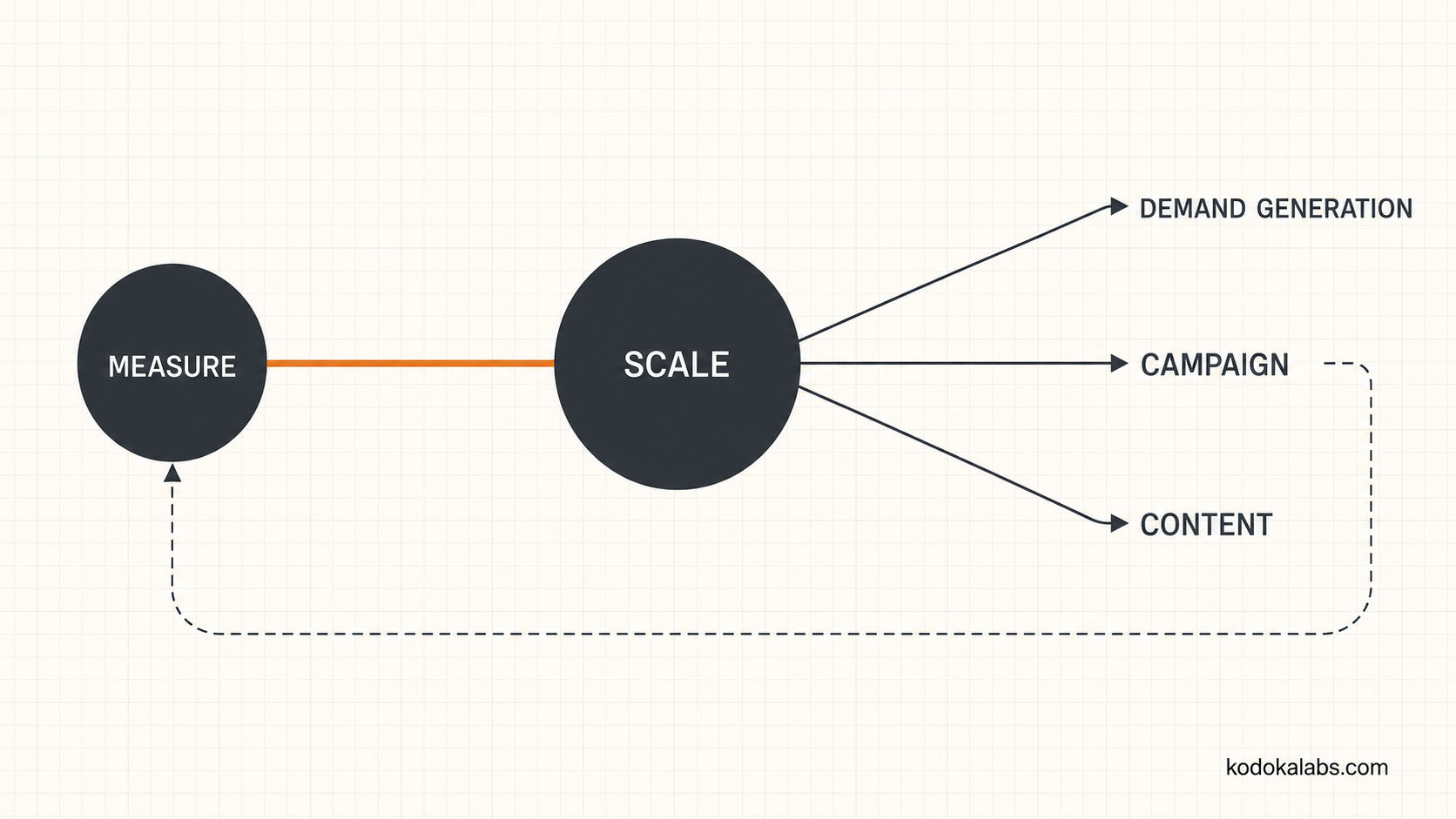
Growth systems is the broader discipline of identifying and scaling what’s working — the Scale phase of The kōdō Transformation System applied specifically to revenue-generating activity. This means systematically testing new channels, content types, or campaign approaches against the existing measurement framework, doubling down on what demonstrably influences pipeline, and retiring what doesn’t, using the same Data-Led Iteration discipline applied throughout the operating system rather than intuition-driven channel decisions.
Common Failure Patterns
- Measuring marketing activity without connecting it to revenue infrastructure. Extensive content and campaign output with no clear line to pipeline leaves marketing unable to defend its budget in commercial terms.
- Ambiguous marketing-sales handoffs. Without clearly defined lead qualification criteria and handoff processes, attribution becomes contested and unreliable, undermining trust in whatever measurement does exist.
- Sales enablement disconnected from the broader content operation. Sales content built outside the governed knowledge base and quality standards tends to drift inconsistent with brand and messaging faster than marketing-produced content.
- Scaling based on intuition rather than measurement. Expanding investment in a channel or content type without evidence it’s actually driving pipeline repeats the fragmented-experimentation problem in a new area.
How This Fits The kōdōkalabs Transformation System
Revenue Systems is the primary capability behind Phase 5: Measure and contributes significantly to Phase 6: Scale of The kōdōkalabs Transformation System. It’s delivered primarily through the Fractional AI Growth Director solution, which owns ongoing measurement, revenue-operations oversight, and growth-system decisions as a standing responsibility rather than a fixed-duration project.
Frequently Asked Questions (FAQ)
What's the difference between Revenue Systems and revenue operations (RevOps)?
RevOps is one component of Revenue Systems — specifically the process and data infrastructure connecting marketing, sales, and customer success. Revenue Systems is the broader discipline, also encompassing demand generation strategy, measurement design, sales enablement, and growth-system decisions.
How do we connect content performance to actual revenue?
Through revenue operations infrastructure that tracks a lead or opportunity's full lifecycle, from the content or channel that first engaged them through to closed revenue, with clearly defined handoff and qualification criteria between marketing and sales so the attribution is defensible rather than contested.
Does this require a dedicated RevOps hire?
Not necessarily as a first step — a Fractional AI Growth Director can own revenue-operations oversight as part of a broader Measure-phase responsibility, particularly for mid-market organizations not yet at the scale that justifies a dedicated full-time RevOps role.
How is AI changing demand generation specifically?
Two ways most notably: production economics shift, making higher-quality content and campaign assets achievable at lower marginal cost; and discovery behavior shifts, as AI answer engines capture a growing share of research-stage activity, making GEO-optimized content a more direct demand-generation lever than it was under a purely traditional-search model.
What metrics should leadership actually track?
A combination of leading capability indicators (execution velocity, governance maturity, content and search performance) and lagging business indicators (pipeline influenced, cost per qualified opportunity, revenue attributable to marketing activity), reviewed together rather than in separate, disconnected reports.
The Latest News and Updates
From the kōdōkalabs
Intelligence Hub
Book An
Assessment
The fastest way to find out where your marketing organization stands is a structured assessment, not a sales call.
In a 90-minute Executive AI Marketing Assessment, we evaluate current maturity, technology, processes, team, content, search, and governance against the AI Marketing Maturity Model, and leave you with a prioritized roadmap — whether or not you engage kōdōkalabs further.