
Entity SEO: Build Clarity, Relevance
and Trust Across Search and AI
Entity SEO, defined
Keywords Are Not Dead
What This Guide Covers
From Strings To Identifiable Things
For most of search engine optimization’s history, the practical unit of competition was the keyword string: the exact or close-variant phrase a page needed to rank for. That remains relevant. What has changed, gradually over more than a decade and accelerated by generative AI systems, is that search and answer systems increasingly need to resolve queries against entities, not just strings.
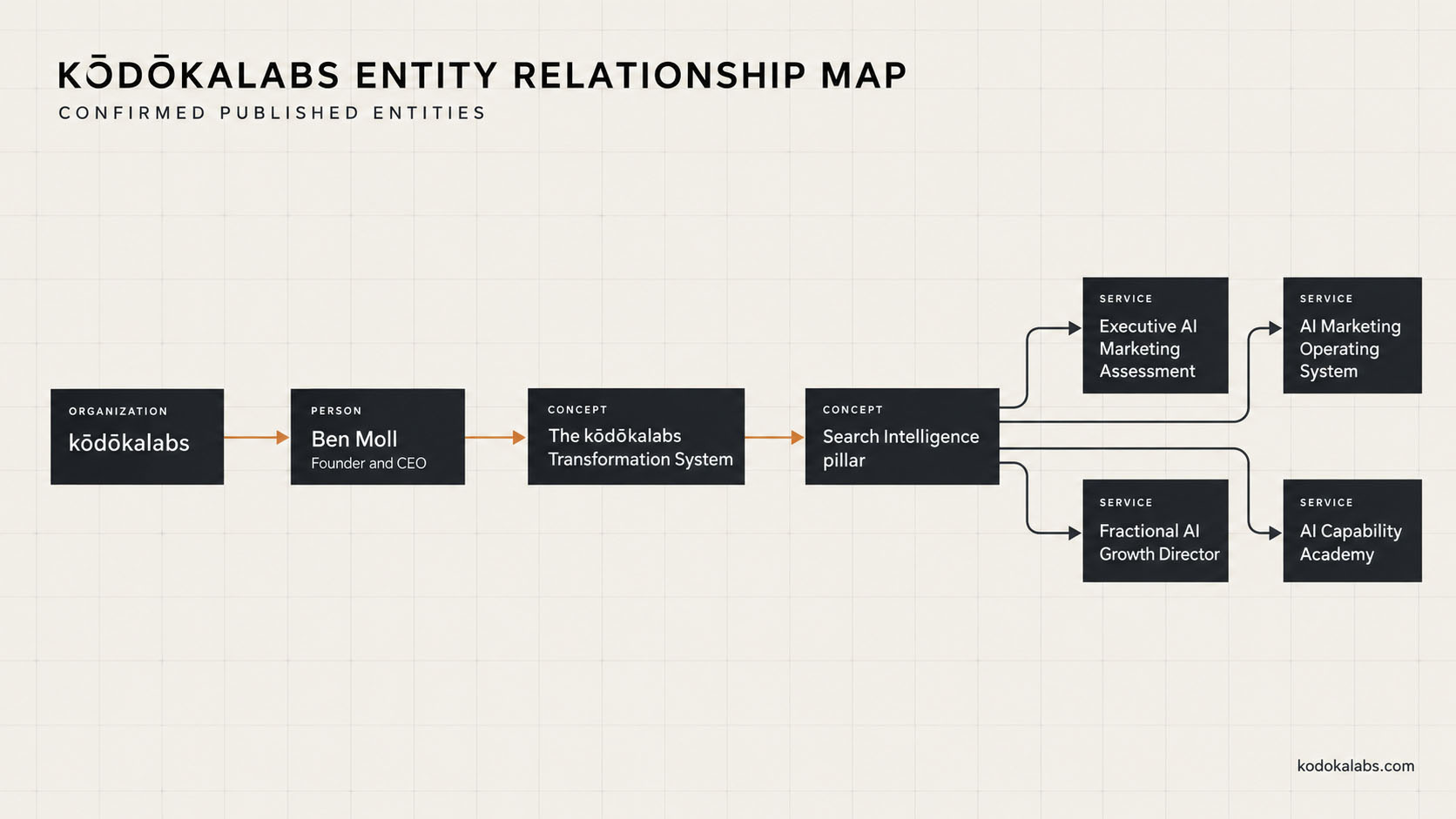
Consider the practical difference. A string-based system asked about “kōdōkalabs Transformation System” can match pages containing that phrase. An entity-aware system can, in principle, recognize that kōdōkalabs Transformation System and The kōdōkalabs Transformation System refer to the same proprietary methodology, understand that it belongs to the organization kōdōkalabs, and connect it to related entities such as the organization’s founder, its published phases, and its associated solutions, provided the organization has made those relationships legible in the first place. That legibility is not automatic. It has to be built through consistent naming, canonical definitions, structured data, and corroboration.
This matters more, not less, in a generative-answer environment. When a system synthesizes an answer rather than returning a ranked list, it needs a higher degree of confidence about who or what it is describing before it will represent that entity accurately, let alone cite it. Ambiguous, inconsistent, or undifferentiated entity representation is a direct barrier to accurate representation in both traditional search features and generated answers, independent of any specific AI-search tactic.
Entity Types And Relationships
Most organizations manage several distinct entity types simultaneously, often without treating them as a deliberate system. The core types relevant to a marketing and content organization are the Organization itself, one or more Person entities (founders, executives, named authors, or spokespeople), Product or Service entities (what the organization sells or delivers), and Concept entities, which include proprietary frameworks, methodologies, and named models the organization has created.
Each entity type carries its own core attributes and relationships. An Organization entity has a name, a category or industry, a location, a mission, and relationships to the people who lead it and the products or services it offers. A Person entity has a name, a role, a body of work, and a relationship back to the organization and to any concepts or methodologies they originated. A Product or Service entity has a name, a description, a category, and a relationship to the organization that offers it. A Concept entity, such as a proprietary framework, has a name, a definition, an originating organization or person, and relationships to the products, services, or content that apply it.
The table below sets out this structure using kōdōkalabs’ own real, published entities as the worked example, not fabricated illustrative data.
| Entity type | Canonical definition owner | Core attributes | Key relationships | Evidence source | Schema candidate |
|---|---|---|---|---|---|
| Organization | kōdōkalabs | Founder-led AI Marketing Systems consultancy and academy, based in Munich, Germany, serving Europe, the United States, Canada, Australia, and Japan | Founded and led by Ben Moll; originator of The kōdōkalabs Transformation System; offers four named solutions | /about/ |
Organization |
| Person | Ben Moll (Founder and CEO) | Marketing strategy, SEO, search, analytics, AI, automation, operational design, leadership, team enablement; active in print and digital advertising since 2001 | Founder and CEO of kōdōkalabs; originator of The kōdōkalabs Transformation System | /about/founder/ |
Person |
| Concept (proprietary framework) | The kōdōkalabs Transformation System | Six-phase system: Diagnose, Architect, Build, Enable, Measure, Scale | Originated by kōdōkalabs and Ben Moll; applied across all four solutions and the Search Intelligence pillar | /framework/ |
CreativeWork or equivalent, describing the visible framework page |
| Concept (pillar) | Search Intelligence | The organizational capability to understand, earn, and measure discoverability and trust across traditional and AI-mediated search | Maps to Build, Phase 3 of The kōdōkalabs Transformation System; parent to 18 cornerstone guides | /intelligence-hub/search-intelligence/ |
CreativeWork or WebPage, describing the visible pillar page |
| Service (solution) | Executive AI Marketing Assessment; AI Marketing Operating System; Fractional AI Growth Director; AI Capability Academy | Four distinct, named service lines, each with its own scope | Offered by kōdōkalabs; the Assessment is the default low-friction conversion path referenced throughout this pillar | /solutions/ |
Service |
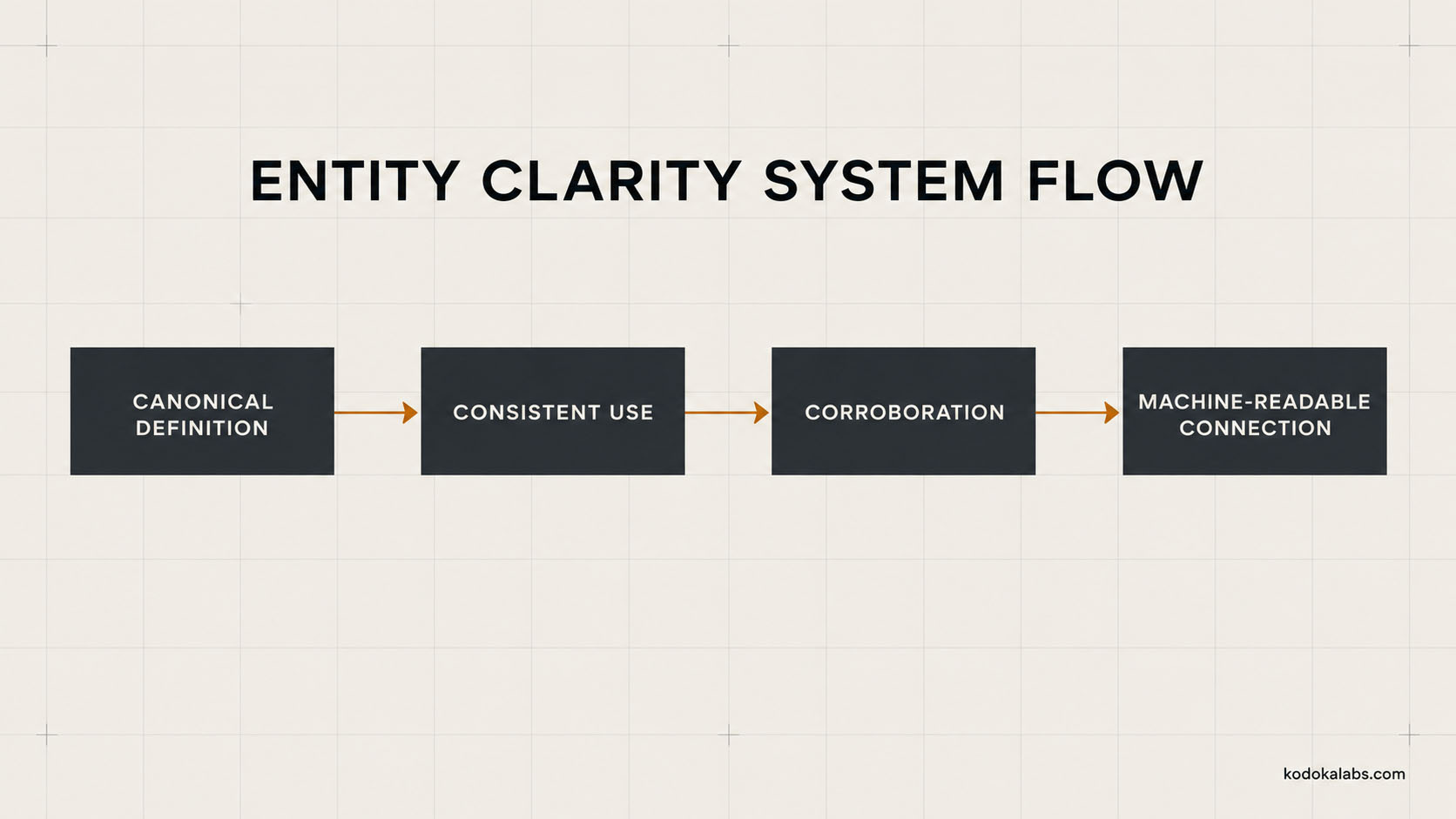
The Entity Clarity System
Building entity clarity is a sequence, not a single task. kōdōkalabs works through six connected steps.
Inventory. List every entity the organization needs search and AI systems to understand correctly: the organization itself, named people, products and services, and proprietary concepts. Most organizations discover this list is larger, and less consistently named, than expected once it is written down.
Define. For each entity, write one canonical definition and designate one canonical page as its source of truth. Ben Moll’s role, for example, is defined once, on the Founder page, and every other page that references him should be consistent with that definition rather than introducing a slightly different description.
Connect. Make the relationships between entities explicit: the Organization relates to the Person who founded it, the Person relates to the Concept they originated, the Concept relates to the Services that apply it. These relationships should be visible in the content itself, through internal linking and clear prose, not only in structured data.
Corroborate. Where possible, support entity claims with independent, verifiable sources: a LinkedIn profile for a Person entity, a published book record for an authored work, a business registration or verified legal record for an Organization’s formal details. Corroboration strengthens confidence; it does not replace a clear canonical definition on the organization’s own site.
Mark up. Apply structured data that describes the visible content accurately, using `Organization`, `Person`, `Service`, and related schema types. Use the `sameAs` property only to point to pages that represent the genuinely same identity, such as a verified LinkedIn profile or an official book listing, not to loosely related pages.
Govern. Assign ownership for each entity’s canonical definition and review it on a regular cadence, especially when facts change, such as a new publication, a changed role description, or an updated solution scope. Entity drift, where the same entity is described inconsistently across pages over time, undermines the clarity this whole system is built to establish.
On-Page And Technical Implementation
Entity clarity starts in the writing itself, before any structured data is applied. Use full, consistent names on first mention of an entity within a page, for example “The kōdōkalabs Transformation System” rather than a shortened or informal variant. Introduce a Person entity with their full name and role before switching to a shorter reference. Keep descriptions of the same entity consistent in substance across every page that mentions it, even where the phrasing varies naturally for readability.
On the technical side, apply `Organization` schema on the organization’s core pages, `Person` schema on founder and author pages, and `Service` schema on solution pages, each describing only what is visibly present on the page. Use `sameAs` sparingly and only for genuinely equivalent identity pages, such as a verified social profile or an official publication listing, reviewed immediately before publication since external profiles can change. Where the organization has named authors or reviewers on cornerstone content, connect that authorship consistently through linked `Person` identities rather than a plain text byline with no structured connection.
Entity Audit And Clarity Scorecard
| Criterion | Red | Amber | Green |
|---|---|---|---|
| Uniqueness | Entity name is ambiguous or shared with unrelated things with no disambiguating context | Entity name is mostly distinct but occasionally conflated with a similar term | Entity name is consistently distinct and disambiguated in context |
| Definition consistency | No canonical definition exists, or definitions conflict across pages | A canonical definition exists but is not consistently applied everywhere | One canonical definition exists and is used consistently sitewide |
| Source-of-truth ownership | No page is designated as the canonical source for this entity | A likely canonical page exists but is not formally designated or linked to | A clearly designated canonical page exists and other pages link to it |
| Relationship clarity | Relationships to other entities are absent or only implied | Some relationships are stated but not comprehensively | Key relationships are explicitly stated and internally linked |
| Corroboration | No independent, verifiable source supports the entity's claims | Some corroboration exists but is outdated or incomplete | Current, verifiable independent corroboration exists where relevant |
| Machine-readable identity | No structured data represents the entity | Partial or inconsistent structured data exists | Structured data accurately and consistently represents the entity |
| Authorship | Content has no attributed author entity | Author is named but not linked to a structured identity | Author is named and connected through consistent, linked identity |
| Change governance | No process exists for updating entity information when facts change | An informal process exists but is not documented or assigned | A documented owner and review cadence exist for this entity |
Failure Patterns And Limits
Measurement And Next Steps
Entity clarity is best measured through a combination of audit-based and outcome-based indicators. Audit-based indicators include the proportion of priority entities that pass each row of the Entity Clarity Scorecard above, and how many pages reference a given entity inconsistently with its canonical definition. Outcome-based indicators, covered in more depth in the Search and AI Visibility Measurement guide, include whether the organization’s Person and Organization entities are accurately represented when they do appear in generated answers or Knowledge Panel-style features, sampled over time rather than assumed from a single observation.
Organizations that have not yet built a formal entity inventory should start there before investing in structured data or link-building focused on entities. [Entity SEO for AI Search](/intelligence-hub/search-intelligence/entity-seo-for-ai-search/) covers the practitioner-level implementation sprint that operationalizes the audit and scorecard described here into an actual production plan, five artifacts from priority backlog through canonical entity records to a governed validation and change log.
Frequently Asked Questions
Does entity SEO mean we should stop optimizing for keywords?
No. Keywords remain how people phrase queries and how systems match content to intent. Entity SEO adds a layer on top: making sure the things behind those keywords, your brand, your people, your concepts, are clearly and consistently identifiable, not a replacement for keyword-informed content strategy.
What is the difference between entity SEO and a knowledge graph?
Entity SEO is the practice of defining, connecting, and corroborating individual entities. A knowledge graph is the more formal data architecture, identifiers, relationships, and machine-readable structure, that can represent many entities and their connections at scale. See the Knowledge Graphs guide for that architecture.
Should every page have Organization or Person schema?
Organization or Person schema?No. Structured data should describe entities that are genuinely and substantively present on that page, not be applied uniformly as a default. Overuse of schema that does not match visible content risks inaccurate or misleading markup.
Can entity SEO guarantee we appear in a Knowledge Panel?
No. Knowledge Panels and similar features are generated by platforms using criteria they have not fully disclosed. Entity clarity is a prerequisite for accurate representation, not a guarantee of a specific feature appearing.
How is this different from brand authority work?
Entity SEO is about definitional clarity and consistency, making sure systems can correctly identify what something is. Brand authority, covered in the Brand Authority in AI Search guide, is about the trust, reputation, and corroborating evidence that accumulates around an already-clear entity over time. The two are connected but distinct.
Where should we start?
With the inventory step: list the entities your organization needs search and AI systems to understand correctly, and check each one against the Entity Clarity Scorecard before investing in structured data or link-building.
Contextual Solution Pathways
Design a governed entity and knowledge architecture inside your AI Marketing Operating System, rather than treating entity clarity as a one-off schema project.