
Knowledge Graphs for Marketing, Search, and AI Systems
What A Knowledge Graph Actually Is, Without The Database Jargon
A knowledge graph, in the practical sense that matters to a marketing organization, is a governed record of the things that organization talks about, its brand, people, products, services, and proprietary concepts, and the relationships between them, structured so that both people and systems can reliably retrieve and reuse it. It is not, by itself, a piece of software, a specific vendor product, or a claim about appearing in a search engine’s own knowledge panel. It is an internal discipline: deciding what your entities are, what is true about them, how they relate, and keeping that record consistent as the organization changes.
The executive case for building one is narrow and practical: a knowledge graph is worth the investment when it measurably improves decision quality and content production, not because having nodes and edges sounds technically sophisticated. A small, well-governed graph that keeps five proprietary framework definitions consistent across forty pages delivers more value than a large, ungoverned graph nobody maintains.
This guide covers entity and relationship modeling, source-of-truth records, identifiers, the distinction between a taxonomy and an ontology, provenance, retrieval, internal linking, schema projection, governance, and a staged implementation path. It does not cover the detailed practitioner work of optimizing individual entities, which is covered in Entity SEO and Entity SEO for AI Search, and it does not cover the full site-wide semantic and taxonomic architecture, which is covered in Semantic Content Architecture. This guide also does not claim that publishing JSON-LD structured data creates or updates any external search engine’s own knowledge graph entry; no platform has documented that mechanism, and structured data describes visible content, it does not write to a third party’s internal systems.
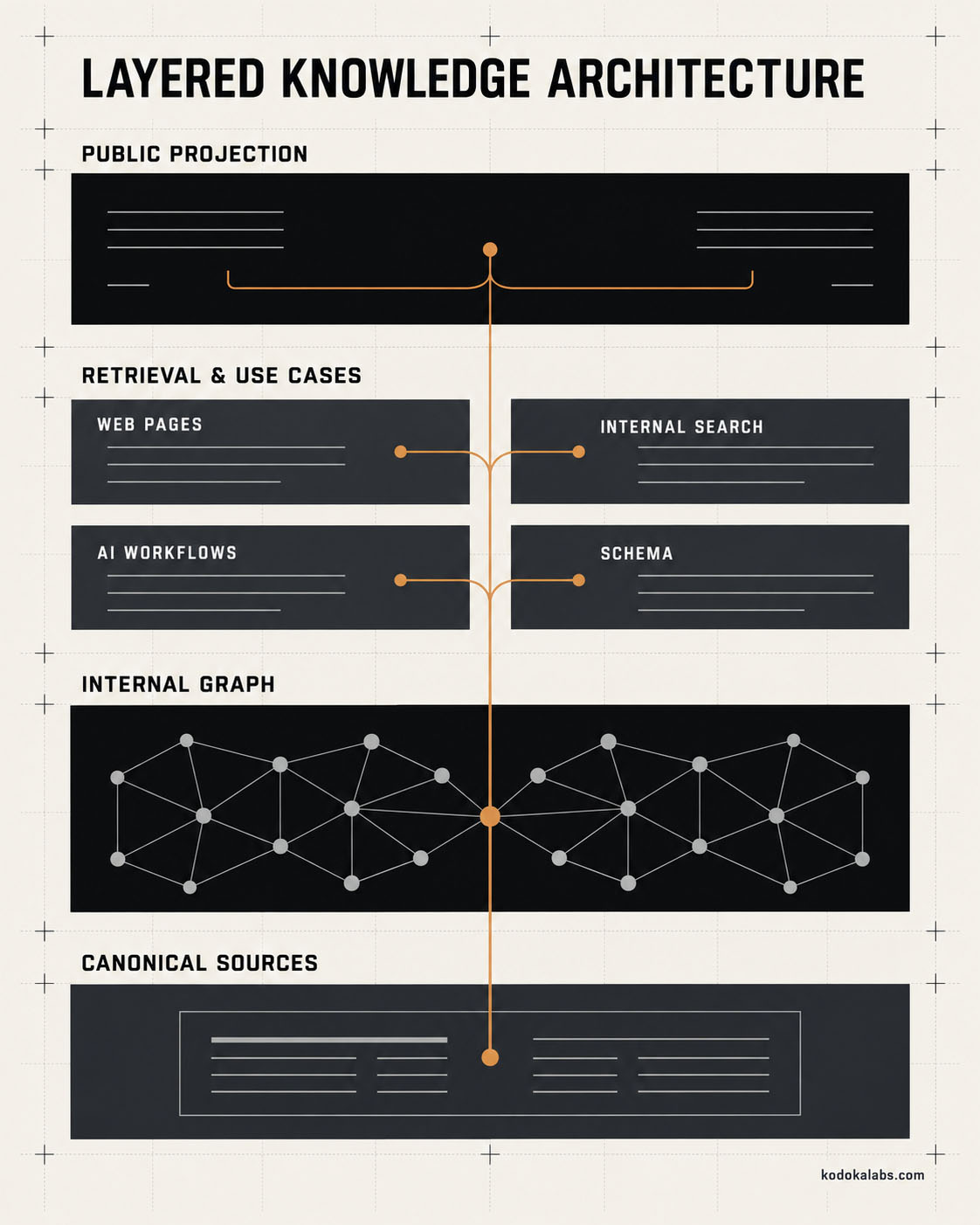
Three Graph Contexts, Not One
| Context | What it is | Who controls it | What it's for |
|---|---|---|---|
| Internal organizational graph | The organization's own governed entity and relationship record | The organization, fully | Content consistency, decision support, internal retrieval, AI-assisted workflows |
| Website semantic architecture | The public expression of entities and relationships through page structure, linking, and structured data | The organization, fully, for what it publishes | Human navigation, search engine interpretation, generative-answer retrieval |
| External platform knowledge system | A search engine or AI platform's own internal entity representation | The platform, not the organization | The platform's own ranking, features, and generated answers |
Confusing these leads to two common mistakes:
- assuming that building an internal graph automatically creates external visibility (it does not, without also projecting the relevant parts to the public site), and
- assuming that adding structured data to a page creates or guarantees an entry in a platform’s own knowledge system (it does not; structured data describes visible content and can make a page eligible for certain features, it does not create a platform-side database record).
Anatomy Of A Useful Graph
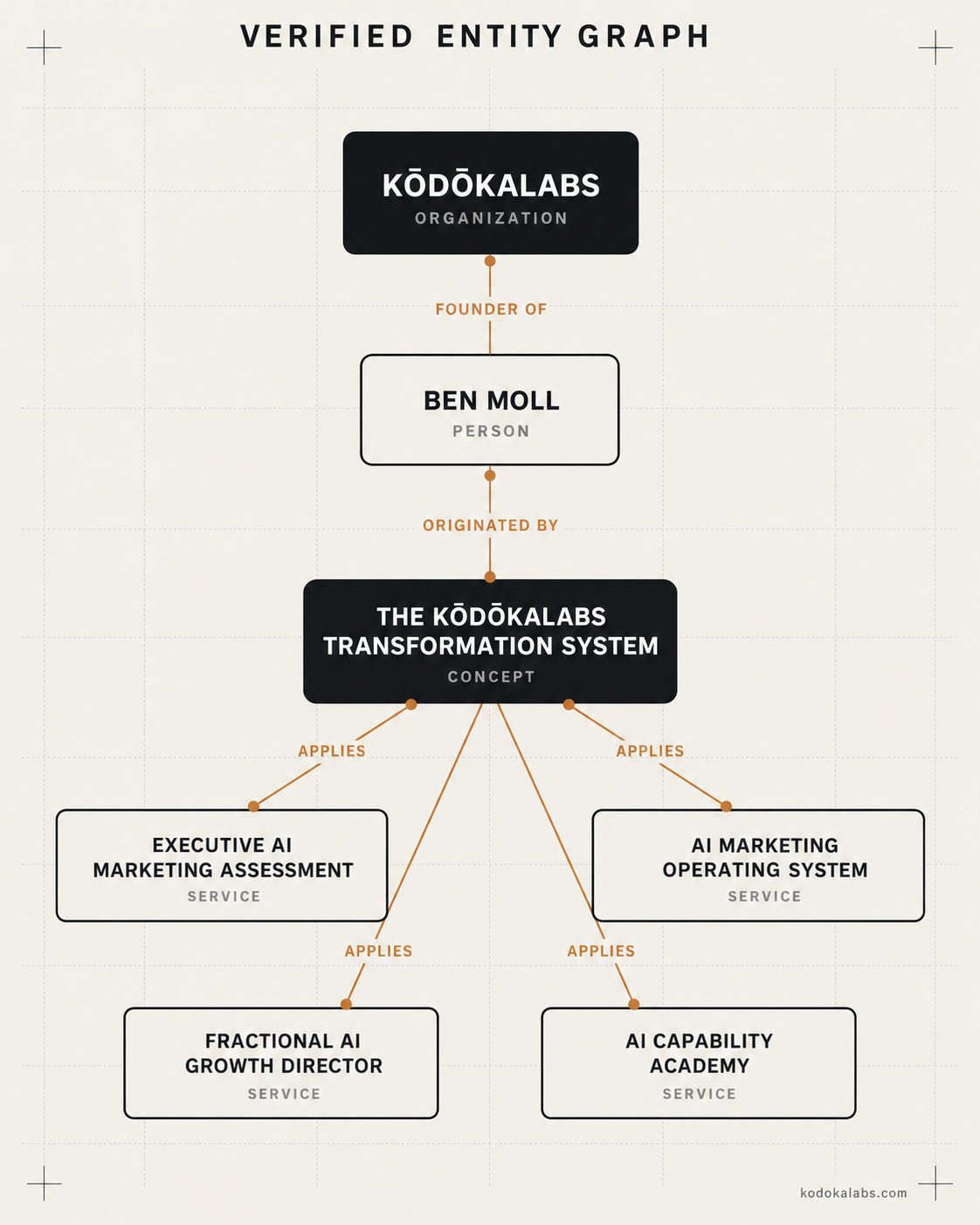
A useful marketing knowledge graph has a small number of essential components, regardless of the scale of implementation. Entities are the nodes: the people, organizations, products, services, and concepts the organization needs to track. Relationships are the edges: how entities connect to each other, such as “Ben Moll” being the “founder of” kōdōkalabs, or “The kōdōkalabs Transformation System” being “applied by” the AI Marketing Operating System solution. Each entity needs a canonical definition, a designated source-of-truth owner, and where relevant, a stable identifier that lets systems and people reference it unambiguously across many pages and data sources.
Two more components separate a useful graph from a fragile one: provenance and governance. Provenance means every non-obvious fact in the graph traces back to a source, whether that is an internal fact sheet, a verified external record, or a dated observation, so the graph’s claims can be checked and trusted rather than taken on faith. Governance means someone owns each entity’s accuracy over time, with a review trigger, such as a scheduled cadence or a defined event like a role change or a new product launch, that prompts a recheck rather than letting the record grow stale silently.
Minimum Viable Architecture
| Field | Purpose |
|---|---|
| Entity ID | A stable, unique reference for the entity, used consistently across records and, where implemented, structured data |
| Entity type | Organization, Person, Product, Service, or Concept, following the same typing used in Entity SEO |
| Canonical name | The one approved name or title used consistently everywhere |
| Canonical definition | The single approved description of what the entity is |
| Source of truth | The internal document or page designated as authoritative for this entity's facts |
| Relationships | A list of edges to other entities in the registry, with a defined relationship type (for example, "founder of," "applies," "originated by") |
| Evidence and provenance | Where each non-obvious fact comes from, internal or external |
| Owner | Who is accountable for keeping this entity's record accurate |
| Publication mappings | Which public pages and which schema properties this entity's record projects into |
| Review trigger | The scheduled cadence or defined event that prompts a recheck |
Build Sequence: Inventory, Model, Normalize, Connect, Expose, Govern
Inventory. List the entities the organization needs to track, drawing on the same process described in Entity SEO’s inventory step, but capturing it here as a structured registry rather than a prose list.
Model. Decide the relationship vocabulary: the defined set of relationship types the organization will use consistently, such as “founder of,” “originated by,” “applies,” or “offered by,” rather than inventing a new phrase for the same relationship type each time it appears.
Normalize. Resolve duplicate or inconsistent entries. It is common, at this stage, to discover the same entity has been described three different ways across old content; normalize to one canonical name and definition per entity.
Connect. Populate the relationship edges between entities, using the vocabulary established in the modeling step, and verify each relationship against a real source rather than assuming it.
Expose. Project the relevant, public-appropriate parts of the graph into the website’s semantic architecture, internal linking, and structured data, using the publication-mapping field from the entity registry to guide what goes where.
Govern. Assign review triggers and owners, and treat the graph as a living record that needs maintenance, not a one-time deliverable. This is the step most commonly skipped, and its absence is the most common reason knowledge graph initiatives quietly decay.
Search And AI Applications
Risks And Failure Modes
The most common failure mode is building a graph that nobody maintains: an initial inventory and modeling effort that is never revisited, so the registry drifts out of sync with reality within months. A second failure mode is scope creep, attempting to model every conceivable entity and relationship from the outset rather than starting with the minimum viable architecture and expanding deliberately. A third is conflating the three graph contexts described earlier, assuming internal work automatically creates external visibility, which leads to disappointment when a well-built internal graph does not, by itself, change how a search engine or AI platform represents the organization.
Sensitive and client-confidential data also needs explicit governance within any knowledge graph effort. Not every internal fact belongs in a registry that feeds public-facing structured data or content; the publication-mapping field in the minimum viable architecture above exists specifically to make that distinction deliberate, entity by entity, rather than leaving it to chance during implementation.
Measurement
Frequently Asked Questions
Do we need special graph database software to do this?
No. A Minimum Viable Marketing Knowledge Graph can be built and maintained in a structured spreadsheet or lightweight content model. Specialized graph technology becomes relevant at a scale and complexity most marketing organizations have not yet reached.
Does adding JSON-LD structured data to our pages create a knowledge graph entry with Google or another platform?
No. Structured data describes visible page content and can make a page eligible for certain platform features; it does not write to, or guarantee an entry in, any external platform's own internal knowledge system.
What is the difference between a taxonomy and this kind of graph?
A taxonomy is typically a hierarchical categorization scheme, categories and subcategories. A knowledge graph's relationships are not limited to hierarchy; entities can relate to each other in many different ways (founder of, applies, originated by), which a simple taxonomy does not capture.
How is this different from Entity SEO?
Entity SEO focuses on making individual entities clear, consistent, and corroborated, primarily for external search and AI systems. This guide covers the broader internal architecture, the registry and relationship structure, that entity work draws from and feeds into.
Where should we start?
With a small inventory of high-priority entities and the minimum viable architecture's field set, not with graph software or an enterprise-scale modeling exercise. Building a Knowledge Graph for AI Visibility covers the technical build phase once the internal registry exists: competency questions, identity, provenance, technology choice, and public projection.