
Semantic Content Architecture for Search, AI, and Human Navigation
What Semantic Content Architecture Is, And Why It Matters
Semantic content architecture is the deliberate design of how a website’s content is organized so that its structure itself communicates meaning: what a page is fundamentally about, how it relates to other pages, which page is the canonical authority on a given topic, and how a reader or a system should navigate from one piece of content to the next. It draws on information architecture, content modeling, internal linking, and structured data, but it is not reducible to any one of them alone, and it is not the same thing as topic clustering, which is a narrower editorial planning tactic.
The business value is practical rather than abstract. A well-architected site reduces content cannibalization, where multiple pages compete for the same topic and dilute each other’s authority. It makes canonical ownership unambiguous, so both editorial teams and machine systems know which page is the definitive source for a given subject. It supports consistent internal linking that expresses real relationships rather than mechanical link quotas. And it gives structured data something coherent to describe, since schema markup is only as good as the underlying content organization it reflects.
This guide covers page roles, hub and cornerstone and support-page relationships, taxonomy and an approachable treatment of ontology, URL hierarchy, breadcrumbs, canonical ownership, the semantic function of internal links, metadata, content types, cannibalization and duplication, change control, and migration. It does not duplicate the editorial production workflow covered in Content Operations, the internal knowledge-graph data architecture covered in Knowledge Graphs, or general technical SEO topics unrelated to content structure.
Architecture Layers
Semantic content architecture operates across six connected layers, each of which reinforces the others when designed deliberately.
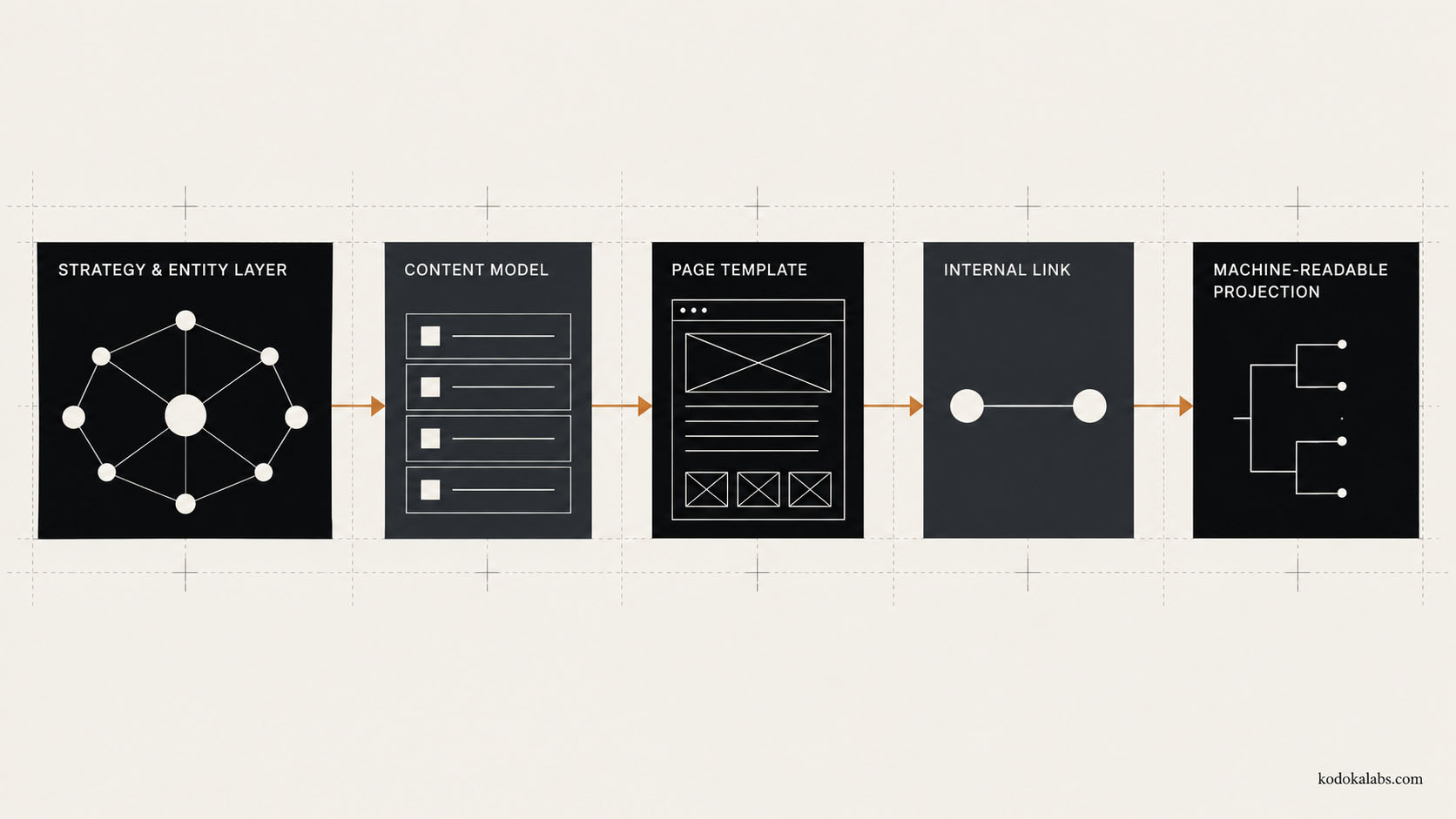
The site layer is the overall structure: how pillars, cornerstone guides, and supporting content relate to each other and to the rest of the site. The content model layer defines the types of content the site produces (pillar page, cornerstone guide, supporting article, solution page, methodology page) and what each type requires structurally. The page layer is an individual page’s own internal organization: its heading hierarchy, its scope statement, its role in the broader structure. The link layer is how pages connect to each other through internal links, expressing real relationships rather than arbitrary navigation. The metadata layer includes titles, descriptions, and other page-level signals that summarize a page’s role and content. The structured data layer is the machine-readable expression of the page’s role, entities, and relationships through schema markup.
These layers should be designed together, not sequentially bolted on. A page template (content model layer) that does not account for how it will link to related content (link layer) tends to produce inconsistent, ad hoc linking later, once the page volume grows too large to fix by hand.
Page Roles And Canonical Ownership
Every page on a well-architected site should have one clearly defined role, and every topic should have exactly one canonical page that owns it. kōdōkalabs uses three primary content roles across the Intelligence Hub: the pillar page, which introduces a broad capability area and links down to its cornerstone guides; the cornerstone guide, which owns a specific, well-defined topic in depth; and the supporting article, a narrower piece that supports a cornerstone guide without duplicating its scope.
| Page role | Purpose | Uniqueness test | Required links | Schema candidate |
|---|---|---|---|---|
| Pillar page | Introduce a broad capability area and organize its cornerstone guides | Is there exactly one page that serves as the entry point for this capability area? | Links down to every cornerstone guide in its cluster; linked from site navigation | WebPage or CreativeWork, describing the visible pillar page |
| Cornerstone guide | Own a specific, well-defined topic in depth, at both executive and practitioner altitude | Does this page have a distinct scope statement that does not overlap with any sibling guide's stated scope? | Links up to its parent pillar; links to at least two sibling guides; links to a relevant adjacent pillar or solution | Article, plus BreadcrumbList |
| Supporting article | Support a cornerstone guide with narrower, more specific coverage | Does this page exist because its parent cornerstone guide cannot cover this depth without exceeding scope? | Links up to its parent cornerstone guide; rarely needs sibling links of its own | Article, plus BreadcrumbList |
The Semantic Architecture Contract
Every page in a well-governed architecture should have an explicit contract defining its role, independent of the visible page copy. kōdōkalabs uses this to keep planning, CMS modeling, and QA aligned. The fields are: page role, primary entity, search or reader intent served, parent page, child pages (if any), sibling pages, canonical definition owned by this page, required relationships to other pages, schema candidate, conversion role, content owner, and lifecycle state (planned, drafted, published, or retired).
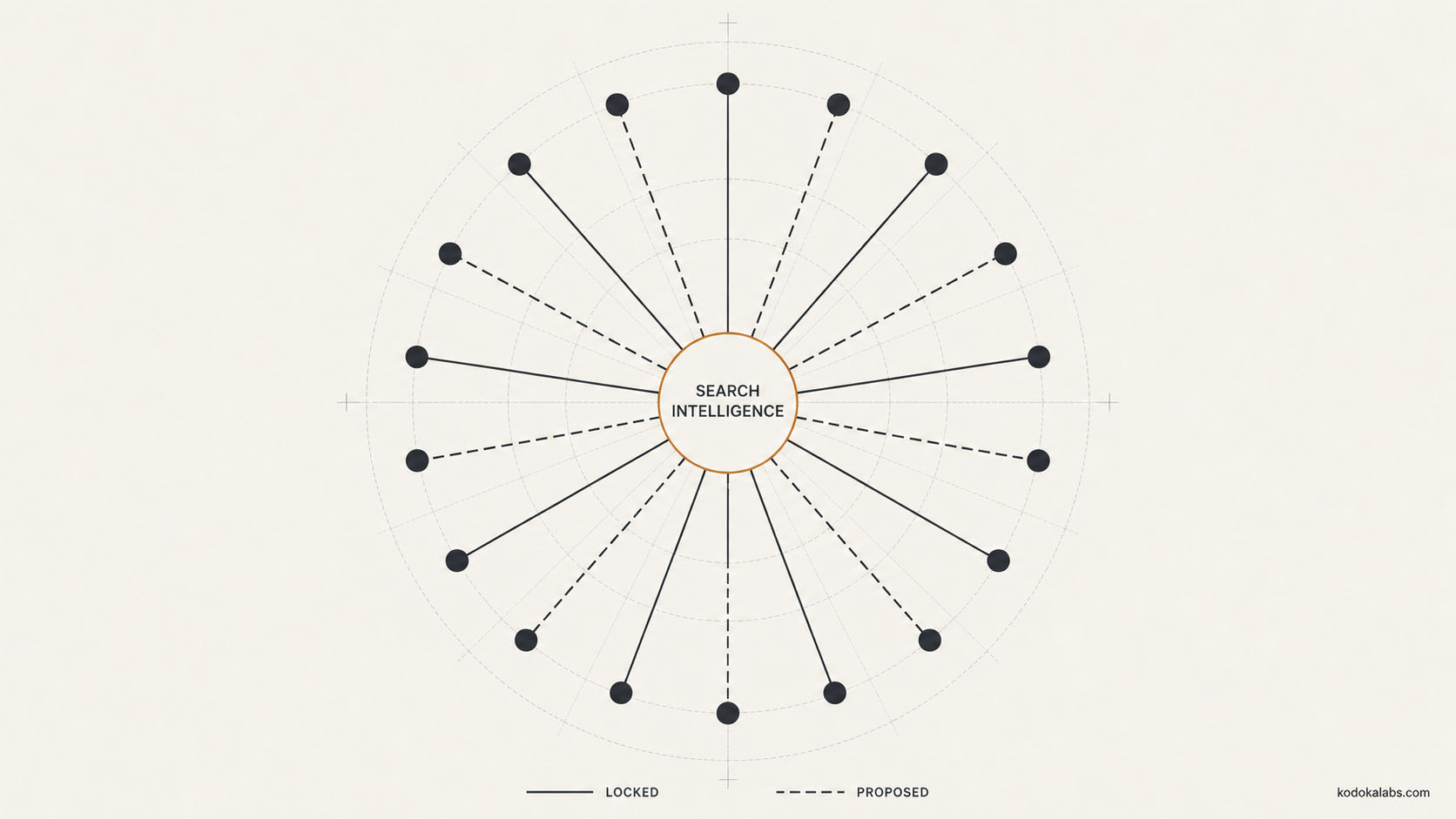
The Search Intelligence cluster itself, the eighteen cornerstone guides this pillar comprises, is the verified worked example. Its contract, as currently filed, looks like this for a representative sample of pages (the full eighteen follow the same pattern):
| Field | Purpose |
|---|---|
| Entity ID | A stable, unique reference for the entity, used consistently across records and, where implemented, structured data |
| Entity type | Organization, Person, Product, Service, or Concept, following the same typing used in Entity SEO |
| Canonical name | The one approved name or title used consistently everywhere |
| Canonical definition | The single approved description of what the entity is |
| Source of truth | The internal document or page designated as authoritative for this entity's facts |
| Relationships | A list of edges to other entities in the registry, with a defined relationship type (for example, "founder of," "applies," "originated by") |
| Evidence and provenance | Where each non-obvious fact comes from, internal or external |
| Owner | Who is accountable for keeping this entity's record accurate |
| Publication mappings | Which public pages and which schema properties this entity's record projects into |
| Review trigger | The scheduled cadence or defined event that prompts a recheck |
Internal-Link Architecture
Internal links are not a mechanical requirement to hit a quota; they are the visible expression of the relationships defined in the Semantic Architecture Contract. Every cornerstone guide in this cluster is expected to link to its parent pillar, to The kōdōkalabs Transformation System and its Build phase, to at least two sibling guides that form a genuine learning path, to an adjacent pillar or solution page where the relationship is substantive, and to the Executive AI Marketing Assessment as the default conversion path.
Anchor text should be descriptive and specific to the linked page’s actual content, not a repeated exact-match phrase used mechanically across many pages. A link from Entity SEO to Knowledge Graphs, for example, should describe what the reader will find there (“the formal data architecture for representing entities and relationships at scale”), not simply repeat “knowledge graphs” as a bare anchor every time. Reciprocal links, where two related guides link to each other, are expected where they genuinely help the reader move between a concept and its implementation companion, as established between several of this cluster’s paired strategy and practitioner guides.
CMS And Governance Implementation
Translating this architecture into a content management system means the content model layer needs to be reflected as actual page types or templates, not left as an informal convention different authors interpret differently. Each page type (pillar, cornerstone, supporting article) should have a defined template that prompts for the Semantic Architecture Contract fields, so an author cannot easily publish a page without deciding its role, parent, and required links.
Governance also needs an explicit change-control process. When a new cornerstone guide is added to a cluster, the parent pillar page’s outline and link structure need a corresponding update, and any pages whose scope might now overlap need a cannibalization check against the uniqueness test described earlier. Assign an owner for the overall architecture, not just for individual pages, so structural drift across the whole cluster is someone’s explicit responsibility.
Measurement
Measuring architecture quality is less about a single metric and more about auditing structural health directly: how many pages fail the uniqueness test against at least one sibling, how many pages lack a completed Semantic Architecture Contract, how consistent internal-link anchor text is for links to the same target page, and whether orphan pages, pages with no meaningful inbound internal links, exist anywhere in the cluster. These structural indicators are a leading signal; they should be reviewed alongside, not instead of, the visibility metrics covered in Search and AI Visibility Measurement.
Frequently Asked Questions
Does good architecture guarantee better rankings?
No. Architecture reduces cannibalization risk and improves clarity for both readers and machine systems, which supports visibility; it is not, on its own, a ranking guarantee, and should not be sold or understood as one.
Is this the same as topic clustering?
No. Topic clustering is a narrower editorial planning tactic, typically grouping related content around a pillar page. Semantic content architecture is the broader discipline covering page roles, taxonomy, linking, metadata, and structured data together, of which topic clustering is one visible expression.
How is this different from Knowledge Graphs?
Knowledge Graphs covers the internal entity and relationship data model. This guide covers how that understanding is expressed in the site's actual page structure, navigation, and linking. The two are connected, this architecture often draws on the same entity registry, but they are distinct disciplines with distinct outputs.
What do we do when two existing pages already compete for the same topic?
Apply the uniqueness test: decide which page should be canonical, consolidate or redirect the other, and update internal links across the site to point to the canonical page going forward.
How often should this architecture be reviewed?
Whenever a cluster expands (as with this batch), whenever a significant content audit is conducted, or on a recurring cadence appropriate to how quickly the organization's content volume is growing.
Where should we start if our site has no deliberate architecture today?
With an inventory of existing pages mapped against the page-role table above, identifying uniqueness-test failures first, since those represent the most immediate cannibalization risk.