
kōdōkalabs
We Build Your AI-Native Marketing Organization.
Our Promise
Helping mid-market B2B companies redesign marketing for the AI era.
Marketing teams have adopted AI. Marketing organizations have not.
Most companies now run AI tools somewhere inside marketing — a copywriting assistant here, an SEO tool there, a chatbot bolted onto the website. Almost none have redesigned how marketing actually operates: who owns what, how quality gets checked, how knowledge compounds instead of evaporating with each new hire or vendor. The tools changed. The organization didn’t.
kōdōkalabs exists to close that gap. We help executive teams diagnose where their marketing organization stands, architect an AI Marketing Operating System, and build the internal capability to run it. So AI becomes infrastructure, not an experiment that quietly stalls.
Executive Summary
kōdōkalabs is an AI marketing transformation partner for CEOs, CMOs, and revenue leaders at mid-market B2B companies. We don’t sell SEO, content, or automation as separate services. We rebuild the operating model underneath all three, using a six-phase framework called The kōdōkalabs Transformation System: Diagnose, Architect, Build, Enable, Measure, Scale.
Three things make this different from a typical agency or AI vendor relationship:
- We start with an assessment, not a proposal. Every engagement opens with an Executive AI Marketing Assessment that produces an honest maturity score using our AI Marketing Maturity Model, not a sales pitch dressed up as a roadmap.
- We build the operating system, then hand it over. Workflows, governance, documentation, and training are structured using our Capability Transfer Framework so the client team can run the system without kōdōkalabs standing over their shoulder indefinitely.
- We’re explicit about what AI does and what a human must do. Our Human + AI Execution Model defines, task by task, which parts of marketing execution are safe to automate and which require human judgment, so quality and brand risk are managed deliberately, not accidentally.
The rest of this page walks through why this shift is happening, why most agencies and most AI rollouts fail to deliver it, and how kōdōkalabs’ framework, solutions, and research fit together into one system.
Who this is for. kōdōkalabs works with CEOs, CMOs, Chief Growth Officers, VPs of Marketing, and Marketing or Revenue Operations Directors at mid-market B2B companies — organizations large enough that marketing decisions run through a small executive group and complex enough that “just buy another tool” has stopped working, but not so large that transformation requires a multi-year enterprise change program.
Who this isn’t for. If you’re looking for a retainer to produce a fixed volume of blog posts or social assets every month, or a single AI tool to bolt onto an unchanged process, kōdōkalabs is the wrong fit. That’s a vendor relationship, not a transformation — and we’d rather say so upfront than take the engagement.
The Industry Shift
Three forces are converging on marketing organizations at the same time, and most leadership teams are only tracking one of them.
Search is splitting in two. Traditional search engines still send traffic, but a growing share of research and purchase influence now happens inside AI answer engines — ChatGPT, Perplexity, Gemini, Copilot — that synthesize an answer instead of returning a list of links. Being “rankable” and being “citable” are no longer the same skill. A page can rank on Google and still never get pulled into an AI-generated answer, because LLMs select for entity clarity, structured data, and information density rather than backlink count alone.
AI tools are being adopted faster than workflows are being redesigned. Gartner, McKinsey, and MIT Sloan have each published research over the past two years pointing to the same pattern: individual AI tool adoption inside marketing teams is high, but organizational redesign — new roles, new governance, new measurement — lags far behind. The result is fragmented experimentation: five people using five different tools with five different quality standards, none of it documented, none of it compounding.
The agency model is misaligned with what companies actually need. Agencies are built to sell time and deliverables. AI collapses the cost of producing deliverables. What’s scarce now isn’t execution capacity — it’s the judgment to direct AI well, the governance to keep quality consistent, and the internal capability to keep improving after the vendor leaves. That’s a leadership and systems problem, not a staffing problem.
The economics of content production have shifted, and most budgets haven’t caught up. When a single operator with a well-governed AI workflow can produce what used to require a small team, the constraint moves from “how many people can we afford” to “how good is our system.” Companies still budgeting and staffing for the old constraint are paying enterprise prices for outputs that no longer require enterprise headcount — while companies that haven’t invested in a system at all are producing high volumes of low-differentiation content that neither ranks well nor gets cited by AI answer engines.
Put together: the channel is changing, the tooling is outpacing the org chart, the vendor relationship is optimized for the wrong scarcity, and the economics of production no longer match how most companies are staffed and budgeted. Companies that treat this as “which AI tools should we buy” are solving the smallest part of the problem.
Traditional Marketing vs. AI-Native Marketing
| Dimension | Traditional Marketing Org | AI-Native Marketing Org |
|---|---|---|
| Content Production | linear, single-author | agentic drafting + human review |
| Search Strategy | keyword-led SEO | entity- and answer-led GEO/SEO |
| Knowledge Management | tribal knowledge, lost on turnover | documented knowledge graph |
| Governance | ad hoc approvals | defined AI Governance Matrix |
| Measurement | channel-level vanity metrics | capability and velocity metrics |
| Vendor Relationship | retainer for deliverables | operating system + internal capability transfer |
| Scalability | linear cost with headcount | non-linear output per operator |
Why Agencies Fail At This
Agencies are structurally incentivized to keep clients dependent. Retainers are built around ongoing execution, not around making themselves unnecessary. That’s not a moral failing — it’s the business model. But it means three things consistently go wrong when a company hires a traditional agency to “do AI marketing”:
- Institutional knowledge stays with the agency, not the client. Prompts, workflows, and quality standards live in someone else’s process documentation, if they’re documented at all.
- Governance is inconsistent because it isn’t owned internally. Nobody on the client side can articulate what AI is and isn’t allowed to touch, so quality drifts engagement to engagement.
- Success is measured in deliverables, not capability. A quarterly content calendar full of published posts can coexist with a marketing organization that is no more capable than it was a year ago.
kōdōkalabs’ Capability Transfer Framework is a direct response to this: every engagement is structured so documentation, training, and governance ownership move to the client’s team on a defined timeline, not indefinitely. We measure our own success partly by how quickly a client stops needing us for a given workflow — a metric most agencies have no incentive to track, let alone publish.
That doesn’t mean kōdōkalabs disappears after the handoff. Fractional AI Growth Director engagements exist precisely because most organizations still want ongoing executive judgment on roadmap, governance, and vendor decisions even after their internal team owns day-to-day execution. The difference is that this ongoing relationship is a deliberate choice the client makes with full internal capability already in place, not a dependency built into the business model from day one.
Why AI Alone Fails Too
The opposite failure mode is just as common: companies buy AI tools directly and skip the agency relationship entirely, assuming the tooling will solve the organizational problem on its own. It doesn’t. The recurring symptoms look like this:
- Fragmented experimentation. Different teams and individuals pilot different tools with no shared standard, so nothing compounds across the organization. Six months later, the company has five subscriptions and no clearer sense of what “good” looks like than when it started.
- Inconsistent quality and voice. Without a defined Human + AI Execution Model, AI-generated content quality varies wildly depending on who’s prompting it and how carefully they review the output. One writer’s AI-assisted drafts read like a trusted analyst; another’s read like a press release generator, and there’s no shared standard to reconcile the two.
- Duplicated effort. The same research, the same prompts, the same briefs get rebuilt from scratch repeatedly because nothing is captured in a shared knowledge base. Every new hire and every new AI tool starts from zero instead of inheriting what the team already learned.
- No governance or risk ownership. Nobody has defined what AI is allowed to publish unsupervised versus what requires human sign-off, which becomes a brand and compliance exposure as usage scales. This is precisely the gap The AI Governance Matrix is designed to close inside an AI Marketing Operating System engagement.
- Limited measurable business impact. Leadership can point to tools purchased and hours theoretically saved, but struggles to connect AI adoption to pipeline, revenue, or measurable capability growth, because nobody defined what to measure before rolling the tools out.
AI tools are necessary but not sufficient. Without an operating system wrapped around them — workflows, governance, measurement, documented knowledge — AI adoption plateaus at “interesting experiment” and never reaches “core infrastructure.” That plateau is where most companies sit today, and it’s the specific problem the Executive AI Marketing Assessment is built to diagnose.
Business Outcomes
Organizations that complete a kōdōkalabs transformation engagement should expect measurable change across five dimensions, tracked from the AI Marketing Maturity Model baseline established in the Assessment phase:
- Execution velocity — time from brief to published, reviewed asset. A documented, governed workflow with clear human/AI handoffs typically compresses this cycle dramatically compared to an ad hoc process with no defined review path.
- Governance maturity — percentage of AI-assisted output following a defined, documented approval path, rather than depending on whichever individual happened to produce it that week.
- Content and search performance — traditional SEO visibility alongside GEO/LLM citation frequency, tracked as two related but distinct metrics rather than treating “ranking” as the only signal that matters.
- Internal capability — team members certified and independently operating the workflows built during the engagement, measured against the milestones defined in the Capability Transfer Framework.
- Cost per output — cost to produce a unit of qualified marketing output (a published guide, an optimized page, a campaign asset) before and after the engagement, isolating the effect of the operating system from headcount changes.

The kōdōkalabs Transformation System
Every kōdōkalabs engagement runs on the same six-phase framework. It’s the throughline connecting the Assessment, the Operating System build, ongoing fractional leadership, and capability training — each Solution below implements one or more phases, and every research pillar in our Intelligence Hub explains the capability behind a specific phase in depth.
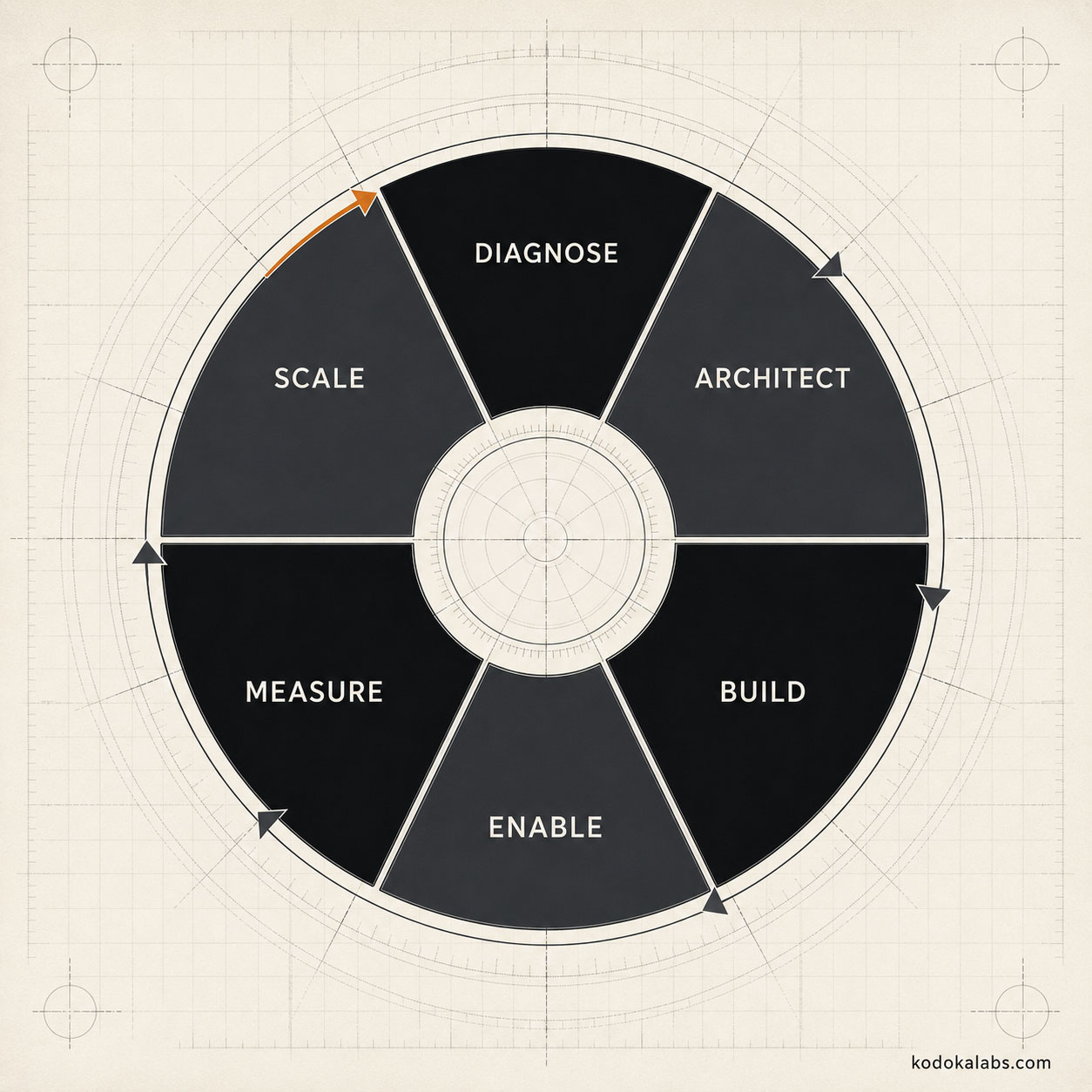
- Diagnose — Establish the current-state baseline using the AI Marketing Maturity Model: technology, workflows, content, search visibility, governance, and team capability, all scored against a common standard. This is the phase most companies skip, going straight to tool purchases without a documented starting point — which is exactly why maturity plateaus and nobody can prove progress later. Delivered primarily through the Executive AI Marketing Assessment.
- Architect — Design the target operating model: workflows, roles, governance structure, and technology stack, mapped to the organization’s specific goals rather than a generic template. Every design decision here is made explicit and documented, so the resulting system can be explained to a board, not just operated by the people who built it. Delivered primarily through the AI Marketing Operating System.
- Build — Implement the workflows, knowledge base, automation, and content engine designed in Architect, with the Human + AI Execution Model defining exactly where AI executes and where a human reviews or intervenes. Also delivered through the AI Marketing Operating System engagement.
- Enable — Train the client’s team to run the new system independently, using the Capability Transfer Framework: documentation, certification, and hands-on workflow ownership, with a defined date by which kōdōkalabs steps back from day-to-day execution. Delivered primarily through the AI Capability Academy.
- Measure — Establish ongoing measurement against the five business outcomes above, with a regular reporting cadence tied to the maturity baseline set in Diagnose, so progress is provable rather than anecdotal. Delivered primarily through the Fractional AI Growth Director engagement.
- Scale — Extend what’s working to new channels, teams, or markets, and feed newly discovered capability gaps back into Diagnose, closing the loop rather than treating transformation as a one-time project with an end date. Also delivered through the Fractional AI Growth Director engagement.
Each phase has its own defined objectives, inputs, outputs, deliverables, KPIs, stakeholders, and risk profile — along with an explicit answer to “what does AI do here, and what requires a human” — detailed in full on the Framework page.
Solutions
kōdōkalabs offers four solutions, not twenty services. Each implements specific phases of The kōdōkalabs Transformation System above.
| Solution | Framework Phase(s) | Primary Deliverable | Best For |
|---|---|---|---|
| Executive AI Marketing Assessment | Diagnose | A structured diagnostic covering AI readiness, workflow, content, search, technology, and governance, delivered as an executive presentation with a prioritized roadmap. Useful on its own, and the required starting point for every other engagement. | The entry point, for organizations that know AI matters but don’t know where to start. |
| AI Marketing Operating System | Architect, Build | Built on the premise that marketing isn’t broken — its operating model is. Includes workflow design, a shared knowledge base, automation, governance, a content engine, measurement infrastructure, training, and full documentation, so the system survives team turnover instead of walking out the door with whoever built it. | The core implementation offer and kōdōkalabs’ primary engagement. |
| Fractional AI Growth Director | Measure, Scale | Ongoing executive marketing leadership delivered fractionally: advisory, roadmaps, quarterly planning, vendor management, governance oversight, and board reporting, without the cost or hiring risk of a full-time executive. | For companies that have decided they don’t need another agency; they need executive leadership. |
| AI Capability Academy | Enable | Structured training and certification programs — executive training, marketing team training, prompt engineering, workflow design, governance — so the client team can run the operating system independently, backed by playbooks, templates, a prompt library, and operating manuals. | The clearest differentiator from a traditional agency model, built on the premise that every engagement should make the client stronger, not more dependent. |
Research And Thought Leadership
Frequently Asked Questions (FAQ)
Is kōdōkalabs an agency?
Will AI replace our marketing team?
What's the difference between the Executive AI Marketing Assessment and a free AI audit?
How long does a full transformation engagement take?
Do you work with companies outside B2B?
What happens after the Capability Transfer Framework handoff — do you disappear?
How is this different from hiring an in-house AI marketing lead?
The Latest News and Updates
From the kōdōkalabs
Intelligence Hub






Book An
Assessment
The fastest way to find out where your marketing organization stands is a structured assessment, not a sales call.
In a 90-minute Executive AI Marketing Assessment, we evaluate current maturity, technology, processes, team, content, search, and governance against the AI Marketing Maturity Model, and leave you with a prioritized roadmap — whether or not you engage kōdōkalabs further.