
The
kōdōkalabs
Agentic Drafting for Governed AI Marketing Workflows
Agentic Drafting: Governed AI-Assisted Marketing Execution
Executive Summary
Agentic Drafting exists because unstructured use of generative AI tends to combine research, reasoning, writing, editing, and approval inside a single prompt and a single opaque output — which makes it genuinely difficult to identify where a source gap occurred, evaluate any specific decision the process made, reproduce the process later, or assign accountability when something goes wrong. Agentic Drafting is kōdōkalabs’ answer: controlled task decomposition, where each stage of the work — from resolving sources to final human approval — is a discrete, observable task with defined inputs, outputs, permissions, and a named human owner. This page covers the seven task groups, how Agent Contracts constrain what each AI-assisted task is permitted to do, how the Claim Register keeps every factual assertion traceable to a source, and how failures are handled and escalated rather than silently absorbed.
Key Takeaways
- Agentic describes workflow decomposition and orchestration — not autonomous publication or independent accountability. A named human remains accountable throughout.
- Adding more AI agents to a workflow does not, by itself, improve output quality; only explicit tasks, evidence, and human review gates do.
- Seven task groups structure the work from source resolution through human approval for Pilot Review.
- Every AI-assisted task operates under an Agent Contract defining its permitted inputs, tools, outputs, and failure behavior.
- The Claim Register makes every factual assertion in a draft traceable to a specific, checkable source.
What Is Agentic Drafting?
Agentic Drafting takes an approved Strategic Architecture specification and executes it through a sequence of discrete tasks — resolving sources, extracting evidence, planning structure, generating drafts, checking that evidence supports what’s been written, reviewing for editorial and framework compliance, and routing to human approval — rather than asking a single AI system to perform all of that inside one undifferentiated prompt. Breaking the work into separately observable tasks is what makes the process auditable: each task has its own inputs, outputs, and evidence trail, so a reviewer can identify precisely which stage produced a specific claim or decision.
What "Agentic" Does and Does Not Mean
“Agentic” in kōdōkalabs’ usage describes how a workflow is decomposed into discrete tasks and how those tasks are orchestrated — it does not mean the workflow publishes autonomously, and it does not mean accountability shifts away from a named human. Every Agentic Drafting workflow terminates in human approval before anything moves toward publication. This distinction matters because “agentic AI” is sometimes marketed as if autonomy were the point — as if the goal were fewer humans in the loop. kōdōkalabs’ use of the term describes the opposite emphasis: more structure, more visibility, and a human still firmly in the loop at the point that matters most.
It’s worth naming this plainly because the term “agentic” has accumulated a fair amount of marketing gloss across the industry, often implying a system that can be trusted to operate independently once configured. kōdōkalabs’ delivery work does use multiple AI-assisted tasks operating in sequence, and in that narrow technical sense the workflow is agentic — but the design goal throughout is observability and accountability, not reduced human involvement. A client evaluating whether “agentic” work is safe to rely on should be asking about the task decomposition, the Agent Contracts, and the human approval gate, not about how autonomous the system sounds in a sales conversation.
Inputs Required from Strategic Architecture
The Seven Agentic Drafting Task Groups
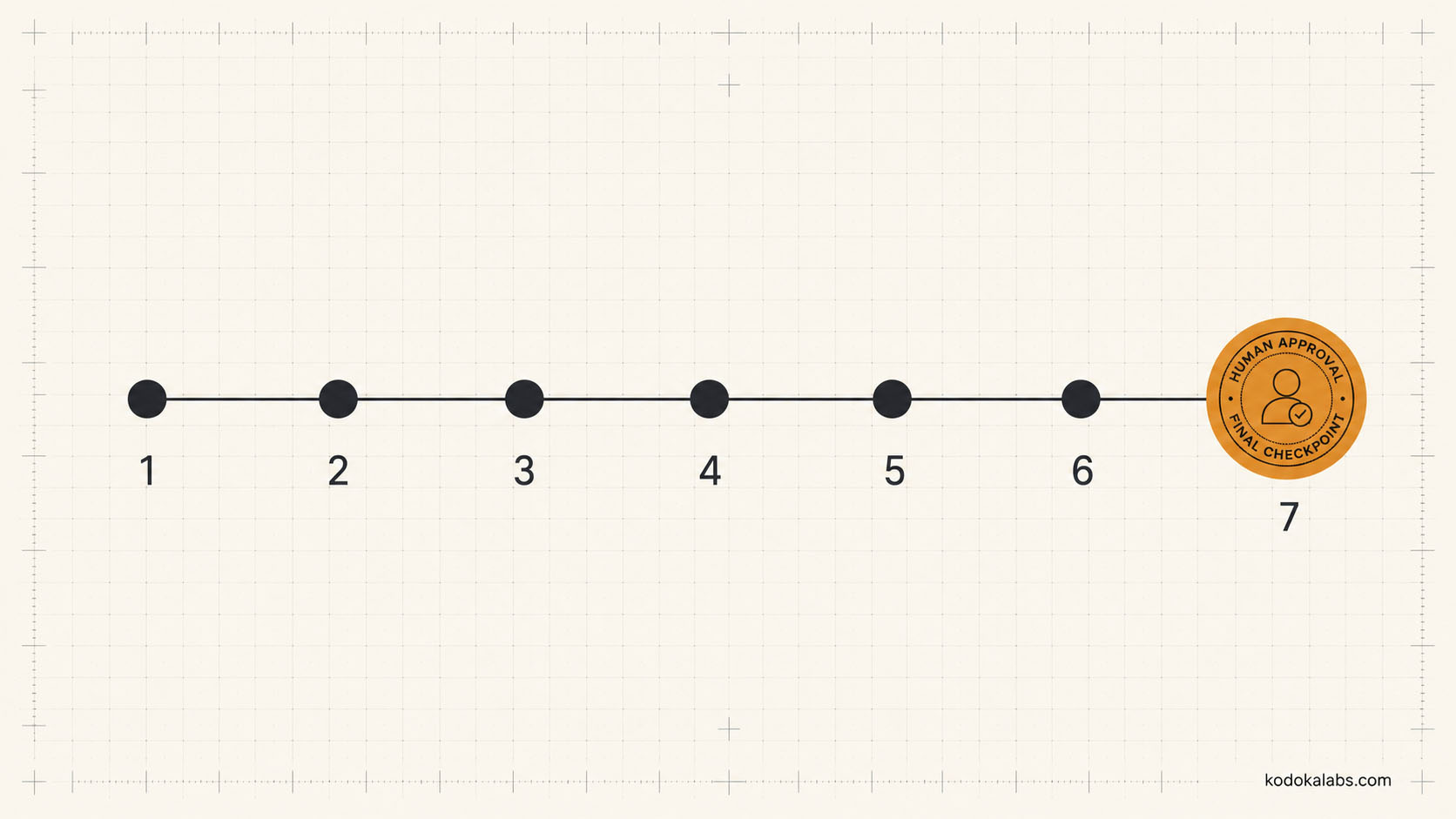
kōdōkalabs’ Agentic Drafting Work Package structures execution into seven task groups.
| # | Task Group | What It Produces |
|---|---|---|
| 1 | Source resolution | Sources retrieved per the approved Source Resolution Plan |
| 2 | Evidence extraction and claim register | Extracted facts logged in the Claim Register with source and confidence |
| 3 | Section or workflow planning | A structured plan for the output, following the specification |
| 4 | Draft generation | The working draft, produced against the plan and available evidence |
| 5 | Evidence and contradiction checking | Verification that claims in the draft match the Claim Register and don’t contradict each other |
| 6 | Editorial and framework compliance review | Check against brand, editorial, and canonical framework naming standards |
| 7 | Human approval for Pilot Review | Named human sign-off before the draft moves to Pilot Review |
Each task group is deliberately narrow in scope, which is what makes it possible to audit: a reviewer examining task group 2 can check whether extracted claims are properly sourced without needing to also evaluate whether the final draft’s tone matches brand guidelines, because that’s a separate, later task.
How Agent Contracts Control Work
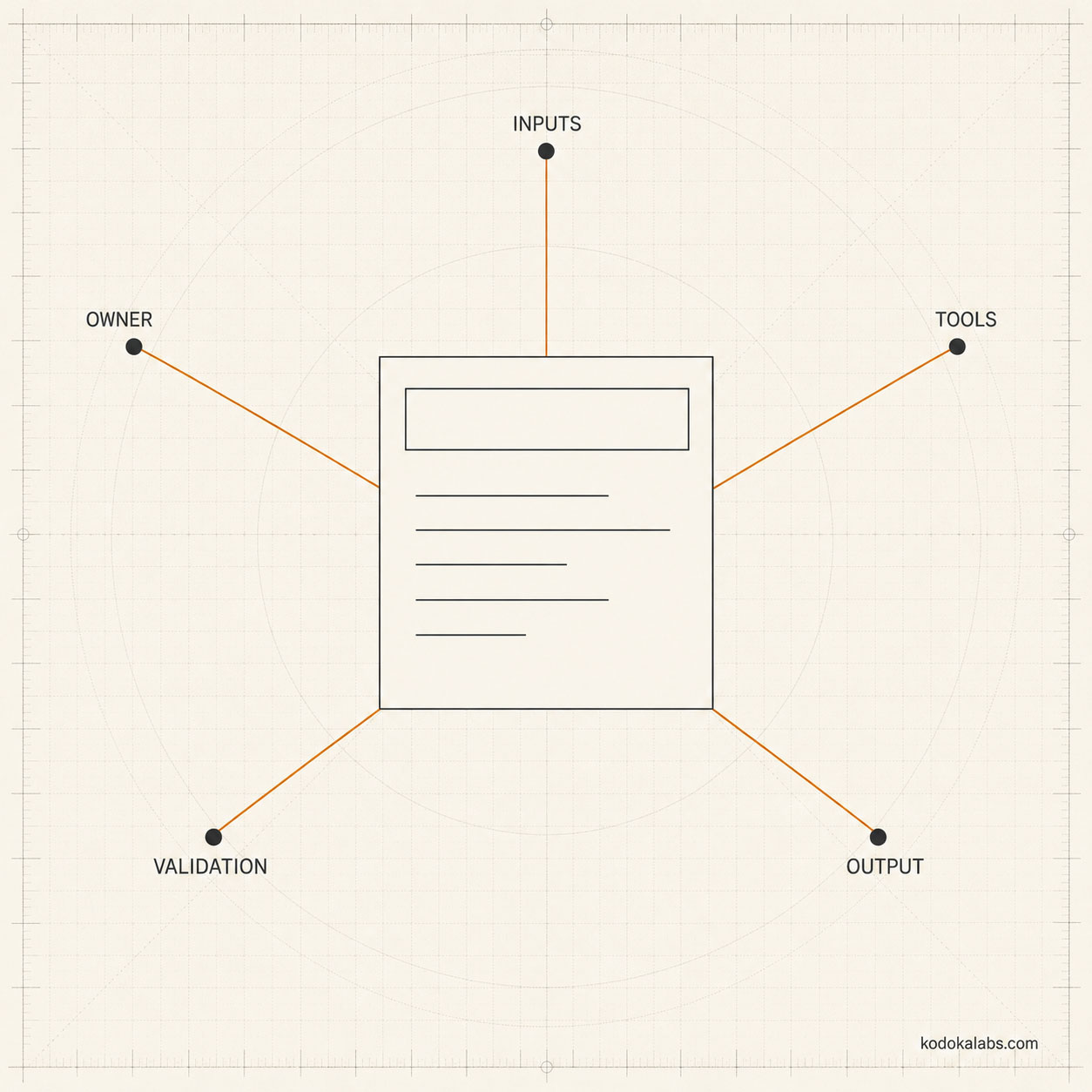
Every automated or AI-assisted task in the workflow operates under an Agent Contract – a defined set of constraints governing exactly what that task is permitted to do.
| Contract Field | What It Specifies |
|---|---|
| Purpose | What this specific task is for |
| Permitted inputs | What data or sources the task may use |
| Prohibited inputs | What the task is explicitly not permitted to use |
| Tools and permissions | Which tools or systems the task may access, and with what permissions |
| Required sources | What sourcing standard applies to this task’s output |
| Output schema | The defined structure the task’s output must follow |
| Validation rules | How the output is checked before being accepted |
| Confidence/uncertainty field | How the task communicates its own confidence, including where evidence is thin |
| Failure/escalation behavior | What happens when the task can’t complete successfully |
| Human owner | The named individual accountable for this task’s output |
| Logging/retention requirements | What gets recorded and how long it’s kept |
Agent Contracts are what make it possible to reason about what a given task can and can’t do without needing to inspect a model’s internal reasoning directly – kōdōkalabs does not claim to audit a model’s private chain-of-thought, and this page makes no such claim. What gets audited instead is observable: inputs, outputs, permitted tool calls, citations, the transformations applied at each stage, the decisions recorded, and the approval records themselves.
Source Grounding and the Claim Register
Every factual claim that appears in an Agentic Drafting output is logged in a Claim Register: the claim itself, its source, the source’s class (per the Source Resolution Plan’s hierarchy), a quotation or evidence note supporting it, the date it was retrieved, its scope of applicability, a confidence rating, any known limitations, its approval status, and where it appears in the draft. This register is what lets a reviewer trace any specific sentence in a draft back to the evidence that supports it, rather than trusting that the drafting process handled sourcing correctly somewhere upstream and out of view.
Human Accountability and Approval Gates
Task group seven – human approval – is not a formality appended at the end of the process; it’s the point where a named individual reviews the completed Claim Register, the editorial and framework compliance check, and the draft itself, and takes accountability for it moving forward to Pilot Review. No draft produced through Agentic Drafting is treated as final, publishable, or self-certifying — a human decision, made by a specific accountable person, is required at this gate regardless of how confident the AI-assisted stages appeared to be.
Failure Handling and Escalation
Agentic Drafting is designed to fail visibly rather than silently. Defined failure and escalation behavior covers several specific situations.
| Failure Type | Escalation Behavior |
|---|---|
| Missing sources | Task flags the gap in the Claim Register rather than proceeding on an unsupported claim |
| Conflicting evidence | Task surfaces the contradiction for human resolution rather than silently picking one version |
| Tool failure | Task halts and escalates rather than substituting an unverified workaround |
| Low-confidence output | Task’s confidence field flags the output for closer human review |
| Policy conflict | Task escalates to the governance reviewer defined in the applicable Agent Contract |
| Data sensitivity concern | Task halts if input data appears to exceed its permitted classification |
| Prompt injection attempt | Task treats unexpected embedded instructions in source material as untrusted, not as new instructions to follow |
| Unexpected output format | Task flags the deviation rather than forcing it into the expected schema silently |
Logging, Reproducibility, and Version Control
Data, Privacy, Security, and Intellectual Property
Agentic Drafting Outputs
Common Agentic Drafting Failure Modes
- Single-pass generation presented as agentic – one undifferentiated prompt producing a full draft, relabeled as “agentic” without any actual task decomposition.
- Fabricated sources – claims presented as sourced when no corresponding entry exists in the Claim Register.
- An agent reviewing its own unsupported output – treating a model’s self-assessment of its own draft as equivalent to independent evidence checking.
- Excessive orchestration – adding more agents or stages than the work actually requires, increasing complexity without improving quality.
- Hidden permissions – a task operating with broader tool access or data access than its Agent Contract discloses.
- Model lock-in – a workflow so tightly coupled to one specific model’s quirks that it can’t be verified or reproduced independently of that model.
- No human owner – a task group with no named individual accountable for its output.
- Treating the draft as final – skipping or rubber-stamping the human approval gate rather than genuinely reviewing the completed work.
From Agentic Drafting to Pilot Review
Once a draft clears its human approval gate, it moves to Pilot Review – kōdōkalabs’ method for validating a completed draft against real-world conditions before it’s treated as a repeatable, scalable workflow output.
Frequently Asked Questions (FAQ)
How does kōdōkalabs use AI to draft marketing content responsibly, with human oversight?
Through Agentic Drafting — a seven-task-group method that decomposes AI-assisted work into source resolution, evidence extraction, planning, drafting, evidence checking, editorial review, and mandatory human approval, with each task constrained by an explicit Agent Contract.
What does "agentic" actually mean in this context?
Workflow decomposition and orchestration into discrete, observable tasks — not autonomous publication and not a shift of accountability away from a named human.
Does adding more AI agents improve output quality?
Not by itself. Quality comes from explicit tasks, evidence requirements, and human review gates — not from the number of agents involved.
What are the seven task groups?
Source resolution, evidence extraction and claim register, section or workflow planning, draft generation, evidence and contradiction checking, editorial and framework compliance review, and human approval for Pilot Review. See the table above.
What is an Agent Contract?
A defined set of constraints for each AI-assisted task — its purpose, permitted and prohibited inputs, tool permissions, required sources, output schema, validation rules, confidence field, failure behavior, human owner, and logging requirements.
Can kōdōkalabs audit a model's internal reasoning?
No, and this page makes no such claim. What's audited is observable evidence — inputs, outputs, permitted tool calls, citations, transformations, decisions, and approval records — not a model's private chain-of-thought.
What is the Claim Register?
A log of every factual claim in a draft, along with its source, source class, supporting evidence, confidence, limitations, approval status, and location — making every claim traceable.
How are failures and disagreements handled?
Through defined escalation behavior per failure type — missing sources, conflicting evidence, tool failure, low confidence, policy conflict, data sensitivity, prompt injection, and unexpected format all have specific, visible escalation paths rather than being silently absorbed.
Is a draft produced through Agentic Drafting ready to publish?
No. It's routed to Pilot Review, kōdōkalabs' method for validating a draft against real-world conditions before it's treated as a repeatable output.
How does Agentic Drafting connect to Strategic Architecture?
It executes against a completed, approved Strategic Architecture specification — the twelve-field specification, Assumption Register, and Source Resolution Plan are its direct inputs.