
kōdōkalabs
AI Marketing Enablement and Capability Transfer
Enable: Build Internal AI Marketing Capability and Ownership
Executive Summary
Key Takeaways
- Capability is demonstrated through governed performance, not attendance or tool familiarity.
- The Capability Transfer Ladder has five levels, from Understand through Improve and teach – progression is role- and workflow-specific.
- Different roles need different depths of capability, mapped explicitly rather than delivered as one generic curriculum.
- Documentation and performance support materials are what make capability durable beyond the training moment.
- Ownership transfer is a formal, recorded event with specific acceptance criteria, not an informal sense that the team seems comfortable now.
What Is the Enable Phase?
Why AI Tool Training Does Not Create Operational Capability
The Capability Transfer Ladder
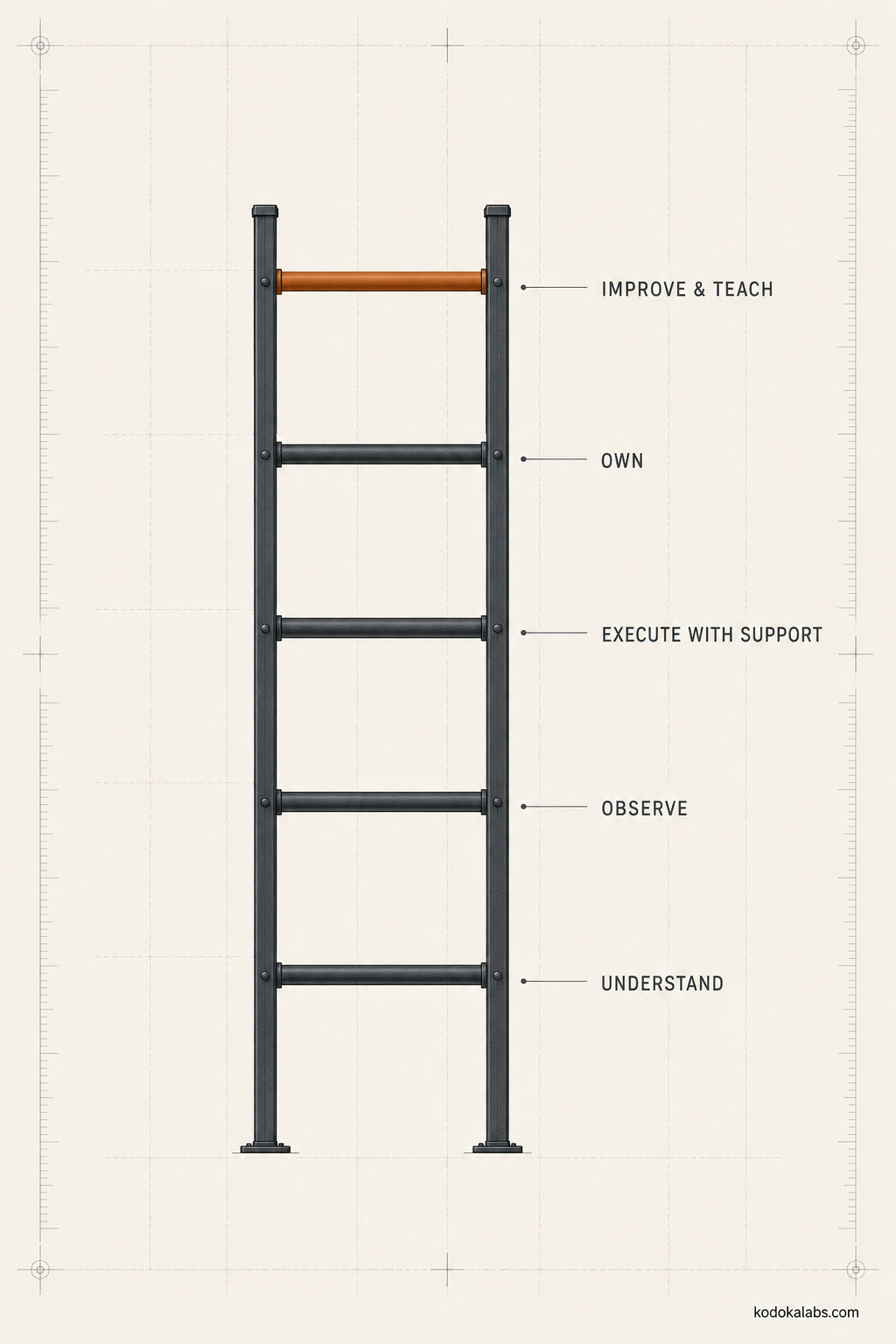
kōdōkalabs’ Capability Transfer Ladder defines five levels of capability, applied per role and per workflow — progression on one workflow doesn’t automatically transfer to another, and this isn’t presented as an accredited certification unless an actual approved certification programme and assessment standard exists.
- Understand – explain the workflow’s purpose, boundaries, risk, and expected value, without yet operating it.
- Observe – follow the workflow in action and recognize its key decisions and controls as they happen.
- Execute with support – operate defined tasks within the workflow under supervision, with a more experienced reviewer available.
- Own – run the workflow independently: execute, review, document, and resolve normal exceptions without supervision.
- Improve and teach – evaluate the workflow’s performance, propose and implement improvements within approved governance, and enable others to reach the levels below.
Most roles don’t need to reach level five on every workflow they touch — the Role-Based Capability Matrix below maps which level each role actually needs.
Progression up the ladder is deliberately sequential. Someone can’t meaningfully skip from Observe to Own — attempting that shortcut is precisely how organizations end up with practitioners who can run the workflow when nothing unexpected happens and freeze, guess, or improvise unsafely the first time it does. Each level also has its own evidence requirement: Understand is verified through explanation, Observe through the practitioner correctly identifying what’s happening and why during a live run, Execute with support through supervised task completion with a reviewer present, Own through unsupervised handling of both routine work and realistic exceptions, and Improve and teach through a practitioner actually proposing and implementing a change within governance, or successfully bringing a colleague up the ladder themselves. A workflow owner who has only ever watched the workflow run, however many times, has not reached Observe in any meaningful sense until they can correctly narrate the decisions being made — passive exposure and demonstrated recognition are not interchangeable.
Role-Based AI Marketing Enablement
Different roles require meaningfully different depths and kinds of capability, mapped through kōdōkalabs’ Role-Based Capability Matrix:
| Role | Typical Target Level | Focus |
|---|---|---|
| Executive sponsor | Understand | Purpose, risk, value, and accountability structure |
| Business owner | Understand to Observe | How the workflow serves the business outcome |
| Workflow owner | Own | Full independent operation and exception handling |
| Practitioner | Execute with support to Own | Day-to-day operation within defined tasks |
| Subject-matter reviewer | Own | Quality and factual review within their domain |
| Technical owner | Own | System configuration, integration, and troubleshooting |
| Governance reviewer | Own | Risk classification and compliance review |
| Internal champion or trainer | Improve and teach | Enabling others and evolving the workflow over time |
Learning Through Real Workflows
Governance and Risk Literacy
Every role touching an AI-assisted workflow needs to understand the governance rules that apply to it – not governance in the abstract, but the specific risk classification, review requirements, and escalation path for the workflow they’re actually operating. This connects directly to the Marketing AI Governance Control Stack established during Architect and implemented during Build – Enable is where that governance structure becomes something the operating team actually understands and applies day to day, rather than a document referenced only when something goes wrong.
Governance literacy is role-specific in the same way operational capability is. A practitioner needs to recognize which of their outputs require human review before publication, understand the boundaries of what the workflow is and isn’t approved to do, and know when a situation falls outside those boundaries and needs escalation. A governance reviewer needs a deeper understanding: the classification logic behind why a given workflow carries the risk level it does, what evidence a review decision needs to be defensible, and how to document a review so it holds up under later scrutiny. An executive sponsor needs enough literacy to ask informed questions in a governance review and recognize red flags, without necessarily needing to perform reviews themselves. Treating governance literacy as a single fixed briefing for everyone, rather than tailoring depth to role, tends to leave the people who most need deep governance fluency under-prepared while over-training people who only need situational awareness.
Documentation and Performance Support
How Capability Is Assessed
Internal Champions and Train-the-Trainer
Ownership Transfer and Handover
Enable Outputs and Exit Criteria
Common Enablement Failure Modes
- Tool demonstrations mistaken for enablement – delivering a walkthrough of what a tool does and calling it capability transfer.
- Generic curricula – the same training content delivered to every role regardless of what that role actually needs to be able to do.
- Attendance treated as competence – assuming someone who sat through training can now operate the workflow, without any observed-performance verification.
- No workflow access during training – teaching concepts without giving practitioners hands-on access to the actual system they’ll be operating.
- No manager reinforcement – enablement that isn’t reinforced by the practitioner’s own manager tends to decay quickly once the formal training period ends.
- Missing documentation – capability that exists only in trained individuals’ heads, with no durable record to support them or train their eventual replacement.
- Dependence presented as support – an ongoing arrangement where the implementer continues doing the actual work while calling it “ongoing enablement support,” rather than genuinely transferring operation to the client team.
From Enable to Measure
Enable hands Measure a capable, accountable operating team and a completed Ownership Transfer Record — the baseline against which Measure evaluates not just workflow performance but adoption and capability specifically, one of the seven dimensions in the AI Marketing Value Scorecard.