
kōdōkalabs
Scale AI Marketing Workflows Across Teams and Markets
Scale: Extend Proven AI Marketing Capability
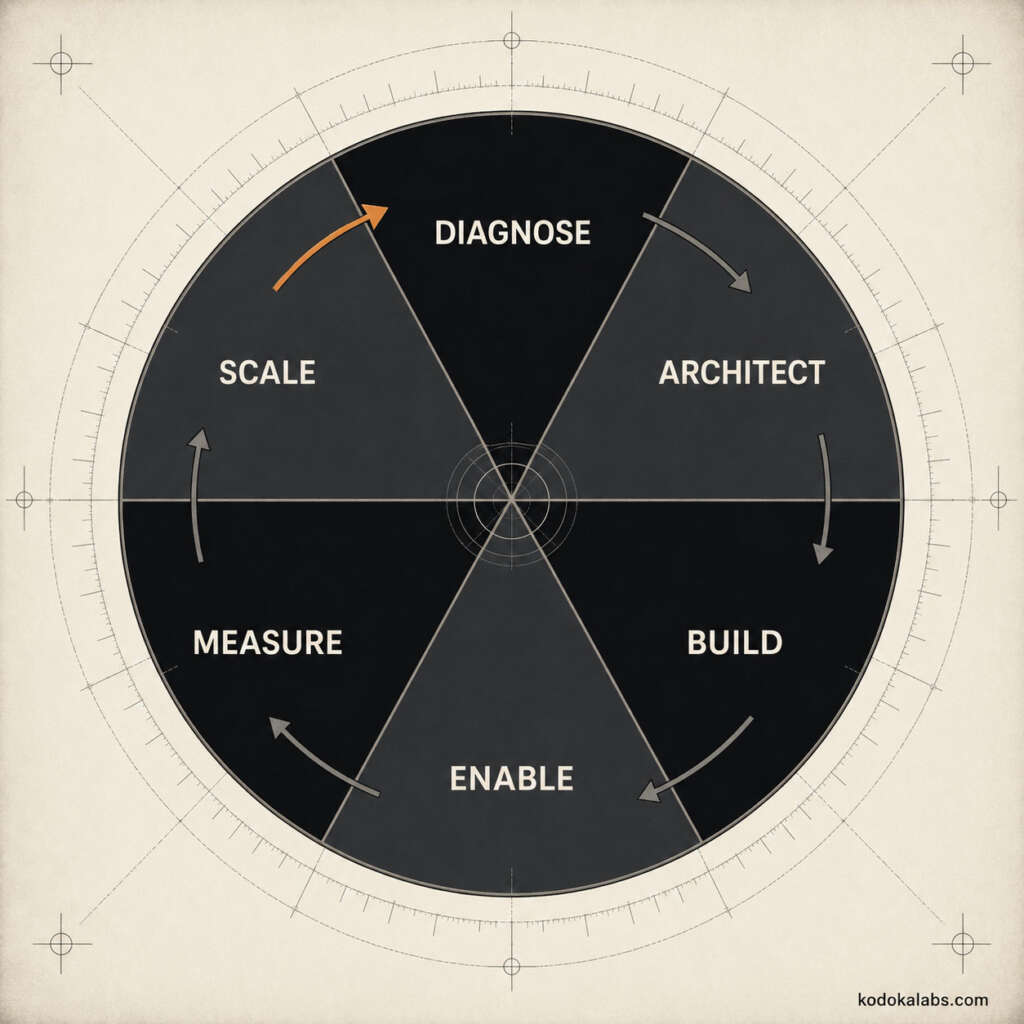
Scale is the sixth phase of The kōdōkalabs Transformation System, with a feedback loop back to Diagnose. It extends measured, governed, and internally owned workflows to new contexts while preserving decision rights, quality controls, evidence, documentation, and local adaptation.
Executive Summary
Scale exists because a workflow that performs well for one team, in one market, on one set of inputs, doesn’t automatically perform the same way anywhere else — and organizations that scale on enthusiasm rather than evidence tend to discover the gap only after it has caused a quality, compliance, or reputational problem in a new context. Scale, in kōdōkalabs’ model, should multiply proven capability, not copy local configuration blindly: it requires explicit evidence thresholds, reusable components, a genuine local-context assessment, capacity planning, governance that travels with the workflow, enablement for the new context’s team, and a feedback loop that returns newly discovered gaps to a fresh Diagnose cycle rather than letting them accumulate unaddressed. This page covers the seven-area Scale Readiness Gate, the Replicate/Adapt/Redesign decision model, what changes when scaling across teams, channels, and markets, and the governance and capacity planning scaling requires.
Key Takeaways
- Scale is a controlled replication and adaptation decision based on Measure’s evidence – not a synonym for increasing output or adding tools.
- The Scale Readiness Gate requires evidence across seven areas before a workflow is extended to a new context.
- Not every workflow should be replicated as-is – Replicate, Adapt, or Redesign is a deliberate decision, not a default.
- Scaling across markets and languages requires genuine local assessment; no universal claim about what works everywhere is safe to make.
- Scale includes a feedback loop back to Diagnose – new contexts surface new gaps, and that’s expected, not a sign of failure.
What Is the Scale Phase?
Why More Output Is Not the Same as Scale
It’s tempting to treat “scale” as shorthand for producing more, faster, or connecting the workflow to more tools and channels – but volume growth without governance, quality control, and genuine local fit isn’t scaling a proven capability; it’s propagating an unvalidated assumption more widely, and it fails in ways that are harder to see because the new failures are distributed across more teams and contexts than the original pilot ever touched. Real scale means the new context receives the same rigor the first context earned, not a lighter-touch copy of it.
This distinction matters most at the moment an early pilot succeeds, because that’s exactly when the pressure to move fast is highest. A pilot that performed well tends to generate enthusiasm – stakeholders want the same result everywhere, quickly – and that enthusiasm is precisely what makes it tempting to skip the evidence-gathering, local assessment, and governance work Scale requires. Treating a pilot’s success as permission to connect the same tool to five more teams’ workflows overnight, without checking whether those teams’ inputs, risk profiles, or systems actually resemble the pilot’s, tends to produce a scaled failure rather than a scaled success – and because it now touches more teams, the failure is both more visible and more expensive to unwind than the original pilot problem would have been.
Evidence Required Before Scaling
The Scale Readiness Gate
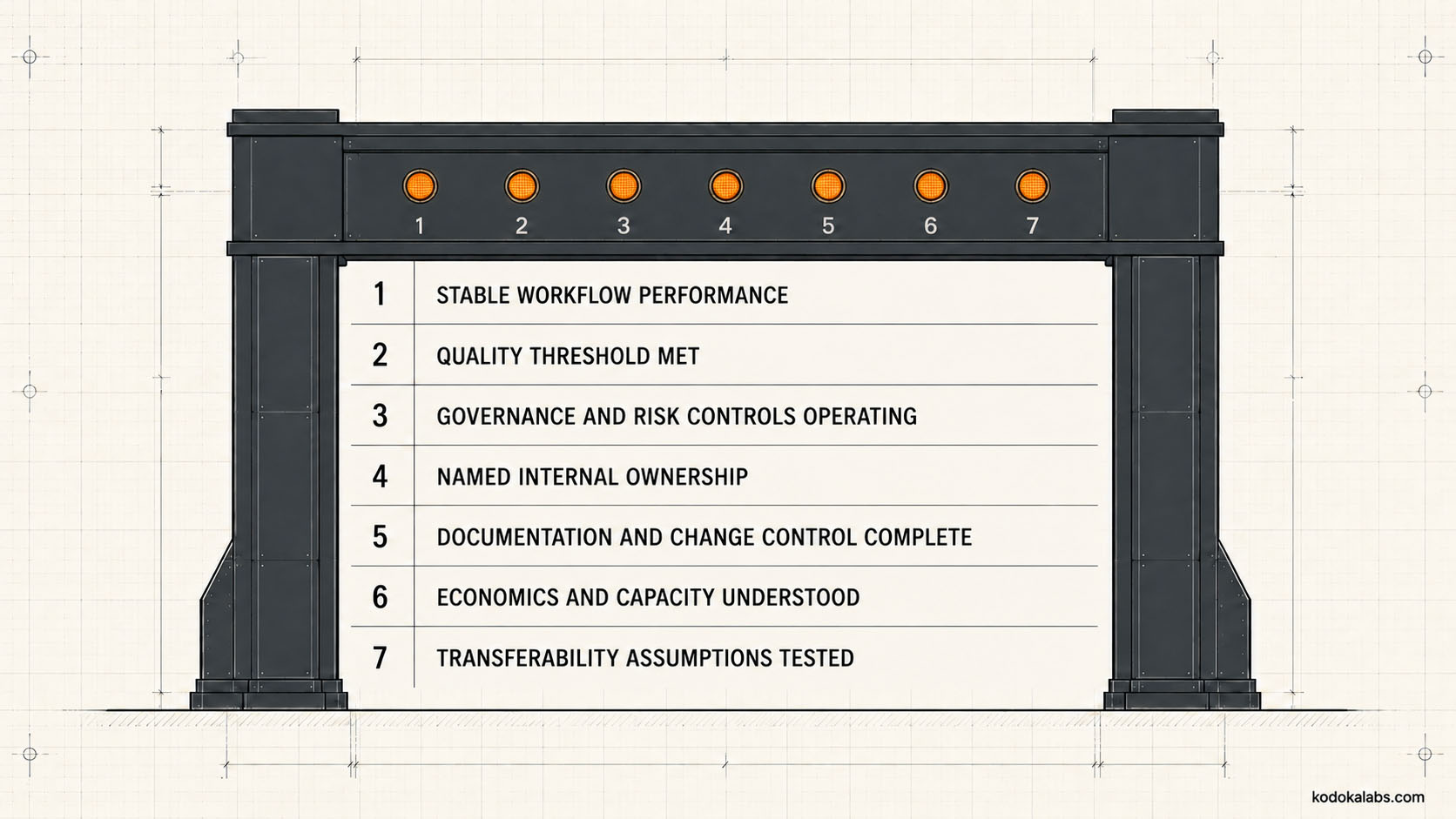
kōdōkalabs’ Scale Readiness Gate requires evidence across seven areas before a workflow moves beyond its original context.
| Readiness Area | What Must Be Evidenced |
|---|---|
| Stable workflow performance | Consistent results over a meaningful period, not a single strong cycle |
| Quality threshold met | Quality measures from Measure consistently meet the organization’s defined acceptable level |
| Governance and risk controls operating | Controls specified in Architect are functioning as designed, per Measure’s risk dimension |
| Named internal ownership | A specific, accountable owner exists per Enable’s Ownership Transfer Record |
| Documentation and change control complete | Operating documentation is current and a change-control process exists |
| Economics and capacity understood | Total cost (per Measure’s cost model) and required capacity for the new context are both known |
| Transferability assumptions tested | Explicit assumptions about what will and won’t transfer to the new context have been identified and checked |
Stable workflow performance
A workflow that performed well once, or performed well only under close implementer supervision, hasn’t yet demonstrated the stability scaling requires — the Readiness Gate looks for consistent performance across a meaningful operating period.
Quality threshold met
Quality results from Measure’s quality dimension need to consistently meet the organization’s own defined threshold, not simply trend in the right direction.
Governance and risk controls operating
Controls that exist on paper but aren’t demonstrably functioning in practice — per Measure’s risk and control dimension — are not a safe foundation for extending a workflow’s reach.
Named internal ownership
Scale should not proceed on a workflow whose Ownership Transfer Record from Enable remains incomplete; extending an un-owned workflow to a new context multiplies the ownership gap rather than resolving it.
Documentation and change control complete
Documentation that’s accurate for the original context but hasn’t been maintained, and a lack of any defined process for managing changes as the workflow evolves, both create risk once more teams depend on the same workflow.
Economics and capacity understood
Scaling without understanding the full cost (per Measure’s total-cost model) and the capacity the new context will require to operate and support the workflow tends to produce budget and staffing surprises after commitments have already been made.
Transferability assumptions tested
Every workflow carries implicit assumptions about its original context — language, regulatory environment, customer base, systems, team structure — and the Readiness Gate requires those assumptions to be identified and explicitly checked against the new context before scaling proceeds, rather than discovered after the fact.
Decide Whether to Replicate, Adapt, or Redesign
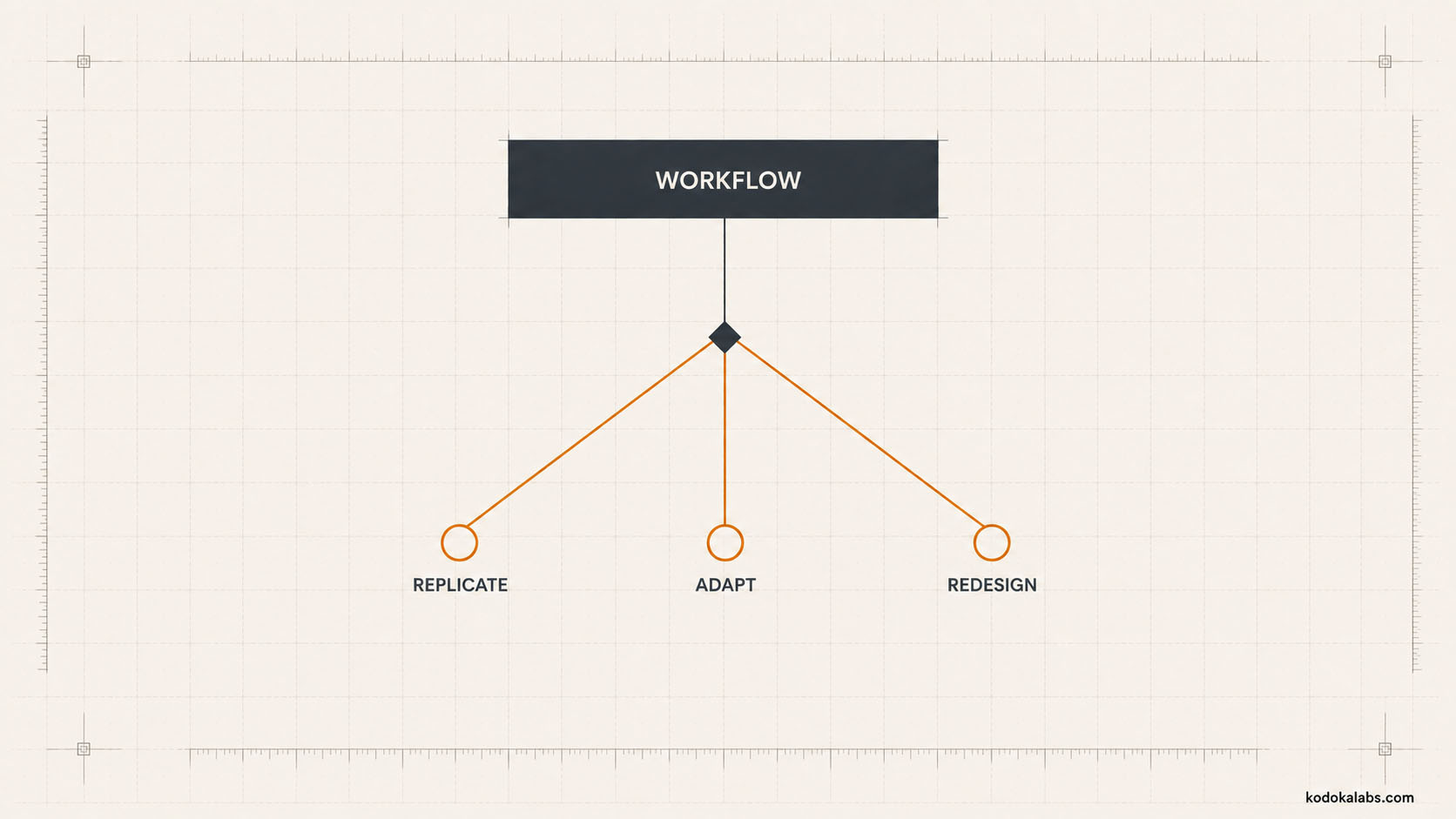
Not every workflow that passes the Readiness Gate should be copied unchanged into its new context. kōdōkalabs’ decision model distinguishes three paths:
| Decision | When It Applies |
|---|---|
| Replicate | Inputs, risk profile, process, audience, and systems are materially equivalent to the original context |
| Adapt | The core workflow logic is valid, but context, language, knowledge base, approval structure, or system integration differs |
| Redesign | The underlying business process, risk profile, data, or decision rights differ materially from the original context |
Replicating a workflow that actually needed adaptation tends to produce quality or compliance problems that surface only once the new context is live; redesigning a workflow that only needed adaptation wastes effort re-solving a problem that was already solved. The decision itself should be made deliberately, using the criteria above, rather than defaulted to whichever option is fastest to execute.
In practice, most scale decisions land closer to Adapt than to either extreme. Purely identical replication is relatively rare once a workflow moves beyond a near-duplicate team or use case, because even superficially similar contexts often differ in one dimension that matters – a different approval chain, a knowledge base that hasn’t been updated for the new audience, or a system integration that behaves slightly differently in the new environment. Redesign, at the other extreme, is also less common than organizations sometimes assume; teams under pressure to move fast sometimes default to redesigning from scratch when a more modest adaptation of the proven workflow would have gotten them there faster with less risk. Naming the decision explicitly, and documenting the specific reasoning behind it, is what keeps this from becoming a matter of instinct rather than evidence.
Scaling Across Teams and Functions
Extending a workflow to a new team or function within the same organization typically requires re-checking ownership (does the new team have its own accountable owner, or is the original team expected to absorb the work), re-running relevant portions of Enable for the new team’s practitioners, and confirming the workflow’s governance classification still fits — a function with a different risk profile than the original team may need additional controls the original context didn’t require.
Scaling Across Channels and Workflows
Extending a workflow’s underlying approach to a new channel or adjacent workflow (for example, from one content type to another) requires checking whether the core logic, source material, and quality standards genuinely transfer, or whether the new channel’s audience, format constraints, or regulatory context mean the situation is closer to Adapt or Redesign than Replicate.
Scaling Across Markets and Languages
| Factor | Why It Needs Local Assessment |
|---|---|
| Local knowledge and market context | Category norms, competitive landscape, and buyer behavior vary by market |
| Regulation | Legal and compliance requirements differ by jurisdiction and must be confirmed locally |
| Cultural context | Tone, imagery, and messaging that work in one market may not translate |
| Translation review | Machine or human translation needs qualified human review before publication |
| Local search behavior | Keyword and intent patterns differ by language and market |
| Data location | Data residency and storage requirements can differ by jurisdiction |
| Local ownership | A new market typically needs its own accountable owner, not remote management from the original market |
Governance and Change Control at Scale
Capability and Support Models
| Model | Description |
|---|---|
| Decentralized ownership | Each team or market fully owns and operates its own instance of the workflow |
| Federated governance | Local teams operate independently within centrally defined governance boundaries |
| Centre-of-excellence support | A central team provides ongoing support, standards, and troubleshooting to distributed operators |
Portfolio Prioritization and Capacity
| Portfolio Map Field | What It Captures |
|---|---|
| Proven value | Evidence strength and magnitude from Measure |
| Transferability | How much adaptation the new context is likely to require |
| Risk | Governance classification and consequence of failure in the new context |
| Owner readiness | Estimated effort to replicate, adapt, or redesign |
| Implementation effort | Whether a credible accountable owner exists for the new context |
| Strategic importance | How central the workflow is to the organization’s priorities |
Scale Outputs and Exit Criteria
Common Scale Failure Modes
- Scaling on enthusiasm, not evidence – extending a workflow because early results felt promising, without Measure’s formal evidence.
- Treating one team’s solution as universal – assuming a workflow’s local configuration will transfer unchanged to a materially different context.
- Concentrated ownership – scaling a workflow while ownership remains with the original pilot team rather than transferring to each new context.
- Governance left behind – extending the workflow’s reach without extending its governance controls to match.
- Ignoring market-specific risk – applying a workflow across languages or jurisdictions without genuine local legal, cultural, or regulatory assessment.
- No feedback loop – treating gaps discovered during scaling as one-off problems to patch quietly, rather than routing them back into Diagnose.
- Capacity underestimated – scaling without accounting for the human review, support, and governance capacity the new context will actually require.
The Scale-to-Diagnose Feedback Loop
Scale is not the end of the Transformation System — new contexts routinely surface gaps the original Diagnose cycle didn’t cover, because the original diagnosis was, correctly, scoped to the original context. kōdōkalabs treats these discoveries as expected input to a fresh Diagnose cycle for the new context, rather than exceptions to be resolved informally outside the framework. This is what makes the Transformation System a cycle rather than a one-directional sequence: Diagnose, Architect, Build, Enable, Measure, and Scale repeat, at increasing scope, as an organization’s AI-enabled marketing capability matures.