kōdōkalabs
AI Marketing Diagnosis and Readiness Assessment
Diagnose: Establish the Evidence for AI Marketing Transformation
Diagnose is the first phase of The kōdōkalabs Transformation System. It establishes an evidence-based baseline of the organization’s strategy, workflows, knowledge, technology, governance, capability, and measurement before a target operating model is designed.
A diagnosis is not a generic audit, a tool inventory, a vendor proposal dressed up as analysis, or a maturity score produced without supporting evidence. Those all produce an opinion about where an organization stands. A diagnosis produces evidence — sourced, labeled by strength, and organized so leadership can see exactly what it’s based on before committing to a redesign.
Executive Summary
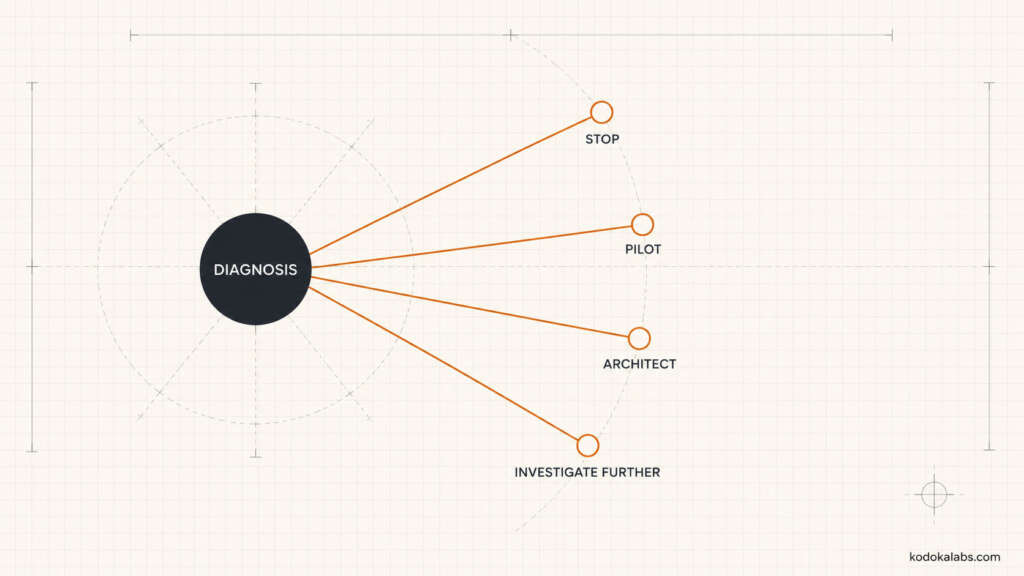
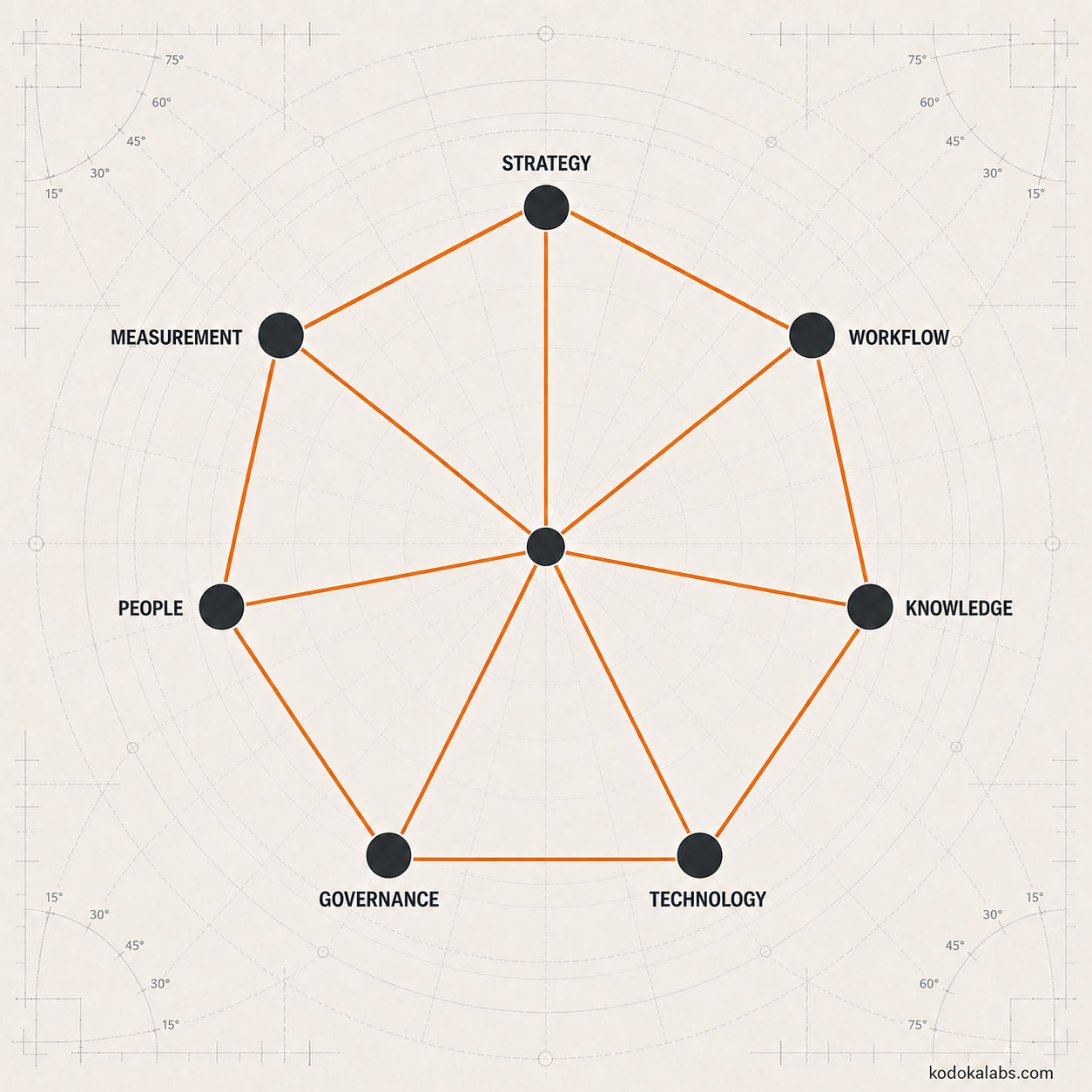
Diagnose exists because AI marketing transformation decisions made without a documented baseline tend to be driven by enthusiasm, anecdote, or whichever tool a competitor recently adopted – not by evidence about what’s actually constraining performance. The phase evaluates seven areas (strategic alignment, workflow reality, knowledge and data readiness, technology and integration, governance and risk, people and capability, and measurement and value), labels every finding by evidence strength, and produces a decision package that tells leadership whether to stop, pilot, move to Architect, or investigate further. It’s the evidence phase, not the fix phase — Architect is where the redesign happens.
Key Takeaways
- Diagnose produces evidence, not opinion — every finding is labeled by evidence strength.
- Seven evidence areas are assessed together, not as isolated audits.
- The phase produces a specific decision package, not a general impression of “how AI-ready” the organization is.
- A diagnosis is distinguishable from a sales-oriented audit by what it’s willing to conclude, including “not now” or “not this.”
- Diagnose feeds directly into Architect — nothing gets designed before it’s diagnosed.
What Is the Diagnose Phase?
Diagnose is the evidence-building phase of the Transformation System. Before any workflow gets redesigned, any tool gets selected, or any budget gets allocated, Diagnose establishes what’s actually true about the organization’s current state — not what leadership assumes is true, not what a vendor proposal implies is true, and not what a generic AI-readiness quiz estimates from a handful of self-reported answers.
The distinction matters because the three most common substitutes for a real diagnosis all skip the evidence step. A tool inventory catalogs what software is installed, which says little about whether it’s used consistently or well. A vendor proposal typically diagnoses exactly the problem the vendor’s product solves. A maturity score without supporting evidence produces a number that feels authoritative but can’t be interrogated — nobody can ask “based on what?”
Why AI Marketing Transformation Requires a Baseline
Without a documented baseline, two things happen. First, later claims of improvement become impossible to substantiate credibly — if nobody recorded the “before” state, there’s no defensible way to demonstrate the “after” state is actually better, only that it’s different. Second, and more consequentially, transformation priorities end up driven by enthusiasm and visibility rather than evidence: the loudest problem, the most recently discussed technology, or the initiative a competitor announced gets resourced, while the actual highest-value or highest-risk gap goes unaddressed because nobody measured it.
A baseline solves both problems by giving Measure (Phase 5) something concrete to compare against later, and by giving Architect (Phase 2) a documented, defensible starting point for prioritization rather than a set of assumptions.
What Diagnose Evaluates
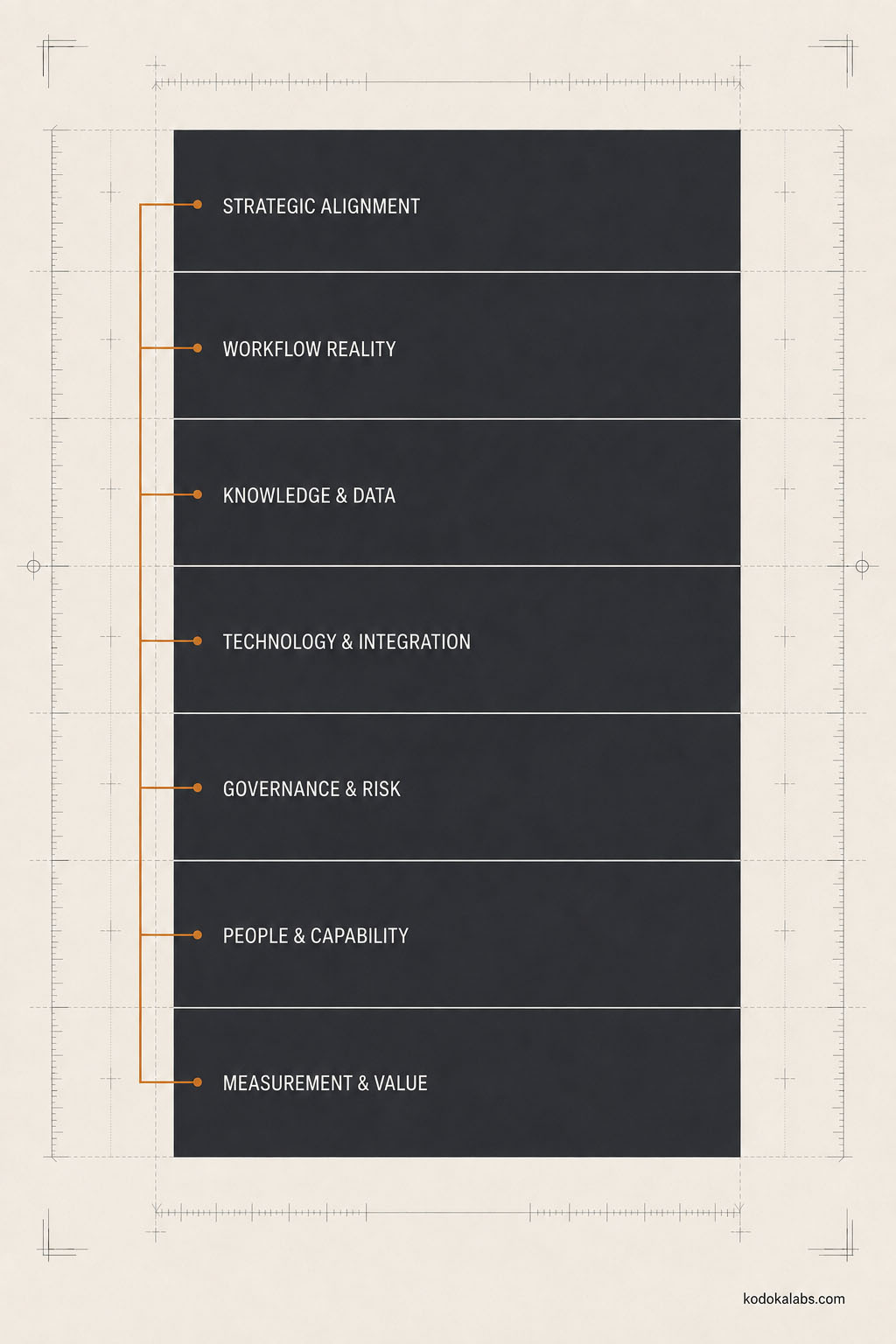
Strategic alignment
Workflow reality
Knowledge and data readiness
Technology and integration
Governance and risk
People and capability
Measurement and value
Evidence Required for an AI Marketing Diagnosis
Every finding produced during Diagnose is labeled using kōdōkalabs’ Evidence Strength Levels – four explicitly defined levels, not an external standard:
| Level | Definition |
|---|---|
| Asserted | Someone stated it; no supporting documentation or observation yet exists |
| Observed | A member of the diagnosis team directly witnessed the behavior or condition |
| Documented | Written evidence exists (a policy, a workflow document, a data record) |
| Measured | Quantified with a defined method, ideally against a comparison point |
How the AI Marketing Maturity Model Is Used
How Workflows and Use Cases Are Assessed
Within the workflow-reality evidence area, individual workflows and candidate AI use cases are evaluated against six criteria:
Business relevance
Frequency and effort
Knowledge and data requirements
Risk and reversibility
Human judgment requirements
Measurement feasibility
Can this workflow’s performance actually be measured with available data, or would measuring it require building new instrumentation first?
Who Participates in Diagnose?
A credible diagnosis requires more than a single stakeholder’s perspective. Participants typically include an executive sponsor (accountable for the transformation decision), a business owner (accountable for the outcome the transformation is meant to achieve), a workflow owner (day-to-day responsibility for the process being examined), a subject-matter expert (domain knowledge the diagnosis team may lack), a technical representative (visibility into systems, data, and integration constraints), governance stakeholders (privacy, security, legal, or compliance perspective where relevant), and a final decision-maker (who will actually act on the diagnosis’s recommendation).
Skipping any of these roles tends to produce a diagnosis with a specific kind of blind spot – for example, omitting the workflow owner in favor of only executive interviews commonly produces a diagnosis that describes the process as documented rather than the process as actually run. Omitting governance stakeholders tends to produce a diagnosis that looks complete on workflow and technology but discovers a privacy or compliance gap only after Architect has already begun designing around the omission — a far more expensive place to discover it.
Participation doesn’t require every role to be present for every conversation. What it requires is that each perspective is captured somewhere in the evidence register before the diagnosis is considered complete, with the source of each contribution documented – a workflow owner’s observation carries different evidentiary weight than an executive’s assertion, and the diagnosis should make clear which is which.
Outputs of the Diagnose Phase
Diagnose produces a defined Decision Package, not a general summary of findings:
- Executive problem statement
- Current-state map
- Maturity profile by dimension
- Workflow and dependency inventory
- Governance and risk gaps
- Opportunity backlog
- Evidence register
- Baseline metrics
- Priority recommendations
- An explicit decision: stop, pilot, move to Architect, or investigate further
That last item matters as much as any other output. A diagnosis that only ever recommends “proceed to the next phase” isn’t functioning as a genuine evidence-gathering exercise — sometimes the evidence supports stopping, or investigating a specific area further before committing to anything.
Diagnose Exit Criteria
The phase is complete only when leadership can state, specifically: what problem is being solved; what evidence supports the diagnosis; which constraints matter most; which opportunities warrant design; what should not proceed; what baseline will be used later; and who owns the Architect decision. If leadership can’t answer these questions in specific terms — not general impressions — the diagnosis isn’t finished, regardless of how much time has been spent on it.
A useful test: if the answer to any of these questions is a vague restatement of the original business goal (“we want to use AI to grow marketing”) rather than a specific, evidence-backed statement (“workflow X consumes Y hours per week with Z percent rework, and the knowledge base supporting it is undocumented”), the exit criteria haven’t actually been met yet, even if a report has been produced and a meeting has been held.
Common Diagnose Failure Modes
- Tool-first assessments – starting from “what tools should we adopt” rather than “what does the evidence show is actually constraining us.” This is the single most common failure mode, largely because it’s the easiest question to answer quickly and the one most vendors are incentivized to help answer.
- Self-reported maturity without evidence – accepting leadership’s own assessment of organizational maturity without corroborating it against observed or documented evidence. Leadership’s view of their own organization’s maturity tends to run more optimistic than what frontline observation supports, particularly on governance and knowledge readiness.
- Missing frontline workflow owners – diagnosing based only on executive interviews, missing the reality of how work actually happens day to day. Executives frequently describe the documented process; workflow owners describe the actual one, exceptions included.
- Ignored governance – treating governance and risk as an afterthought rather than one of the seven core evidence areas. A diagnosis that skips governance can produce a technically sound redesign that turns out to be materially riskier than anyone realized once implementation begins.
- Invented benchmarks – comparing the organization against unverified or fabricated industry figures rather than its own documented baseline. Comparisons to the organization’s own prior state are almost always more defensible than comparisons to an unverifiable external number.
- Recommendations that precede findings – arriving at a preferred solution first, then gathering evidence selectively to support it. This is the pattern that most closely resembles a sales audit rather than a genuine diagnosis, and it’s often the hardest one for an organization to self-detect without an outside perspective.