
The
kōdōkalabs
Content Operations
Intelligence Hub
Content Operations is the editorial system, research process, and production infrastructure that determines whether content output stays consistent and citable as volume scales, or degrades into inconsistent, low-authority material. It’s the discipline behind Phase 3 (Build) of The kōdōkalabs Transformation System, covering editorial systems, knowledge capture, research standards, authority-building, and the content supply chain — the operational backbone of the Content Engine inside an AI Marketing Operating System.
Definition
Content Operations is the set of documented systems — editorial workflow, research standards, knowledge management, and quality control — that determine how content actually gets produced inside a marketing organization, at whatever volume the organization requires. It’s distinct from content strategy (what to write about) and from search optimization (how to structure it for discovery) — content operations is the production infrastructure underneath both, and it’s where most of the inconsistency problems that plague AI-assisted content production actually originate.
An organization can have excellent content strategy and strong SEO/GEO knowledge and still produce inconsistent, unreliable output if the underlying operational system — who researches what, how sources get verified, how drafts get reviewed, how institutional knowledge gets captured and reused — isn’t documented and governed.
This becomes especially visible once AI-assisted drafting enters the picture. AI collapses the time required to produce a first draft, which means the quality of the final output increasingly depends on what happens before and after drafting — the research that informs the brief, and the review that catches errors, inconsistency, or generic phrasing before publication. An organization that speeds up drafting without strengthening research and review simply produces low-quality content faster, which is a net loss, not a net gain, however it looks on a content-volume dashboard.
Content operations, in other words, is where the theoretical benefits of AI-assisted marketing either get realized or get squandered. Two organizations with access to the identical AI tools can produce dramatically different results depending entirely on the operational discipline surrounding how those tools get used.
Latest Content Operations Content





The Editorial Operating System
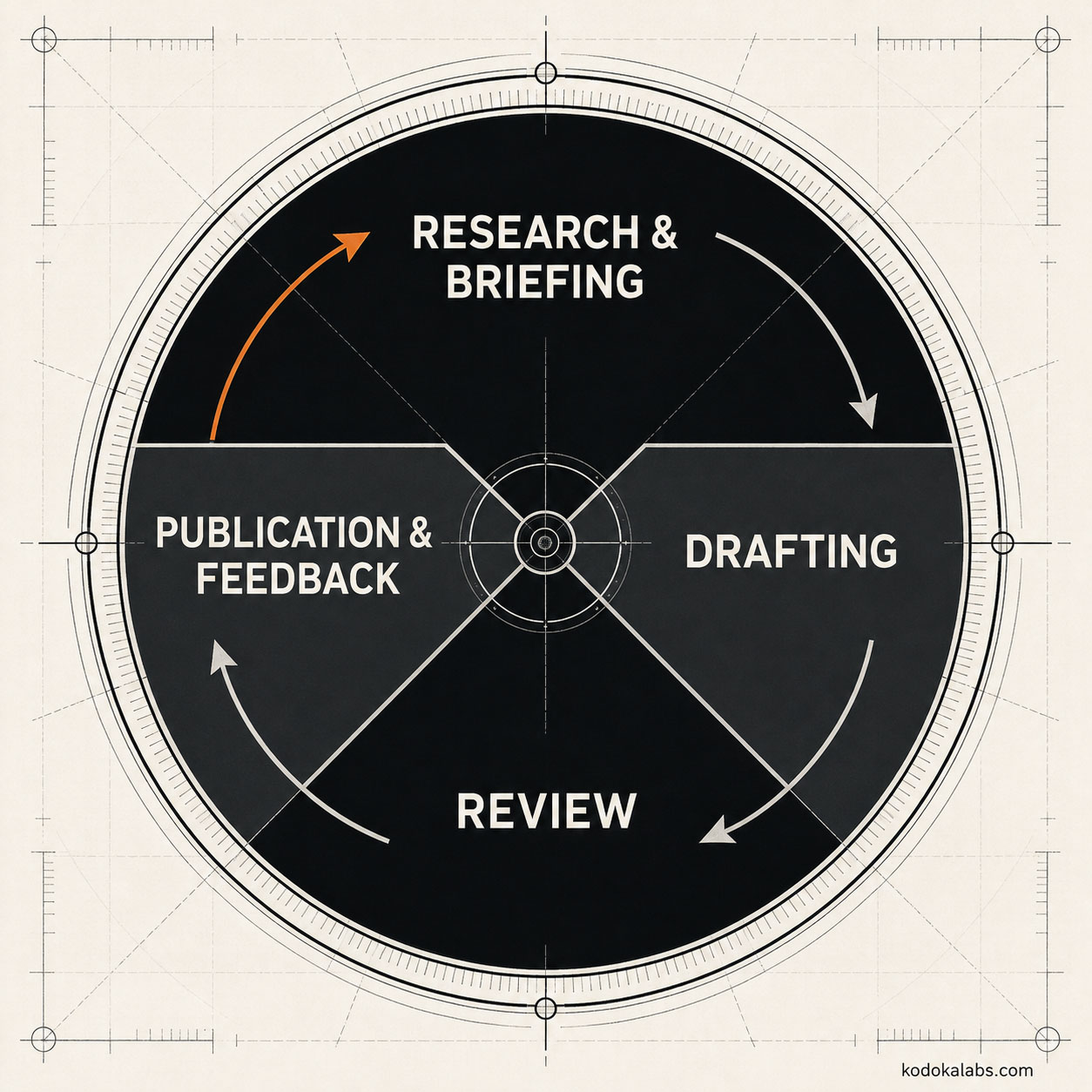
kōdōkalabs’ Editorial Operating System is the framework governing how content moves from idea to published, reviewed asset. It defines four connected stages:
- Research and briefing — gathering source material, defining the angle and required information gain, and producing a structured brief before drafting begins.
- Drafting — AI-assisted first-draft production against the brief, using the organization’s knowledge base and the Human + AI Execution Model to determine what’s AI-generated versus human-written.
- Review — quality, accuracy, and brand-voice review against the standards defined in the AI Governance Matrix, calibrated to the content category’s risk level.
- Publication and feedback capture — publishing the finished asset and capturing performance data and lessons learned back into the knowledge base, so the next piece of content on a related topic starts from a stronger foundation.
This structure exists specifically to prevent the two most common content-quality failure modes: content produced without adequate research grounding (fast but shallow), and content produced through an undocumented, ad hoc process that different team members execute inconsistently (variable quality, no compounding improvement).
Each stage has a defined owner and a defined quality bar, documented specifically enough that a new team member — or a newly certified team member coming out of the AI Capability Academy — can execute it consistently with an experienced one. This is deliberately different from how content production commonly works without a documented system, where quality is closely tied to which specific person happens to be involved, and institutional standards live as tacit knowledge rather than written process.
The loop structure is also deliberate: without an explicit feedback-capture stage, published content becomes a dead end — valuable research and lessons learned disappear the moment an asset goes live, and the next related piece of content starts from the same blank page the previous one did.
Knowledge Capture
Research Standards
Content grounded in weak or unverified research is a specific and growing risk as AI-assisted drafting increases production speed — the bottleneck shifts from writing speed to research and verification quality. kōdōkalabs’ research standards specify: primary sources are preferred over secondary summaries wherever practical; specific claims and statistics require a traceable source, not a general impression; and information gain — genuinely new synthesis, framework, or perspective, not just a restatement of what’s already widely published — is treated as a required element of cornerstone content, not an optional enhancement.
This last point connects directly to GEO performance, covered in depth on the Search Intelligence pillar: AI answer engines specifically favor sources that add genuine information gain over sources that restate commonly available information, which makes research rigor a search-performance lever, not just an editorial-quality one.
Building Topical Authority
Topical authority — being recognized, by both human readers and AI systems, as a credible, comprehensive source on a given subject — is built cumulatively, through consistent coverage depth, internal linking that reflects genuine topical structure, and named, defensible frameworks rather than restated industry consensus. A single excellent article rarely builds authority on its own; a well-structured cluster of interconnected content, anchored by a strong pillar page and supported by cornerstone guides that each go deep on a specific sub-topic, does.
This is precisely the logic behind kōdōkalabs’ own Intelligence Hub structure: six pillar pages, each anchoring a cluster of cornerstone guides and supporting articles that link back to the pillar, reference The kōdōkalabs Transformation System, and point to the relevant Solution — building topical authority as a connected system rather than a collection of isolated posts, per the interlinking and knowledge graph approach applied across the entire site.
Authority also compounds over time in a way that’s easy to underestimate early on. The first few pieces of content in a cluster establish the foundation but rarely generate much authority signal on their own; it’s the accumulated depth and interconnection of a mature cluster — ten, twenty, or more pieces all reinforcing the same core entities and linking coherently to each other — that produces the kind of topical authority both traditional search engines and AI answer engines reward. This is one of the clearest reasons content operations discipline matters most for organizations planning a long-term content investment rather than a short campaign: the operational consistency of the first year determines how much authority the content built in that year is actually capable of compounding into over the following years.
The Content Supply Chain
The Content Supply Chain
| Stage | Input | Output | Quality Checkpoint |
|---|---|---|---|
| Research & Briefing | topic, prior knowledge base | structured brief | brief completeness review |
| Drafting | brief, knowledge base | first draft | AI/human division per Execution Model |
| Review | draft | reviewed, approved asset | Governance Matrix-defined review level |
| Publication | approved asset | live content | performance and feedback capture |
Quality Control At Scale
Common Failure Patterns
- Treating research as a step to minimize rather than invest in. Faster drafting from weaker research produces content that reads fine but adds little genuine information gain, undermining both reader trust and GEO citation potential.
- No knowledge capture discipline. Research value evaporates at publication instead of compounding, so content velocity never actually increases even as AI drafting speed does.
- Uniform review regardless of risk. Applying the same heavy review process to routine content that a genuinely high-risk piece requires slows everything down without improving the outcomes that matter most.
- Content clusters without real internal-linking structure. Publishing many articles on related topics without deliberately connecting them as a cluster forfeits much of the topical-authority benefit that structure would otherwise produce.
How This Connects To Search Intelligence
Content Operations and Search Intelligence are tightly coupled but distinct: Content Operations governs how content gets produced (research, drafting, review, knowledge capture); Search Intelligence governs how that content gets structured for discovery and citation once produced (SEO, GEO, entities, knowledge graphs). Both are required for the Content Engine component of the AI Marketing Operating System to function well — strong production discipline without strong search structure produces well-researched content nobody finds; strong search structure without production discipline produces well-optimized content that’s shallow or inconsistent.
Frequently Asked Questions (FAQ)
What's the difference between content operations and content strategy?
Content strategy determines what to create and why — topics, audience, business goals. Content operations determines how it actually gets produced consistently — the research, drafting, review, and knowledge-capture systems underneath. Both are necessary; neither substitutes for the other.
How does AI change content operations specifically?
AI increases drafting speed substantially, which shifts the operational bottleneck toward research quality and review capacity. Without a documented Editorial Operating System to match the new drafting speed, quality control becomes the limiting factor, and inconsistency risk increases rather than decreases as output volume scales.
What is knowledge capture, practically?
It's the discipline of retaining research, source material, and lessons learned in a structured, searchable knowledge base after each piece of content is published, so future content production can draw on it directly rather than starting research from zero each time.
How do we measure content operations maturity?
As part of the AI Marketing Maturity Model's content dimension, evaluated during the Executive AI Marketing Assessment — covering research rigor, documentation of editorial workflow, knowledge base structure, and consistency of quality across different content categories and contributors.
Does this apply to organizations with small content teams?
Yes — smaller teams often benefit more from documented content operations, since there's less redundancy to absorb inconsistency, and knowledge capture matters even more when institutional knowledge might otherwise live with just one or two people.
The Latest News and Updates
From the kōdōkalabs
Intelligence Hub
Book An
Assessment
The fastest way to find out where your marketing organization stands is a structured assessment, not a sales call.
In a 90-minute Executive AI Marketing Assessment, we evaluate current maturity, technology, processes, team, content, search, and governance against the AI Marketing Maturity Model, and leave you with a prioritized roadmap — whether or not you engage kōdōkalabs further.