
The Architecture of an Impact-Driven AI Marketing Operating System
Executive Summary
Key Takeaways for the AI Marketing Operating System Architecture
- AI tool adoption and AI-driven commercial impact are not the same thing, and conflating them is the single most common reason enterprise AI marketing initiatives stall after an encouraging pilot.
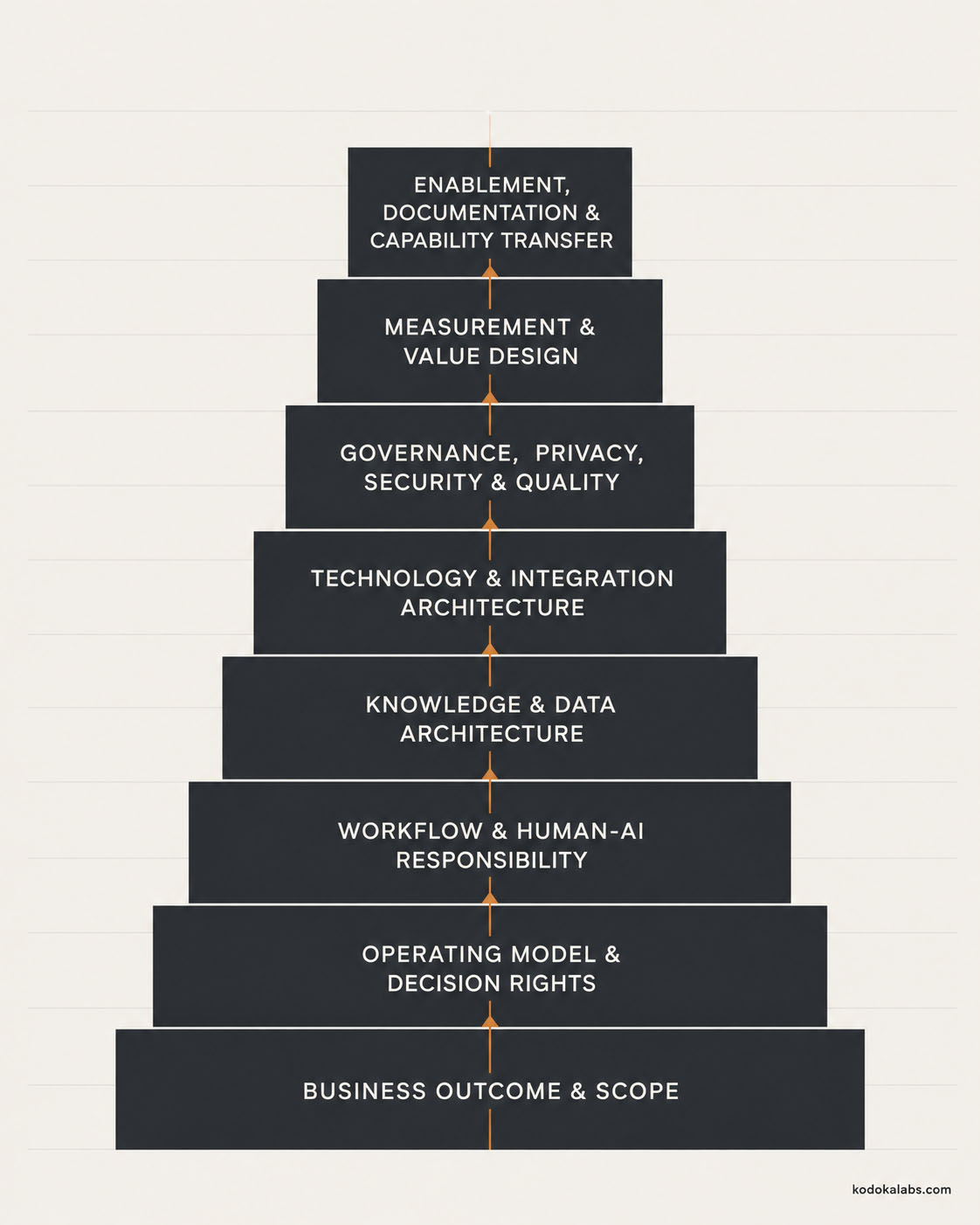
- The Architecture Decision Stack sequences eight interdependent design layers, from business outcome and scope through enablement and capability transfer, so that no layer is designed in isolation from the ones above and below it.
- The Human + AI Execution Model assigns every marketing task to one of four tiers, human-owned, AI-assisted, AI-executed under supervision, or prohibited, based on brand exposure and operational reversibility, not on convenience.
- A workflow isn’t production-ready until it’s specified across eleven fields covering trigger, inputs, steps, owners, systems, knowledge, exceptions, approvals, outputs, evidence, and metrics, specific enough that it survives the departure of the person who built it.
- Generative Engine Optimization now depends on information density and verifiable entity structure, not keyword placement, which means an un-architected content operation is increasingly invisible to the answer engines that are replacing traditional search.
Executive Thesis: Why Enterprise Marketing Has AI Backwards
Marketing organizations across the mid-market and enterprise segment have adopted generative AI tools at a pace that would have seemed implausible five years ago. Seat licenses for drafting assistants, research copilots, and image generators now sit inside nearly every marketing department we work with. What has not kept pace is the redesign of how marketing actually operates underneath that tooling. We see departments that bought the technology and never touched the operating model it was supposed to run inside, and the gap between those two things is where almost every stalled AI initiative lives.
This is the conviction we at kōdōkalabs bring to every engagement: marketing organizations have adopted AI tools, but they have not redesigned how marketing actually operates, and that mismatch, not any shortfall in the underlying models, is the primary reason AI initiatives fail to produce board-level results. Tool proliferation and operational stagnation are not opposing forces. They coexist comfortably inside the same organization, often inside the same quarter, because buying software requires no change to decision rights, review workflows, data governance, or team structure. Redesigning the operating model requires all four.
The empirical baseline is sobering and well documented. RAND Corporation’s research into AI project outcomes finds that more than 80% of AI projects fail outright, roughly twice the failure rate of comparable non-AI information technology initiatives, and traces the dominant causes to misaligned purpose, weak data foundations, and fading executive sponsorship rather than to technical limitation. Gartner’s research adds a forward-looking data point: at least 30% of generative AI projects are projected to be abandoned after proof of concept, and a much larger share, 40%, of agentic AI initiatives are projected to be canceled by 2027. Different methodologies, different time horizons, the same structural conclusion. Enterprise AI marketing initiatives fail at a rate most other corporate technology investments would never tolerate, and the common root cause across the research is organizational, not algorithmic.
Our thesis follows directly from that evidence: artificial intelligence delivers compounding commercial value in marketing only when it’s implemented as an operating system redesign spanning workflows, data architecture, governance, and capability transfer, not as a procurement line item layered on top of an unchanged organization. An operating system, in the sense we mean it here, is the complete set of decision rights, workflows, knowledge structures, governance gates, measurement baselines, and enablement mechanisms that determine how work actually gets done, reviewed, and improved over time. A tool is a component inside that system. It is never a substitute for it. The remainder of this guide lays out, layer by layer, what that operating system actually looks like when it’s built with engineering discipline rather than assembled by accident.
Deconstructing the Anatomy of Implementation Failure
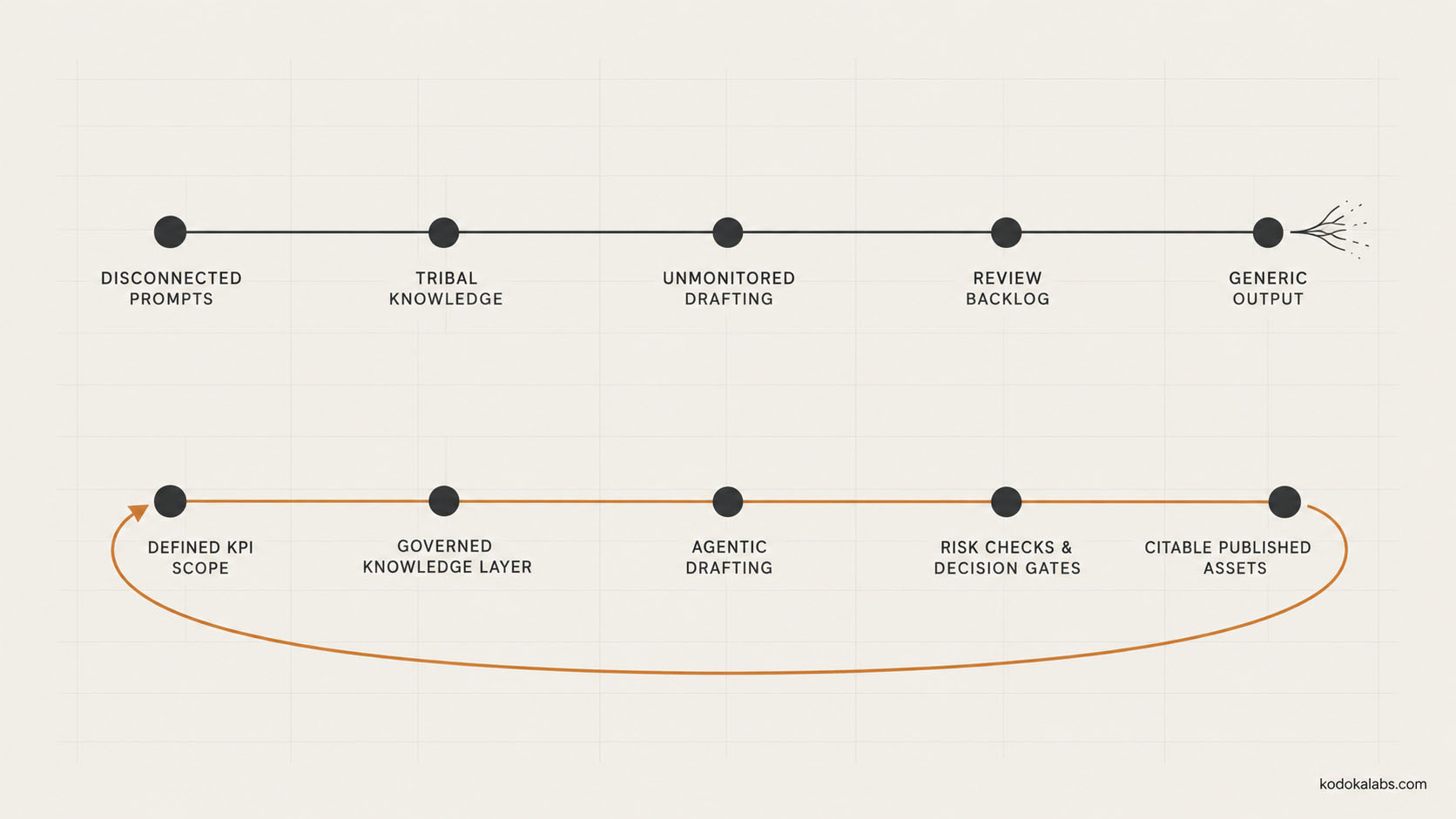
Before we can design the operating system that works, it’s worth being precise about the four failure modes that dismantle the ones that don’t, because each one shows up repeatedly across the organizations we diagnose, and each one has a specific, identifiable signature.
The first is the point-solution trap. This is the condition where individual teams and individual contributors adopt generative tools independently, a content lead experimenting with a browser-based assistant, a demand generation manager building a private prompt library, a product marketer feeding competitive intelligence into a chatbot with no data-handling policy attached. Each adoption decision is locally rational. None of them is coordinated, documented in a place colleagues can find, or evaluated against a shared governance standard. Enterprise software sprawl follows almost immediately: unmanaged seat licenses nobody is tracking for utilization, isolated prompt libraries that live in someone’s personal notes app, and no institutional mechanism for what one team learns to compound into what another team already knows. The organization ends up with dozens of small, disconnected AI experiments and zero accumulated capability.
The second is the review bottleneck, and it’s the failure mode that looks most like success right up until someone checks the numbers. Generative tools can realistically accelerate first-draft production by a significant multiple, five times faster initial copy generation for routine marketing collateral is a plausible, often conservative estimate. What that acceleration does not do is reduce the fact-checking, brand-voice alignment, legal review, and editorial judgment every piece of content still requires before publication. That work doesn’t disappear. It moves downstream, compresses into a shorter window, and lands on the desks of the senior editors and subject-matter reviewers whose time was already the organization’s scarcest resource. A team generating five times the draft volume without adding reviewer capacity doesn’t produce five times the finished output. It produces a queue, and the queue grows until someone either reduces the review standard, which creates its own risk, or accepts that the productivity gain was never real at the organizational level, even though it was genuinely real at the individual drafting-task level.
The third is knowledge collapse. A foundational large language model, used without structured contextual grounding, a documented brand voice, verified proprietary data, and a defined knowledge base, defaults toward the statistically safest, most generic phrasing available across its training distribution. That output reads as competent, fluent, and completely indistinguishable from what any competitor using the same tool without the same discipline would produce. Worse, generation without grounding carries a real hallucination risk, specific claims, statistics, or technical details that sound confident and are simply wrong. Publishing that kind of content at volume doesn’t just risk an occasional embarrassing correction. It erodes, article by article, the specific and differentiated market positioning an organization spent years building, replacing it with content that could have come from anywhere.
The fourth failure mode is less visible from inside the marketing department because it’s structural to a commercial relationship rather than to an internal process: agency retainer lock-in. Legacy agency models bill for time or for deliverable volume, and generative tools let many agencies produce that volume faster without changing what they actually deliver to the client. The agency’s commercial incentive runs directly against building the client’s internal capability, because a client who can run its own AI-enabled marketing operation no longer needs the retainer. The result is an enterprise client paying recurring fees for execution that’s now substantially faster to produce, while institutional knowledge, prompt engineering, workflow documentation, and the technical architecture behind the output all remain the exclusive, undocumented property of the agency. The client ends up paying for speed that AI created without ever gaining the operational ownership that would let it capture that speed for itself.
The Core Blueprint: The Architecture Decision Stack
Layer 1: Business Outcome and Scope.
Layer 2: Operating Model and Decision Rights.
Layer 3: Workflow and Human-AI Responsibility.
Layer 4: Knowledge and Data Architecture.
Layer 5: Technology and Integration Architecture.
Layer 6: Governance, Privacy, Security, and Quality Controls.
Layer 7: Measurement and Value Design.
Layer 8: Enablement, Documentation, and Capability Transfer.
| Layer | Primary Focus | Mandatory Operational Deliverables |
|---|---|---|
| 1. Business Outcome and Scope | Commercial bounds and out-of-scope ledger | Named KPI target, explicit out-of-scope list, executive sponsor |
| 2. Operating Model and Decision Rights | Governance structure and prompt authority | RACI matrix, named approval authority, escalation path |
| 3. Workflow and Human-AI Responsibility | Task partitioning by risk tier | Human + AI Execution Model applied to every workflow step |
| 4. Knowledge and Data Architecture | Proprietary grounding for generation | Brand knowledge graph, vector retrieval system, source-of-truth registry |
| 5. Technology and Integration Architecture | Modular, vendor-agnostic tooling | API orchestration layer, documented model-routing logic |
| 6. Governance, Privacy, Security, Quality Controls | Risk tiers and approval gates | Programmatic risk checks, audit trail, compliance sign-off record |
| 7. Measurement and Value Design | Pre-implementation baselines and KPI telemetry | Baseline metrics captured before launch, attribution model, dashboard |
| 8. Enablement, Documentation, Capability Transfer | Runbooks, training, scheduled handoff | Workflow runbooks, internal certification program, handoff timeline |
Task Governance: The Human + AI Execution Model
Tier 1: Human-Owned Execution.
Tier 2: AI-Assisted Execution.
Tier 3: AI-Executed Under Supervision.
Tier 4: Prohibited or Restricted Execution.
| Marketing Task | Execution Tier | Required Review Gate | Accountable Role |
|---|---|---|---|
| Executive positioning and crisis communications | Tier 1: Human-Owned | Absolute human sign-off | CMO or designated executive owner |
| Core brand narrative and messaging architecture | Tier 1: Human-Owned | Absolute human sign-off | Head of Brand or equivalent |
| Long-form research synthesis and topic clustering | Tier 2: AI-Assisted | Mandatory subject-matter expert review | Content lead or subject-matter expert |
| First-draft technical and thought-leadership content | Tier 2: AI-Assisted | Mandatory subject-matter expert review | Senior editor |
| Competitive and market research summarization | Tier 2: AI-Assisted | Mandatory subject-matter expert review | Analyst or strategist of record |
| Metadata tagging and taxonomy classification | Tier 3: Supervised AI | Periodic spot-check and automated tests | Marketing operations manager |
| JSON-LD schema and structured data generation | Tier 3: Supervised AI | Periodic spot-check and automated tests | Technical SEO owner |
| Performance reporting extracts and dashboard population | Tier 3: Supervised AI | Periodic spot-check and automated tests | Marketing operations analyst |
| Autonomous publishing without a human checkpoint | Tier 4: Prohibited | Hard programmatic block | Not permitted under any role |
| Ingestion of non-anonymized customer data into external models | Tier 4: Prohibited | Hard programmatic block | Not permitted under any role |
| Unverified contractual, legal, or compliance claims | Tier 4: Prohibited | Hard programmatic block | Not permitted without legal sign-off at Tier 1 |
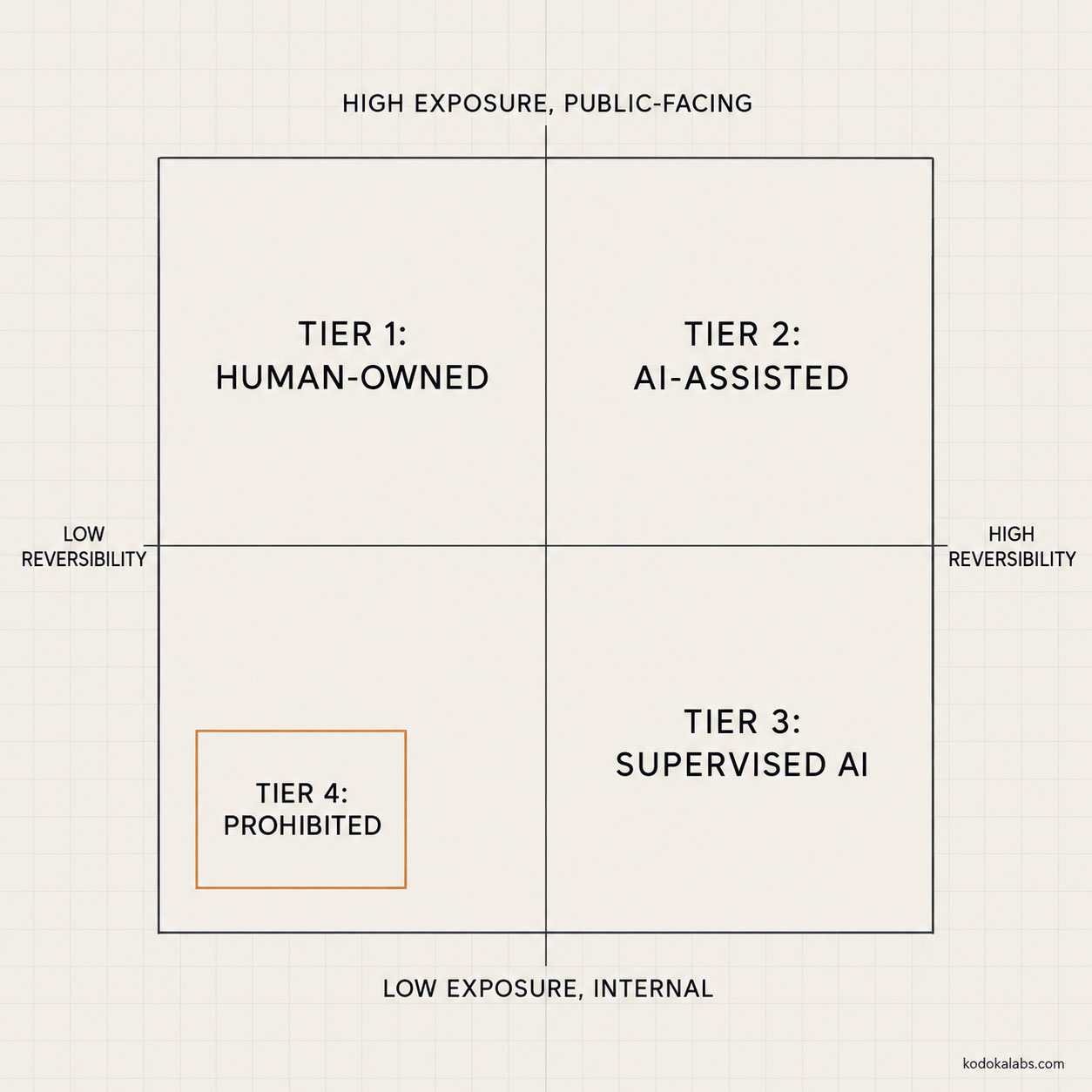
The two-axis grid plots operational reversibility on the horizontal axis, running from low reversibility and high impact on the left to high reversibility and low impact on the right, against brand and factual exposure on the vertical axis, running from high exposure and public-facing at the top to low exposure and internal-operational at the bottom. Tier 1, human-owned work, sits in the top-left quadrant where exposure is highest and mistakes are hardest to undo. Tier 2, AI-assisted work, sits top-right, still publicly exposed but more forgiving of iteration before publication. Tier 3, supervised AI, sits bottom-right, where tasks are lower-exposure and easily corrected. Tier 4, prohibited execution, sits bottom-left, a deliberately small, hard-blocked zone regardless of apparent reversibility, because certain categories of task, unvetted customer data handling chief among them, carry regulatory and trust consequences that the reversibility axis alone doesn’t capture.
Workflow Engineering: Codifying the Eleven Core Fields
A governance model and an architecture stack tell an organization how decisions should be made. They don’t, by themselves, make any single workflow reproducible. That’s the job of workflow specification, and it’s the layer most enterprise marketing teams skip entirely, relying instead on casual prompt libraries that live in someone’s personal notes and depend on that person’s memory of why a particular prompt was written a particular way. That approach fails the moment the person who built the workflow goes on leave, changes roles, or leaves the company, because the knowledge of how the workflow actually works, and why it handles its edge cases the way it does, was never written down anywhere a colleague could find it.
We specify every production workflow across eleven mandatory fields before it goes live, specific enough that a new team member could pick it up and run it without having to reconstruct anyone’s reasoning from scratch. The eleven fields are trigger, the event or condition that initiates the workflow; inputs, the specific information and assets the workflow requires to begin; steps, the sequential actions the workflow performs, in enough detail that each step’s output feeds the next step’s input; owners, the named individuals accountable for the workflow’s design and its ongoing performance; systems, the specific tools and platforms the workflow touches at each step; knowledge, the source-of-truth documents and data the workflow draws on for grounding; exceptions, the documented handling for cases that fall outside the normal path, since a meaningful share of real-world volume for most workflows turns out to be exceptions rather than the clean, happy-path case; approvals, the specific sign-off required before output moves downstream, mapped to the Human + AI Execution Model tiers described above; outputs, the concrete deliverable the workflow produces; evidence, the documentation that proves the workflow actually performed as specified, which matters enormously the first time someone has to audit or debug it; and metrics, the specific, pre-defined measurements that will show whether the workflow is creating the value it was designed to create.
To make this concrete rather than abstract, consider how these eleven fields apply to an automated technical research and entity optimization pipeline, a workflow type increasingly common across the enterprise marketing organizations we work with as Generative Engine Optimization becomes a board-level priority.
Trigger:
Inputs:
Steps:
Owners:
Systems:
The organization’s knowledge graph and vector retrieval platform, its approved AI drafting pipeline, its content management system, its JSON-LD generation tooling, and its citation and answer-engine visibility monitoring platform.
Knowledge:
Exceptions:
Approvals:
Draft content requires Tier 2 subject-matter expert review under the Human + AI Execution Model; the JSON-LD and metadata generation operates at Tier 3 with periodic spot-checking; publication requires final editorial sign-off before the piece goes live.
Outputs:
Evidence:
A documented record of which sources were cited, which claims were graded at which Evidence Strength Level, and which reviewer approved the final draft, stored alongside the published piece rather than scattered across email threads.
Metrics:
Search in the Algorithmic Era: Engineering for Vector Spaces and GEO
Traditional search engine optimization and Generative Engine Optimization share a common ancestor but have diverged into genuinely different disciplines. Classic SEO optimizes primarily for ranking inside a list of results, a process substantially shaped by keyword relevance, backlink authority, and technical crawlability. Generative Engine Optimization optimizes for a different outcome entirely: being extracted, trusted, and directly cited by a large language model answering a question rather than returning a list of links for a human to click through.
Modern answer engines, Perplexity, ChatGPT Search, Microsoft Copilot, and Google’s AI Overviews among them, don’t process a web page the way a classic crawler does. They process content in chunks, map the entities and relationships a piece of content describes, and synthesize a direct answer by retrieving and recombining the passages, across potentially many sources, that best address the query. A model performing retrieval-augmented generation is, in effect, scoring every chunk of content it encounters for how much genuine information it adds and how clearly it defines the entities involved.
This is why high information density, proprietary data points, and structured JSON-LD entity markup aren’t optional refinements for an enterprise content operation, they’re the mechanism by which content becomes eligible for inclusion in an answer at all. Content that restates widely available ideas in competent but unremarkable language, the default output of the point-solution trap described earlier in this guide, carries little unique information for a retrieval system to surface. Commoditized, low-density AI content is systematically deprioritized by retrieval algorithms not because it’s poorly written, but because it adds nothing a model couldn’t already synthesize from dozens of other, equally generic sources. An organization that wants to be the source an answer engine actually cites has to publish something a retrieval system can’t get anywhere else, grounded in the kind of proprietary knowledge architecture described in Layer 4 of the Architecture Decision Stack, structured with the entity clarity that JSON-LD markup provides, and verified to the evidentiary standard the Evidence Strength Levels framework demands.
The kōdōkalabs Transformation System and Internal Capability Building
Everything described in this guide, the architecture layers, the execution tiers, the workflow fields, gets implemented through the kōdō Transformation System, our six-phase methodology: Diagnose, Architect, Build, Enable, Measure, and Scale. Each phase exists because skipping it produces a predictable, specific failure, which is why we treat the sequence as load-bearing rather than optional.
The Diagnose phase establishes an evidence-based baseline before any architecture or tooling decision gets made. It evaluates the organization across seven maturity dimensions, strategic alignment, workflow reality, knowledge and data readiness, technology and integration, governance and risk, people and capability, and measurement and value, using the Evidence Strength Levels framework to grade every claim about current-state performance as asserted, observed, documented, or measured. An organization that skips Diagnose and moves straight to buying tools is, by definition, designing an architecture against assumptions rather than evidence, which is precisely the pattern behind the point-solution trap this guide opened with.
Architect takes what Diagnose established and converts it into the eight-layer design described above. Build implements that design. Enable is where the Capability Transfer Framework takes over, and it’s worth being explicit about what that framework actually requires: outside engagements, whether with kōdōkalabs or any other partner, have to follow a scheduled timeline for handing over operational ownership to the internal team, not an open-ended advisory relationship that quietly becomes permanent. Measure validates whether the architecture is producing the commercial result Layer 1 defined, against the baseline Layer 7 established. Scale extends what’s working to additional workflows and teams without repeating the diagnostic and architectural work from scratch, because the knowledge and governance structures built in the earlier phases are designed to generalize.
Marketing leaders who want to know where their own organization currently stands against this model, rather than estimating it, can benchmark their organization against the AI Marketing Maturity Model through a kōdōkalabs Executive AI Marketing Assessment, which applies the same seven-dimension, evidence-graded diagnostic described above to the organization’s actual current state before any architecture
Frequently Asked Questions
What is an AI Marketing Operating System, and how is it different from an AI tool stack?
An AI tool stack is the collection of software a marketing team has access to. An AI Marketing Operating System is the complete set of decision rights, workflows, knowledge architecture, governance gates, measurement baselines, and enablement mechanisms that determine how that software actually gets used, reviewed, and improved over time. A tool stack can exist without an operating system around it, and when it does, the pattern described throughout this guide, the point-solution trap, the review bottleneck, knowledge collapse, is the predictable result.
Why does the Architecture Decision Stack have exactly eight layers?
Each layer represents a design decision that the layers above it depend on and that the layers below it have to be consistent with. Business scope has to be set before decision rights can be assigned, decision rights have to exist before workflows can be designed around them, workflows need a knowledge architecture to draw on, and so on through to enablement. Collapsing or skipping a layer tends to surface as a design gap later, usually at the most expensive possible point, mid-implementation, rather than during planning.
How is the Human + AI Execution Model different from a generic AI usage policy?
A generic usage policy typically states broad principles, use AI responsibly, verify output before publishing, without mapping those principles to specific tasks, specific review gates, and specific accountable roles. The Human + AI Execution Model assigns every concrete marketing task to one of four tiers based on brand exposure and operational reversibility, and attaches a specific, enforceable gate to each tier, which is what makes it operational rather than aspirational.
Why do workflows need eleven specified fields instead of just a documented prompt?
A prompt captures what to ask a model. It doesn't capture who's accountable, what happens when the input doesn't match the expected case, what approval has to happen before output gets used, or how anyone will know later whether the workflow actually worked. The eleven fields exist because each one answers a question that eventually gets asked, often during an audit, a handoff, or a failure, and an organization that can't answer it quickly has a workflow that depends on someone's memory rather than on documented architecture.
Does Generative Engine Optimization replace traditional SEO?
Not entirely, but it changes where the marginal value lies. Traditional technical SEO fundamentals, crawlability, site structure, page performance, still matter as a baseline. What's changed is those fundamentals are no longer sufficient on their own, because a growing share of research and consideration-stage queries are now answered directly by a generative engine rather than resolved through a list of search results. Winning that channel depends on information density and entity clarity in a way that keyword optimization alone doesn't address.
What does capability transfer actually look like in practice, concretely?
It looks like a scheduled timeline, agreed before the engagement begins, for handing over documented workflows, architecture decisions, prompt specifications, and system access to named internal owners, verified through internal certification rather than assumed once the contract ends. If a transformation partner can't describe that timeline specifically when asked, the engagement is very likely structured to create dependency rather than to transfer capability.
Conclusion and Executive Assessment
The organizations that escape the pattern described throughout this guide, significant AI spending with no corresponding board-level result, share a common trait: they treated the operating model, not the tool catalog, as the thing that needed to be engineered. The eight-layer Architecture Decision Stack, the Human + AI Execution Model, the eleven-field workflow specification, and the evidence-graded diagnostic that precedes all three aren’t theoretical constructs. They’re the specific mechanisms that separate a marketing department that uses AI from one that has actually redesigned itself around it.
For a CMO, VP of Marketing Operations, or Chief Digital Officer evaluating where their own organization currently stands, the most useful next step isn’t another tool evaluation. It’s an honest, evidence-based diagnostic benchmarked against the AI Marketing Maturity Model, available through a kōdōkalabs Executive AI Marketing Assessment, paired with a candid look at whether the organization’s current content is actually visible to the answer engines increasingly deciding what gets read at all, covered in depth in our Search Intelligence: SEO, GEO & AI Search Framework.