
AI Research Workflows: Evidence-First Content Production
Key Takeaways for the AI Research Workflow
- A citation generated by an AI model is not, by itself, verified evidence. It is a claim about where information came from, and that claim needs to be checked against the actual source before anyone relies on it.
- A source citing another source is not independent verification of a claim. Tracing a claim back to where it originates, not just to the nearest document that repeats it, is the core discipline this guide teaches.
- Evidence strength and claim fit are two separate questions: how strong is this source, generally, and does this specific source actually support this specific claim. A strong source can still be a poor fit for a particular claim.
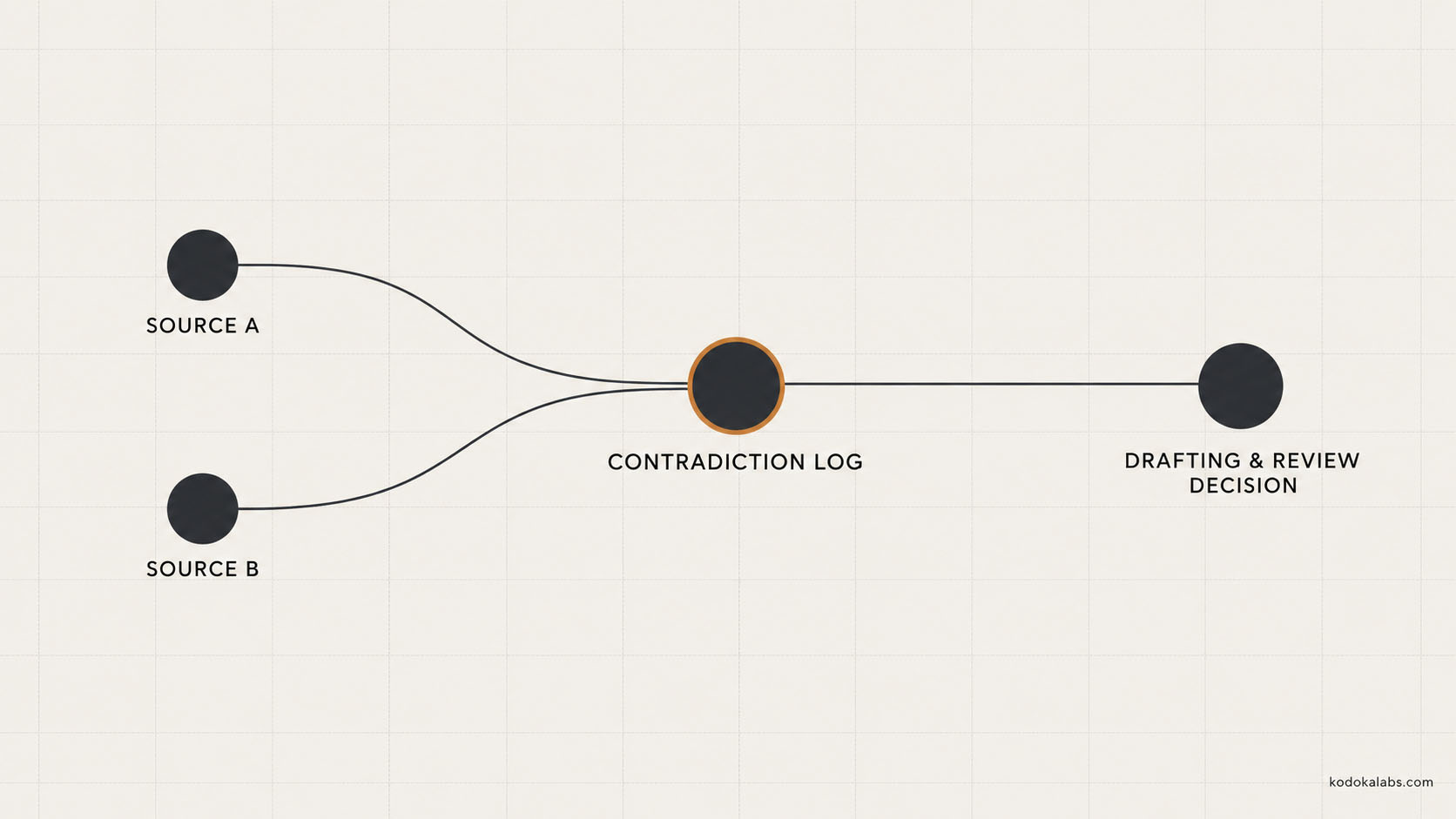
- Contradictory credible evidence should be recorded, not silently resolved by picking whichever source is more convenient. The research packet should show the organization grappled with the conflict, not that it never existed.
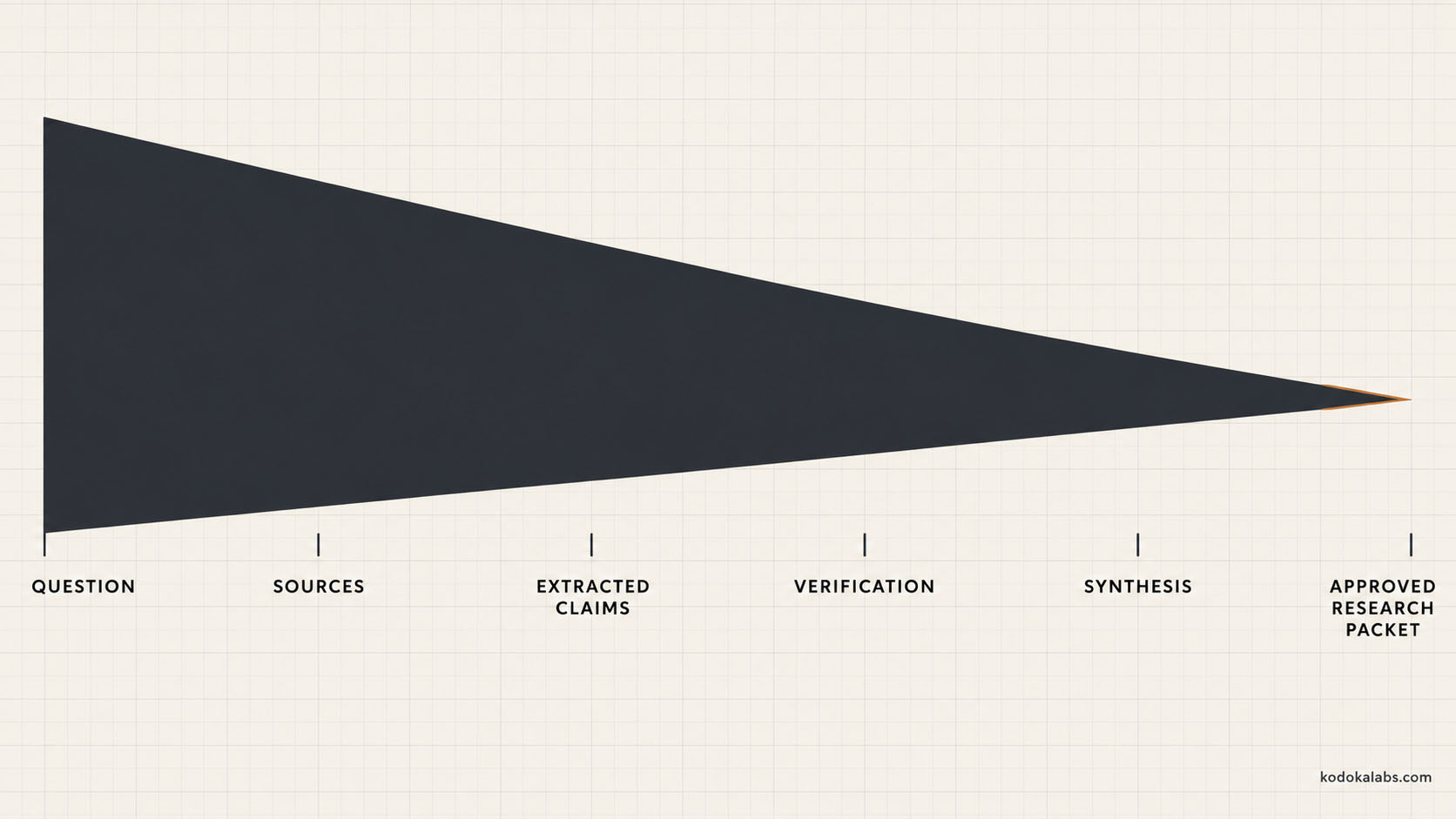
- The output of this workflow is a research packet with named human approval, not a pile of links. Drafting should never begin from unapproved research.
Definition and the Research Failure This Guide Corrects
An AI research workflow is the governed process that takes an approved research question and scope and produces a traceable, evidence-backed set of sources, claims, verification results, identified gaps, and synthesis, before any drafting begins. AI assistance can meaningfully accelerate discovery, extraction, comparison across sources, and the organization of findings into a usable structure. What it cannot do, and what this guide insists an organization never ask it to do unsupervised, is decide which sources are authoritative, interpret ambiguous or conflicting evidence, determine which claims are safe to publish, or make the final call on whether research is complete enough to hand off to drafting.
The specific failure this guide corrects is common enough to name directly, and common enough that most content organizations using generative AI tools have encountered some version of it already: treating a citation a model generates as if it were verified evidence. A generative AI system asked to support a claim will often produce something that looks exactly like a citation, a source name, sometimes a URL, sometimes a page number, with complete confidence and no indication of whether that citation actually exists, actually says what it’s being cited for, or was fabricated to fit the pattern of what a citation should look like. Fast retrieval is not the same thing as verified research, and an organization that conflates the two will, with some regularity, publish confident-sounding claims attributed to sources that either don’t exist or don’t say what the content claims they say.
The promised outcome of this guide is an approved research packet and claim register that a writer or drafting workflow can use safely, without having to re-verify the underlying research themselves. That handoff, from a verified research packet to a drafting task that trusts it, is what makes the four-stage AI Editorial Operating System actually work at the pace AI assistance makes possible.
The Research Contract
Research begins with a contract, not an open-ended instruction to “look into” a topic. The contract specifies the decision the research needs to support, the specific questions that decision depends on, the scope boundaries (what’s explicitly out of scope, to prevent research sprawling into adjacent but unnecessary territory), known risk factors (does this touch a sensitive-tier claim per AI Editorial Governance), and a deadline that’s realistic for the depth the decision actually requires.
A research contract without a clearly stated decision tends to produce research that’s broad but not useful, because nobody defined what “useful” means for this specific case. If the underlying decision is “should we publish a claim that X technology reduces review time by a specific margin,” the research contract should say exactly that, rather than a vague brief to “research AI productivity,” because the specific decision determines what counts as sufficient evidence and what doesn’t.
Scope exclusions deserve the same explicit treatment as scope inclusions. A research contract that doesn’t say what’s out of scope will often expand under its own momentum, since interesting adjacent findings are easy to chase and hard to resist once a researcher, human or AI-assisted, is already deep in a topic. Naming the boundary up front, even roughly, makes it much easier to recognize when research has wandered past its actual purpose.
Risk should be assessed at the contract stage, not discovered partway through research. A contract that will ultimately support a sensitive-tier legal or financial claim should flag that from the outset, so the research team applies the heavier source-tier and verification standard from the first search rather than retrofitting rigor onto research that was originally scoped for a routine claim. Retrofitting is harder and less reliable than starting with the right standard, because it requires someone to remember, after the fact, which sources were checked casually and which deserve a second, more careful look.
The deadline field of the contract deserves equal honesty. A deadline set without reference to the actual evidentiary bar the decision requires tends to produce one of two bad outcomes: research that’s rushed past the point of real verification to hit the date, or a deadline that’s quietly ignored once the team realizes the topic needs more time than planned. Naming the risk tier and the evidentiary bar at the same time as the deadline lets a requester see, up front, whether the timeline is actually realistic for what they’re asking for, rather than discovering the mismatch midway through the work.
Source Strategy
Before research begins in earnest, the workflow builds a source hierarchy appropriate to the claim types the contract requires. Primary sources, original data, official documentation, direct company statements, carry the most weight and should be sought first wherever a claim’s importance justifies the effort. Secondary sources, analysis, commentary, and reporting on primary sources, can provide useful context and framing but should never substitute for checking the primary source directly when a specific factual claim depends on it.
A discovery plan should specify where to look for each claim type before research starts, rather than improvising search strategy claim by claim. And a stopping rule matters as much as a starting plan: research can expand indefinitely if there’s no defined point at which the team decides enough credible, independent sources have been checked. A reasonable stopping rule combines source saturation (additional searching is turning up the same sources repeatedly rather than new ones) with contract fit (the evidence gathered now actually answers the contract’s stated questions).
Source independence deserves particular attention when building the hierarchy, because the modern information environment makes it unusually easy to mistake volume for corroboration. A statistic that originated in a single press release can appear, within days, across dozens of articles, each restating it with its own framing but none of them having independently verified it. A source strategy that counts search-result volume as a proxy for credibility will systematically overrate exactly this kind of claim. The corrective habit is simple to state and easy to skip under time pressure: before treating a widely repeated claim as well-supported, trace at least one instance of it back to where it actually originated, and check whether that original source itself meets the authority and recency bar the claim’s importance requires.
It’s also worth distinguishing a source’s general authority from its fit for a specific claim. A highly authoritative primary source, a major research institution’s published study, is not automatically a strong source for every claim someone might want to attribute to it. The same study might be excellent evidence for one specific finding and silent, or only tangentially related, on an adjacent claim someone is tempted to attribute to it because the source looks credible. Evaluating fit claim by claim, rather than assuming a credible source credibly supports everything nearby, is where the Claim and Evidence Verification stage below does its real work.
| Claim type | Appropriate source tier | Authority consideration | Verification method |
|---|---|---|---|
| Statistical or research finding | Primary (original study, dataset, or official report) | Check publication date, sample, and method | Open the primary source directly; confirm the exact figure and its stated scope |
| Regulatory or legal fact | Primary (the regulation, statute, or official guidance itself) | Confirm current applicability and jurisdiction | Read the specific provision; flag for qualified legal review |
| Industry trend or expert opinion | Secondary, clearly labeled as opinion | Assess the author's stated expertise and any conflict of interest | Distinguish opinion from fact in the claim register; do not present as settled fact |
| Company or product capability | Primary (first-party documentation) | Check documentation date against current product version | Confirm against current first-party docs, not a historical review |
| Historical or definitional fact | Primary where available, otherwise a well-established reference source | Check for consensus across independent sources | Cross-check at least two independent sources for a load-bearing definitional claim |
AI-Assisted Discovery and Extraction
AI assistance is genuinely useful across several discovery and extraction tasks: surfacing candidate sources the research team might not have found through manual search alone, summarizing long source documents to help a human researcher triage what deserves a closer read, extracting specific figures or quotations from a document into a structured format, and comparing multiple sources side by side to identify where they agree, disagree, or simply don’t address the same question.
Each of these tasks needs a human checkpoint before its output is trusted. A list of candidate sources needs a human to confirm those sources actually exist and are reputable before anyone cites them. A summary needs a human to spot-check it against the original document, since a summary can be fluent and confident while subtly misrepresenting what the source actually said. An extracted quotation needs to be checked character-for-character against the original, not approximately matched, because a close paraphrase presented as a direct quotation is a specific and avoidable integrity failure.
The useful framing here is that AI assistance expands what a research team can look at, not what it can conclude. A team that uses AI to triage one hundred candidate sources down to the fifteen worth reading closely has genuinely accelerated its work; a team that lets an AI system decide, unchecked, which of those fifteen sources actually support a given claim has skipped the step the entire workflow exists to enforce.
This boundary is easiest to hold when the workflow’s AI assistance tasks are each narrowly scoped to a specific, checkable output rather than bundled into one open-ended research request. A task scoped as “extract every statistic mentioned in this specific document, with page references” produces an output a human can verify quickly, line by line, against the source. A task scoped as “research this topic and tell me what’s important” produces an output that looks like research but has quietly made dozens of unstated judgment calls about relevance, credibility, and interpretation along the way, none of which the human reviewer can easily unpick after the fact. The first framing is the one this guide recommends; the second is the one that tends to drift, over time, into exactly the unverified-citation failure mode this guide exists to prevent.
Claim and Evidence Verification
This is the stage where research either becomes trustworthy or doesn’t, and it deserves the most rigor of any stage in this workflow. Claim decomposition breaks a piece of research down into its individual factual assertions, since a single paragraph of findings often contains several distinct claims that each need their own verification rather than being checked as a single bundled unit.
Each claim then gets traced to its source: not the nearest document that states it, but the origin point, the original study, the official statement, the primary dataset. A claim that appears in three different articles but traces back to a single original source is supported by one piece of evidence, not three, and the research packet should record that accurately rather than counting repetition as independent corroboration. This distinction, between genuine independent verification and a source simply citing another source, is the single most important discipline in this entire guide, because it’s the one most easily skipped under time pressure and the one whose absence is hardest to detect just by reading the finished content.
Each verified claim gets graded against an evidence strength rubric based on source proximity (how close is this source to the original information), method transparency (can the methodology behind a statistic actually be checked), recency (is this still current, particularly for anything describing a fast-moving capability or market condition), independence (is this corroborated by a genuinely separate source, not a repetition of the same one), and claim fit (does this specific source actually support this specific claim, at this specific level of precision, rather than a related but looser claim).
Contradictions between credible sources should be recorded explicitly in a contradiction log rather than resolved by quietly choosing the more convenient answer. When two reputable sources disagree on a figure or a conclusion, the research packet should note both, note what might explain the discrepancy if that’s discernible (different methodology, different time period, different population), and let the drafting and review stages make an informed decision about how to handle the disagreement in the published content, rather than presenting one side as settled fact.
Verification work is also where AI assistance can quietly reintroduce the exact risk this guide is designed to eliminate, if it’s used carelessly at this stage. Asking a model to “confirm” whether a source supports a claim is a different task from asking a human to open that source and check, and a model’s confirmation carries the same fabrication risk as its original citation did. The safer pattern is to have AI assistance locate and extract the specific passage relevant to a claim, quoted directly, so a human reviewer can read that exact passage and judge for themselves whether it supports the claim as stated, rather than trusting a model’s own judgment about whether support exists.
A claim register maintained this way becomes a genuine organizational asset over time, not just a one-off compliance artifact for a single piece of content. Once a claim has been traced, verified, and graded, it doesn’t need to be re-verified from scratch every time a future piece of content wants to reference it, provided the register tracks when it was last checked and what would trigger a re-check, a new edition of the source, a reasonable staleness window for a time-sensitive figure, or a direct challenge to its accuracy. This is the specific mechanism by which careful research work on one piece of content reduces the research burden on every related piece that follows it.
| Claim ID | Claim (as proposed for use) | Primary source | Evidence strength (proximity / method / recency / independence / fit) | Scope and limitations | Approval status |
|---|---|---|---|---|---|
| Example: RC-01 | "X% of organizations report Y outcome" | Named primary report, publisher, date | Strong proximity, transparent method, current, single-source (flag if not independently corroborated) | Note sample size, population, and any stated limitation from the source itself | Pending reviewer approval |
| Example: RC-02 | "Regulation Z requires disclosure of W" | The specific regulation or official guidance, with provision cited | Strong proximity (primary legal text), requires legal review for current applicability | Note jurisdiction and any transition period or exemption | Requires qualified legal review before use |
Synthesis and Information Gain
Synthesis is where verified evidence becomes something more useful than a list of individual facts: a coherent analysis, a comparison, an original framing that connects findings in a way no single source stated on its own. This is also where research can add genuine information gain, value a reader couldn’t get from any single source already, provided the synthesis stays within what the evidence actually supports rather than extrapolating past it.
The discipline here is distinguishing an inference the evidence actually supports from an inference that merely sounds plausible given the evidence. “Three independent studies found adoption increasing in this category, suggesting the trend is likely to continue” is a reasonable synthesis if those three studies genuinely found that. “This trend will clearly reshape the entire industry within two years” is a claim the same evidence does not support, and a research packet that lets synthesis drift into that kind of extrapolation has quietly exceeded its own evidence base. The synthesis notes field in the research packet should make explicit which conclusions are directly evidenced and which are the research team’s own reasonable interpretation, so that downstream drafting and review know which claims carry which level of confidence.
Genuine information gain tends to come from one of a few specific moves, not from simply restating what a single authoritative source already said. Combining findings from sources that don’t typically get discussed together, applying a general finding to a specific, concrete scenario the sources themselves didn’t address, or identifying a gap, a question the existing evidence base hasn’t actually answered yet, all produce content that offers a reader something they couldn’t get from any single source in the research packet. A synthesis that simply summarizes the single best source in different words has accelerated writing, but it hasn’t added anything a careful reader of that original source wouldn’t already have.
Handoff and Knowledge Capture
The output of this workflow is a Research Evidence Packet: a research contract, a query log documenting what was searched and where, a source register, a claim register with evidence-strength ratings, a contradiction log, a list of identified evidence gaps the research couldn’t close, synthesis notes, any permissions required for specific source material, and a named reviewer’s approval. This packet, not an informal pile of links or a chat transcript, is what hands off to the Drafting stage of the AI Editorial Operating System.
Approved research shouldn’t disappear once a single piece of content is published. Verified sources, claims, and the organization’s own synthesis should flow into the broader AI Marketing Knowledge Base so that the next piece of content on a related topic starts from what’s already verified rather than repeating the same research from scratch. This connects directly to Expert Knowledge Capture for findings that originate from an internal subject-matter expert rather than an external source, and to Authority Engineering for how accumulated, verified research becomes a durable authority asset over time rather than a one-off input to a single article.
The handoff itself deserves a defined acceptance step, not an assumption that the drafting stage will simply trust whatever arrives. A writer or drafting workflow owner receiving a research packet should be able to confirm, at a glance, which claims are approved for use at full confidence, which carry a noted limitation that needs to be reflected in how the claim is phrased, and which remain open gaps the content should either avoid or explicitly flag as unresolved. A packet that hands off cleanly on this dimension prevents one of the more common sources of rework in the Review stage: a reviewer discovering, after drafting, that a claim’s actual evidentiary support was weaker than the finished prose implied.
A mature knowledge base built this way eventually changes the economics of the whole research function. Early in a content program’s life, nearly every piece requires substantial fresh research, since the knowledge base holds very little verified material yet. As the base of approved, graded claims grows, a growing share of new content can draw on material that’s already been through the full verification process, and genuinely new research effort concentrates on the specific gap each new piece actually introduces. This is the same compounding dynamic described across the broader AI Editorial Operating System, applied specifically to the research function rather than to production as a whole.
Failure Modes or the AI Research Workflow
Frequently Asked Questions
How is this different from just asking an AI tool to "research and cite sources"?
Asking a model to research and cite sources, without a defined contract, verification step, and evidence-strength rating, produces exactly the hallucinated-citation risk this guide exists to prevent. This workflow treats AI output as a starting point for human-verified research, not as research itself.
What counts as independent verification of a claim?
A second, genuinely separate source that arrived at the finding through its own investigation, not a source that is itself citing the first source. If tracing a claim back far enough reveals a single original source behind multiple citing articles, that's one piece of evidence, not several, regardless of how many places it appears.
Who approves a research packet before drafting begins?
A named human reviewer with appropriate subject-matter familiarity, documented in the research packet's approval field, per the decision-rights structure in AI Editorial Governance. Drafting should never begin from a research packet that hasn't received this sign-off.
What happens when credible sources genuinely disagree?
The disagreement gets recorded in the contradiction log rather than resolved by picking a side during research. The decision about how to handle a genuine, unresolved disagreement in published content is a drafting and review decision, made with the disagreement visible, not a research-stage decision made by discarding one side.
How does this guide relate to Expert Knowledge Capture?
This guide covers research into external sources, published studies, official documentation, third-party reporting. Expert Knowledge Capture covers eliciting and validating knowledge that exists inside the organization, in a subject-matter expert's experience and judgment, which requires a different elicitation and validation process than source-based research.
Does every piece of content need the full Research Evidence Packet?
The depth scales with the content's risk tier under AI Editorial Governance. A routine internal update needs a lighter version of this process; a sensitive-tier public claim needs the full packet with complete claim-register rigor and, where applicable, qualified legal review of the sources themselves.
Install an Evidence Workflow That Makes Drafting Safer
A research workflow this disciplined makes everything downstream faster, not slower, because drafting and review can trust what they’re building on rather than re-verifying it themselves. The AI Editorial Operating System shows how this research stage connects to drafting, review, and publication in full; AI Editorial Governance defines the risk tiers that determine how deep this research process needs to go for a given piece of content. Organizations ready to install this discipline across their own content operation can start with a kōdōkalabs Executive AI Marketing Assessment.