AI Marketing Knowledge Base: Architecture and Governance

AI Marketing Knowledge Base: Building the Knowledge Layer for Reliable Workflows

An AI marketing knowledge base is a governed collection of approved organizational knowledge, metadata, access rules, ownership, and retrieval mechanisms used by people and AI-enabled workflows.

Executive Summary

AI systems are routinely expected to compensate for fragmented documentation, conflicting facts, inaccessible expertise, and unclear ownership – but retrieval technology can surface content; it cannot decide, on its own, which of several conflicting sources an organization actually treats as authoritative. That decision requires governance, and without it, an AI-assisted workflow is only as reliable as whatever it happens to retrieve, with no way to distinguish a canonical source from an outdated draft. This guide covers the Knowledge Readiness Model, the Canonical Source Hierarchy that resolves conflicting information, the metadata structure that makes knowledge usable by both people and AI systems, and how to handle the contradictions and evidence gaps that inevitably surface once an organization actually looks closely at what it knows.

Key Takeaways:

AI output quality depends on more than model quality – it depends on whether the organization can supply relevant, permitted, current, authoritative knowledge in a retrievable form. Retrieval systems surface content; they don’t resolve which source is authoritative without governance behind them. The Canonical Source Hierarchy ranks sources from source-of-record down to deprecated, so conflicts have a defined resolution path. – Every knowledge object needs metadata – owner, status, effective date, permissions – not just content. – A knowledge base that isn’t fed corrections and feedback degrades quietly over time, even if it looked complete at launch.

What Is an AI Marketing Knowledge Base?

An AI marketing knowledge base is governed knowledge, not just stored content – it’s a collection of approved organizational information, structured with metadata that identifies its owner, status, and freshness, protected by access rules that respect confidentiality boundaries, and connected to a retrieval mechanism that lets both people and AI-enabled workflows find and verify what they need. The word “governed” is doing real work in that definition: a folder of documents is not a knowledge base until someone has decided what’s authoritative, who owns keeping it current, and who’s permitted to see what.

Most organizations already have something that resembles the raw material for a knowledge base – a shared drive, a wiki, a CMS, scattered slide decks – without having done the governance work that turns that material into something an AI-assisted workflow can rely on. That gap is often invisible until an AI system confidently cites something from an outdated deck that was superseded eighteen months ago, because nothing in the underlying storage indicated it had been superseded. The technology didn’t fail in that scenario – it retrieved exactly what was there. The organization’s knowledge simply wasn’t governed well enough to support the reliability the workflow needed.

Knowledge Base vs. Document Repository vs. Search Index vs. RAG

These four terms get used loosely, and the differences matter for what each one can actually deliver.
Term
What It Provides
What It Lacks Without Governance

Document repository

Storage for files
No authority ranking, no metadata standard, no freshness signal

Search index

Findability across stored content
No distinction between authoritative and outdated content

RAG (retrieval-augmented generation)

A technical mechanism connecting a model to external content at query time
No inherent judgment about which retrieved content is correct or current

Governed knowledge base

Authoritative, permissioned, metadata-rich content with defined ownership

RAG in particular is frequently mistaken for a governance solution – it’s a retrieval mechanism, and a well-implemented one can only retrieve what’s actually there. If the underlying content is contradictory, outdated, or unstructured, RAG retrieves contradictory, outdated, or unstructured content just as efficiently as it would retrieve reliable content – the technology has no independent way to know which is which.

Why Model Quality Cannot Fix Knowledge Disorder

A more capable model can reason more effectively over the information it’s given, but it cannot manufacture organizational knowledge that doesn’t exist, and it cannot reliably determine which of two contradictory internal sources reflects current company policy without being told. Organizations sometimes respond to unreliable AI-assisted output by upgrading to a newer or larger model, when the actual constraint is the quality and governance of the knowledge that model has access to. No model upgrade resolves the underlying question of which source the organization treats as authoritative – that’s a governance decision, not a technical one, and it has to be made explicitly.

This is worth stating plainly because it runs counter to a common and understandable instinct: when AI-assisted output is unreliable, the intuitive response is to look for a technology fix – a better model, a different vendor, a more sophisticated retrieval configuration. Sometimes that’s the right diagnosis. But when the unreliability traces back to conflicting internal sources, missing ownership, or outdated content presented with the same confidence as current content, no technology change addresses the actual cause. Organizations that repeatedly upgrade their AI tooling in response to knowledge-quality problems, without ever doing the underlying governance work, tend to find the same category of error resurfacing with each new tool, because the tool was never the source of the problem.

Knowledge Readiness Model

kōdōkalabs - intelligence hub - AI Marketing Operating Systems - AI Marketing Knowledge Base - Knowledge Layer Architecture
AI Marketing Knowledge Base - Knowledge Layer Architecture
kōdōkalabs’ Knowledge Readiness Model evaluates organizational knowledge across eight dimensions before it’s considered ready to support AI-assisted workflows reliably.
Dimension
What It Assesses

Authority

Whether it’s clear which source is the authoritative one when sources conflict

Completeness

Whether relevant knowledge gaps have been identified, not just assumed absent

Structure

Whether knowledge is organized in a form a retrieval system can actually use

Accessibility

Whether the people and systems that need the knowledge can actually reach it

Freshness

Whether knowledge is current, with defined review cycles

Permissions

Whether access respects confidentiality and client boundaries

Traceability

Whether a piece of knowledge can be traced back to its source and approval

Feedback

Whether there’s a mechanism for correcting and improving knowledge over time
A workflow missing several of these components isn’t undocumented in the sense of having zero documentation – it’s documented in a way that leaves specific, predictable gaps, and those gaps are exactly where handover fragility and investigation difficulty come from.

What Belongs in the Marketing Knowledge Layer

The marketing knowledge layer typically includes brand guidelines and voice standards, product and service facts, approved messaging and positioning, customer and market research, performance data and case evidence, legal and compliance constraints relevant to marketing claims, and organizational terminology and framework definitions. Not everything an organization has ever written belongs in this layer – the goal is approved, currently relevant knowledge that workflows can rely on, not a comprehensive archive of every document ever produced. Distinguishing “everything we’ve written” from “what we currently rely on” is itself a governance decision, not just a data-migration exercise.

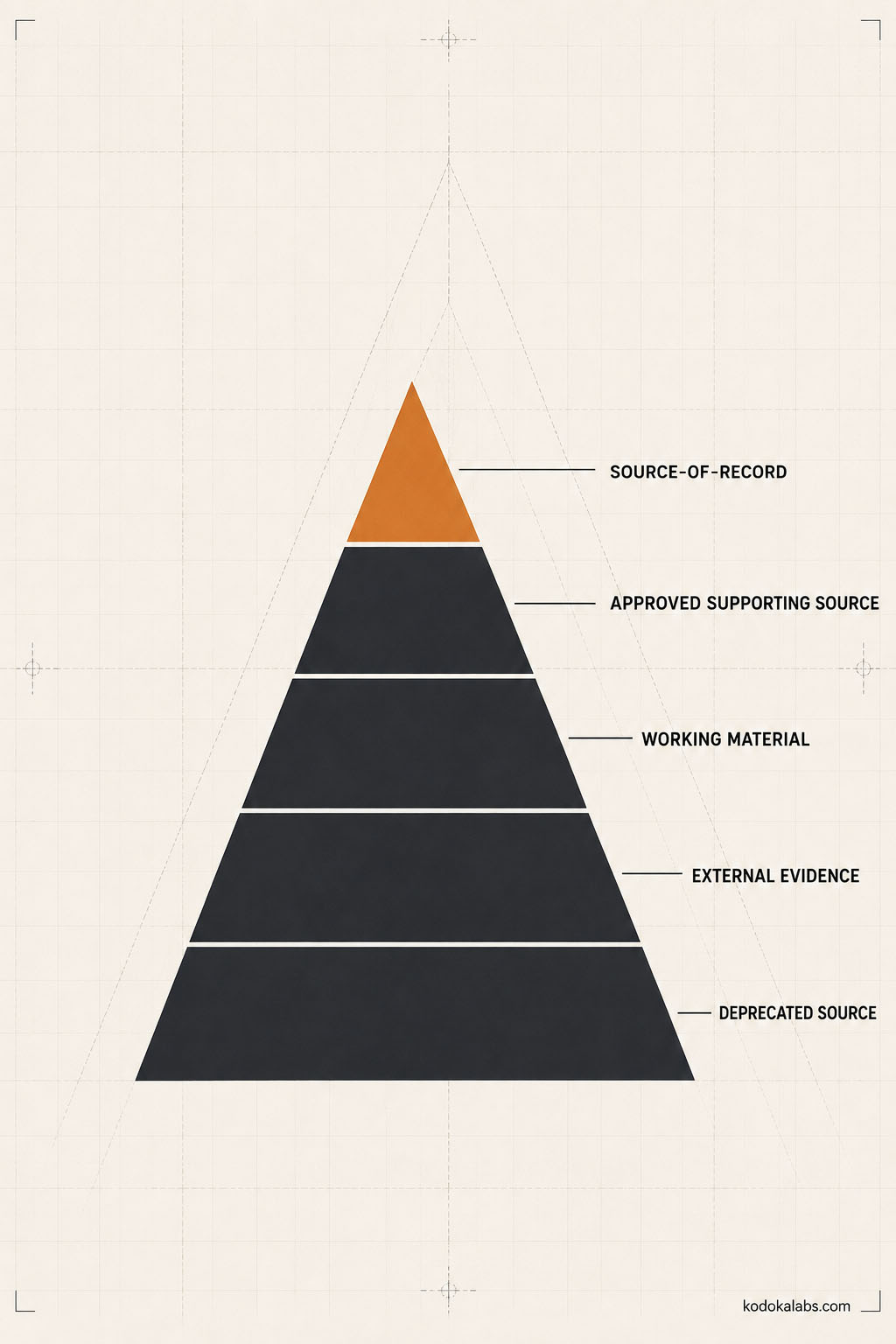
Canonical Source Hierarchy

kōdōkalabs - intelligence hub - AI Marketing Operating Systems - AI Marketing Knowledge Base - Source Hierarchy
AI Marketing Knowledge Base - Source Hierarchy
kōdōkalabs’ Canonical Source Hierarchy ranks knowledge by authority, giving workflows and reviewers a defined way to resolve conflicts rather than guessing.
Rank
Source Class
Description

1

Source-of-record
The single authoritative version for a given fact

2

Approved supporting source

Vetted, current material that supports but doesn’t override the source-of-record

3

Working material
Content in progress, not yet approved for reliance

4

External evidence
Third-party research or data, used with appropriate attribution and currency checks

5

Deprecated source
Formerly authoritative material explicitly retired and flagged as no longer current
When two pieces of content disagree, the hierarchy – not whichever document a practitioner happens to find first – determines which one governs. A deprecated source that hasn’t been clearly flagged as such is a common and preventable cause of AI-assisted workflows citing outdated information with full apparent confidence.

Knowledge Objects, Metadata, and Taxonomy

Every piece of knowledge in a governed knowledge base is a knowledge object carrying structured metadata, not just raw content.
Metadata Field
Purpose

Title and unique ID

Unambiguous identification

Owner

Who’s accountable for this object’s accuracy

Type

What kind of knowledge this is (fact, guideline, research, policy)

Audience

Who this knowledge is intended for

Source status

Where it sits in the Canonical Source Hierarchy

Effective date and review date

When it became current and when it’s due for review

Geography and product/entity

Scope of applicability

Permissions

Who’s allowed to access it

Citations

What it’s based on

Dependencies

What other knowledge objects it relies on or affects

Version

Current revision

Retirement state

Whether it’s active, under review, or deprecated
This metadata is what turns a document into something a retrieval system and a human reviewer can both reason about – without it, every piece of content looks equally current and equally authoritative, which is rarely true.

Ownership, Approval, and Freshness

Every knowledge object needs a named owner accountable for its accuracy, an approval record confirming who signed off on its current version, and a defined review cadence appropriate to how quickly that category of knowledge changes – pricing and product specifications typically need more frequent review than foundational brand principles. Knowledge without an owner tends to go stale invisibly: no one is accountable for noticing it’s out of date, so it simply sits there, silently degrading the reliability of anything built on top of it.

Access, Confidentiality, and Client Boundaries

A marketing knowledge base at a firm serving multiple clients, or one containing genuinely confidential internal information, needs access rules that respect those boundaries at the retrieval level, not just as a policy stated in a document somewhere. This means workflows and AI systems retrieving from the knowledge base need to respect the same permissions a human user would – a workflow serving one client should not have retrieval access to another client’s confidential material, and internal-only knowledge shouldn’t be retrievable by systems serving external-facing outputs.

Retrieval Design and Source Attribution
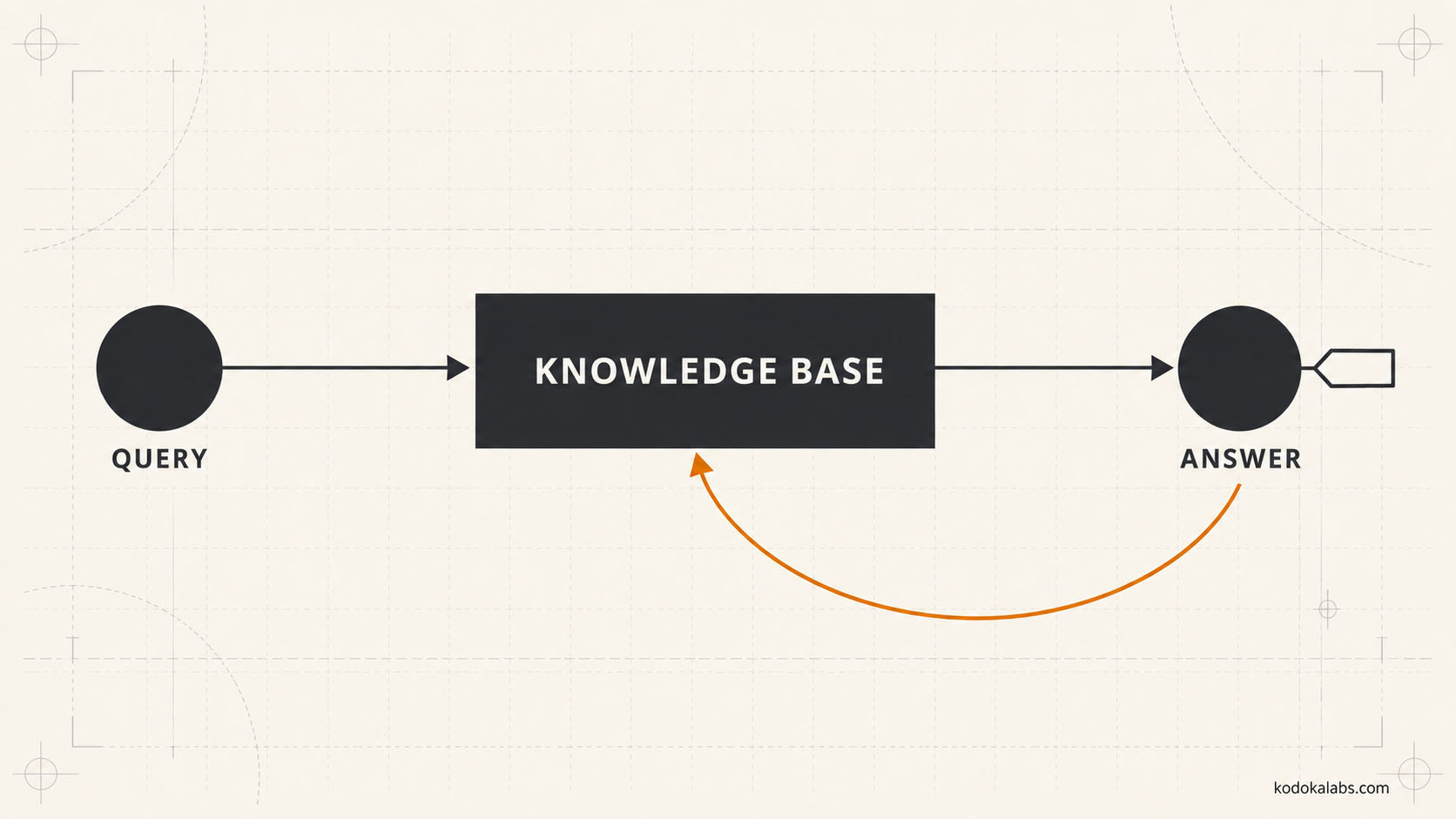
kōdōkalabs - intelligence hub - AI Marketing Operating Systems - AI Marketing Knowledge Base - Retrieval with Citation and Feedback
AI Marketing Knowledge Base - Retrieval with Citation and Feedback
A well-designed retrieval system doesn’t just surface relevant content – it attributes what it retrieved to its source, so a human reviewer can verify the claim rather than trusting the AI system’s synthesis on faith. Retrieval design should prioritize the Canonical Source Hierarchy’s ranking, surface source status and freshness alongside the content itself, and make it straightforward for a workflow to flag when nothing sufficiently authoritative was found – an honest “no reliable source available” is more useful than a confident answer built on a deprecated or low-authority source.

Handling Contradictions and Evidence Gaps

Contradictions between sources and gaps where no approved knowledge exists are both normal discoveries in any real knowledge base – the question is whether the organization has a defined process for handling them or lets them surface as unpredictable AI output instead. A contradiction should route to the object owners for resolution using the Canonical Source Hierarchy; a genuine gap should be logged and flagged rather than silently filled by an AI system’s best guess. Workflows that surface “we don’t have an approved source for this” are providing more real value than workflows that always produce a confident-sounding answer regardless of whether the underlying knowledge actually supports it.

This preference for honest gaps over confident guesses runs against a natural pull in the opposite direction – a workflow that occasionally says “I don’t have a reliable source for this” can feel less impressive than one that always produces a polished, complete-sounding answer, and there’s often organizational pressure to configure systems toward the more impressive-looking behavior. Resisting that pull is one of the more important, and more counterintuitive, governance decisions a knowledge base owner makes. An answer that’s wrong but confident tends to cause more downstream harm than a gap that’s honestly flagged, because the wrong answer gets trusted and acted on, while the flagged gap at least prompts someone to go find the actual answer before proceeding.

Expert Knowledge Capture

A significant portion of an organization’s most valuable knowledge exists only in the heads of specific experienced people – the account manager who knows why a particular client relationship requires careful handling, the product specialist who understands an edge case never written down. Capturing this knowledge deliberately, through structured interviews, review of past decisions, or documentation exercises built into the normal course of work, is what prevents a knowledge base from being limited to whatever happened to already be written down. This capture work should be planned and resourced, not left to happen incidentally whenever someone has spare time.

Feedback, Correction, and Deprecation

A knowledge base needs an active feedback loop: a way for anyone who encounters an error, an outdated fact, or a gap to report it, and a defined process for correcting or deprecating the affected object. Without this loop, a knowledge base that was accurate at launch degrades quietly as the business changes – prices update, products get discontinued, positioning shifts – and nothing in the knowledge base reflects those changes unless someone actively maintains it. Deprecation should be explicit, not just deletion – a formerly authoritative source that’s quietly removed can leave gaps that are harder to notice than one clearly marked as retired.

Measuring Knowledge-Base Health

Knowledge-base health is measurable across several signals: the proportion of objects overdue for review, the frequency of contradictions surfaced during use, the rate of reported errors and how quickly they’re corrected, retrieval success rate (how often a workflow finds an adequately authoritative source), and coverage gaps identified through actual use rather than assumed complete. Treating these as ongoing operational metrics, reviewed periodically, catches degradation before it shows up as unreliable AI-assisted output that erodes trust in the whole system.

Implementation Roadmap

Building a governed knowledge base from scratch is rarely a single project – a practical sequence starts with identifying and ranking existing sources using the Canonical Source Hierarchy, then defining the metadata schema and applying it to the highest-priority knowledge objects first, then establishing ownership and review cadences, then connecting retrieval for a limited pilot workflow, and only then expanding coverage and access as the governance model proves out. Attempting to migrate and structure an organization’s entire knowledge estate before any workflow can use it tends to delay value indefinitely – starting with the knowledge a specific pilot workflow actually needs, done well, tends to build both the governance model and the organizational buy-in to expand from.

Common Failure Modes

  • Mistaking retrieval for governance – assuming a RAG implementation solves knowledge quality on its own, without addressing what’s actually being retrieved.
  • No authority ranking – content that’s technically searchable but has no way to indicate which version is current when sources conflict.
  • Ownerless knowledge – objects with no accountable owner, drifting out of date invisibly.
  • Confidentiality leakage – retrieval systems that don’t respect the same access boundaries a human user would.
  • Silent gap-filling – an AI system producing a confident answer where no authoritative source actually exists, rather than flagging the gap.
  • One-time knowledge projects – treating knowledge-base creation as a project with an end date rather than an ongoing operational discipline.
  • Deletion instead of deprecation – removing outdated content without a clear record of what was retired and why.

Knowledge Readiness Checklist

Before relying on a knowledge base to support AI-assisted marketing workflows, confirm: sources are ranked using the Canonical Source Hierarchy; every knowledge object carries complete metadata; owners are named and review cadences defined; access respects confidentiality and client boundaries; retrieval attributes content to its source; a process exists for handling contradictions and gaps; expert knowledge capture is planned, not incidental; a feedback and correction loop is active; and knowledge-base health is measured on an ongoing basis.

Frequently Asked Questions

Governance - authority ranking through the Canonical Source Hierarchy, structured metadata on every object, defined ownership and freshness cycles, and access controls that respect confidentiality - not just the presence of a retrieval mechanism like RAG.
A repository stores files and a search index makes them findable, but neither inherently distinguishes authoritative, current content from outdated or contradictory material - see the comparison table above.
No. A more capable model can reason better over the information it's given, but it can't manufacture missing organizational knowledge or reliably resolve which of two contradictory sources is current without being told.
A five-level ranking - source-of-record, approved supporting source, working material, external evidence, deprecated source - that gives workflows a defined way to resolve conflicting information.
At minimum: title, ID, owner, type, audience, source status, effective and review dates, scope, permissions, citations, dependencies, version, and retirement state.
Retrieval systems should respect the same access permissions a human user would - a workflow shouldn't retrieve content it wouldn't be permitted to see if a person requested it directly.
No. Retrieval can only surface what's actually in the knowledge base - if the underlying content is outdated, contradictory, or unstructured, retrieval will surface that unreliable content just as readily as reliable content.
Routed to the relevant object owners for resolution using the Canonical Source Hierarchy, rather than left for an AI system to arbitrate on its own or for a workflow to surface inconsistently.
Through deliberate, resourced capture work - structured interviews, review of past decisions, documentation built into normal workflows - rather than waiting for it to be written down incidentally.
Through signals like the proportion of overdue reviews, frequency of surfaced contradictions, error-correction turnaround, retrieval success rate, and coverage gaps identified through actual use.

Conclusion

A governed knowledge base is the layer that makes every other capability in the AI Marketing Operating Systems cluster – prompt architecture, multi-agent coordination, content quality control – actually reliable, because all of them depend on the knowledge those systems draw from being current, authoritative, and traceable. Organizations that invest in workflow design and tooling while leaving their underlying knowledge ungoverned tend to find that no amount of downstream process improvement compensates for an unreliable knowledge layer.

Are you ready to
Build Your Marketing Knowledge Layer?