
Building a Knowledge Graph for AI Visibility: Technical Implementation Guide
What This Guide Builds, And Its Dependency On Knowledge Graphs
Building a Knowledge Graph makes the business case for a governed entity and relationship record and introduces the Minimum Viable Marketing Knowledge Graph specification. This guide is its technical companion: how to actually build that graph, from defining what questions it needs to answer through modeling, identity, provenance, technology choice, ingestion, validation, retrieval, and public projection. If your organization has not yet decided why it needs a knowledge graph, start there. This guide assumes that decision is made and the question is now how to build it well.
One point carries over directly and is worth restating here: buying graph database software does not create authority, visibility, or AI citation. Technology is a storage and query layer for a governed record; the governance, the provenance, and the accuracy of that record are what create value. This guide stays technology-neutral where possible and explicitly avoids implying that a specific product purchase is the meaningful step.
Use Cases And Competency Questions For Building A Knowledge Graph
Modeling Entities And Relationships
With competency questions in hand, model the entities and relationships that answer them. Each entity gets a type (Organization, Person, Product, Service, Concept, following the same typing used across this pillar), a set of attributes relevant to the competency questions, and a set of typed relationships (predicates) connecting it to other entities, such as “founder of,” “originated by,” or “applies.”
Keep the relationship vocabulary controlled: a fixed, documented list of predicate types the organization uses consistently, rather than free-text relationship descriptions that vary from entry to entry. This is what separates a genuinely queryable graph from an unstructured list of facts. Where the organization later adopts formal semantic-web standards, this controlled vocabulary can be expressed as RDF triples (subject-predicate-object statements) or as a property graph’s edge types; the modeling discipline is the same regardless of which storage technology is chosen, which is covered next.
Identity And Provenance
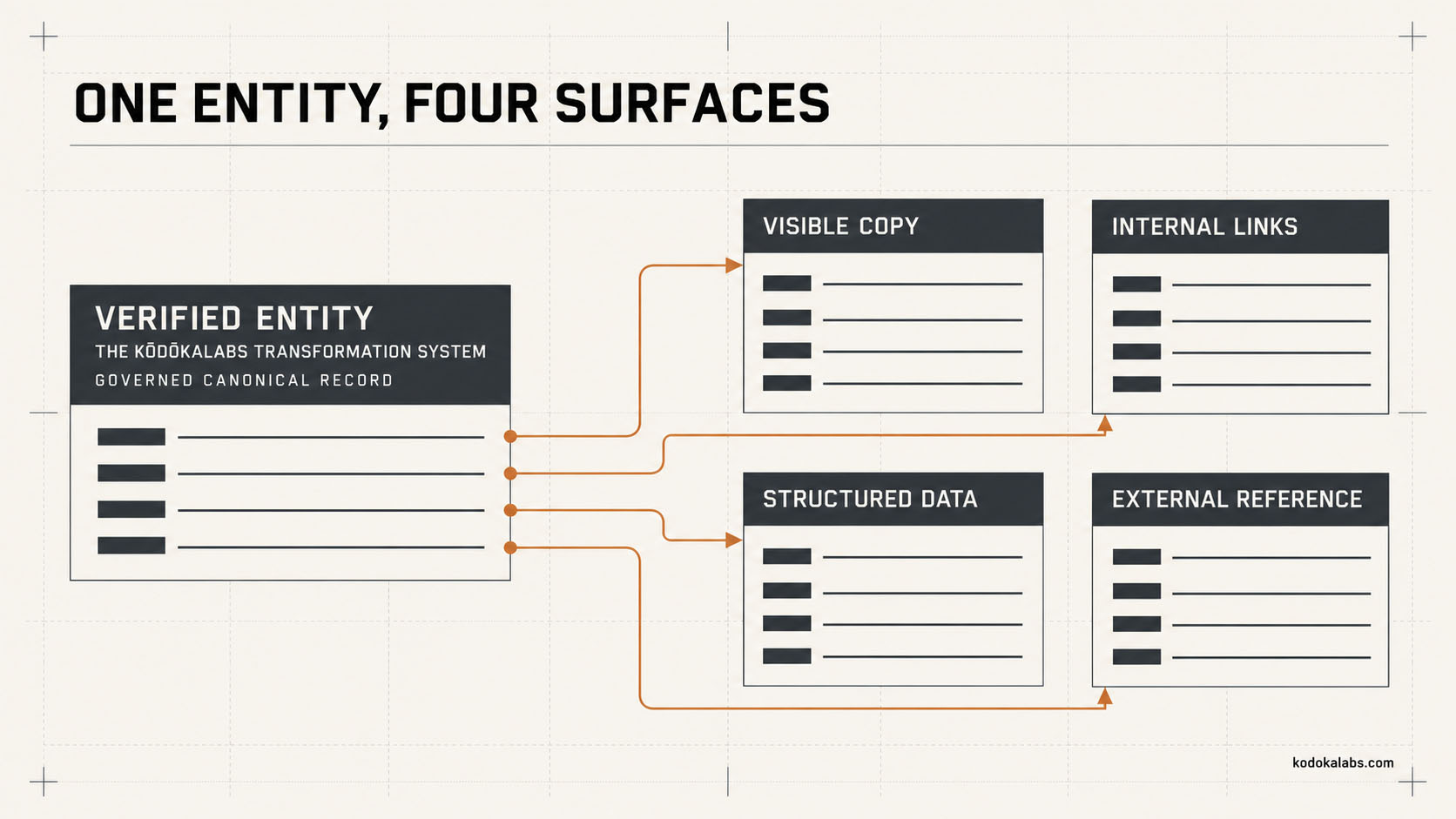
Every entity needs a stable, unique identifier that does not change even if the entity’s name or description is later updated. This identifier, not the display name, is what relationships and cross-references should point to internally. Where the organization implements structured data using shared `@id` values, this internal identifier and the public-facing `@id` should be coordinated, so the internal graph and the public projection stay resolvable to the same entity.
Provenance is mandatory, not an optional appendix. Every non-obvious fact in the graph needs a recorded source: an internal document, a verified external record, or a dated first-party observation, along with when it was captured and who is accountable for it. Establish a source hierarchy for cases where facts might conflict, for example: a verified legal record outranks an internal fact sheet, which outranks an informal note, so that discrepancies have a documented resolution rule rather than an ad hoc judgment call each time.
Technology And Storage Choice To Building A Knowledge Graph
| Approach | Complexity to implement | Query needs it suits | Governance | Portability | Relative cost |
|---|---|---|---|---|---|
| Structured spreadsheet or lightweight CMS content type | Low | Simple lookups, small entity counts, manual governance | Straightforward; a single owner can maintain it directly | High; easy to export and migrate | Low |
| Relational database | Moderate | Structured queries across a moderate number of well-defined entity types | Requires a defined schema and change process | Moderate; requires a defined export process | Moderate |
| Document database | Moderate | Flexible, semi-structured entity records with varying attributes | Requires application-level validation discipline | Moderate | Moderate |
| Graph database (property graph or RDF triple store) | High | Complex, multi-hop relationship queries at meaningful scale | Requires dedicated technical ownership and formal validation tooling (for example, SHACL for RDF) | Depends on standards adherence; RDF is more portable than proprietary graph formats | Higher |
Ingestion And Quality Pipeline
Populating and maintaining the graph needs a defined pipeline, not ad hoc manual entry that degrades over time. At minimum, this pipeline should include a defined ingestion step, where new or updated facts enter the graph from an identified source with recorded provenance; a deduplication step, checking whether an incoming entity already exists under a different name or partial record before creating a duplicate; and validation rules that check new or updated entries against required fields (entity type, canonical name, source of truth, provenance) before they are considered complete.
Deduplication deserves particular attention, since it is the most common source of graph quality decay. A simple, effective control is requiring a documented uniqueness check, does an entity with this name, or a close variant, already exist, before any new entity record is created, rather than relying on whoever is entering data to remember every prior entry.
Schedule a recurring review, not a one-time audit, since entity facts (a role, a product scope, a published work) change over time and drift back toward inconsistency without an owner checking periodically.
Retrieval And Public Projection
The graph’s value is realized through retrieval: how internal teams, tools, and AI-assisted workflows query it, and how selected parts of it are projected into public content. Internally, this might mean a content team querying the graph before writing to confirm the current canonical definition of a proprietary framework, or an AI-assisted drafting workflow being grounded against the graph’s verified facts rather than the model’s own unverified assumptions.
Publicly, the projection step should draw directly from the graph’s publication-mapping field (established in Knowledge Graphs’ minimum viable architecture), which entities and which specific approved facts are appropriate for public pages, internal linking anchor text, and structured data. This is also where access control becomes essential: entities and attributes marked confidential in the graph must never be pulled into a public projection by mistake, and the publishing pipeline should enforce this as a hard rule, not a manual reminder.
Operations, Security And Handover
A knowledge graph is an operational system, not a one-time deliverable, and needs the same operational discipline as any other production system. Version changes to entity records so that prior states are recoverable if an error is introduced. Monitor for drift between the graph and its downstream public projections, since a graph that is updated without its projections being refreshed accordingly creates exactly the inconsistency the graph was built to prevent. Classify every entity and attribute by access level, public, internal, or confidential, at the point of entry, not as an afterthought.
Handover matters as much here as in any other kōdōkalabs engagement: whoever builds the initial graph should produce an operating runbook covering how to add an entity, how to resolve a provenance conflict, how to run the deduplication check, and who owns ongoing governance, so the organization’s own team can operate and extend the graph without permanent dependence on external implementation support.
Ingestion And Quality Pipeline
Populating and maintaining the graph needs a defined pipeline, not ad hoc manual entry that degrades over time. At minimum, this pipeline should include a defined ingestion step, where new or updated facts enter the graph from an identified source with recorded provenance; a deduplication step, checking whether an incoming entity already exists under a different name or partial record before creating a duplicate; and validation rules that check new or updated entries against required fields (entity type, canonical name, source of truth, provenance) before they are considered complete.
Deduplication deserves particular attention, since it is the most common source of graph quality decay. A simple, effective control is requiring a documented uniqueness check, does an entity with this name, or a close variant, already exist, before any new entity record is created, rather than relying on whoever is entering data to remember every prior entry.
Schedule a recurring review, not a one-time audit, since entity facts (a role, a product scope, a published work) change over time and drift back toward inconsistency without an owner checking periodically.
Sprint Plan And Failure Modes
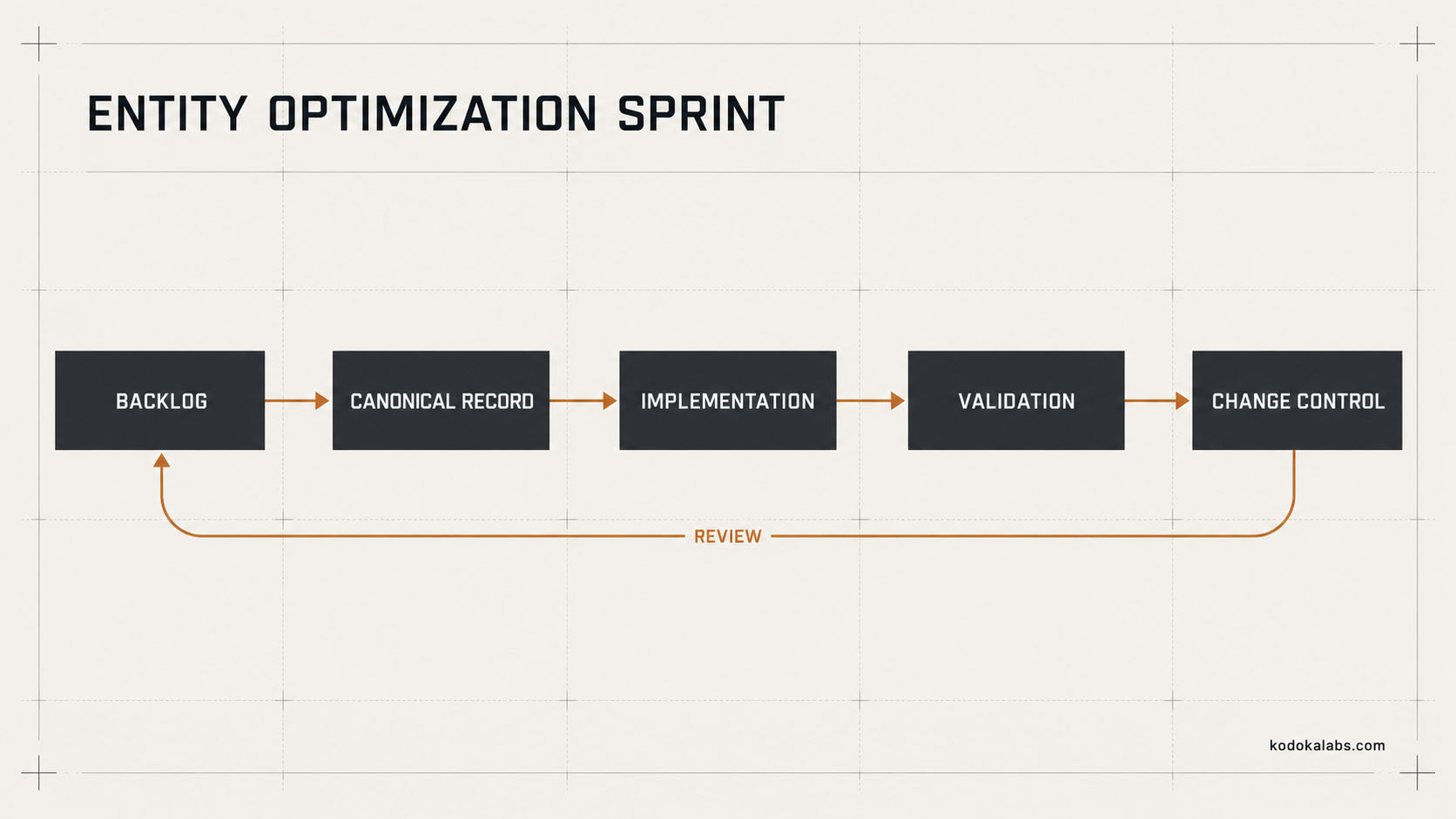
A first Entity Optimization Sprint typically works best scoped to a small number of high-priority entities, perhaps three to five, rather than attempting the full inventory at once. Run the five stages in order: build the backlog, produce canonical entity records for the entities in scope, implement across pages and structured data, validate against the severity model above, and log the outcome with a scheduled review date. Treat the first sprint as a template to refine before scaling to the rest of the entity inventory.
The most common failure mode is skipping the canonical entity record and moving straight to structured data. Without a documented source of truth, technical implementation has nothing authoritative to validate against, and inconsistencies resurface as soon as more than one person touches the content. A second common failure mode is treating validation as a one-time launch step rather than a recurring discipline, which allows entities to drift back out of alignment within months.
Frequently Asked Questions
How is this different from the Entity SEO guide?
Entity SEO explains why entity clarity matters and introduces the underlying concepts. This guide is the practitioner workflow: how to actually run an entity optimization project, artifact by artifact, from backlog to governed change control.
How many entities should a first sprint cover?
Start small, typically three to five high-priority entities, rather than attempting a full-site rollout immediately. A focused first sprint produces a validated template that scales more reliably than an unbounded initial effort.
Do we need a knowledge graph before starting this?
No. A formal knowledge graph, covered in Building a Knowledge Graph for AI Visibility, is a more advanced data architecture for representing many entities and relationships at scale. This sprint can and should happen first, on a smaller set of priority entities, using the canonical-record pattern described here.
What if we cannot corroborate an entity externally yet?
Log the gap honestly in the canonical entity record rather than manufacturing a weak or unrelated substitute. A missing external corroboration is a normal state for a newer or lower-visibility entity.
Who should own the canonical entity records long-term?
Whoever has decision authority over the underlying facts, typically a content or brand owner for most entities, working alongside technical SEO for the structured-data implementation. The record needs one accountable owner, not a shared or ambiguous one.
How often should entity records be reviewed?
On a recurring schedule tied to how likely the underlying facts are to change; a founder's biography might be reviewed annually or on any material change, while a product entity tied to an active roadmap might need quarterly review.
Contextual Solution Pathways
Turn entity strategy into a governed implementation across content, data, and workflows inside the AI Marketing Operating System.