
Advanced Marketing Automation with AI:
A Governed Model
Advanced Marketing Automation with AI: From Rules to Governed Orchestration
Executive Summary
Key Takeaways:
- Advanced automation is governed orchestration across systems, data, AI, and human decisions – not simply a longer sequence of no-code steps.
- The Automation Maturity Ladder describes six levels of increasing independence – higher is not automatically better for a given task.
- The Automation Readiness Test evaluates whether a workflow is actually prepared for more automation, across ten factors.
- Every automation needs defined permissions, exception handling, observability, and a stop condition – a workflow that only works when everything goes right isn’t ready for production.
- Value should be measured beyond time saved – quality, cost structure, risk, and commercial contribution all matter too.
What Is Advanced Marketing Automation?
Advanced marketing automation is the coordinated orchestration of data sources, business rules, AI systems, tools, human decision points, and feedback loops across a complete, defined workflow, aimed at a measurable business output that improves over time. This is meaningfully different from stringing together a longer sequence of no-code triggers and actions – the word “governed” is what separates advanced automation from simple automation: explicit permissions, exception handling, observability, and human oversight designed in from the start, not bolted on after something breaks.
This distinction shows up clearly in how each kind of automation fails. Simple, ungoverned automation tends to fail invisibly – it keeps running, producing output that’s gradually drifted from what was intended, with no one noticing until the cumulative effect becomes obvious downstream, often in a customer complaint or a brand inconsistency someone happens to spot manually. Governed automation, by contrast, is designed to fail visibly and safely: an unexpected condition triggers a defined fallback or stop, an anomaly gets logged and flagged, and a human is notified rather than left to discover the problem days or weeks later. The difference isn’t that governed automation fails less often – all automation eventually encounters something it wasn’t designed for – it’s that governed automation is designed around the assumption that it will, and simple automation typically isn’t.
Traditional Automation vs. AI-Assisted Automation vs. Agents
Type
Description
Traditional automation
AI-assisted automation
Agentic automation
The Automation Maturity Ladder
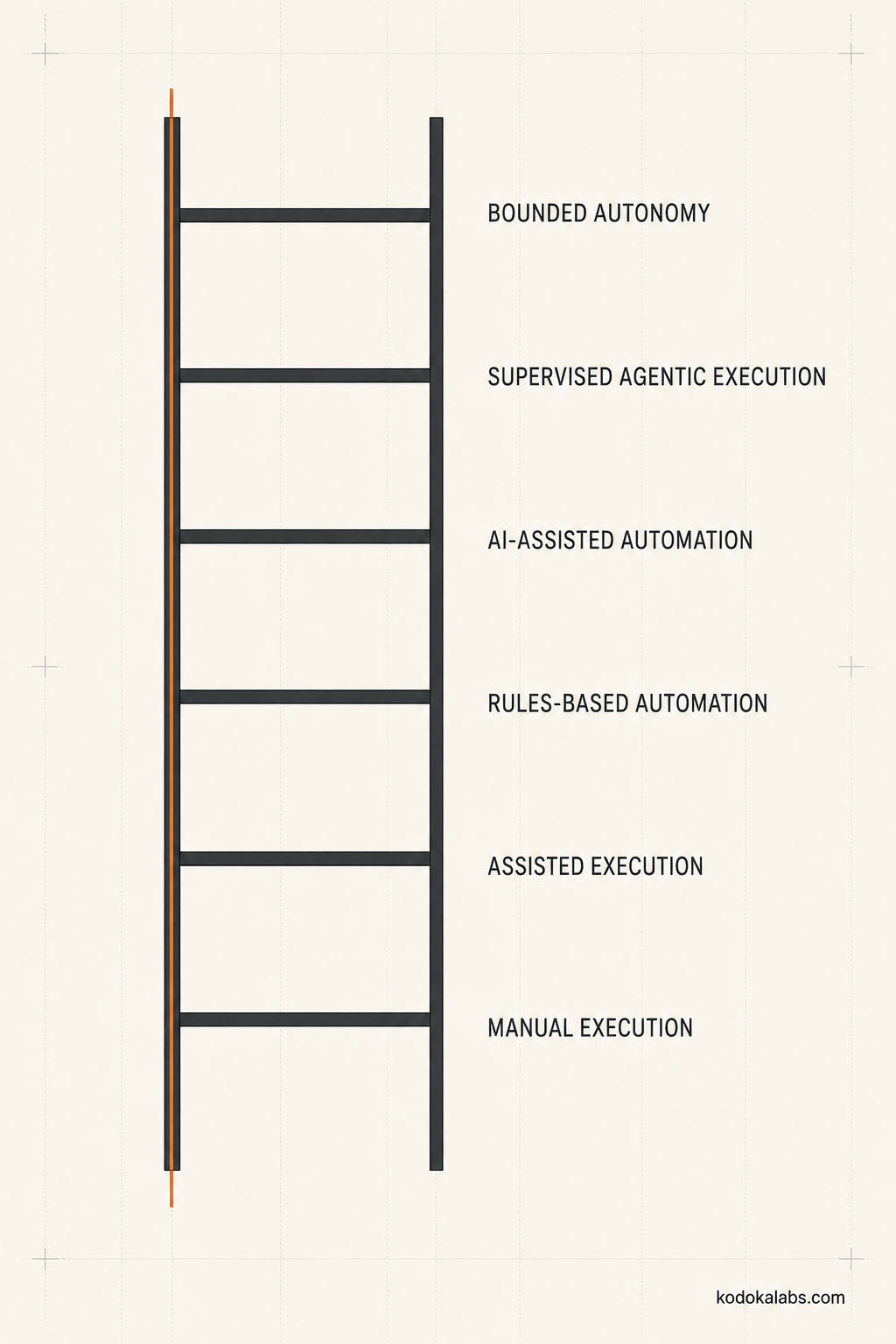
Level
Description
1. Manual execution
2. Assisted execution
3. Rules-based automation
4. AI-assisted automation
5. Supervised agentic execution
6. Bounded autonomy
What Should Be Automated-and What Should Not
Tasks well suited to automation tend to be stable, high-volume, well-standardized, and reasonably tolerant of occasional error caught downstream. Tasks poorly suited to automation tend to be ambiguous, low-volume, highly context-dependent, or carry serious consequences if something goes wrong without being caught quickly. Some tasks should not be automated regardless of technical feasibility – final legal sign-off, for instance, or decisions carrying significant consequence for an individual, where the value of a genuinely human decision outweighs any efficiency gain from automating it.
This distinction is worth making explicit because “can this be automated” and “should this be automated” are answered by different questions entirely. Technical feasibility has expanded rapidly – a growing range of judgment-requiring marketing tasks can now be performed by an AI system with reasonable competence. But feasibility says nothing about whether removing a human decision-maker from a specific point in the process is the right call for that organization’s risk tolerance, its regulatory environment, or the people affected by the decision. A useful habit is to treat “should this be automated” as a governance question requiring its own explicit sign-off, separate from and prior to any technical feasibility assessment, rather than letting feasibility quietly answer the should-we question by default.
Automation Readiness Test
Factor
What It Assesses
Stability
Volume
Decision clarity
Data quality
Exception frequency
Reversibility
Observability
Security
Ownership
Measurable value
Architecture Layers
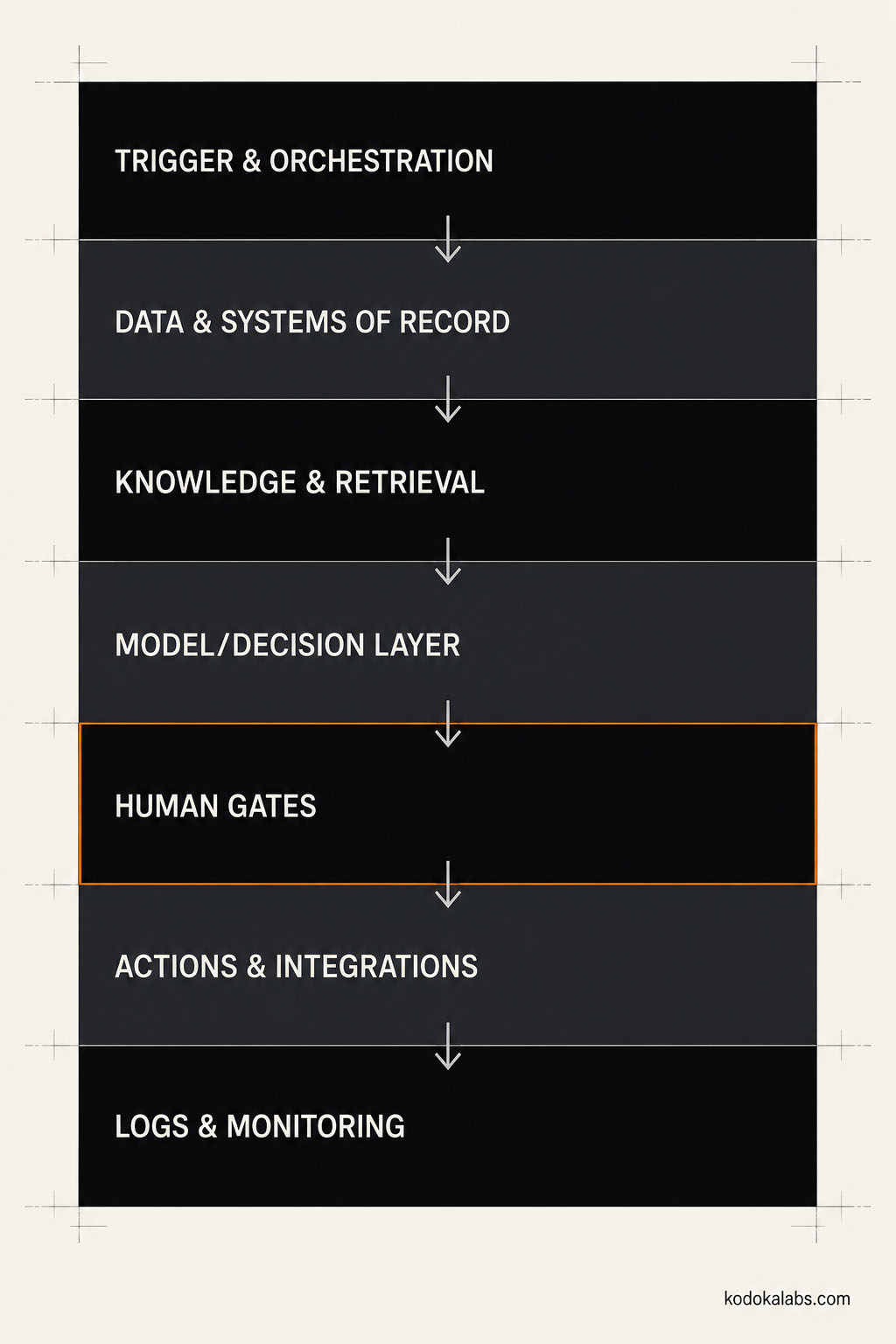
Trigger and orchestration
What starts the automation, and the logic coordinating its subsequent steps.
Data and systems of record
Knowledge and retrieval
Model or decision layer
Human gates
Actions and integrations
Logs, monitoring, and measurement
What’s recorded about the automation’s operation, and how its performance is tracked.
Skipping any one of these layers in the design – building actions and integrations without corresponding logs and monitoring, for instance – tends to produce an automation that works until something unexpected happens, at which point there’s no way to understand what occurred.
Permissions and External Actions
Exceptions, Retries, Fallbacks, and Stop Conditions
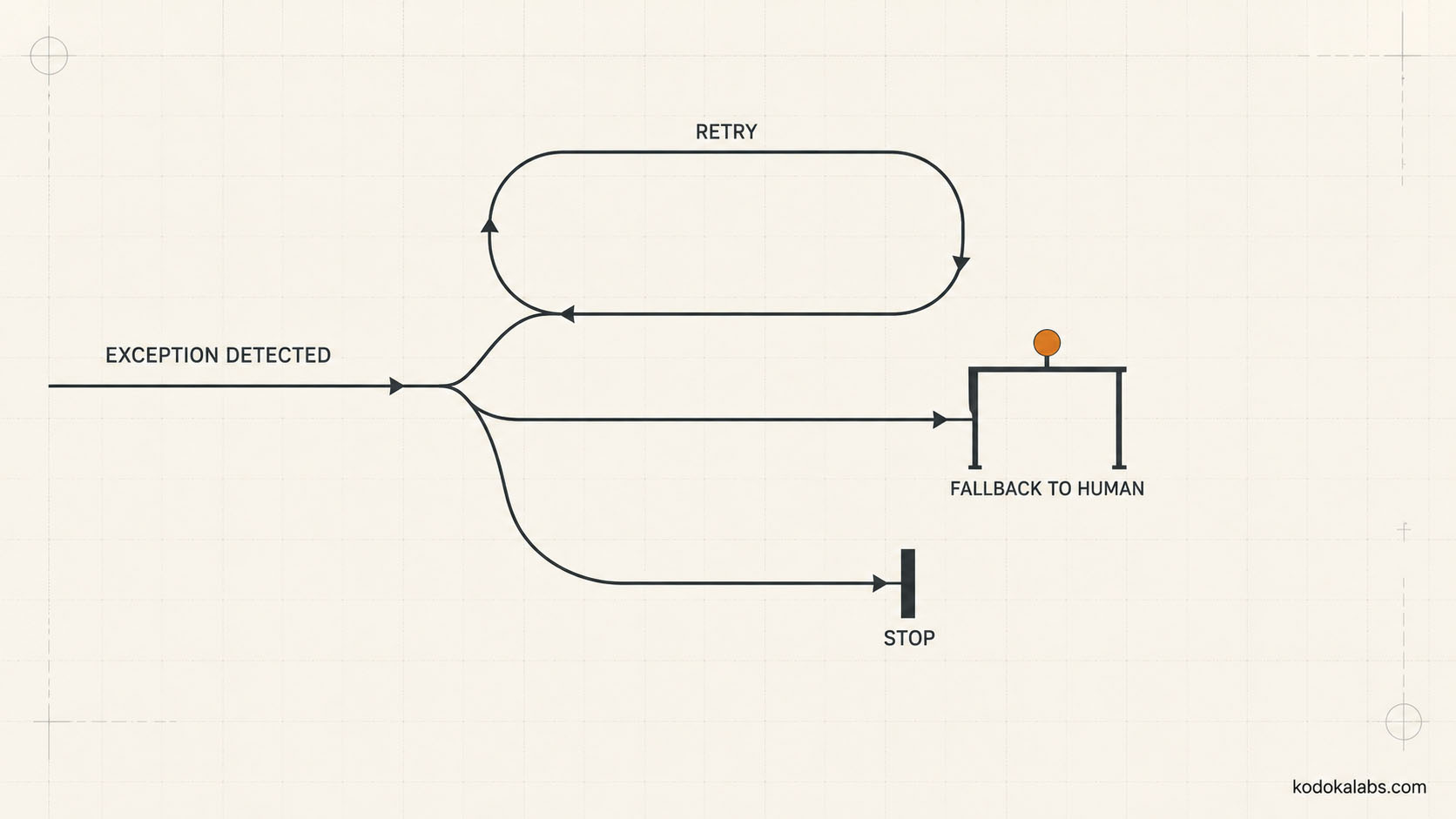
An automation that only works when every input arrives as expected isn’t production-ready – real-world data is messy, systems are occasionally unavailable, and edge cases will occur regardless of how carefully the automation was designed. Well-governed automation defines what happens on failure: a retry policy for transient issues, a fallback path (often routing to human handling) for cases the automation can’t resolve, and explicit stop conditions that halt the automation rather than letting it continue operating on a possibly-corrupted state. Designing these paths in advance, rather than improvising a response the first time a failure actually occurs, is what separates automation that degrades gracefully from automation that fails in ways nobody anticipated.
Retry policies deserve particular care, because a naive retry – simply attempting the same failed action again – can turn a transient glitch into a much bigger problem if the underlying cause wasn’t actually transient. An automation that retries a failed publish action repeatedly against a system that’s genuinely down, rather than failing fast and escalating, can create duplicate content once the system recovers, or exhaust resources that other parts of the workflow needed. A well-designed retry policy distinguishes between errors worth retrying (a brief network interruption) and errors that indicate a structural problem requiring human attention (a permissions failure, a malformed input) – treating every failure the same way, with the same retry logic, tends to handle neither case well.
Testing and Pilot Design
Automation should be tested against representative conditions before production deployment – not just the clean scenario used during initial development, but the messy inputs, unusual timing, and edge cases the automation will actually encounter. This connects directly to Pilot Review, kōdōkalabs’ method for validating a workflow against realistic and adversarial conditions before wider deployment – an automation pilot that never tests a failure scenario has not actually validated the exception-handling design described above.
Observability and Incident Investigation
Measuring Value Beyond Time Saved
Time saved is the most commonly cited automation metric and, on its own, one of the least reliable measures of genuine value – it typically doesn’t account for the review and correction time the automation’s output requires, the cost of exceptions that had to be handled manually, or whether the automation’s output actually performed as well commercially as what it replaced. A fuller measurement approach, consistent with kōdōkalabs’ broader AI Marketing Value Scorecard, considers efficiency, quality, risk, capability, and commercial contribution together – an automation that saves drafting time while quietly increasing downstream review burden and introducing new risk hasn’t necessarily created net value, even though the time-saved number looks good in isolation.
Time-saved figures are also unusually easy to overstate, because they’re typically calculated by comparing automated execution time against an estimate of how long the manual process used to take – an estimate that’s rarely measured rigorously and often reflects an optimistic memory of how efficient the manual process actually was. A more honest accounting compares the full cost of the automated workflow, including review, correction, exception handling, and maintenance, against the full cost of the process it replaced, measured the same way. Organizations that skip this fuller comparison and report only the headline time-saved figure risk making scaling decisions based on a number that doesn’t reflect what the automation is actually costing to run.
Scaling and Change Control
Build, Buy, Configure, or Integrate
Organizations building advanced automation face a recurring decision about how to source each component: build custom logic in-house, buy a vendor solution that already handles the need, configure an existing platform’s built-in automation features, or integrate several existing systems together. Each option trades off differently on cost, control, time to deploy, and long-term maintenance burden – a custom-built solution offers the most control but the highest maintenance cost; a vendor solution can deploy faster but ties the organization to that vendor’s roadmap and limitations. This decision should be made deliberately per component, based on the specific requirements of that piece of the automation, rather than defaulting to the same approach for every part of the system.
Common Failure Modes
- Demonstration-driven design – an automation built and validated only against clean, favorable conditions that don’t reflect production reality.
- No exception handling – an automation with no defined behavior for the inputs and conditions it wasn’t explicitly designed for.
- Excessive permissions – broad access granted for convenience rather than scoped tightly to what each action actually requires.
- Insufficient observability – logging too coarse to investigate what happened when the automation misbehaves.
- Time-saved tunnel vision – measuring only hours saved while ignoring quality, risk, and downstream review cost.
- Uncontrolled changes – modifying a production automation without documentation, testing, or a rollback plan.
- Autonomy for its own sake – advancing a workflow up the maturity ladder because the technology allows it, not because evidence supports it.