
AI-Ready Marketing SOPs: Structure and Governance
AI-Ready Marketing SOPs: Documenting Human–AI Execution
Executive Summary
Key Takeaways:
- Traditional SOPs assume a trained human will fill contextual gaps — AI-enabled workflows need those gaps made explicit instead.
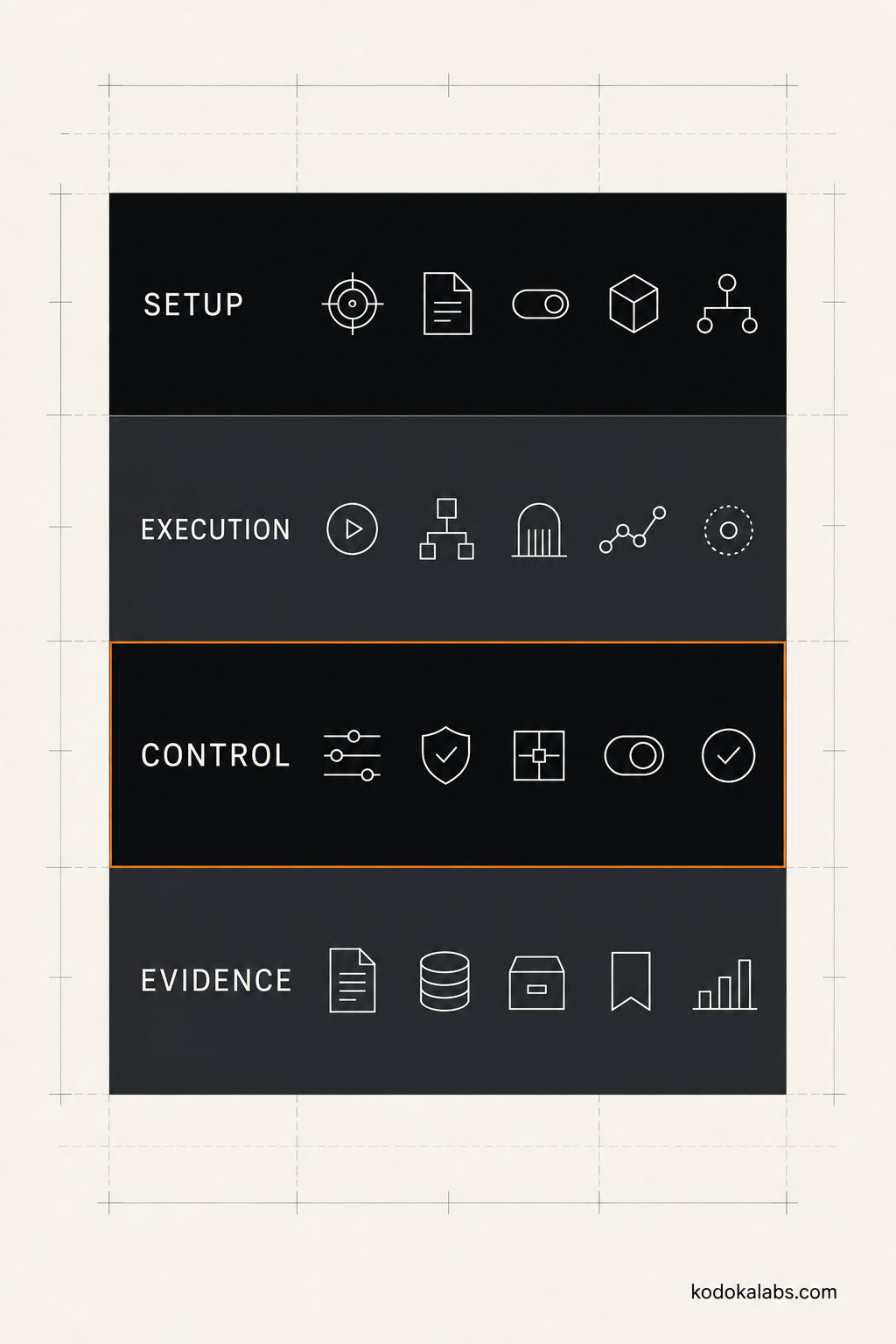
- An AI-ready SOP has a defined anatomy: purpose, scope, trigger, owner, roles, inputs, procedure, human gates, output criteria, exceptions, escalation, records, and measures.
- The Ambiguity Test identifies steps that rely on tribal knowledge, subjective terms, or undocumented recovery — the places a traditional SOP silently depended on human judgment.
- Being AI-ready doesn’t mean eliminating judgment — it means being honest about where judgment is still required.
- SOPs, workflow maps, playbooks, and operating manuals are related but distinct documentation types, each serving a different purpose.
What Is an AI-Ready Marketing SOP?
Why Traditional SOPs Break in AI-Enabled Workflows
A traditional SOP written for an experienced human executor can afford to be somewhat vague, because the person reading it fills gaps with contextual judgment the document never had to spell out — “use good judgment when the client’s tone seems off” means something concrete to an experienced marketer and means almost nothing actionable to an AI system following the same instruction. AI-enabled workflows expose every implicit assumption a traditional SOP relied on: which source counts as authoritative, what threshold separates an acceptable output from one needing revision, what specifically triggers escalation. An SOP that was perfectly workable for a trained human can be nearly unusable as a specification for an AI-assisted step, not because the underlying process changed, but because the document never actually specified what it assumed a human would supply.
This is often the moment organizations discover just how much of their operational knowledge was never actually documented in the first place. A team might have been running a marketing process smoothly for years using an SOP that, read literally, is missing half the information needed to execute it — because the missing half lived entirely in the experienced staff member’s head, filled in automatically without anyone noticing the document itself was incomplete. Attempting to hand that same SOP to an AI-assisted workflow surfaces the gap immediately and often uncomfortably, since the AI system has no equivalent tacit knowledge to draw on and will either fail visibly or, more concerning, fill the gap with a plausible-sounding but ungrounded assumption of its own.
SOP vs. Workflow Map vs. Playbook vs. Operating Manual
Type
Purpose
Workflow map
SOP
Playbook
Operating manual
Anatomy of an AI-Ready SOP
Component
What It Specifies
Purpose
Scope
Trigger
Owner
Roles
Prerequisites
Approved systems
Data and knowledge inputs
Procedure
Prompts or agent references
Human gates
Output criteria
Exceptions
Escalation
Records
Measures
Version history
How to Capture the Current Procedure
Writing an AI-ready SOP starts with observing or documenting how the procedure actually happens today, not how it’s assumed to happen – the same current-state discipline described in AI Marketing Workflow Design. This captures the real sequence, including informal workarounds and undocumented judgment calls, which is exactly the raw material the next step needs to work with.
How to Expose Hidden Judgment and Tribal Knowledge
kōdōkalabs’ Ambiguity Test identifies specific patterns in a captured procedure that indicate hidden judgment an AI-ready SOP needs to make explicit: steps relying on tribal knowledge only one person holds, subjective terms without a defined threshold (“if the tone seems off,” “when appropriate”), missing thresholds for otherwise-quantifiable decisions, implicit permissions no one has actually written down, and undocumented recovery paths for when something goes wrong. Running a captured procedure through this test surfaces exactly the gaps that would otherwise only become visible once an AI system, lacking the contextual judgment a human would have applied automatically, fails at exactly that step.
Applying the Ambiguity Test is often best done as a structured exercise involving the actual people who currently execute the procedure, rather than an analyst reading the existing documentation in isolation. The people doing the work every day are usually the only ones who can articulate the judgment calls they’re making automatically, precisely because those calls have become so habitual they no longer feel like decisions worth mentioning. A useful technique is to walk through the procedure step by step and ask, at each point, “what would someone need to know that isn’t written here to make the same call I’d make” – a question that reliably surfaces exactly the kind of tribal knowledge an AI-ready SOP needs to capture explicitly.
How to Document Human and AI Responsibilities
Inputs, Permissions, and Approved Systems
Prompts, Agents, and Automation References
Where a step in the procedure relies on a specific prompt or an agent operating under an Agent Contract, the SOP should reference that prompt or contract directly – by its registry ID, per Enterprise Prompt Architecture – rather than describing its behavior informally in the SOP’s own words. This keeps the SOP and the underlying prompt or agent from drifting out of sync as either one is updated independently.
Quality Gates and Acceptance Criteria
Exceptions, Escalation, and Recovery
Records, Metrics, and Change History
Testing an SOP Through Real Work
Training and Capability Transfer
SOP Governance and Ownership
Example SOP Outline
A hypothetical SOP for “AI-assisted social caption drafting” would specify: its purpose (produce approved social captions from a content brief); its scope (caption drafting only, not the underlying creative asset); its trigger (an approved content brief entering the queue); its owner (the social content lead); its roles (an AI system drafts against the referenced prompt, a social editor reviews); its approved systems and knowledge sources (the brand voice guide and current campaign brief, specifically, not general web knowledge); its procedure (retrieve brief, draft caption per referenced prompt, apply brand-voice check, route to human gate); its output criteria (matches brand voice guide, within platform character limits, no unapproved claims); its exceptions (brief missing required fields, caption fails brand-voice check twice); and its escalation path (route to social content lead for unresolved exceptions). This illustrates the anatomy in a concrete case – it is not a universal template, since the right procedure depends on the actual workflow, tools, and risk profile involved.
Common Failure Modes
- Vague judgment language – “use good judgment” or “as appropriate” standing in for an actual specified threshold or rule.
- No prompt or agent references – an SOP describing AI behavior informally rather than pointing to the actual governed prompt or Agent Contract in use.
- Undocumented exceptions – a procedure with no defined response for the situations that fall outside the standard path.
- SOP-practice drift – the documented procedure and the actual current practice diverging silently over time, with no review cadence catching the gap.
- Never tested on real work – an SOP that reads well but has never actually been followed step by step by someone other than its author.
- Treated as a one-time deliverable – writing the SOP once and never revisiting it as the underlying workflow, tools, or team change.
- Forcing false precision – attempting to reduce genuinely judgment-dependent decisions to a rigid rule rather than honestly flagging where human judgment is still required.
SOP Readiness Checklist
Frequently Asked Questions
01 How should marketing teams document procedures that combine human and AI execution?
Through an AI-ready SOP built on the full anatomy - purpose, scope, trigger, owner, roles, inputs, procedure, prompt/agent references, human gates, output criteria, exceptions, escalation, records, and measures - with hidden judgment surfaced through the Ambiguity Test rather than left implicit.
02 Why do traditional SOPs break down in AI-enabled workflows?
Because traditional SOPs assume a trained human will fill contextual gaps using judgment the document never spells out - AI systems can't fill those gaps the same way, so the SOP needs to make them explicit instead.
03 What's the difference between an SOP, a workflow map, a playbook, and an operating manual?
A workflow map visualizes steps at a high level, an SOP provides detailed executable instructions, a playbook offers strategic options for a category of situation, and an operating manual is the navigable reference connecting all of them across the organization. See the comparison table above.
04 How is hidden judgment and tribal knowledge exposed?
Through the Ambiguity Test, which looks for tribal-knowledge dependencies, subjective terms without defined thresholds, missing decision thresholds, implicit permissions, and undocumented recovery paths.
05 How should human and AI responsibilities be documented?
Explicitly, at every step, naming a specific role or system rather than vague language like "the team handles this" - consistent with the Human–AI Task Allocation Test.
06 How are prompts and agents referenced in an SOP?
By pointing to their specific registry ID or Agent Contract rather than describing their behavior informally, keeping the SOP synchronized with the underlying governed asset as it's updated.
07 What should be included for exceptions and escalation?
The specific situations likely to fall outside the standard procedure, who's notified for each, what they're authorized to do, and a defined path back to normal operation.
08 How is an SOP actually tested?
By having someone other than its author follow it step by step against real work - the author's own contextual familiarity can mask gaps a fresh reader would immediately encounter.
09 Who should own an SOP?
A named individual accountable for keeping it current, with a defined review cadence tied to how often the underlying procedure, tools, or team actually change.
10 Does being AI-ready mean removing all judgment from a procedure?
No. It means being explicit about where judgment is genuinely still required, rather than either leaving it unspecified or forcing a false precision onto decisions that can't actually be reduced to a fixed rule.
Conclusion
AI-ready SOPs are what make the workflows, prompts, and knowledge this cluster describes actually executable and transferable – a workflow design that never gets documented into an executable SOP remains dependent on whoever originally understood it. Getting SOPs right is foundational to the documentation hierarchy this cluster builds toward, feeding directly into AI Workflow Documentation and the Marketing Operating Manual.