
Marketing Operating Model for the AI Era
Why Traditional Marketing Operating Models Break in the AI Era
Executive Summary
Key Takeaways:
- AI changes the economics and speed of marketing execution, but the operating model around it determines how much of that value actually gets captured.
- Eight structural breakpoints, from planning cycles to measurement, each represent a traditional-versus-AI-native contrast worth diagnosing individually.
- Symptoms like rising review time, flat quality despite higher output volume, or unclear ownership signal a structural problem, not a tooling problem.
- Redesign should be phased and evidence-led, using the existing Diagnose, Architect, Build, Enable, Measure, Scale sequence, not attempted all at once.
- Some processes should not be automated yet: those that are undefined, high-risk, built on weak data, or lack sufficient review capacity.
What Is a Marketing Operating Model?
Why AI Exposes Existing Structural Weaknesses
AI increases output capacity and decision speed, and structures that were merely inefficient under manual execution become active bottlenecks once execution speeds up around them. A review process that took two days when content was produced weekly becomes a binding constraint when content can be produced daily; an approval chain built for a handful of campaigns a quarter becomes the limiting factor when a team can now generate dozens. These weaknesses existed before AI; AI simply removes the slack that used to keep them from mattering.
This dynamic explains a pattern many organizations notice but struggle to name: AI adoption that looks successful in isolated pilots but fails to produce organization-wide value once it scales. A pilot typically runs within a small, informally managed process where a handful of people can absorb whatever structural friction exists through extra effort and close coordination. Scaling the same AI capability across the full organization removes that informal slack, since the same handful of people can no longer personally compensate for every handoff delay or unclear ownership question across a much larger volume of work. The operating model weaknesses that a successful pilot masked become fully visible, and often for the first time, at exactly the point the organization is trying to capture AI’s value at scale.
The Eight Structural Breakpoints
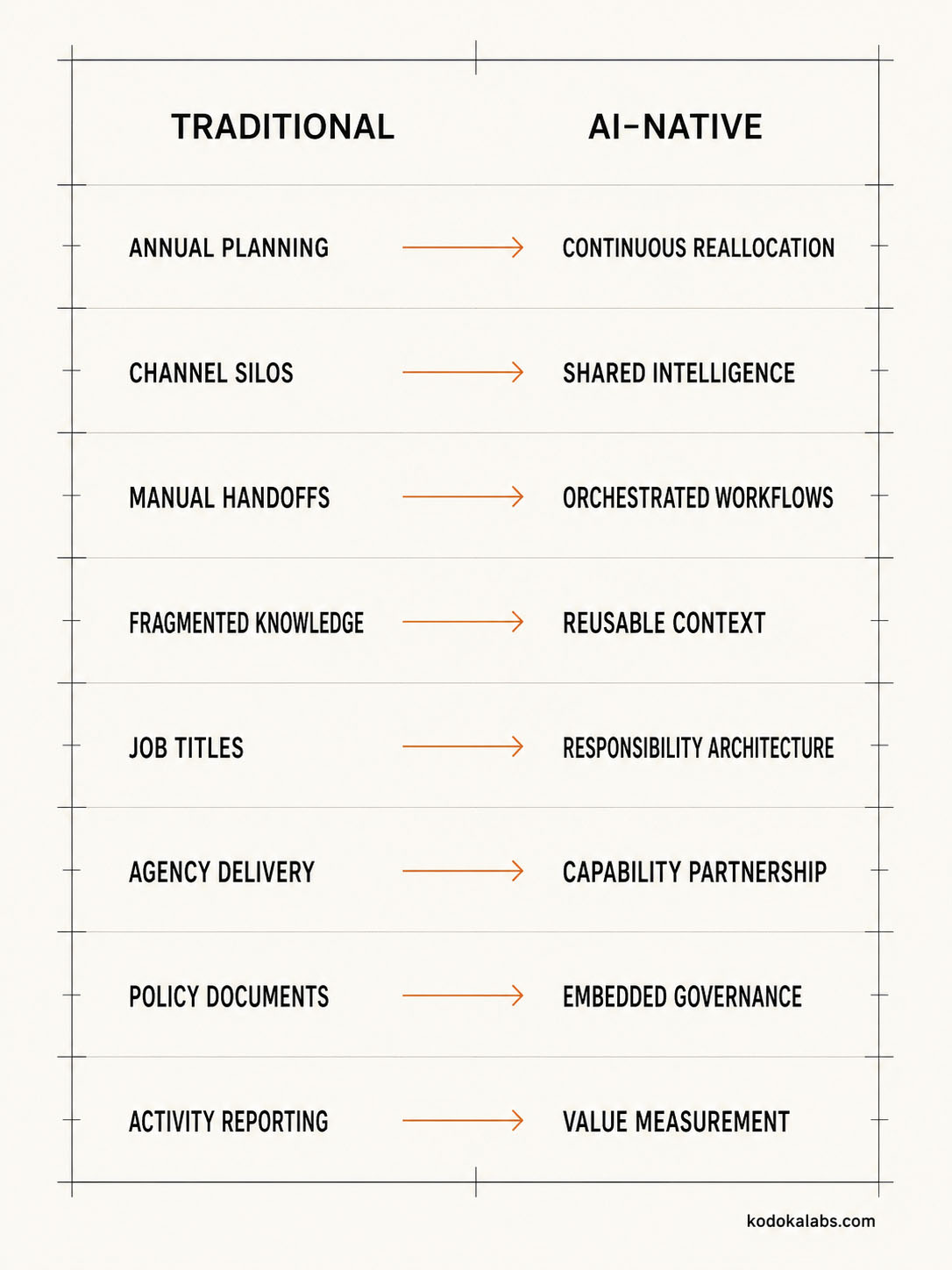
Annual Planning vs. Continuous Reallocation
Fixed annual budgets and campaign calendars struggle to accommodate the pace at which AI-enabled teams can identify and act on new opportunities; continuous reallocation lets resourcing shift as evidence accumulates rather than waiting for the next planning cycle.
Channel Silos vs. Shared Intelligence
Manual Handoffs vs. Orchestrated Workflows
Fragmented Knowledge vs. Reusable Context
Job Titles vs. Responsibility Architecture
Agency Delivery vs. Capability Partnership
Policy Documents vs. Embedded Governance
Activity Reporting vs. Value Measurement
Reporting built around activity (campaigns launched, content produced) measures output, not outcome; value measurement, consistent with the AI Marketing Value Scorecard described in AI Marketing ROI, connects activity to the value it’s actually creating.
Traditional vs. AI-Native Marketing Economics
AI changes several underlying economic relationships in marketing work: marginal production cost falls as more output can be produced without proportional increases in labor; review cost can rise if quality control doesn’t scale alongside production speed; coordination cost changes as work moves faster through the organization; experimentation becomes cheaper, enabling more of it; expertise leverage increases as fewer specialists can support more work, if the workflow is designed well; content volume rises; and error propagation risk increases if that higher volume isn’t matched by proportional review capacity. These are directional, qualitative shifts worth planning around, not universal percentages that apply identically to every organization.
The review-cost relationship is worth dwelling on specifically, because it’s the one most likely to surprise organizations that expect AI to straightforwardly reduce marketing costs across the board. If production cost per unit of content falls sharply while review remains a fixed, per-piece human activity, and output volume rises accordingly, total review cost can actually increase even as production cost falls, because review is now being applied to a much larger number of pieces. Organizations that only track production cost, and don’t track review cost as a distinct line item, can end up with a marketing function that looks dramatically more efficient by one measure while quietly becoming more expensive to operate overall. Planning for this relationship explicitly, rather than assuming falling production cost automatically means falling total cost, is part of what the Total Cost framework described in AI Marketing ROI is designed to catch.
The Marketing Operating Model Stress Test
Dimension
What to Assess
Speed
Adaptability
Clarity
Knowledge reuse
Quality
Governance
Commercial alignment
Do marketing definitions and metrics reconcile with sales and finance?
Internal capability
Learning
Symptoms That the Operating Model Needs Redesign
AI tools not reducing cycle time despite being adopted, output volume rising while quality falls, managers spending more time reviewing rather than less, knowledge remaining trapped in individual people or documents, agencies controlling key workflows the organization can’t operate independently, teams duplicating effort across silos, measurement remaining unclear despite more activity to measure, and governance blocking scale because it was never embedded into the workflows it’s meant to control, are all reliable signals that the operating model itself, not the specific tools in use, needs redesign attention.
These symptoms tend to be misdiagnosed as tooling problems more often than they should be, largely because the tool is the most visible, most recently changed element in the system when something goes wrong. A team experiencing rising review time after adopting an AI writing tool will often, understandably, suspect the tool first, when the actual cause may be that the review process itself was never redesigned to handle a higher volume of drafts arriving faster than before. Distinguishing a genuine tool problem from an operating-model problem usually comes down to a simple test: would switching to a different, better tool actually resolve the symptom, or would the same symptom likely persist under a different tool because the underlying workflow, review capacity, or ownership structure hasn’t changed? If the honest answer is the latter, the fix belongs in the operating model, not the tool stack.
What Should Be Redesigned First?
What Should Not Be Automated Yet?
Undefined processes that haven’t been mapped clearly enough to automate safely, high-risk decisions with significant brand, legal, or financial consequence, workflows built on weak or unverified data, processes with unclear accountability for their output, workflows producing unstable or inconsistent results even under manual execution, and processes where the organization lacks sufficient review capacity to catch AI-introduced errors at the volume automation would enable, should all wait for further groundwork before automation, consistent with the Automation Readiness Test described in Advanced Marketing Automation.
There’s a specific failure pattern worth naming directly here: automating a process specifically because it’s unstable or poorly understood, in the hope that AI will impose order on it. This gets the sequence backwards. A process that produces inconsistent results under manual execution, because the steps aren’t clearly defined, because different people interpret ambiguous instructions differently, because the underlying data is unreliable, will typically produce inconsistent results under AI-assisted execution too, just faster and at higher volume. Automation amplifies whatever process it’s applied to; it doesn’t inherently fix the process first. The correct sequence is to define, stabilize, and clarify a process under manual or lightly assisted execution, confirm it behaves consistently, and only then consider automating it, rather than treating automation as a shortcut past the harder work of process definition.
A Phased Operating-Model Redesign

Operating-model redesign should follow kōdōkalabs’ existing Transformation System rather than being attempted all at once: Diagnose establishes the baseline and identifies which structural breakpoints matter most for a given organization; Architect designs the target workflows, decision rights, and governance; Build implements the redesigned workflows, incorporating the piloting discipline described in Pilot Review; Enable trains the people who’ll operate the new model; Measure evaluates whether the redesign is actually producing value, using the same evidence-level discipline described in AI Marketing ROI; and Scale extends what’s working to the rest of the organization. Attempting to redesign every structural breakpoint simultaneously, rather than sequencing through this phased approach, is one of the more common ways operating-model redesign efforts stall or lose organizational support partway through.
This phased approach also gives an organization a natural point to apply the “what should not be automated yet” filter at each stage, rather than only at the very start. A structural breakpoint that looked ready for redesign during Diagnose can turn out, once Architect gets into the actual workflow detail, to depend on data or process clarity that isn’t there yet, in which case the right move is to address that dependency first rather than push forward into Build on a shaky foundation. Treating the phase sequence as genuinely iterative, willing to loop back a phase when Architect or Build surfaces a gap Diagnose didn’t catch, produces a more durable redesign than treating the sequence as a rigid, one-way pipeline that never revisits an earlier decision once the next phase has started.
Common Mistakes
- Assuming a tooling problem when it’s a structural problem, adding more AI capability to a workflow that’s actually bottlenecked by unclear decision rights or a broken handoff.
- Redesigning everything simultaneously rather than following a phased, prioritized sequence.
- Treating traditional practice as inherently obsolete, discarding structures that were never actually the problem.
- Ignoring review capacity when scaling output, letting quality erode as volume increases.
- Leaving governance as a policy document rather than embedding it into the workflows it’s meant to control.
- Automating undefined or high-risk processes before the groundwork the Automation Readiness Test would flag has been completed.
Implementation Roadmap
- Inventory – catalog current AI tool usage and use cases across marketing.
- Prioritize – identify highest-risk, highest-volume use cases first.
- Establish interim rules – put lightweight guardrails in place before full governance is built.
- Classify use cases – apply the Risk Classification Matrix to prioritized use cases.
- Design workflow controls – build the specific review, logging, and approval steps for each risk tier.
- Train teams – ensure everyone understands the controls relevant to their workflows.
- Monitor – track quality, data, and escalation incidents against the new controls.
- Revise – update policy, classification, and controls based on monitoring evidence.
Readiness Checklist
Frequently Asked Questions
01 What is a marketing operating model?
02 Why does AI require operating-model change?
03 Which parts should be redesigned first?
Does AI-native marketing require restructuring?
04 Does AI-native marketing require restructuring?
05 How should agencies fit into the new model?
As capability partners structured around genuine transfer, consistent with the Install-Enable-Transfer Model, rather than as permanent external delivery with no plan for internal capability to grow.