AI Tools Without Strategy: Why Transformation Fails

Why Buying AI Tools Does Not Create AI Transformation

AI tool sprawl is the uncontrolled accumulation of overlapping AI applications, models, and workflow components without shared use-case priorities, architecture standards, ownership, governance, or value measurement.

Executive Summary

Organizations routinely accumulate overlapping AI tools through decentralized purchases, employee experimentation, vendor pressure, fear of falling behind, unclear ownership, and the absence of any use-case prioritization or architecture standard. The result is duplicated cost, fragmented data, inconsistent output, weak governance, unclear accountability, low genuine adoption, and a growing integration burden, none of which adds up to transformation no matter how many tools are involved. This guide sets out the Tool-to-Transformation Gap, the AI Tool Rationalization Matrix, the Use Case Before Tool Principle, and the Build, Buy, or Configure Framework, the practical instruments for distinguishing tool accumulation from actual transformation.

Key Takeaways:

  • AI tool sprawl is a symptom of missing operating-model design, not a technology problem that better tools will solve on their own.
  • Tools are necessary components of transformation, not evidence of transformation by themselves; the distinction matters more as AI tool adoption accelerates.
  • Total cost of tool sprawl extends well beyond licensing: integration, data, security review, training, context switching, administration, and vendor risk all add up.
  • Use case should be defined before tool selection, not after, following a defined use-case-before-tool sequence.
  • Consolidation should protect legitimate experimentation through sandboxes and a defined exception process, not shut it down entirely.

What Is AI Tool Sprawl?

AI tool sprawl is the uncontrolled accumulation of overlapping AI applications, models, and workflow components without shared use-case priorities, architecture standards, ownership, governance, or value measurement. It is distinct from experimentation, which is a deliberate, bounded activity, and from a genuinely diverse toolset serving genuinely distinct purposes. Tools themselves are necessary components of transformation, not evidence of transformation by themselves; the number of tools an organization has adopted says nothing about whether those tools are creating coordinated value.

The distinction between sprawl and a genuinely diverse toolset is worth drawing carefully, because it’s easy to misapply the sprawl label to any organization using more than a handful of tools. A marketing function with fifteen tools, each serving a distinct, defined use case, each governed to an appropriate standard, each measured for value, is not experiencing sprawl even though the count looks similar to a genuinely sprawling stack. The defining characteristic of sprawl isn’t the number of tools; it’s the absence of the coordinating layer, shared priorities, standards, ownership, governance, and measurement, that would let those tools work as a coherent system rather than a pile of disconnected point solutions.

Why Tool Adoption Is Mistaken for Transformation

Tool adoption is visible, easy to report, and satisfying in a way that operating-model redesign is not: a new subscription, a rollout announcement, a training session, all feel like progress. Operating-model work, the unglamorous business of defining workflows, decision rights, knowledge governance, and measurement, produces less immediately visible progress even though it’s what actually determines whether the tools create value. Organizations under pressure to show AI progress quickly tend to default to the visible signal, tool adoption, over the slower, less visible work that actually produces transformation.

The Tool-to-Transformation Gap

kōdōkalabs - intelligence hub - AI Marketing Transformation - AI Tools without Strategy - Tool-to-Transformation Gap
AI Tools without Strategy - Tool-to-Transformation Gap
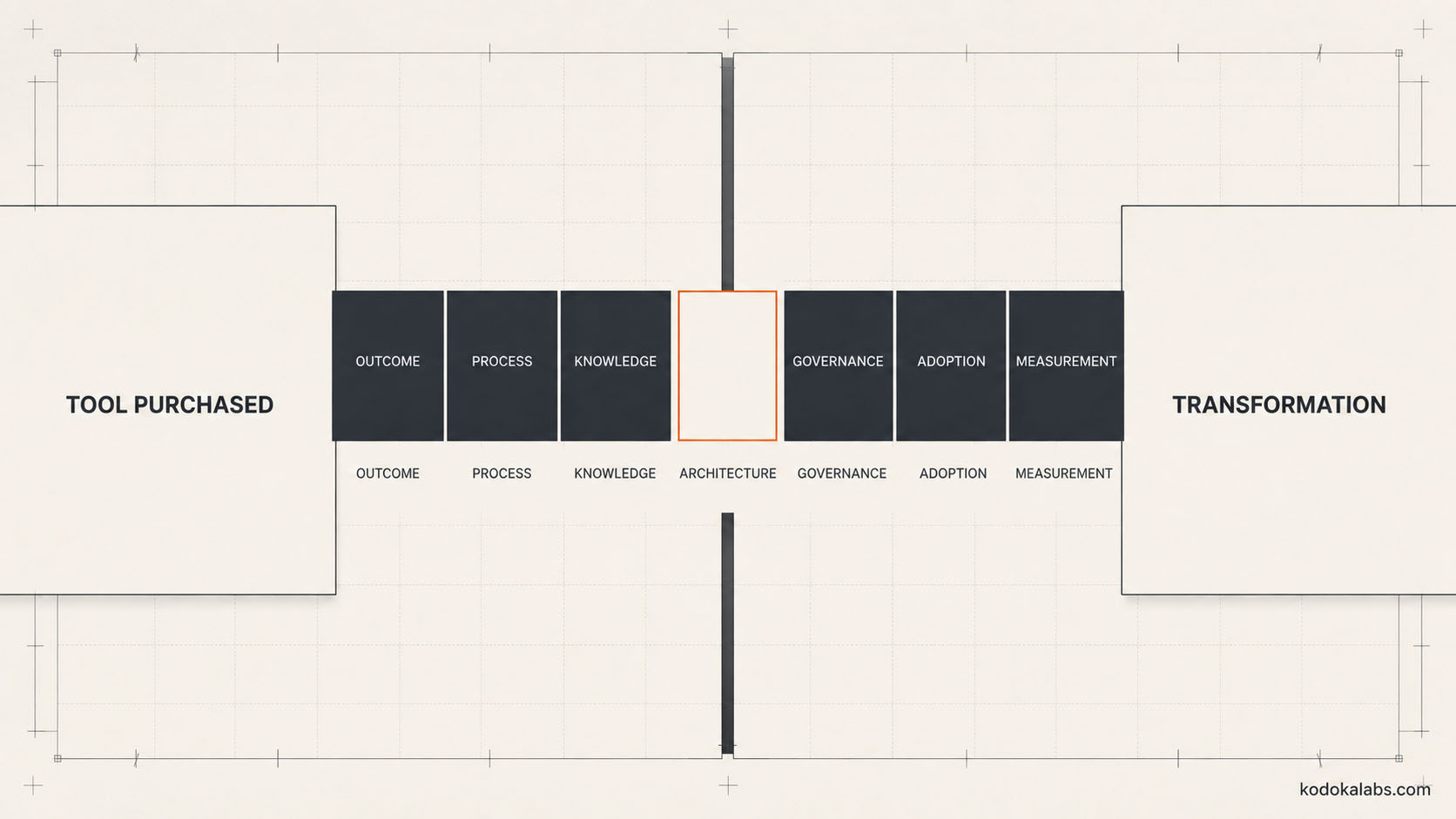
Between “we bought an AI tool” and “we transformed how marketing works” sit seven layers most organizations underinvest in: a defined business outcome the tool is meant to serve, process clarity about the workflow it fits into, trusted knowledge and data for it to draw on, workflow architecture connecting it to the rest of the system, governance appropriate to its risk level, genuine capability and adoption among the people using it, and measurement that can actually tell whether it’s working. A tool purchased without these seven layers in place doesn’t create transformation; it creates a capability the organization owns but hasn’t actually operationalized.

Common Causes of AI Tool Sprawl

Decentralized purchasing where individual teams or managers buy tools independently, employee experimentation that goes unmanaged and unconsolidated, vendor sales pressure exploiting fear of falling behind competitors, unclear ownership of the AI tool decision within the organization, absence of a use-case prioritization process, and the lack of any architecture standard new purchases are expected to meet, all combine to produce sprawl over a relatively short period, often without any single decision that looks unreasonable in isolation.

This is worth emphasizing because organizations reviewing how they ended up with a sprawling stack often look for a single bad decision to explain it, and rarely find one. A content team adopts a writing assistant because it solves an immediate deadline problem. A separate analytics team adopts a different AI-assisted reporting tool because it was recommended at a conference. A regional office signs up for a localization tool independently because head office procurement felt too slow. Each decision, evaluated on its own, was a reasonable response to a real problem. The sprawl emerges from the absence of any mechanism connecting these decisions to each other, not from any individual decision being obviously wrong at the time it was made.

The Hidden Costs of Tool Sprawl

License duplication across overlapping tools, integration engineering effort, data preparation and governance overhead, security review for each new system, training time for every additional tool, the context-switching cost of teams working across multiple overlapping platforms, ongoing administration burden, vendor risk from an expanding set of third-party relationships, and the sunk cost of tools that get abandoned after limited use, all accumulate as real costs that rarely appear anywhere near the original purchase decision that created them.

Why Tools Fail Without Defined Workflows

A tool introduced into an undefined workflow tends to get used inconsistently across the team, since without a defined process each person effectively improvises their own way of incorporating it. That inconsistency shows up as unpredictable output quality, unclear accountability when something goes wrong, and difficulty measuring whether the tool is actually improving anything, since there’s no consistent baseline process to compare it against.

This is a recurring pattern worth naming directly: an organization evaluates a tool, finds the results inconsistent, and concludes the tool itself is the problem, when the actual issue is that the tool was deployed into an undefined workflow where five different people were using it five different ways. Redesigning the workflow first, defining what the tool is meant to do, where it fits in the sequence of work, what inputs it receives, and what human review follows it, often resolves quality problems that look like they call for a different or better tool but are really calling for a defined process the existing tool could have served well all along.

Why Company Knowledge Matters

AI tools are only as good as the knowledge and data they can draw on. A tool operating without access to an organization’s actual product information, brand standards, customer context, and institutional expertise defaults to generic output, technically fluent but not distinctively useful, regardless of how capable the underlying model is. This is why knowledge governance, consistent with the Knowledge Readiness Model described in AI Marketing Knowledge Base, needs to be addressed before or alongside tool selection, not treated as a separate concern.

Governance Before Scale

Scaling a tool’s usage before governance is in place multiplies whatever risk exposure that tool carries, rather than multiplying its value in isolation. A tool with weak controls used by five people is a contained risk; the same tool used by five hundred people, without governance having caught up, is a materially different and larger exposure. Governance should be established proportional to a tool’s intended scale before that scale is reached, not retrofitted after problems surface.

Retrofitting governance after scale is reached is possible but considerably more disruptive than establishing it beforehand, because it typically means pausing or restricting a workflow people have already come to rely on, which creates internal friction that early governance design avoids entirely. It also tends to surface exactly the risks governance was meant to prevent, an inconsistency in output quality, a factual error that reached a customer, a data-handling question no one had answered, at the point they’ve already caused some degree of harm rather than being caught in advance. The Marketing AI Governance Control Stack’s risk classification step exists specifically to make this proportionality decision explicit before scale happens, rather than leaving it to be discovered under pressure afterward.

Adoption and Capability

A tool with sophisticated capability and low genuine adoption creates the appearance of AI investment without the substance of it. Adoption should be tracked honestly, distinguishing active meaningful use from nominal license assignment, and low adoption should trigger a genuine investigation into whether the tool solves a real problem, whether training was adequate, or whether the workflow around it was never actually defined.

How to Audit the AI Tool Stack

An AI tool audit should inventory every tool currently in use across the marketing function, including ones adopted informally by individual teams; assess each against the AI Tool Rationalization Matrix; identify overlapping capability across tools; confirm data access, security, and governance status for each; and produce a consolidated view of total cost, including the hidden costs most organizations don’t currently track. This audit is worth repeating on a defined cadence, since sprawl re-accumulates naturally between reviews if nothing actively prevents it.

The AI Tool Rationalization Matrix

Criterion
What It Assesses

Business relevance

Whether the tool serves a defined, prioritized use case

Unique capability

Whether the tool does something no other tool in the stack already does

Overlap

Whether the tool’s function duplicates another tool already in use

Integration

How well the tool connects to the rest of the workflow architecture

Data control

Whether the organization retains appropriate control over data the tool touches

Governance

Whether the tool can be governed to the standard its risk level requires

Adoption

Whether the tool is genuinely, actively used, not just licensed

Switching cost

How difficult it would be to replace the tool if needed

Measurable value

Whether the tool’s contribution can actually be measured

Strategic fit

Whether the tool supports the organization’s actual transformation priorities
Scoring the existing tool stack against this matrix, rather than against each tool’s own marketing claims, is what turns a vague sense that “we have too many tools” into a specific, actionable consolidation plan.

Use Case Before Tool Selection

The Use Case Before Tool Principle states that organizations should select tools only after defining the use case, workflow, risk, ownership, evidence requirements, and expected value the tool is meant to serve. Reversing this order, selecting a tool first and then looking for a use case to justify it, is one of the most reliable predictors of sprawl, since a tool acquired without a defined use case has no natural boundary on how, or how much, it gets used.

Build, Buy, Configure, or Outsource?

Option
Best Fit When

Off-the-shelf tool

The use case is common and well-served by existing products

Configured platform

The use case is close to standard but needs organization-specific adaptation

Workflow automation

The need is to connect and orchestrate existing systems, not add new AI capability

Custom agent

The use case is distinctive enough that no existing tool serves it well

Internal capability

The use case is core to the business and worth owning long-term

External service

The need is specialized, infrequent, or better served by dedicated expertise
This decision should follow the use case, not precede it, and should be revisited as internal capability grows; an option that made sense as an external service in year one may make more sense as an internal capability once the organization has built enough Install-Enable-Transfer experience with related workflows.

How to Consolidate Without Slowing Innovation

Consolidation doesn’t have to mean shutting down experimentation. A well-designed approach includes approved experimentation channels, sandbox environments isolated from production systems and data, shared standards new tools are expected to meet before graduating to production use, a regular portfolio review cadence, a defined exception process for genuinely novel needs, and clear sunset criteria for tools that don’t earn their place. This structure lets teams keep exploring new capability while preventing that exploration from silently becoming ungoverned production sprawl.

What an AI Marketing Architecture Should Include

A coherent AI marketing architecture includes systems of record for core business data, a governed knowledge layer, a model layer defining which AI capabilities are approved for which purposes, an orchestration layer connecting tools and workflows, defined interfaces for how humans interact with the system, governance controls appropriate to risk, logging sufficient to support audit and troubleshooting, and measurement that connects tool usage back to actual business outcomes. Tool selection decisions made against this architecture, rather than in isolation, are what keep the stack coherent as it grows.

Common Procurement Mistakes

Purchasing based on a vendor demo rather than a defined use case, skipping data and security review under time pressure, failing to check for overlap with tools already in use, signing multi-year contracts before confirming genuine adoption, and neglecting to define what evidence would justify renewal versus cancellation, are among the most common and costly procurement mistakes organizations make when acquiring AI tools.

The vendor-demo mistake deserves particular attention because it’s easy to fall into even with good intentions. A well-run demo is specifically designed to show a tool performing at its best, on curated examples, without the messiness of an organization’s actual data, existing workflows, or edge cases. Procurement decisions made primarily on the strength of that demo experience, rather than on a defined use case tested against the organization’s own real conditions, tend to discover the gap between demo performance and production performance only after the contract is signed and the tool is already being rolled out, at which point walking back the decision is considerably more expensive than it would have been to test properly beforehand.

Readiness Checklist

[    ] A defined use case exists before tool evaluation begins.

[    ] The tool has been scored against the AI Tool Rationalization Matrix.

[    ] Overlap with existing tools has been explicitly checked.

[    ] Data control, security, and governance requirements have been confirmed.

[    ] A build, buy, configure, or outsource decision has been made deliberately, not by default.

[    ] Adoption will be tracked honestly, not measured by license count alone.

[    ] A measurement plan exists for assessing the tool’s actual value.

[    ] The tool fits within the organization’s defined AI marketing architecture.

[    ] Renewal versus cancellation criteria are defined before the contract is signed.

Frequently Asked Questions

The uncontrolled accumulation of overlapping AI applications, models, and workflow components without shared use-case priorities, architecture standards, ownership, governance, or value measurement.
There's no universal number; the right count is whatever the organization's defined use cases, architecture, and governance capacity can actually support well, evaluated tool by tool against the Rationalization Matrix rather than against an arbitrary target.
Not necessarily, different use cases can justify different models, but the choice should follow the organization's model layer and governance standards rather than being made independently by each team.
Against the AI Tool Rationalization Matrix, covering business relevance, unique capability, overlap, integration, data control, governance, adoption, switching cost, measurable value, and strategic fit.
When the audit and rationalization process identifies genuine overlap, low adoption, or weak strategic fit, following a defined portfolio review cadence rather than only in response to a crisis.
Only when the use case is distinctive enough that no existing tool serves it well, and the organization has the internal capability to build and maintain it; for common use cases, an off-the-shelf or configured option is usually more efficient.
A defined use case, an evaluation against the Rationalization Matrix, a data and security review, and a check for overlap with tools already in the stack.
A named owner with authority over the AI marketing architecture and the Rationalization Matrix process, rather than the decision being distributed informally across whoever happens to be purchasing at a given moment.
Against pre-defined sunset criteria established when the tool was adopted, with a clear process for data extraction and workflow transition before the tool is fully decommissioned.
Often yes, since eliminating duplicated licensing, integration overhead, and administration burden directly reduces the total cost side of the AI Marketing ROI equation, though consolidation should be evidence-led rather than pursued purely for its own sake.

Conclusion

Buying more AI tools has never, by itself, been the same thing as transforming how marketing works, and the gap between the two only becomes more expensive to ignore as tool adoption accelerates. The organizations that actually create value from AI are the ones that define the use case, build the architecture, govern the risk, and measure the outcome first, then select tools to serve that system, rather than accumulating tools and hoping a system emerges around them.

Are you ready to
Audit Your AI Tool Stack and Operating Model?