
AI Content Quality Control:
A Complete Review System
AI Content Quality Control: A Multi-Dimensional Review System
Executive Summary
AI content review is routinely reduced to grammar checking, tone assessment, or an AI-detection score – a narrow lens that misses whether the content is actually true, useful, differentiated, permitted to publish, aligned with the audience’s actual intent, accessible, technically valid, and appropriate for the context it’s being published into. Quality is multi-dimensional and purpose-specific, and no single detector, quality score, prompt instruction, or final proofread can establish it alone. This guide covers the Nine-Dimension Content Quality Model, the quality gates that should structure review across the content lifecycle, the defect taxonomy that gives severity and disposition to problems found during review, and why AI-detection tools shouldn’t be relied on as evidence of content quality or authorship.
Key Takeaways:
- Content quality control reduced to grammar and AI-detection scores misses whether content is actually true, useful, and appropriate for its purpose.
- Quality has nine distinct dimensions, from source integrity through performance and learning – no single check covers them all.
- Quality gates should span the full content lifecycle, from brief approval through post-publication measurement, not concentrate only at final review.
- Defects need a defined taxonomy – critical, material, moderate, minor – with clear ownership and disposition, not an undifferentiated pile of “issues.”
- AI-detection scores are unreliable and shouldn’t be treated as proof of authorship or quality, regardless of how confident the tool’s output looks.
What Is AI Content Quality Control?
Why Grammar and AI Detectors Are Not Quality Systems
Nine Dimensions of Content Quality
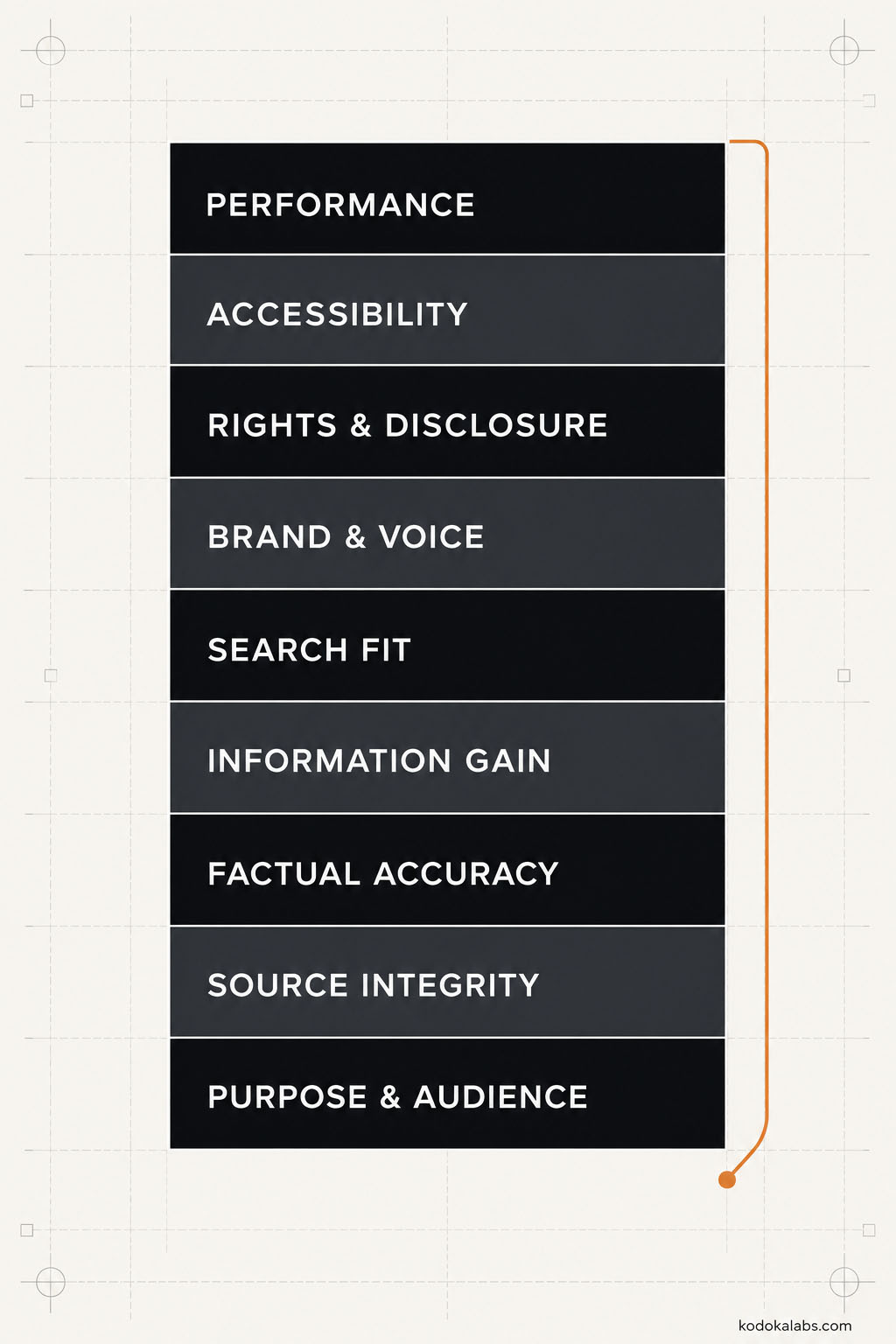
Component
Dimension
What It Evaluates
1
2
3
4
5
6
7
8
9
Quality Gates Across the Content Lifecycle
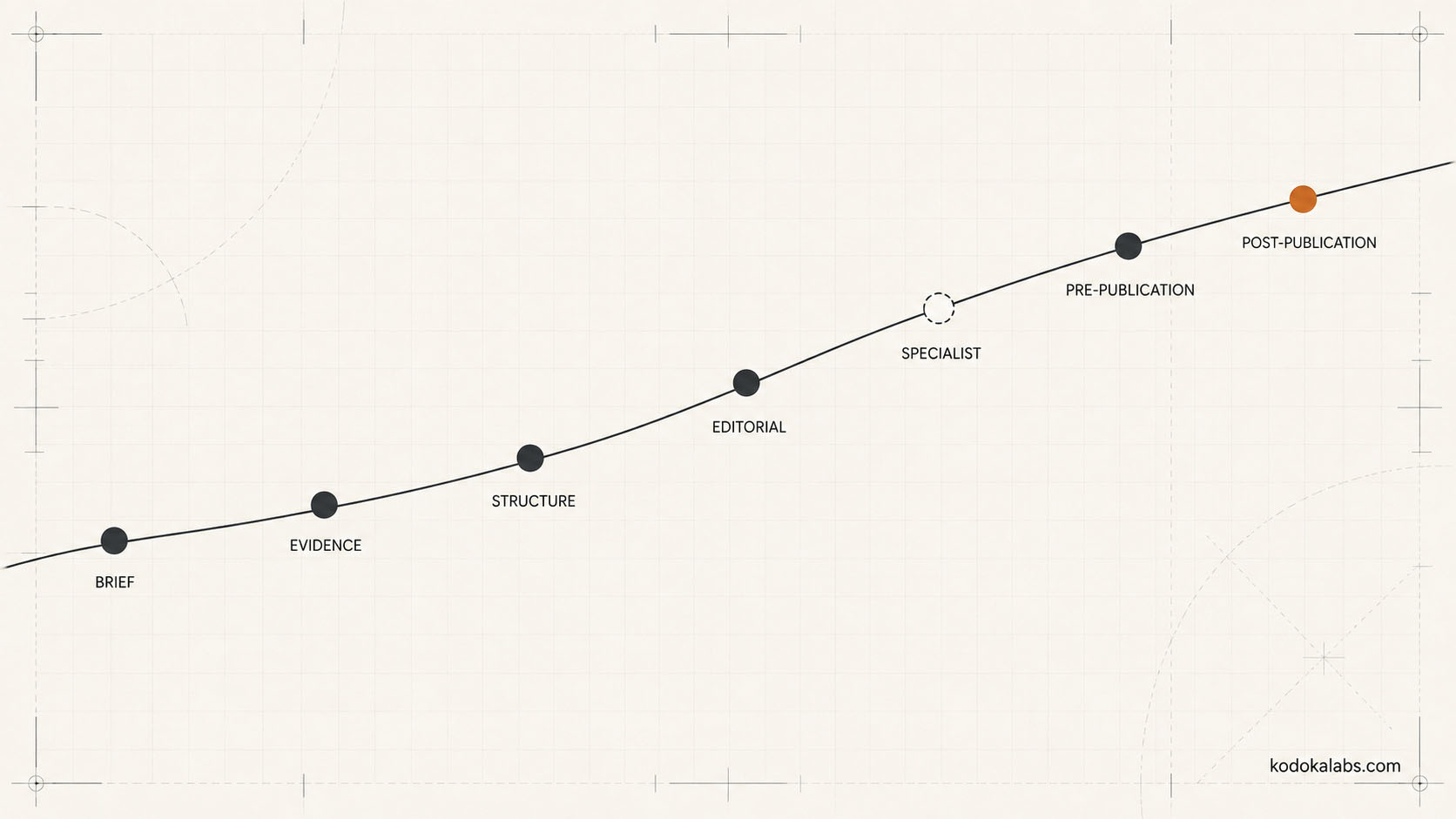
Gate
What It Confirms
Brief approval
Evidence approval
Structural review
Substantive editorial review
Specialist/legal review (when triggered)
Pre-publication QA
Post-publication measurement
Concentrating all review at a single pre-publication gate means every category of problem – a flawed brief, an unverified claim, a structural gap – gets caught (if it’s caught at all) at the most expensive possible point, after the content is already fully drafted. Distributing gates across the lifecycle catches problems earlier and cheaper.
The cost curve here is worth making explicit, because it’s the actual argument for distributing gates rather than concentrating them. A flawed brief caught at the brief-approval gate costs a conversation and a revision. The same flaw, undetected until pre-publication QA, means an entire piece of content – researched, drafted, structurally reviewed, and edited for voice – has to be substantially reworked or scrapped, after consuming far more time and effort than the brief-stage fix would have. Every gate skipped or treated as a formality shifts the cost of catching a problem further downstream, where it’s consistently more expensive to fix, not less.
Source and Evidence Verification
This gate confirms that claims in the content are traceable to sources appropriate for their claim type, drawing on the organization’s governed AI Marketing Knowledge Base and the Claim Register discipline described in Agentic Drafting. Content built on unverified or informally sourced claims should be caught here, before those claims are woven into a polished draft that makes them harder to isolate and check later.
Factual, Statistical, and Quotation Checks
Information Gain and Original Contribution
Search Intent, Entity, and Semantic Review
Brand, Voice, and Editorial Quality
Rights, Disclosure, and Sensitive-Topic Review
This dimension checks that content respects intellectual property in any material it draws on or references, includes appropriate disclosure per kōdōkalabs’ AI Transparency & Content Disclosure Statement where applicable, and receives appropriate additional scrutiny for sensitive topics – health, financial, legal, or other high-consequence subject matter – where a factual or framing error carries more serious consequence than it would in lower-stakes content.
Accessibility and Technical Quality
Defect Taxonomy and Escalation
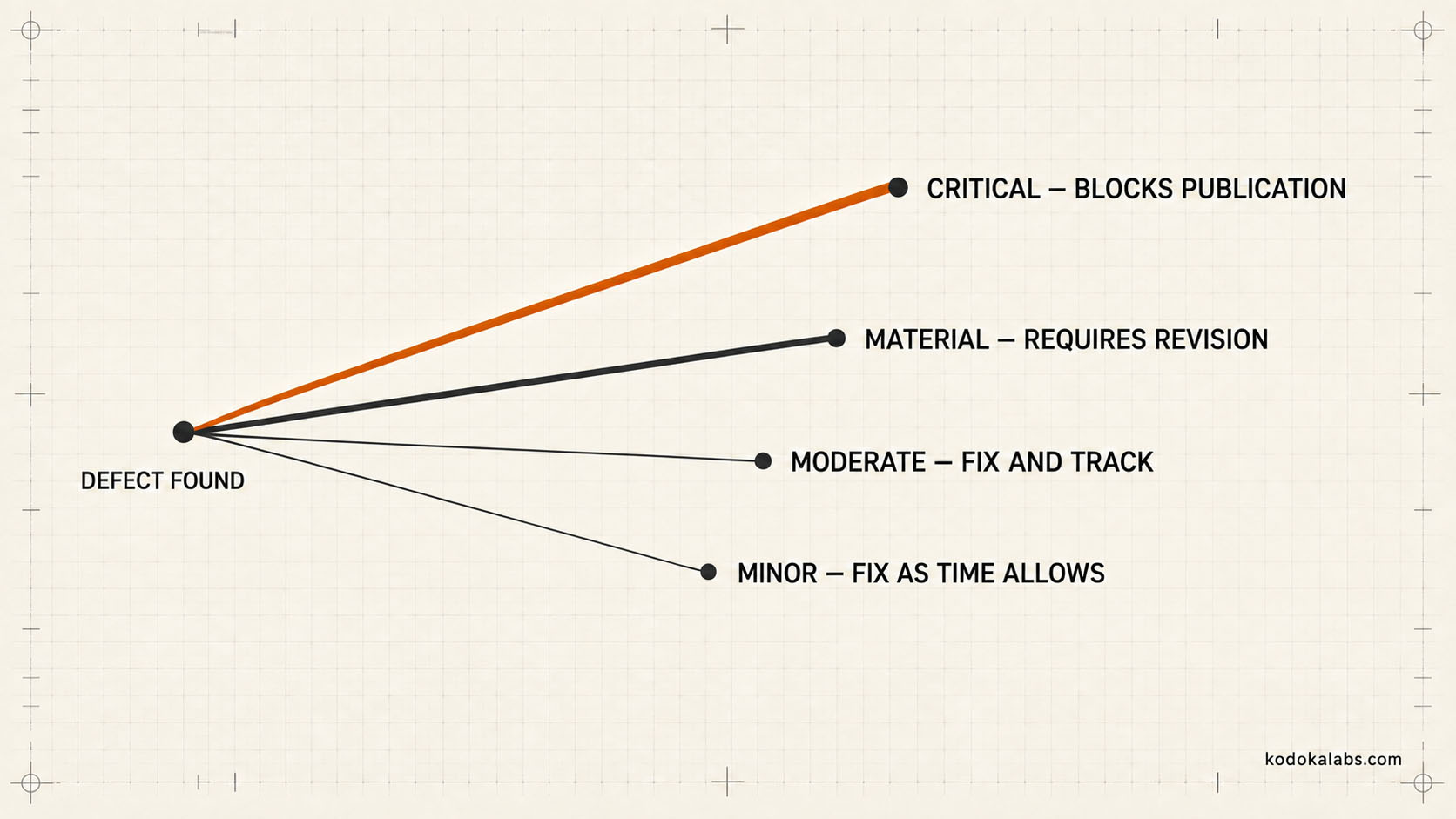
kōdōkalabs’ Defect Taxonomy classifies problems found during review by severity, giving each a defined disposition rather than treating every issue as equally urgent.
Severity
Description
Typical Disposition
Critical
Material
Moderate
Minor
Recording defects by severity, with an owner and a disposition, also supports recurrence tracking – if the same category of defect keeps appearing across multiple pieces of content, that’s a signal pointing back to a systemic issue (a flawed prompt, a gap in the knowledge base, insufficient reviewer training) worth addressing at the source rather than repeatedly catching the symptom.
This pattern-recognition function is one of the most underused benefits of a proper defect taxonomy. Individual defects, reviewed and fixed one at a time, tend to look like isolated incidents – a wrong statistic here, an off-brand phrase there – with no obvious connection between them. Only when defects are logged consistently, by category, across many pieces of content over time does the pattern become visible: perhaps a particular prompt consistently produces unsupported claims on a specific topic, or a particular knowledge source has quietly gone stale and keeps generating outdated references. Without the taxonomy and the discipline of logging every defect rather than just fixing and forgetting it, this kind of systemic insight simply isn’t available, and the same category of problem keeps recurring at the same rate indefinitely.
Sampling vs. Full Review
Reviewer Competence and Workload
Post-Publication Measurement and Corrections
Quality Scorecards Without False Precision
Common Failure Modes
- Grammar-as-quality – treating a clean grammar check as sufficient evidence of overall content quality.
- AI-detector reliance – using an unreliable AI-detection score as if it were a quality or authorship verification tool.
- Single-gate review – concentrating all quality checks at one point right before publication, missing cheaper earlier opportunities to catch problems.
- Undifferentiated defects – treating every issue found during review as equally urgent, with no severity or disposition.
- Uniform review depth – applying the same review intensity to low-risk and high-risk content alike.
- No post-publication feedback loop – treating publication as the end of the quality process rather than the start of a measurement cycle.
- False-precision scorecards – presenting a single quality number without transparency into what it’s actually measuring.