
The kōdōkalabs
AI Marketing Operating System
For CMOs and VPs of Marketing at mid-market B2B companies whose teams have adopted AI tools without redesigning how work actually flows: the AI Marketing Operating System is kōdōkalabs’ core implementation offer — a fully designed, built, governed, and documented operating model for AI-assisted marketing, delivered so it survives team turnover and scales without re-litigating quality standards every time.
Marketing Isn't Broken. Its Operating Model Is.
Most marketing teams kōdōkalabs meets are not short on talent, and they’re rarely short on AI tools either. What they’re missing is the operating model that turns individual talent and individual tools into a system that compounds — where a new AI capability gets absorbed in days because the governance and documentation already exist to evaluate and integrate it, instead of triggering weeks of ad hoc negotiation about who owns quality control this time.
That’s the specific problem the AI Marketing Operating System solves. It isn’t a content production service, and it isn’t a single automation project. It’s the design and implementation of the operating model underneath content, campaigns, search, and measurement — workflows, a shared knowledge base, automation, governance, a content engine, measurement infrastructure, training, and full documentation — built once, owned by your team, and structured to keep working after kōdōkalabs steps back.
The distinction matters because most alternatives on the market solve a narrower problem. A marketing automation platform gives you tooling but not the workflow design or governance to use it consistently. A content agency gives you output but not a system your team can run independently once the retainer ends. A single AI tool gives you a capability, but not the surrounding structure that determines whether that capability gets adopted consistently across a team of any size. The AI Marketing Operating System is deliberately the layer underneath all three — the operating model that makes tools, output, and capability actually compound instead of existing as separate, disconnected initiatives.
This is also kōdōkalabs’ primary and most requested engagement, and the one that produces the deepest and most durable transformation, because it’s the phase where the actual operating model changes — not just the tools sitting on top of it.
What's Actually Going Wrong Without An Operating System
Before describing what gets built, it’s worth being specific about the failure pattern this solves, because it rarely looks like an obvious crisis. It looks like steady, low-grade friction that leadership has learned to work around rather than fix:
- Every new hire starts from zero. Prompts, quality standards, and workflow knowledge live in individual people’s heads or scattered documents, so onboarding a new team member or a new AI tool means rebuilding institutional knowledge that should already exist. This shows up as a real, measurable cost every time someone leaves the team and takes undocumented process knowledge with them.
- Quality depends on who’s producing the work. Without a documented Human + AI Execution Model, one team member’s AI-assisted output reads like a trusted subject-matter expert, and another’s reads like an unedited AI draft — and there’s no shared standard to close that gap. Leadership ends up managing quality person by person instead of system by system.
- Nobody owns governance. Approval paths exist informally, if at all, which becomes a real brand and compliance exposure the moment AI-assisted output volume scales past what a single reviewer can informally track. This is often invisible until a mistake happens publicly, at which point the absence of a defined process becomes a leadership accountability problem, not just an operational one.
- Measurement doesn’t connect to the operating model. Dashboards report channel performance, but nobody can say whether the marketing organization is more capable than it was two quarters ago, because capability was never defined as something to measure. Budget conversations default back to headcount and channel spend, because there’s no other vocabulary for describing organizational progress.
- The technology stack outgrows what the team can actually use. Tools get purchased faster than workflows get redesigned around them, so adoption stalls well below what the technology is capable of. It’s common to find organizations paying for enterprise-tier AI tooling that a majority of the team has never been trained to use beyond its most basic function.
Symptom vs. Root Cause
Symptom
Root Cause
Where the Operating System Fixes It
New hires and new tools take weeks to become productive
Institutional knowledge lives in individual people’s heads, not in a shared system
Knowledge Base + Documentation capture workflow and brand knowledge so it survives turnover
Inconsistent content quality across team members
No documented Human + AI Execution Model defining task-level handoffs
Build phase defines exactly where AI drafts and where a human reviews, for every workflow
No one is accountable for approvals or quality control
Governance exists informally, if at all, with no defined owner
The AI Governance Matrix assigns an accountable owner and required review level per content category
Leadership can't show whether AI adoption is working
Measurement tracks channel output, not organizational capability
The KPI dashboard ties execution velocity, governance maturity, and cost per output back to a documented baseline
Expensive tools sit underused
Workflows were never redesigned around the technology that was purchased
Workflow Design and Training rebuild the process around the tool, not the other way around
What's Included
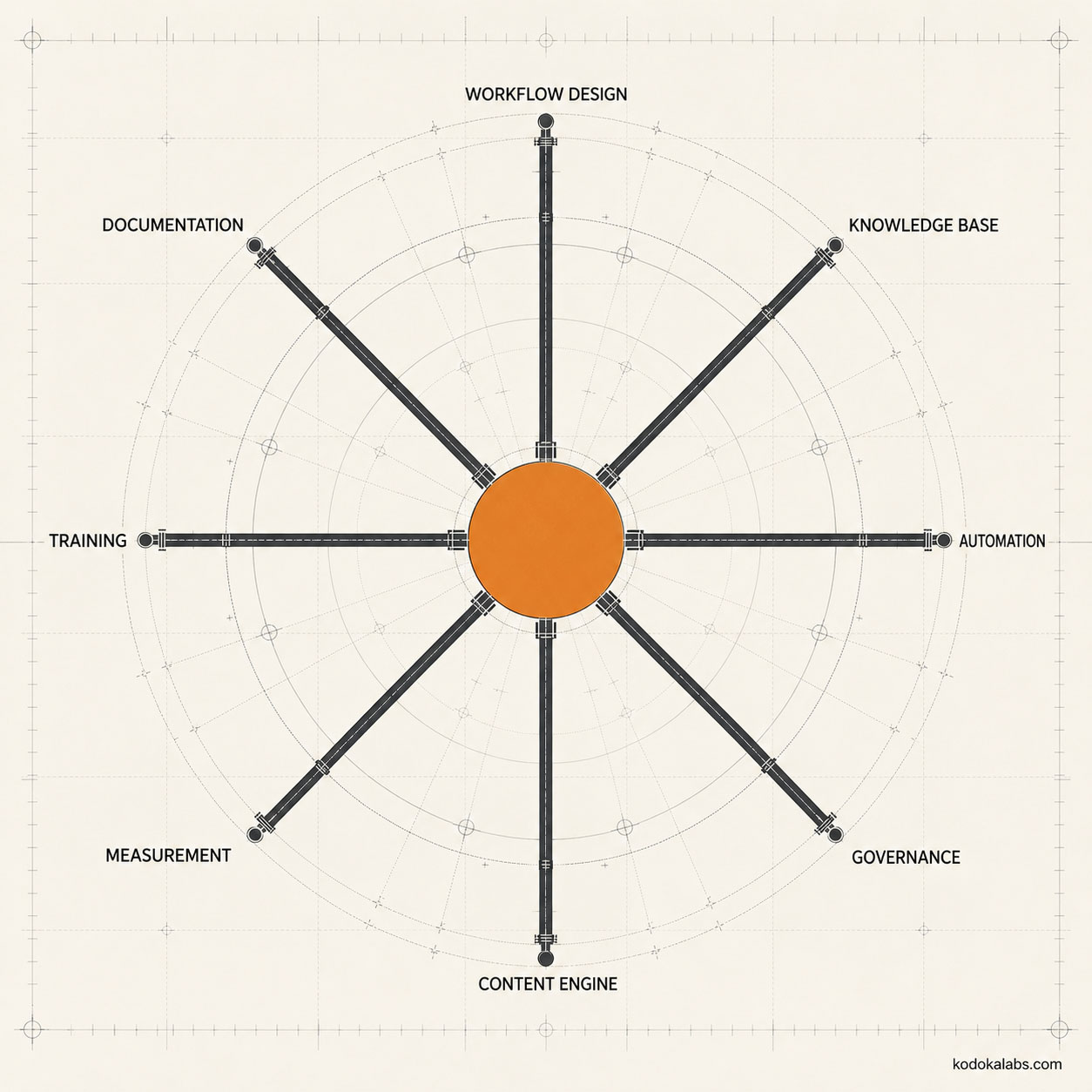
The AI Marketing Operating System engagement delivers eight components, each documented and each transferred to your team by the end of the engagement:
- Workflow Design — documented, end-to-end workflows for your organization’s core content and campaign types, from brief to published, reviewed output, with clear ownership at every step. Each workflow specifies exactly where AI drafts, where a human reviews, and what “done” looks like, so two different people running the same workflow produce comparably consistent results.
- Knowledge Base — a structured, searchable repository of your organization’s marketing knowledge: brand guidelines, past research, approved messaging, competitive intelligence, and prior campaign learnings, so nothing has to be rebuilt from memory. This becomes the shared context every AI-assisted workflow draws from, which is part of what makes output consistent across different team members and over time.
- Automation — configured automation for the repetitive, well-defined parts of the workflow, scoped specifically to tasks the Human + AI Execution Model has classified as safe for AI to execute with defined review checkpoints. Automation is applied deliberately narrow rather than broad — the goal is reliable automation of well-understood tasks, not maximizing the percentage of work that’s automated for its own sake.
- Governance — a formal structure (The AI Governance Matrix) defining who approves what, what requires human review before publication, and how quality gets audited on an ongoing basis. This is the component most organizations skip when adopting AI independently, and the one most likely to become a real liability if it stays undefined.
- Content Engine — the operational system that turns the knowledge base and workflows into a repeatable production capability for guides, campaigns, and search-optimized content, built to the GEO and SEO standards described in kōdōkalabs’ own editorial guidelines. This is what allows content velocity to increase without a corresponding increase in quality risk.
- Measurement — a KPI dashboard tracking execution velocity, governance maturity, content and search performance, internal capability, and cost per output, tied back to the baseline established in the Executive AI Marketing Assessment. Measurement is built into the system from day one rather than bolted on afterward, so progress is provable from the first reporting cycle.
- Training — role-specific training for the team members who will run the system, delivered as part of the transition into the AI Capability Academy’s certification program. Training is scoped to the actual workflows built during this engagement, not generic AI literacy content.
- Documentation — complete written documentation of every workflow, governance rule, and system component, so the operating system doesn’t depend on any single person’s memory. This is the artifact that makes the system auditable, transferable to new hires, and defensible to a board asking how AI is actually being governed.
How It's Built
The AI Marketing Operating System is delivered across Phases 2 and 3 of The kōdōkalabs Transformation System — Architect and Build — using the underlying tactical methodology of Strategic Architecture, Agentic Drafting, Pilot Review, and Data-Led Iteration:
- Strategic Architecture. Working from the baseline established in the Executive AI Marketing Assessment, kōdōkalabs designs the target operating model: workflow diagrams, governance structure, role definitions, and a technology stack recommendation, signed off by your leadership team before implementation starts. This phase typically produces two or three design options where a genuine tradeoff exists — for example, a faster rollout with narrower initial scope versus a slower rollout covering more content types at once — so leadership makes an informed choice rather than inheriting a single predetermined answer.
- Agentic Drafting. Workflows are implemented iteratively, starting with the highest-priority content or campaign type identified in Architect, using AI-assisted drafting configured to the Human + AI Execution Model’s defined division of labor. Starting with the highest-priority workflow, rather than the easiest one, ensures the first real proof point is also the one leadership cares most about.
- Pilot Review. Each new workflow produces real output that’s reviewed against the quality bar defined in governance, with adjustments made before the workflow is considered production-ready and rolled out more broadly. This is where most of the fine-tuning happens — prompt refinement, adjusting where a human checkpoint sits in the process, tightening the knowledge base content that’s feeding the AI-assisted steps.
- Data-Led Iteration. Once live, performance data feeds back into refining the workflow, the governance rules, and the automation configuration — the system keeps improving after go-live rather than being treated as finished at handoff. This loop continues into Phase 5 (Measure) of The kōdōkalabs Transformation System, where it becomes a standing part of ongoing operations rather than a one-time implementation activity.
Each iteration through this four-step loop typically covers one workflow or workflow family, so a full Build phase might run through it four to eight times depending on how many distinct content and campaign types are in scope.

The AI Marketing Operating System Framework
At the center of this solution is the AI Marketing Operating System framework itself — kōdōkalabs’ model for how a marketing organization’s operating layer should be structured, distinct from any specific tool or vendor. The framework organizes the operating layer into three connected layers:
Layer
What It Contains
Changes
Primary Owner
Execution Layer
Workflows, automation, the content engine
Frequently — refined continuously through Data-Led Iteration
Marketing Operations
Governance Layer
The AI Governance Matrix, approval paths, quality standards
Slowly — requires leadership sign-off before changing
Marketing leadership
Knowledge Layer
Knowledge base, documentation, measurement infrastructure
Gradually — accumulates value over years rather than being rebuilt
Shared across the team, maintained as a living system
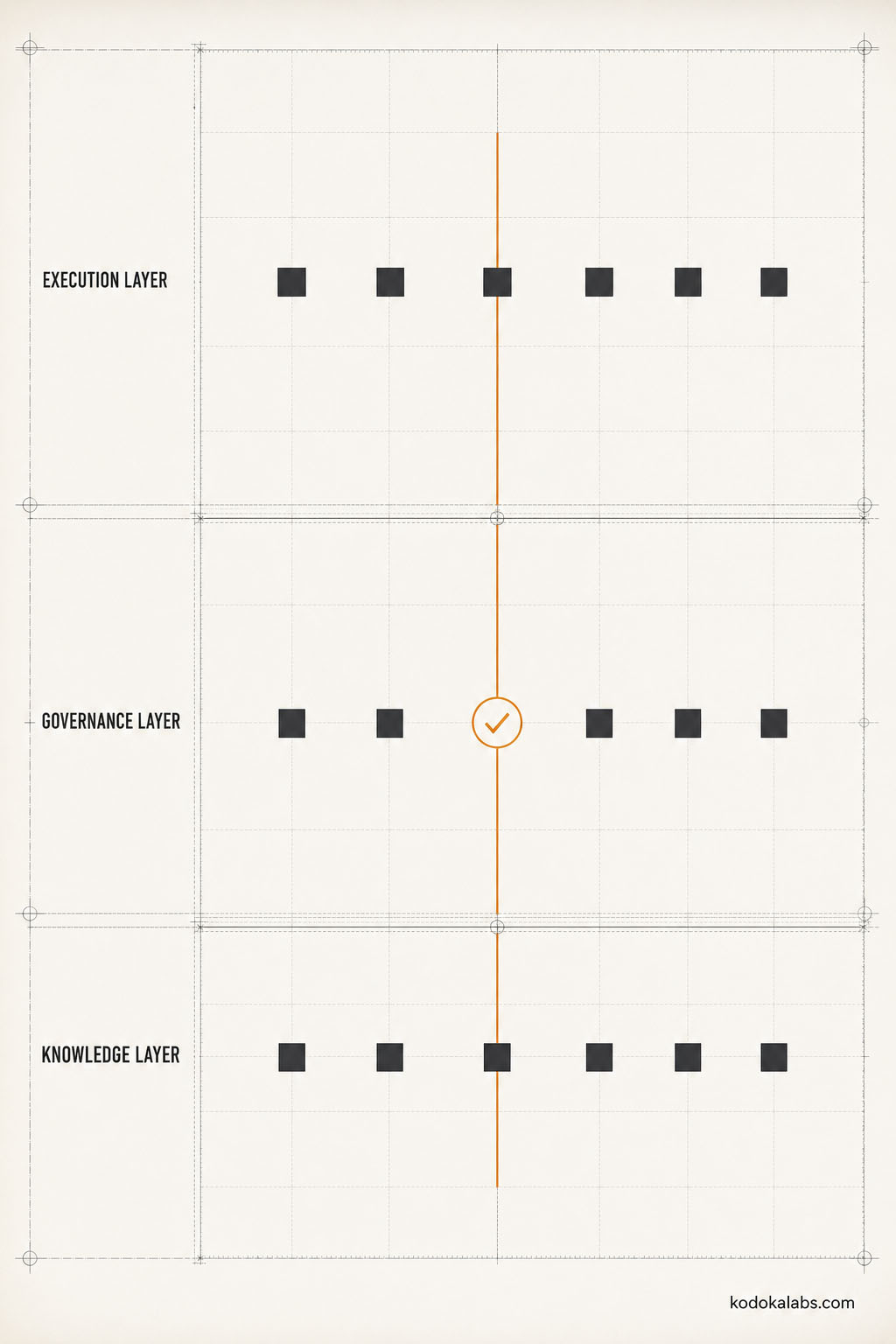

This structure is deliberately layered rather than flat, because the three layers change at different speeds: execution-layer workflows get refined constantly as part of Data-Led Iteration, governance-layer rules change more slowly and require leadership sign-off, and the knowledge layer is meant to be durable, accumulating value over years rather than being rebuilt with each campaign.
Governance: The AI Governance Matrix
Governance is frequently the most under-invested part of AI adoption, and it’s the component most likely to become a real liability if skipped. The AI Governance Matrix defines, in writing: what categories of content can be published with AI assistance and no additional review; what requires a single human reviewer; what requires multi-stakeholder sign-off (legal, compliance, executive); and who is accountable when something goes wrong.
Content Category
AI Involvement
Required Review
Accountable Owner
Routine social copy
AI-drafted, human-scheduled
Single reviewer
Content lead
Blog posts and cornerstone guides
AI-assisted drafting from an approved brief
Editorial review against the quality bar
Content lead
Regulated-industry or compliance-sensitive claims
AI-assisted research only, no unsupervised drafting
Legal + subject-matter expert sign-off
Compliance owner
Executive-authored thought leadership
AI-assisted drafting, human-authored final voice pass
Named executive sign-off
CMO
Paid ad copy and landing pages
AI-drafted, human-reviewed against brand and legal guidelines
Marketing lead + legal for regulated claims
Marketing Operations
Customer case studies and testimonials
AI-assisted drafting from source interviews only
Customer sign-off + marketing lead review
Content lead
Internal-only research summaries
AI-drafted, unsupervised
None required for internal use
Requesting team lead
This is an illustrative starting matrix, not a template to copy directly — the actual content categories, review requirements, and accountable owners are defined for your organization during Architect, based on your specific risk tolerance and regulatory context.
Building this matrix is part of Architect, testing it against real output is part of Build, and training the team to use it correctly is part of Enable under the AI Capability Academy.
Common Objections
01 We already have a marketing automation platform — isn't this redundant?
A marketing automation platform executes tasks; it doesn't define which tasks should be automated, who reviews what, or how quality is governed. The AI Marketing Operating System typically works alongside your existing platform rather than replacing it, adding the workflow design, governance, and knowledge layer your current tooling assumes already exists but usually doesn't.
02 This sounds like it will slow us down while we're implementing it.
Build is deliberately iterative and workflow-by-workflow rather than a single all-at-once cutover, specifically so your team keeps producing output throughout the engagement instead of pausing operations for a redesign. Most clients see their first governed workflow live and in production within the first few weeks of Build, not at the end of the engagement.
03 How do we know this won't just become shelfware, like our last consulting engagement?
This is the specific risk the Capability Transfer Framework and the AI Capability Academy are built to prevent — documentation and training aren't an afterthought at the end of the engagement, they're built into Enable as a defined phase with certification tied to demonstrated workflow ownership, not just a handoff meeting and a binder nobody reads afterward.
Ongoing Maintenance After Go-Live
An operating system isn’t static once built. Content types evolve, new AI capabilities become available, and organizational priorities shift — all of which the operating system needs to absorb without breaking governance or quality consistency. Two things make this sustainable long-term: the Knowledge Layer is designed to be extended by your team without kōdōkalabs’ involvement, using documentation produced during Build, and Data-Led Iteration is taught during Enable as a standing practice, not a one-time event, so your team knows how to evolve workflows and governance rules as circumstances change rather than treating the system as fixed the day kōdōkalabs steps back.
Clients who want ongoing senior judgment on how the system should evolve — particularly around new AI capabilities, governance updates, or scaling to new scope — typically continue with a Fractional AI Growth Director relationship rather than trying to make every evolution decision without outside perspective.
Human + AI Execution Model In Practice
The Human + AI Execution Model is the task-level companion to the AI Governance Matrix’s content-category rules. Where the Governance Matrix defines review requirements by content type, the Execution Model defines, task by task within a workflow, what AI executes and what requires human judgment — research synthesis and first-draft generation are commonly AI-executed; final brand-voice review, factual verification on sensitive claims, and strategic prioritization decisions are commonly reserved for humans.
Making this division explicit, in writing, and specific to your organization’s risk tolerance is what separates a governed operating system from ad hoc AI usage. It also gives your team a shared, defensible answer when someone asks “should AI be doing this task or not” — a question that otherwise gets answered inconsistently, person by person, in the absence of a documented model.
How This Fits The kōdōkalabs Transformation System
The Human + AI Execution Model is the task-level companion to the AI Governance Matrix’s content-category rules. Where the Governance Matrix defines review requirements by content type, the Execution Model defines, task by task within a workflow, what AI executes and what requires human judgment — research synthesis and first-draft generation are commonly AI-executed; final brand-voice review, factual verification on sensitive claims, and strategic prioritization decisions are commonly reserved for humans.
Making this division explicit, in writing, and specific to your organization’s risk tolerance is what separates a governed operating system from ad hoc AI usage. It also gives your team a shared, defensible answer when someone asks “should AI be doing this task or not” — a question that otherwise gets answered inconsistently, person by person, in the absence of a documented model.
What Scope Typically Looks Like
Engagement scope varies by organization size and how many content and campaign types are in play, but most engagements fall into one of two shapes. A focused engagement covers one to three core content or campaign types end to end — a common starting point for organizations that want to prove the model on their highest-priority workflow before expanding further, and a natural on-ramp if the Executive AI Marketing Assessment identified one specific area (content operations, or campaign production, for example) as the most urgent gap. A full operating-system engagement covers the marketing organization’s complete content and campaign production surface in one coordinated Build phase, better suited to organizations where fragmentation is spread evenly across multiple content types and a piecemeal fix would leave significant gaps.
Both shapes deliver the same eight components — Workflow Design, Knowledge Base, Automation, Governance, Content Engine, Measurement, Training, and Documentation — scoped to the workflows in play rather than compromising on what’s included.
Before And After
Dimension
Before
After
Onboarding a new team member
Weeks of informal, tribal-knowledge transfer
Days, using documented workflows and the knowledge base
Quality consistency
Varies by who’s producing the work
Consistent, governed by the Human + AI Execution Model
Governance ownership
Informal or absent
Explicit, documented, and audited via the AI Governance Matrix
Adding a new AI tool or capability
Weeks of ad hoc, uncoordinated evaluation
Days, evaluated against the existing governance and workflow framework
Measurement
Channel-level vanity metrics (traffic, impressions)
Capability and velocity metrics tied to a documented maturity baseline
Content production cost
Scales roughly linearly with headcount
Scales non-linearly as documented workflows and knowledge reuse compound
Institutional knowledge
Lives with individuals; lost on turnover
Captured in the Knowledge Base; survives team changes
Who Delivers It
Frequently Asked Questions (FAQ)
01 How long does implementation take?
Architect typically takes two to four weeks depending on organizational complexity. Build is iterative and workflow-by-workflow, usually spanning two to four months depending on how many workflows are in scope and team size.
02 Do we need the Executive AI Marketing Assessment first?
Yes, in almost all cases. Architect designs against the specific gaps and baseline identified in Diagnose — skipping that step means designing against assumptions instead of evidence, which is the single most common reason operating-model redesigns miss the actual problem.
03 Will this replace our existing marketing technology stack?
Not necessarily. The Technology Audit (part of the Assessment) and Architect phase evaluate your existing stack and recommend changes only where there's a real gap or redundancy — the goal is a governed system, not a wholesale technology replacement for its own sake.
04 What if our team resists the new workflows?
Pilot Review is specifically designed to surface resistance early, on a small scope, before a workflow rolls out broadly — and Enable (delivered through the AI Capability Academy) is built around hands-on ownership rather than top-down mandate, because workflows people helped pilot are workflows they're far more likely to actually use.
05 Who owns the system once it's built?
Your team, following the Capability Transfer Framework's defined handoff timeline. Many clients continue with a Fractional AI Growth Director relationship for ongoing executive judgment on governance and roadmap decisions, but day-to-day ownership of the operating system moves to your team by design.
06 What happens if we need to change a workflow after go-live?
That's expected and built into the system — Data-Led Iteration is an ongoing part of how the operating system runs, not a one-time implementation step, and your team is trained during Enable to make and document these changes themselves.
07 Can we start with just one part of the operating system, like governance, without doing the full build?
The eight components are designed to work together — governance without documented workflows to govern, or a knowledge base without a content engine to draw from it, tends to under-deliver relative to the full system. That said, a focused engagement scoped to one or two content types still includes all eight components for that scope, which is usually a better starting point than a partial build across everything.
08 Does this work if we're already using a specific AI vendor's platform?
In most cases, yes. The operating system is designed around workflow, governance, and knowledge-layer principles that sit above any specific vendor's tooling, and the Technology Audit from the Assessment phase evaluates your existing stack to determine what to build around versus what genuinely needs to change.
The Latest News and Updates
From the kōdōkalabs
Intelligence Hub





Book An
Assessment
The fastest way to find out where your marketing organization stands is a structured assessment, not a sales call.
In a 90-minute Executive AI Marketing Assessment, we evaluate current maturity, technology, processes, team, content, search, and governance against the AI Marketing Maturity Model, and leave you with a prioritized roadmap — whether or not you engage kōdōkalabs further.