Why Enterprise AI Marketing Implementations Stall: The Hidden Cost of the Point-Solution Trap
Enterprise AI Marketing Implementations stall because organizations treat generative AI as a tool to be purchased rather than an operating model to be redesigned, a mismatch that produces faster first drafts, slower review cycles, and almost no measurable gain in revenue or margin.
Executive Summary
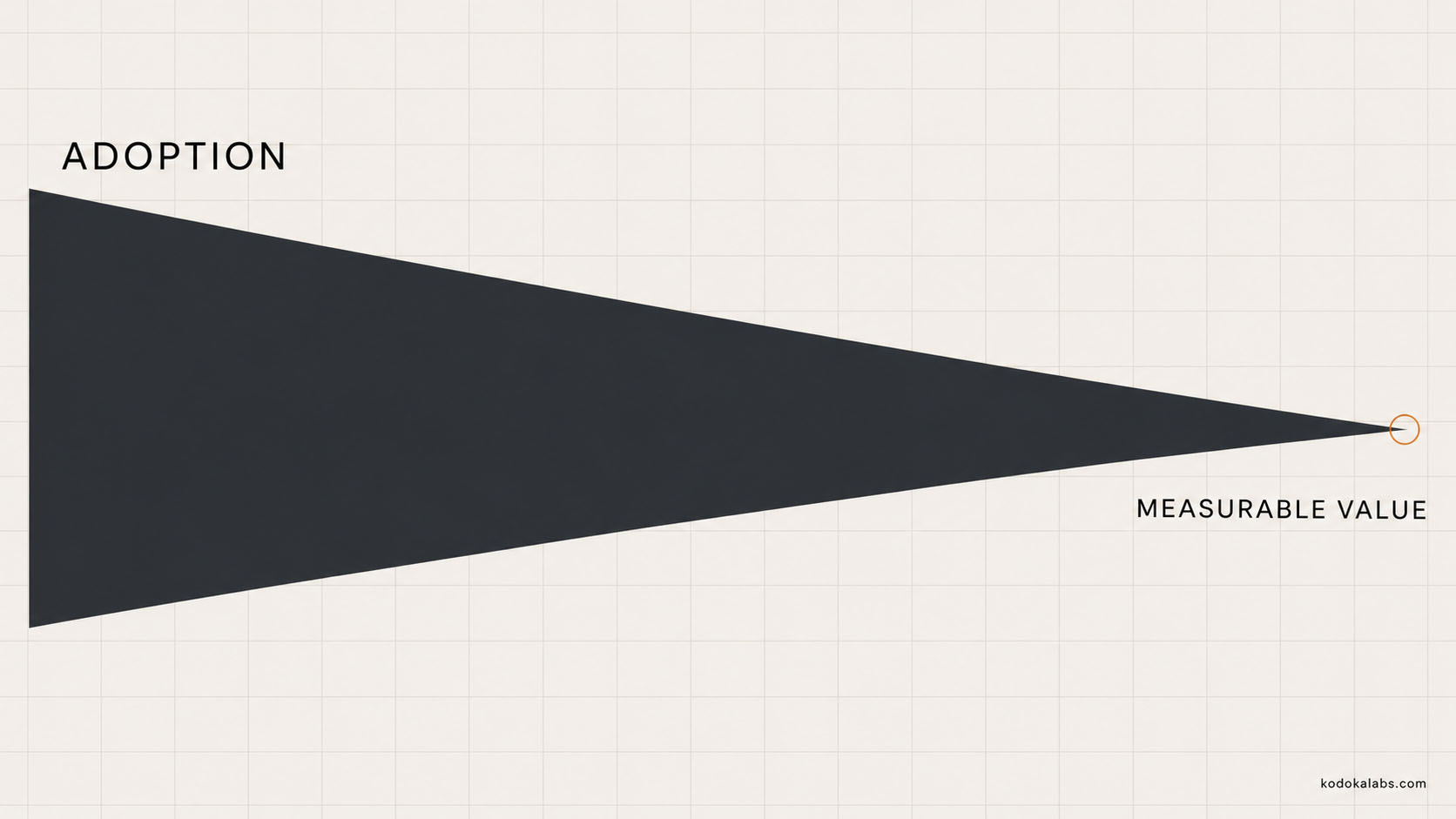
Generative AI adoption inside large organizations is nearly universal, yet the share of companies that can point to a measurable earnings contribution from it remains small. That gap is not a technology problem. Research from RAND, Gartner, Boston Consulting Group, and McKinsey converges on the same root cause: AI initiatives fail when leadership treats them as software procurement rather than workflow and organizational redesign. Enterprises that buy seat licenses without redesigning the surrounding review, governance, and knowledge systems around them don’t accelerate marketing, they relocate the bottleneck from drafting to review while quietly degrading the quality and search visibility of everything they publish.
Key Takeaways for Enterprise AI Marketing Implementations
- Generative AI use is now reported by the large majority of companies, but only a small minority attribute a meaningful share of earnings to it, a gap documented by McKinsey’s State of AI research.
- RAND Corporation research finds that more than 80% of AI projects fail, roughly double the failure rate of comparable non-AI information technology projects, and that the root causes are overwhelmingly organizational rather than technical.
- Gartner projects that at least 30% of generative AI projects will be abandoned after proof of concept, with an even higher abandonment rate forecast for autonomous, agentic AI initiatives.
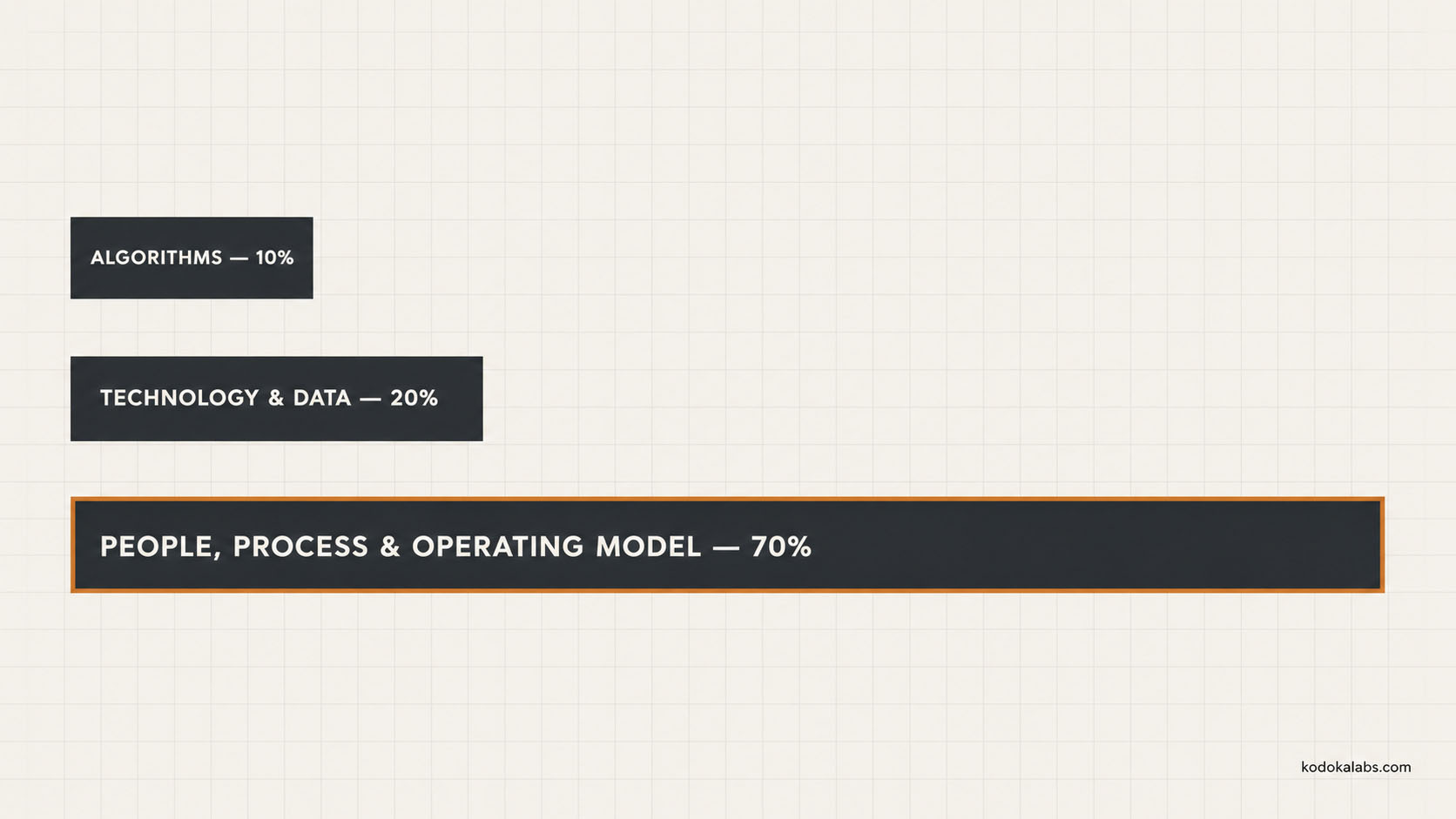
- Boston Consulting Group’s research describes a 10/20/70 pattern: successful AI transformation allocates roughly 10% of effort to algorithms, 20% to technology and data, and 70% to people, workflow, and operating model change, a ratio most failed initiatives invert.
- Faster drafting without redesigned review workflows creates a review bottleneck, not a productivity gain, and generic AI-assisted content carries a real cost in generative engine visibility.
The Enterprise Generative Paradox
Generative AI has moved faster into the enterprise than almost any technology category before it. McKinsey’s 2025 State of AI research, drawn from nearly 2,000 participants across more than 100 countries, found that 88% of organizations now use AI in at least one business function, up from 78% the prior year. Marketing is consistently among the functions with the heaviest early adoption, since drafting, research, and creative production are exactly the tasks generative tools were first built to accelerate.
The paradox sits one layer below that adoption number. The same McKinsey research found that only 39% of organizations report any earnings impact from AI at all, and when the bar is raised to a meaningful earnings contribution, the number collapses further: just 6% of organizations qualify as AI “high performers,” attributing more than 5% of EBIT to AI with what McKinsey characterizes as significant realized value. The share of organizations reporting that any AI use case has been fully scaled across the business sits at just 7%.
| Metric | Share of organizations | Source |
|---|---|---|
| Use AI in at least one business function | 88% | McKinsey, State of AI 2025 |
| Report any EBIT impact from AI | 39% | McKinsey, State of AI 2025 |
| Qualify as AI "high performers" (>5% of EBIT, significant value) | 6% | McKinsey, State of AI 2025 |
| Report at least one AI use case fully scaled | 7% | McKinsey, State of AI 2025 |
This is the enterprise generative paradox: nearly every marketing organization has access to the tools, and almost none of them can show the board a defensible revenue or margin line connected to that access. RAND Corporation’s 2024 research into AI project failure, based on interviews with experienced data scientists and engineers, puts a number on the other side of that gap. More than 80% of AI projects fail outright, roughly twice the failure rate RAND finds for comparable non-AI information technology initiatives. RAND’s central finding is the one that should reshape how a CMO plans a rollout: the dominant causes of failure are misaligned purpose between the business and the technical team, weak or fragmented data foundations, and executive sponsorship that fades once the initial announcement has been made. Algorithmic limitations barely register as a cause.
Gartner’s research points at a related, forward-looking version of the same pattern. Gartner predicts that at least 30% of generative AI projects will be abandoned after proof of concept by the end of 2025, citing poor data quality, inadequate risk controls, escalating costs, and unclear business value as the primary drivers, and separately forecasts that 40% of agentic AI projects, the category of AI systems that act with more autonomy inside a workflow, will be canceled by the end of 2027.
The core thesis that follows from all three bodies of research is straightforward: AI fails in enterprise marketing organizations not because the models are inadequate, but because leadership approaches AI as a procurement decision rather than an operating-model transformation. A seat license changes what an individual contributor can produce in an afternoon. It does nothing, by itself, to change how work is reviewed, governed, measured, or owned across a team.
The Mechanics of the Point-Solution Trap
The point-solution trap begins at the team level, usually with good intentions. A content lead adopts a browser-based writing assistant. A paid media manager builds a personal library of prompts for ad copy. A product marketer starts feeding competitive research into a chatbot without a clear policy on what data is safe to paste into it. Each of these choices is individually reasonable and often genuinely helpful in the moment. None of them is coordinated with the others, documented anywhere a colleague could find it, or evaluated against a shared governance standard. The result, multiplied across a marketing organization of any real size, is a sprawl of disconnected tools, informal prompt libraries that live in someone’s personal notes, and ad hoc data ingestion practices that nobody outside the individual user can see or audit.
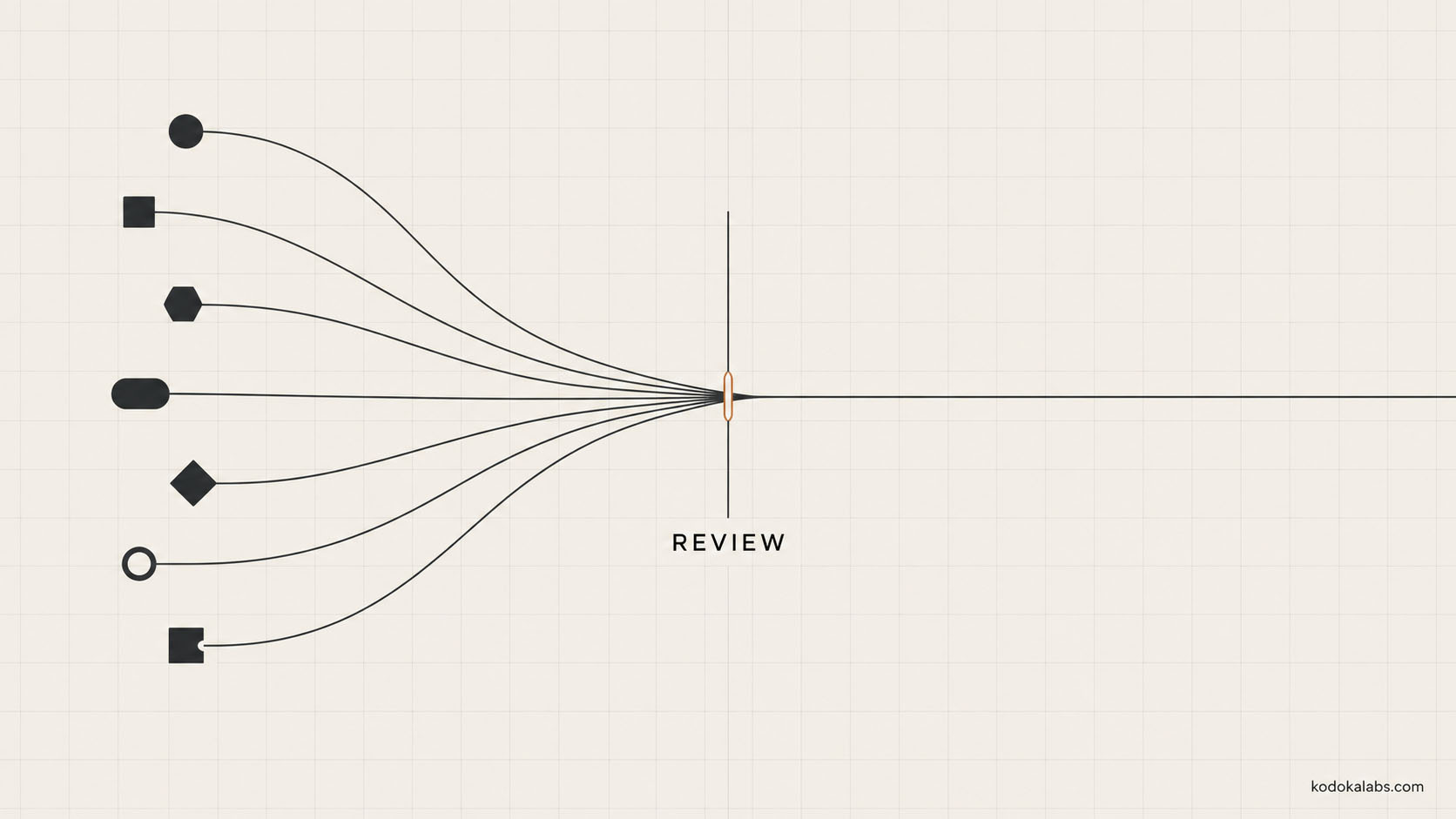
That sprawl produces a specific and measurable failure mode: the review bottleneck. Generative tools can realistically accelerate first-draft production by a significant multiple, five times faster initial copy generation is a plausible, often conservative, estimate for routine marketing collateral. But that acceleration doesn’t eliminate the need for fact-checking, brand-voice alignment, legal and compliance review, and editorial judgment, it just moves all of that work downstream and compresses it into a much shorter window. Senior editors and subject-matter reviewers, the people whose time is most expensive and least scalable, absorb a fact-checking and editing backlog that can easily grow faster than the drafting time it replaced. A team that generates five times more draft volume without adding reviewer capacity doesn’t produce five times more finished, trustworthy output. It produces a queue.
| Stage | Pre-AI baseline | Point-solution adoption | Net effect |
|---|---|---|---|
| First draft production | 1x | ~5x faster | Real time savings at the drafting stage |
| Fact-checking and editing | 1x | Up to ~10x the review volume | Senior staff capacity becomes the new constraint |
| Net throughput of trustworthy, published content | 1x | Often flat or negative | Efficiency gains are absorbed, then erased, by review |
The second consequence is quieter but more damaging over time: brand dilution. Generative models, used without a documented voice standard, a verified knowledge base, and a human review gate calibrated to the content’s risk level, tend toward generic, median phrasing, the statistically safest word choices across their training distribution. That output reads as competent and also as indistinguishable from what any competitor using the same tools without the same discipline would produce. Worse, ungoverned generation carries a real hallucination risk, confident-sounding claims, statistics, or specifics that are plausible but unverified. Publishing that kind of content at scale doesn’t just risk an embarrassing correction, it slowly erodes the specific, differentiated positioning a marketing organization spent years building.
The 10/20/70 Law of Transformation Failure
Boston Consulting Group’s research into AI transformation offers one of the clearest explanations for why so many enterprise initiatives stall despite real investment. BCG’s analysis describes what it calls a 10/20/70 pattern: in transformations that actually produce measurable value, roughly 10% of the effort goes into the algorithms and models themselves, 20% goes into technology and data infrastructure, and the remaining 70% goes into people, process, and operating-model redesign, new roles, new workflows, new decision rights, new review standards, and the change management required to make all of that stick. BCG’s research also finds that approximately 70% of the challenges organizations encounter in AI rollouts trace back to people and process issues, not to algorithms or infrastructure.
Failed enterprise initiatives consistently invert this ratio. A disproportionate share of budget goes to software licenses and, often, to external agency retainers for execution, while workflow re-engineering, role redesign, and governance design receive whatever time is left over, which in practice is very little. An organization that spends 90% of its AI budget on tools and outside execution, and 10% or less on redesigning how the work actually flows through the organization, is, by BCG’s own framing, allocating its investment in almost the exact inverse of what the research associates with success.
Un-architected data foundations compound the problem in a way that’s easy to underestimate until it shows up in output quality. A generative model asked to produce marketing content is only as differentiated as the knowledge it’s given access to. A model drawing on fragmented file drives, outdated wikis, and institutional knowledge that exists only in a few people’s heads will produce commoditized, generic output almost by construction, there’s no proprietary substance for it to draw on. This is why kōdōkalabs’ own diagnostic work treats a structured knowledge and data architecture, not just a model subscription, as a prerequisite for any AI initiative expected to produce differentiated marketing output, a principle formalized across the seven evidence areas of the Diagnose Evidence Stack, which assesses strategic alignment, workflow reality, knowledge and data readiness, technology and integration, governance and risk, people and capability, and measurement and value before any architecture or tooling decision is made.
Search and the New Discovery Reality
The point-solution trap carries a cost that extends beyond internal review capacity: it damages how discoverable an organization’s content is in the search environment that’s actually replacing traditional keyword search. A growing share of research and purchase-consideration queries now run through generative answer engines, Perplexity, ChatGPT Search, Microsoft Copilot, and Google’s AI Overviews, rather than through a conventional list of ten blue links. Generative Engine Optimization, the discipline of structuring content so that large language models can parse, trust, and cite it, is a materially different exercise than classic keyword-driven SEO.
Large language models evaluating a piece of content for inclusion in an answer or a citation aren’t primarily scoring keyword density. They’re assessing information density, whether the piece contains genuinely unique data, analysis, or perspective rather than a restatement of what’s already broadly available, and whether entities, people, organizations, concepts, and the relationships between them, are defined clearly enough for a model to extract and reuse with confidence.
Generic, AI-assisted content produced under point-solution conditions tends to fail this test on both dimensions. It restates widely available ideas in competent but unremarkable language, and it rarely introduces a genuinely new data point, framework, or argument. The practical consequence is a steady decline in citation frequency: a marketing organization publishing a high volume of undifferentiated AI-assisted content isn’t just failing to stand out to a human reader, it’s becoming statistically less likely to be the source an answer engine chooses to cite at all, in favor of a competitor whose content carries more unique substance.
The Path Forward: From Tools to Operating Systems
The organizations that escape the point-solution trap share a common starting move: they stop treating additional tool acquisition as the next step and start treating diagnostic clarity as the prerequisite for any further investment. Before adding another platform, license, or agent, the more productive question is whether the organization actually knows, with evidence rather than impression, where its current workflows, knowledge architecture, and governance stand today.
That diagnostic discipline is what separates ad hoc tool adoption from systemic architecture. A governed AI Marketing Operating System doesn’t start with a tool; it starts with an honest baseline, using a structured instrument like the Evidence Strength Levels framework, which grades every claim about current-state performance as asserted, observed, documented, or measured, so that investment decisions are built on the strongest available evidence rather than on anecdote. From that baseline, architecture, workflow redesign, governance, and tooling decisions can be made in the right order, rather than backward.
For a CMO or VP of Marketing Operations looking at a board presentation with real seat-license spend and no corresponding EBIT story, the next right move isn’t a new tool evaluation. It’s a structured look at The Architecture of an Impact-Driven AI Marketing Operating System, which lays out the eight-layer design stack that turns scattered AI usage into a governed, measurable system, and a candid look at how discoverable the organization’s own content currently is to answer engines through the Search Intelligence: SEO, GEO & AI Search Framework. Organizations that want an outside, evidence-based read on where they currently stand before committing further budget can also start with a kōdōkalabs Executive AI Marketing Assessment.

Frequently Asked Questions
Why do most enterprise AI marketing implementation projects fail to show measurable ROI?
Because the investment is concentrated in software licenses rather than in the workflow, governance, and knowledge-architecture redesign that research from BCG and RAND identifies as the actual driver of value. Tools change what's possible; redesigned operating models are what make that possibility measurable.
Is the enterprise AI marketing implementation failure rate really over 80%?
RAND Corporation's 2024 research puts the AI project failure rate at more than 80%, roughly double the failure rate of comparable non-AI information technology projects. Gartner's research, focused specifically on generative and agentic AI, separately projects abandonment rates of at least 30% for generative AI proofs of concept and 40% for agentic AI initiatives on a longer time horizon. The exact figure depends on scope and definition, but all three bodies of research describe failure as the statistically normal outcome absent deliberate operating-model redesign.
What is the review bottleneck, and why does faster drafting make it worse?
The review bottleneck occurs when generative tools accelerate first-draft production without a corresponding increase in reviewer, fact-checking, and governance capacity. Draft volume can grow several times faster than before, while the senior staff time required to verify, align, and approve that volume doesn't grow at all, so the organization's net throughput of trustworthy, published content can stay flat or decline even as raw output increases.
What does the BCG 10/20/70 rule mean for marketing budgets specifically?
It suggests that of every dollar allocated to an AI marketing initiative expected to produce real value, roughly ten cents should go to the underlying algorithms or models, twenty cents to technology and data infrastructure, and seventy cents to the people, workflow, and operating-model changes, new roles, documented processes, governance standards, and training, that let the organization actually use the technology well. Most failed initiatives spend the overwhelming majority of their budget on the first two categories and treat the third as an afterthought.
How does Generative Engine Optimization differ from traditional SEO?
Traditional SEO optimizes primarily for ranking in a list of search results driven substantially by keyword relevance and backlink signals. Generative Engine Optimization optimizes for being extracted, trusted, and cited by a large language model answering a question directly, which depends more heavily on information density, genuinely unique substance, and clearly defined entities than on keyword placement alone.
What should a marketing leader do before buying another AI tool?
Establish an evidence-based diagnostic baseline first, understanding current workflow reality, knowledge and data readiness, and governance maturity, using a structured framework like the Diagnose Evidence Stack, rather than adding another point solution on top of an unarchitected foundation. Tool decisions made after that diagnosis tend to solve problems that actually exist; tool decisions made before it tend to add complexity to a system nobody has fully mapped.
Conclusion and Next Steps
Enterprise AI adoption and enterprise AI value creation are, for the large majority of organizations, two separate stories right now. The research from RAND, Gartner, BCG, and McKinsey points to the same underlying diagnosis from four different angles: the gap is organizational, not algorithmic. Marketing leaders who want a different outcome than the 80%+ failure pattern RAND documents need to treat the next AI decision as an operating-model question before it’s a tool question. The next step for most organizations isn’t a new platform evaluation, it’s an honest, evidence-based look at the eight-layer architecture that turns scattered AI usage into a governed system built to produce a measurable result.