
AI-Native Marketing Organization:
Operating Model and Roles
 Ben
BenAI-Native Marketing Organization: Operating Model, Roles, and Capabilities
Executive Summary
An AI-native marketing organization is a marketing operating model in which human expertise, governed AI systems, company knowledge, workflows, and performance data are deliberately designed to work as one coordinated system – not a department where employees happen to use generative AI tools. Tools alone are insufficient because they change what individuals can produce without changing how the organization decides, governs, measures, or retains what it learns. Becoming AI-native requires six interdependent layers: strategic direction, human expertise, knowledge and context, workflow and agent design, governance and quality, and measurement and learning. Companies should not attempt to build all six at once or pursue full autonomy; they should begin by diagnosing current maturity, selecting a small number of high-value workflows, and expanding in controlled phases.
Key Takeaways:
- AI-native marketing is an operating-model discipline, not a software category.
- Individual tool adoption without organizational redesign produces fragmented, unmeasurable productivity gains.
- Six layers — strategy, humans, knowledge, workflow, governance, measurement — must work together, not in isolation.
- Human and AI responsibilities should be allocated deliberately, based on risk and reversibility, not by default.
- The transition should happen in controlled phases, starting with a diagnosis of current maturity.
What Is an AI-Native Marketing Organization?
An AI-native marketing organization is a marketing operating model in which human expertise, governed AI systems, company knowledge, workflows, and performance data are deliberately designed to work as one coordinated system. This guide is written for mid-market and enterprise marketing teams that have already adopted AI tools individually but have not yet redesigned how marketing work is organized around them.
The distinction that matters most is between AI *usage* and AI-*native* operations. AI usage means employees have access to generative AI tools and use them at their own discretion, with no shared standard for how outputs are produced, reviewed, or reused. AI-native operations means the organization has defined, documented, and governed how AI participates in specific workflows, what knowledge it draws on, who reviews its output, and how its performance is measured — the same rigor applied to any other core business system.
This distinction explains why two companies with similar levels of individual AI tool usage can have very different actual maturity. One company might have every employee using a generative AI assistant daily, with no shared prompt standards, no governance, and no way to know whether output quality is improving or degrading. Another company might have fewer individual “AI power users” but a small number of tightly governed, well-documented workflows producing consistent, measurable results. By any operating-model definition, the second company is more AI-native, even though the first looks more active on the surface.
This guide covers the operating-model layers, role changes, governance requirements, measurement approach, and phased transition path required to become AI-native. It does not claim that one universal organizational chart applies to every company, and it does not treat AI-native transformation as synonymous with headcount reduction. Becoming AI-native does not mean removing the marketing team and replacing it with automation — it means redesigning what the team is responsible for and how its work gets done.
Why Traditional Marketing Structures Struggle With AI
Most marketing departments were organized around channels, campaigns, and specialist roles, with workflows that assume human execution at every step. This structure struggles to absorb AI-assisted work for eight specific reasons:
- Channel silos. Teams organized by channel (SEO, paid, content, social) each adopt AI independently, with no shared standard across channels.
- Fragmented ownership. No single role is accountable for how AI is used across the marketing organization as a whole, so adoption happens person by person.
- Linear approval chains. Approval processes built for a slower, single-author production model bottleneck when AI increases the volume of draft output needing review.
- Undocumented processes. Workflows that exist as tacit knowledge, not written specification, can’t be evaluated for where AI should participate or reviewed for quality consistently.
- Disconnected data. Brand guidelines, research, and performance history live in disconnected systems and individual inboxes, inaccessible to AI systems that could otherwise draw on them.
- External dependency. Heavy reliance on agencies for execution means institutional knowledge about what works sits outside the organization, unavailable to internal AI workflows.
- Activity-based reporting. Measurement built around channel activity (posts published, campaigns launched) doesn’t capture whether AI-assisted work is actually improving quality or business outcomes.
- Tool-first procurement.</strong Technology purchasing decisions are made before workflows are redesigned, so tools get adopted into an unchanged process rather than an intentionally redesigned one.
Traditional Marketing Department vs. AI-Native Marketing Organization
Dimension
Traditional Marketing Department
AI-Native Marketing Organization
Organizing principle
Channels and campaigns
Workflows and outcomes, supported by channel expertise
Workflow design
Informal, tribal knowledge
Documented, with explicit AI/human handoffs
Knowledge access
Scattered across individuals and tools
Centralized, structured, and accessible to AI systems
Role of AI
Ad hoc, individual discretion
Defined participation in specific, governed workflows
Role of humans
Quality control
Governance
Measurement
Agency relationship
Learning cycle
The AI-Native Marketing Organization Stack
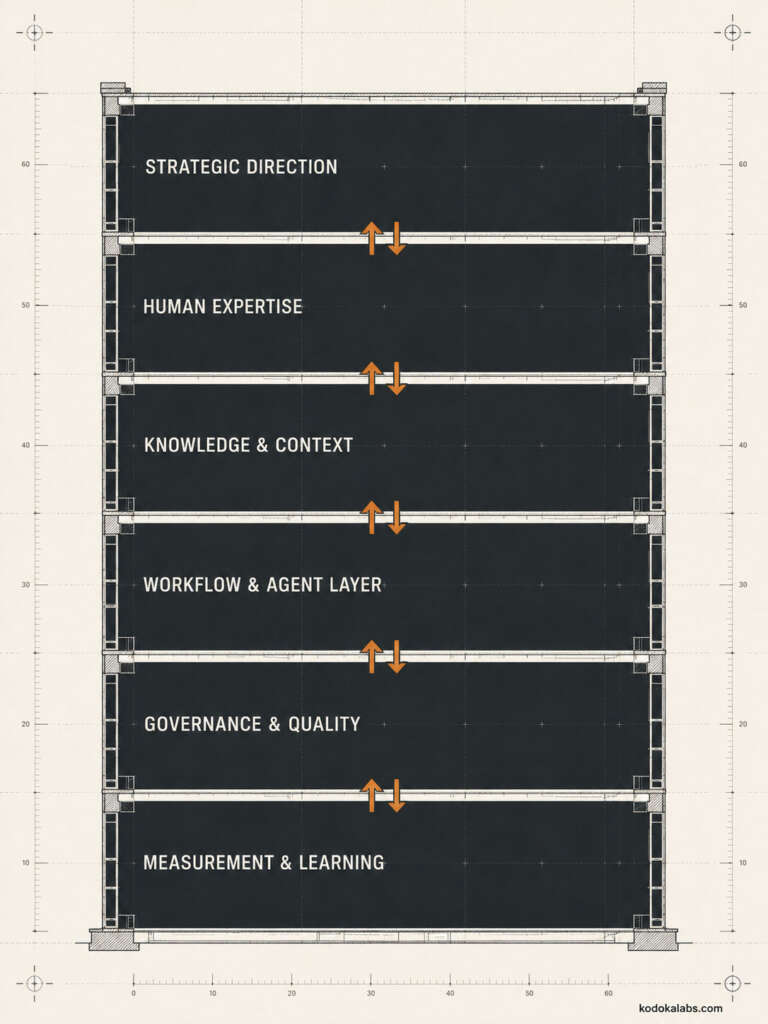
1. Strategic Direction
- Purpose: Anchor every workflow and AI decision in business priorities, not technology capability.
- Required components: Business priorities, ICP definition, positioning, commercial objectives, executive decision rights.
- Executive owner: CEO, CMO, or Chief Growth Officer.
- Operational owner: Marketing leadership team.
- Common failure mode: AI initiatives launched without a clear connection to a specific business priority, making it impossible to evaluate whether they’re succeeding.
- Maturity indicator: Every active AI workflow can be traced to a named business priority and an accountable executive.
2. Human Expertise
- Purpose: Preserve and elevate the judgment, creativity, and accountability that AI cannot substitute for.
- Required components: Domain judgment, creative direction, ethical accountability, customer understanding, final approval authority.
- Executive owner: CMO or Marketing Director.
- Operational owner: Senior specialists and subject-matter experts.
- Common failure mode: Treating human review as a formality rather than substantive judgment, or removing human review too early to save time.
- Maturity indicator: Human reviewers can articulate specifically what they’re checking for and why, not just that “someone looked at it.”
3. Knowledge and Context
- Purpose: Give both humans and AI systems a shared, accurate foundation to work from.
- Required components: Brand standards, product knowledge, audience evidence, market research, performance history, approved sources.
- Executive owner: CMO or Head of Content.
- Operational owner: Marketing operations or a dedicated knowledge/content architect.
- Common failure mode: Knowledge scattered across individual inboxes and drives, inaccessible to both new hires and AI workflows.
- Maturity indicator: A new team member or a new AI workflow can access the same current, structured knowledge base without asking a specific individual.
4. Workflow and Agent Layer
- Purpose: Turn strategy and knowledge into repeatable, governed execution.
- Required components: Structured processes, AI agents, automation, integrations, exception handling, human review points.
- Executive owner: Marketing Operations Director.
- Operational owner: Workflow owners for each core process.
- Common failure mode: Automating a process that was never clearly defined, which scales inconsistency rather than removing it.
- Maturity indicator: Every core workflow has a documented specification showing exactly where AI executes and where a human reviews.
5. Governance and Quality
- Purpose: Manage risk and maintain consistent quality as AI-assisted output scales.
- Required components: Acceptable-use rules, risk classification, source validation, approval thresholds, documentation, auditability.
- Executive owner: CMO, with legal/compliance input for regulated content.
- Operational owner: A named governance owner (often within marketing operations).
- Common failure mode: Governance exists as a policy document that nobody consults during actual production decisions.
- Maturity indicator: Governance rules are embedded in the workflow itself (approval gates, required fields) rather than relying on memory or goodwill.
6. Measurement and Learning
- Purpose: Prove whether the operating model is actually working and feed lessons back into future execution.
- Required components: Efficiency, quality, adoption, commercial outcomes, workflow performance, feedback capture.
- Executive owner: CMO or Revenue Operations Director.
- Operational owner: Marketing analytics or operations.
- Common failure mode: Measuring only activity or hours saved, without connecting AI-assisted work to quality or commercial outcomes.
- Maturity indicator: Leadership can answer, with evidence, whether a specific AI-assisted workflow is producing better outcomes than the process it replaced.
How Human and AI Responsibilities Should Be Divided
Dividing responsibility between humans and AI should not be left to individual discretion. kōdōkalabs uses a proprietary four-part model, the Human + AI Execution Model (also referred to as the Human–AI Responsibility Matrix), to make this allocation explicit:
- Human-owned – decisions and work that must be made or produced by a person, with no AI drafting involved.
- AI-assisted – AI contributes a draft, analysis, or option set, and a human makes the final decision or edit.
- AI-executed under supervision – AI completes the task with defined review checkpoints, not full independent judgment.
- Prohibited or restricted – categories where AI involvement is not permitted, or is restricted to narrow, defined uses.
Allocation across these four categories depends on risk, reversibility, factual sensitivity, brand exposure, and financial consequence — not on what’s technically possible.

Function
Typical Allocation
Why
Strategy
Research
Content creation
SEO/GEO
Media optimization
Customer communication
Reporting
Legal or sensitive claims
Roles in an AI-Native Marketing Team
Existing roles evolve rather than disappear, and new roles emerge to own the operating model itself. This is contextual, not universal — a 10-person marketing team and a 200-person marketing organization will staff these responsibilities differently, sometimes combining several into one role.
- CMO or marketing director – owns strategic direction and governance accountability, increasingly requiring AI-governance literacy alongside traditional marketing leadership skill.
- Marketing operations – owns workflow design and the day-to-day operating system, a role that grows in importance as AI adoption scales.
- Subject-matter experts – provide the domain judgment AI cannot originate, increasingly consulted earlier in the workflow to inform AI-assisted research and drafting.
- Content strategists – shift from producing individual assets to designing content systems and briefs AI execution draws from.
- SEO/GEO specialists – shift toward entity strategy, structured data, and citation performance rather than manual on-page optimization alone.
- Analysts – shift from reporting activity to evaluating whether AI-assisted workflows are producing better outcomes.
- Automation or AI systems architects – a newer role owning how AI agents and automation are configured and integrated.
- Editors and reviewers – shift from line-editing every asset to auditing against defined quality and governance standards.
- Legal, compliance, or data-protection stakeholders – increasingly involved earlier, in risk classification, rather than only at final sign-off.
- External partners – shift from primary execution to specialist input inside a governed internal system, per the Capability Transfer Framework’s approach to reducing dependency over time.
Centralized, Distributed, and Federated AI Models
Organizations structure AI governance and operations in one of three models:
- Centralized – a single team owns AI strategy, tooling, and governance for the whole organization.
- Distributed – each team or channel owns its own AI adoption independently, with minimal shared standards.
- Federated – a central team sets shared standards, governance, and infrastructure, while individual teams retain flexibility to apply them to their specific workflows.
For many mid-market organizations, a federated model offers a reasonable balance – this is a contextual recommendation, not a universal rule, and the right model depends on company size, risk tolerance, and existing organizational structure.
Dimension
Centralized
Distributed
Federated
Decision speed
Control
Duplication risk
Local flexibility
Governance complexity
Suitable company context
The Knowledge Infrastructure Behind AI-Native Marketing
AI systems and human team members both depend on the same underlying knowledge infrastructure. Building it requires attention to:
- Source-of-truth systems – a defined, authoritative location for brand, product, and messaging information, not multiple competing versions.
- Structured content – information organized so it can be retrieved precisely, not buried in long, unstructured documents.
- Taxonomy and metadata – consistent labeling so content and knowledge can be found and connected by both search and AI retrieval.
- Permissions – appropriate access control, particularly for confidential or regulated information.
- Retrieval – the technical mechanism (often retrieval-augmented generation) by which AI systems draw on this knowledge accurately.
- Freshness – a defined process for keeping knowledge current, since outdated information degrades AI output quality silently.
- Brand and product context – the specific detail AI needs to produce on-brand, accurate output rather than generic content.
- Expert knowledge capture – a deliberate process for capturing what subject-matter experts know, since this knowledge rarely exists in written form otherwise.
- Prompt specifications – documented, reusable prompt structures tied to specific workflows, not ad hoc prompting reinvented each time.
Governance and Quality Assurance
Governance for an AI-native marketing organization must cover:
- Acceptable-use policies – what AI tools and use cases are approved.
- Data classification – what information can and cannot be entered into which tools.
- Model selection – which AI systems are approved for which categories of work.
- Human review thresholds – which content categories require what level of review before publication.
- Source verification – how factual claims get checked before publication.
- Claim logging – keeping a record of sourced claims for audit and correction purposes.
- Version control – tracking changes to workflows, prompts, and governance rules over time.
- Escalation – a defined path for handling edge cases the standard process doesn’t cover.
- Audit trails – records sufficient to reconstruct how a specific piece of AI-assisted output was produced and reviewed.
- Accountability – a named, accountable owner for every governed content category, not diffuse or implied responsibility.
How to Measure an AI-Native Marketing Organization
Category
Metric
Efficiency
Cost
Quality
Quality
Process
Adoption
Capability
Reliability
Commercial
Commercial
Learning
Common Mistakes
- Purchasing AI tools before defining specific use cases.
- Automating a process that was already broken, which scales the underlying problem.
- Allowing every team to create its own separate standards, recreating the fragmentation this guide addresses.
- Removing human review too early, before the workflow has demonstrated consistent quality.
- Measuring usage (how much AI is being used) rather than value (what it’s actually producing).
- Failing to document workflows, which prevents both quality consistency and knowledge transfer.
- Ignoring employee concerns about role change, which undermines adoption regardless of the technical design.
- Outsourcing ownership of the operating model permanently, recreating agency dependency in a new form.
AI-Native Marketing Organization Readiness Checklist
- [ ] Do we have a documented business priority for every active AI initiative?
- [ ] Can we name the executive and operational owner for each of the six operating-model layers?
- [ ] Is our brand, product, and performance knowledge centralized and accessible, or scattered across individuals?
- [ ] Do our core workflows have documented, AI/human handoff specifications?
- [ ] Do we have a defined governance structure, or informal, ad hoc approval?
- [ ] Have we classified our content categories by risk level?
- [ ] Do we know, with evidence, which of our current AI usage is producing measurable value?
- [ ] Have we distinguished activity metrics from outcome metrics in our reporting?
- [ ] Do our current roles reflect judgment, direction, and validation, or are they still built for manual execution?
- [ ] Have we defined which responsibilities must remain human-owned?
- [ ] Is our agency relationship built around capability transfer, or indefinite execution dependency?
- [ ] Have we run a structured maturity assessment, or are we estimating our maturity informally?
- [ ] Do we have a phased plan, or are we attempting broad transformation all at once?
- [ ] Is there a named individual accountable for AI governance in marketing?
- [ ] Have we asked our own team what concerns they have about this transition?
Frequently Asked Questions
01 What does AI-native mean in marketing?
AI-native means a marketing organization has deliberately redesigned its operating model — strategy, workflows, knowledge, governance, and measurement — so that AI participates as a governed part of the system, rather than being used ad hoc by individual employees on top of an unchanged process.
02 Is an AI-native marketing organization fully automated?
03 Which marketing roles will still be needed?
04 Does a company need an internal AI team?
Not necessarily a dedicated team from day one. Smaller organizations often start with existing marketing operations owning AI governance and workflow design as part of their responsibilities, adding a dedicated role as scale justifies it.
05 How long does the transition take?
It depends on organizational size and starting maturity. Most organizations move through Diagnose and Architect within one to two months, with Build, Enable, Measure, and Scale unfolding over two to four quarters — this is not a fixed universal timeline.