Menu Close

kōdōkalabs
AI Marketing Architecture and Operating Model Design

Architect: Design the AI Marketing Operating Model

Architect is the second phase of The kōdōkalabs Transformation System. It converts validated Diagnose findings into a target operating model, workflow specifications, governance controls, knowledge requirements, technology decisions, measurement design, and an implementation backlog.

Executive Summary

Architect exists because most organizations that fail at AI marketing transformation don’t fail at Diagnose — they fail in the gap between knowing what’s wrong and building something that actually works. That gap gets filled with tool configuration when it should be filled with design: explicit decisions about operating model, decision rights, workflow responsibility, knowledge architecture, technology integration, governance, measurement, and ownership transfer. Architecture is decision infrastructure, not a slide deck. This page covers the eight design layers that make up a complete architecture, how human and AI responsibilities get allocated within it, what Architect must deliver before Build can begin, and the failure modes that turn architecture into an expensive documentation exercise nobody actually uses.

Key Takeaways

  • Architecture is a set of explicit design decisions, not a future-state diagram.
  • Eight connected layers span business scope through ownership transfer — skipping any layer leaves a gap Build will discover the hard way.
  • Every material decision gets documented with its rationale, not just its conclusion.
  • A Minimum Viable Architecture exists for controlled pilots — not every organization needs enterprise-scale documentation from day one.
  • Architect is distinct from the Strategic Architecture delivery methodology, which specifies individual workstreams within the operating model Architect defines.

What Is the Architect Phase?

Architect takes what Diagnose established as evidence and converts it into a design. Where Diagnose answers “what’s true about our current state,” Architect answers “what should the target state look like, specifically enough that it can be built, governed, measured, and eventually operated by the client’s own team.” The output isn’t a vision statement – it’s a set of interconnected, documented decisions that Build can implement directly.

Why Architecture Comes Before Automation

Organizations frequently move from diagnosis directly into tool configuration, skipping the design step entirely. This produces a specific, recognizable pattern: disconnected automations that each solve a narrow problem without fitting into a coherent whole, unclear responsibility for who owns what once something breaks, weak knowledge inputs because nobody designed what the AI system should actually know, inconsistent review because governance wasn’t built in from the start, and metrics that get added after deployment because measurement wasn’t part of the original design. Architecture closes this gap by making the relationships between these pieces explicit before implementation begins, not after something has already gone wrong in production.

Inputs Required from Diagnose

Architect starts from Diagnose’s Decision Package — the evidence register, the maturity profile, the prioritized opportunity backlog, and the explicit decision about what warrants design. If any of these inputs are missing or incomplete, Architect’s first move should be returning to Diagnose for that specific gap rather than designing around an assumption. Architecture built on an incomplete diagnosis tends to produce a well-documented design for the wrong problem.

The Eight Layers of AI Marketing Architecture
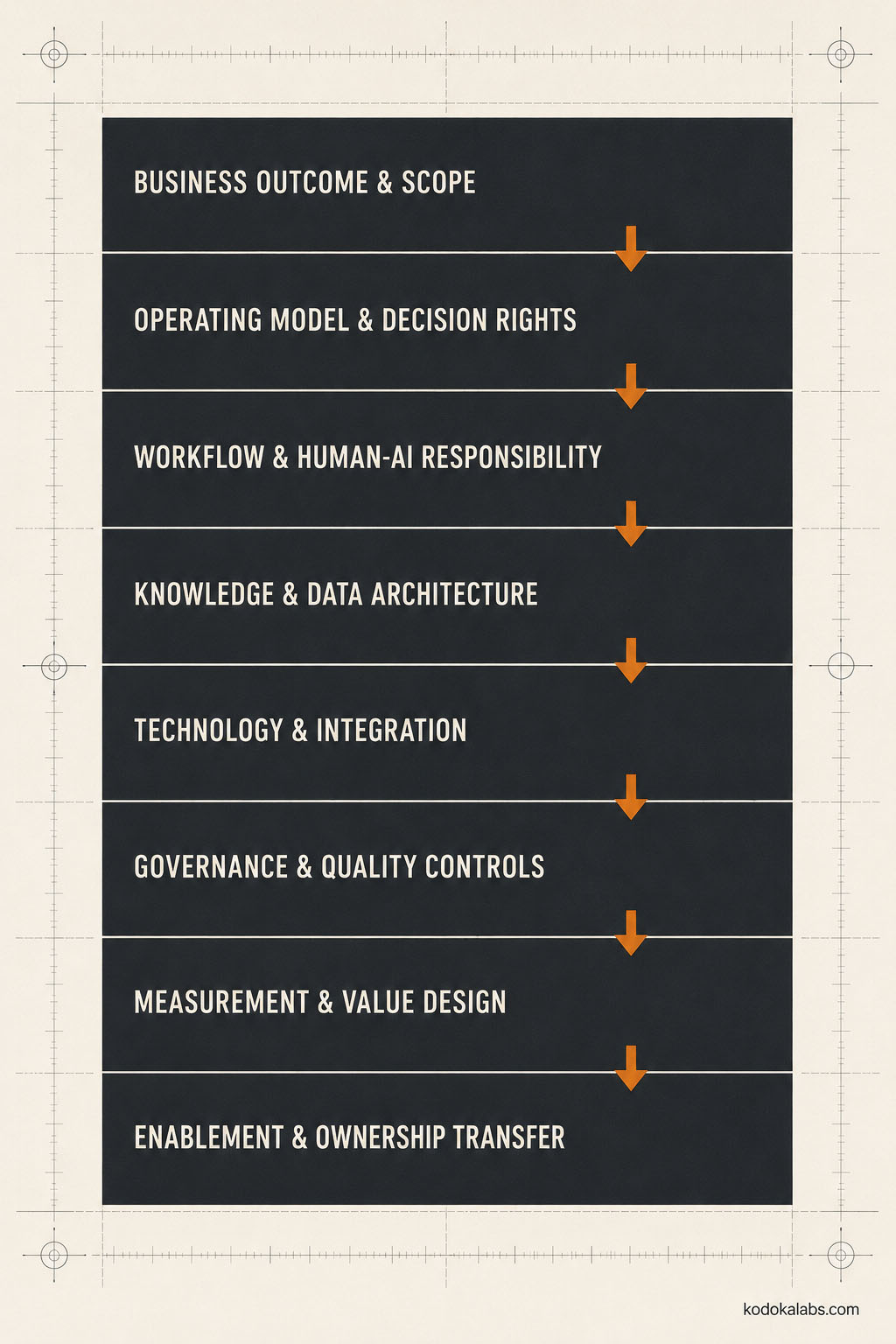
kōdōkalabs - Framework - Architecture Phase - Eight Layer AI Marketing Architecture

kōdōkalabs’ Architecture Decision Stack organizes design work into eight connected layers. This is kōdōkalabs’ own methodology, not an externally standardized architecture framework. For every layer, the design work specifies required inputs, the actual design decisions, outputs, approvers, and what Build depends on from that layer.

Business outcome and scope

What business outcome is this architecture meant to serve, and what’s explicitly out of scope? A design without clear scope boundaries tends to expand until it’s attempting to solve every problem Diagnose surfaced at once, which usually means it solves none of them well.

Operating model and decision rights

Who decides what, at what level, and with what authority? This layer defines the organizational structure the rest of the architecture operates within — without it, later layers have no clear owner.

Workflow and human–AI responsibility

Which specific workflows are being redesigned, and how is responsibility allocated between human judgment and AI assistance within each one? See the dedicated section below for the model this layer applies.

Knowledge and data architecture

What knowledge does the system need access to, in what structure, with what access controls, and how does it stay current? This layer determines whether AI-assisted work in the resulting system will be reliable or will confidently produce plausible-sounding errors.

Technology and integration architecture

Which tools and systems are involved, how do they connect to each other, and what technical constraints does that create? Architecture treats specific tools as replaceable components serving the design, not the other way around.

Governance, privacy, security, and quality controls

What review requirements, risk classifications, and quality checks apply to this workflow, and at what point in the process do they occur? See “Governance by Design” below.

Measurement and value design

How will this workflow’s performance actually be measured once it’s operating, and against what baseline? Measurement designed after implementation tends to measure what’s convenient to measure rather than what actually matters.

Enablement, documentation, and ownership transfer

What does the client team need to know and be able to do to operate this system independently, and what documentation makes that transfer possible? This layer is what connects Architect’s design to the Enable phase that follows Build.

How Human and AI Responsibilities Are Designed

Within the workflow and human-AI responsibility layer, Architect applies the Human + AI Execution Model and risk-based review logic established earlier in the Transformation System: work gets allocated across human-owned, AI-assisted, AI-executed-under-supervision, and prohibited-or-restricted categories based on risk, reversibility, factual sensitivity, brand exposure, and financial consequence — not based on what’s technically possible to automate. A task being automatable doesn’t make automating it the right design decision; that determination depends on the risk profile Architect assesses for each specific workflow.

Workflow Architecture Requirements

Each workflow specification produced during Architect covers: triggers (what starts this workflow), inputs (what it needs to run), steps (the actual sequence of work), owners (who’s accountable at each step), systems (what tools are involved), knowledge (what information the workflow draws on), exceptions (what happens when the normal path doesn’t apply), approvals (where human sign-off is required), outputs (what the workflow produces), evidence (how quality and accuracy get verified), and metrics (how performance gets measured). A workflow specification missing any of these fields is incomplete, regardless of how detailed the parts that are present may be — exceptions and approvals in particular are the fields most often skipped, and the ones whose absence causes the most trouble once a workflow reaches real-world use.

Knowledge and Context Architecture

This layer decides what structured knowledge base the redesigned workflows will draw on, who owns keeping it current, what access controls apply, and how gaps or conflicts in that knowledge get resolved. A workflow architecture can be well-designed on paper and still fail in practice if the knowledge layer underneath it is incomplete, stale, or structured in a way AI systems can’t reliably retrieve from.

Governance by Design

Governance gets built into the architecture at the point where each workflow is specified, not added afterward as a compliance review. This means each workflow’s risk classification, required review level, and approval gate are defined as part of its specification — consistent with the Marketing AI Governance Control Stack – rather than discovered later when legal or security asks how a workflow that’s already built actually handles a specific risk.

Measurement Before Implementation

Every workflow specification includes how its performance will be measured before that workflow gets built, connecting directly back to the baseline established in Diagnose. Designing measurement after implementation tends to produce metrics chosen because they’re easy to pull from whatever system happens to be in place, rather than metrics that actually answer whether the workflow is creating the value it was designed to create — a problem the Measure phase depends on Architect having avoided.

Architecture Deliverables

Architect requires a specific set of deliverables before Build can begin: a target operating model, workflow specifications for each redesigned workflow, a responsibility matrix, a knowledge map, an integration blueprint, a governance matrix, a measurement plan, a prioritized implementation backlog, a defined pilot scope, a documentation plan, and a capability-transfer plan. Each deliverable has a specific approver — architecture isn’t considered complete when it’s written, only when it’s approved by the people who’ll be accountable for what it produces. The prioritized implementation backlog deserves particular attention because it’s where architecture connects to sequencing. Not every workflow specified in the architecture needs to be built simultaneously — the backlog orders redesigned workflows by a combination of value, risk, dependency, and readiness, giving Build a defensible starting point rather than an undifferentiated list of everything the architecture covers. A backlog that doesn’t distinguish “build this first” from “build this eventually” tends to produce a Build phase that either stalls trying to do everything at once or picks an arbitrary starting point disconnected from actual priority.

Architecture Review and Approval Gates

Before Build begins, the architecture passes through review from the roles with a stake in what’s being designed: the executive sponsor confirms the design still serves the original business outcome; governance stakeholders confirm risk classification and review requirements are adequate; the workflow owners who’ll eventually operate the system confirm the design is actually operable by their team, not just technically elegant; and a final approver signs off on the complete package. Skipping any of these reviews tends to surface the skipped perspective’s concerns later, during Build, when addressing them is more expensive. These reviews are sequenced deliberately rather than run as one combined sign-off meeting. Governance review before workflow-owner review means risk and compliance concerns get addressed while the design is still flexible, rather than after the people who’ll operate it have already built expectations around a version that governance later requires changing. Workflow-owner review happening before final approval means the final approver is signing off on a design that’s already been confirmed as genuinely operable, not just theoretically sound on paper.

Architect Exit Criteria

Architect is complete when every one of the eight layers has documented decisions with named approvers, the Architecture Decision Record captures the rationale behind each material choice, workflow specifications exist for every workflow in scope, and Build has everything it needs to begin implementation without having to make design decisions on the fly. If Build finds itself making a first-time design decision partway through implementation, that’s a signal Architect wasn’t actually finished. This doesn’t mean every possible edge case has to be anticipated before Build starts — a Minimum Viable Architecture for a controlled pilot is a legitimate way to satisfy the exit criteria at a lighter level of detail. What it does mean is that the decisions that were made, however minimal in scope, are complete and documented for that scope, rather than partially specified and left for Build to fill in informally.

Common Architecture Failure Mode

  • Tool-led design – designing around a specific tool’s capabilities rather than around the business outcome and workflow requirements, then working backward to justify the tool choice. This is the most direct route back into the pattern Architect exists to prevent – the same tool-first thinking Diagnose was meant to interrupt reappearing one phase later under the label of “architecture.”
  • Undefined ownership – a design that specifies what should happen without specifying who’s accountable when it doesn’t. Ownership gaps are usually invisible in the architecture document itself and only become visible the first time a workflow produces an unexpected result and nobody is clearly the person who resolves it.
  • Overengineering – building enterprise-scale documentation and governance for a workflow that only needed a Minimum Viable Architecture for a controlled pilot. Overengineering tends to slow delivery without proportionally reducing risk, since the added documentation rarely covers scenarios the lighter-weight version would have missed.
  • Missing exception handling – a workflow specification that covers the normal path in detail but never addresses what happens when something falls outside it. In practice, a meaningful share of a workflow’s real-world volume tends to be exceptions, not the documented happy path – architecture that only specifies the happy path leaves the highest-friction cases entirely undesigned.
  • Hidden data movement – knowledge or data flowing between systems in ways the architecture doesn’t document, which governance review then can’t actually evaluate. This is particularly common with AI tools that quietly send context to a third-party API as part of normal operation, in a way the workflow specification never explicitly names.
  • Weak evidence – design decisions justified by assertion rather than by the evidence Diagnose actually produced. A design decision that can’t be traced back to a Diagnose finding, or to a clearly labeled assumption pending validation, is a decision made on the architect’s preference rather than on evidence.
  • No measurement baseline – proceeding to Build without having defined how the resulting workflow’s performance will be measured, which reliably produces the same after-the-fact metrics problem Diagnose was designed to avoid at the organizational level.
  • A design the client team can’t operate – architecture that’s technically sound but assumes a level of ongoing technical sophistication the client’s actual team doesn’t have and Enable hasn’t been scoped to build. An elegant design nobody on the client side can maintain independently isn’t a successful architecture by kōdōkalabs’ standard, regardless of how well it performs on day one.

From Architect to Build

Architect hands Build the complete deliverable set: target operating model, workflow specifications, responsibility matrix, knowledge map, integration blueprint, governance matrix, measurement plan, prioritized backlog, pilot definition, documentation plan, and capability-transfer plan. Build implements what Architect specified — it isn’t the place where missing design decisions get made for the first time.

Frequently Asked Questions - Architect Phase - (FAQ)

All eight layers of the Architecture Decision Stack: business outcome and scope, operating model and decision rights, workflow and human-AI responsibility, knowledge and data architecture, technology and integration architecture, governance and quality controls, measurement and value design, and enablement/documentation/ownership transfer.

Architect defines the target operating model for the whole transformation scope. Strategic Architecture is the repeatable delivery method kōdōkalabs uses to specify an individual workstream, workflow, or content system within that already-approved operating model — narrower in scope, applied repeatedly during Build.

The eight layers apply at some scale to every architecture, but the depth varies — a Minimum Viable Architecture for a controlled pilot documents each layer at a lighter level of detail than an enterprise-wide operating model redesign would require.
The executive sponsor, relevant governance stakeholders, the workflow owners who'll operate the result, and a named final approver — see "Architecture Review and Approval Gates" above.
The right response is returning to Diagnose for that specific area, not designing around an assumption — architecture built on incomplete evidence tends to produce a well-documented design for the wrong problem.
Governance is one of the eight layers, not an optional add-on — a workflow's risk classification and review requirements are part of its specification, not a separate approval sought after the design is otherwise finished.
This depends heavily on scope — a single-workflow pilot architecture and an enterprise-wide operating model redesign require meaningfully different levels of design effort, which is part of why Minimum Viable Architecture exists as a defined, lighter-weight option.

Ready to
Design Your AI Marketing Operating Model?

If you’re tired of fragmented, keyword-centric strategies, it’s time to build a foundation that withstands algorithm shifts. Let’s start with the blueprint that guarantees high-ROI execution.