
kōdōkalabs
Build an AI Marketing System with Governed Workflows
Build: Implement a Governed AI Marketing System
Executive Summary
Key Takeaways
- A working AI marketing system is more than an automation that produces output — it needs approved knowledge, defined responsibility, observable controls, and a named human owner.
- Workflows move through three deliberate release states: sandbox validation, controlled pilot, and production-ready.
- Testing an AI-assisted workflow covers functional, factual, quality, brand, and risk dimensions — not just “does it run.”
- Models and tools are replaceable components inside an approved architecture, not the operating system itself.
- Build hands Enable a specific, documented, testable system — not a working demo with undocumented gaps.
What Is the Build Phase?
What Build Is Not
Inputs Required from Architect
The Eight Components of the Build Package
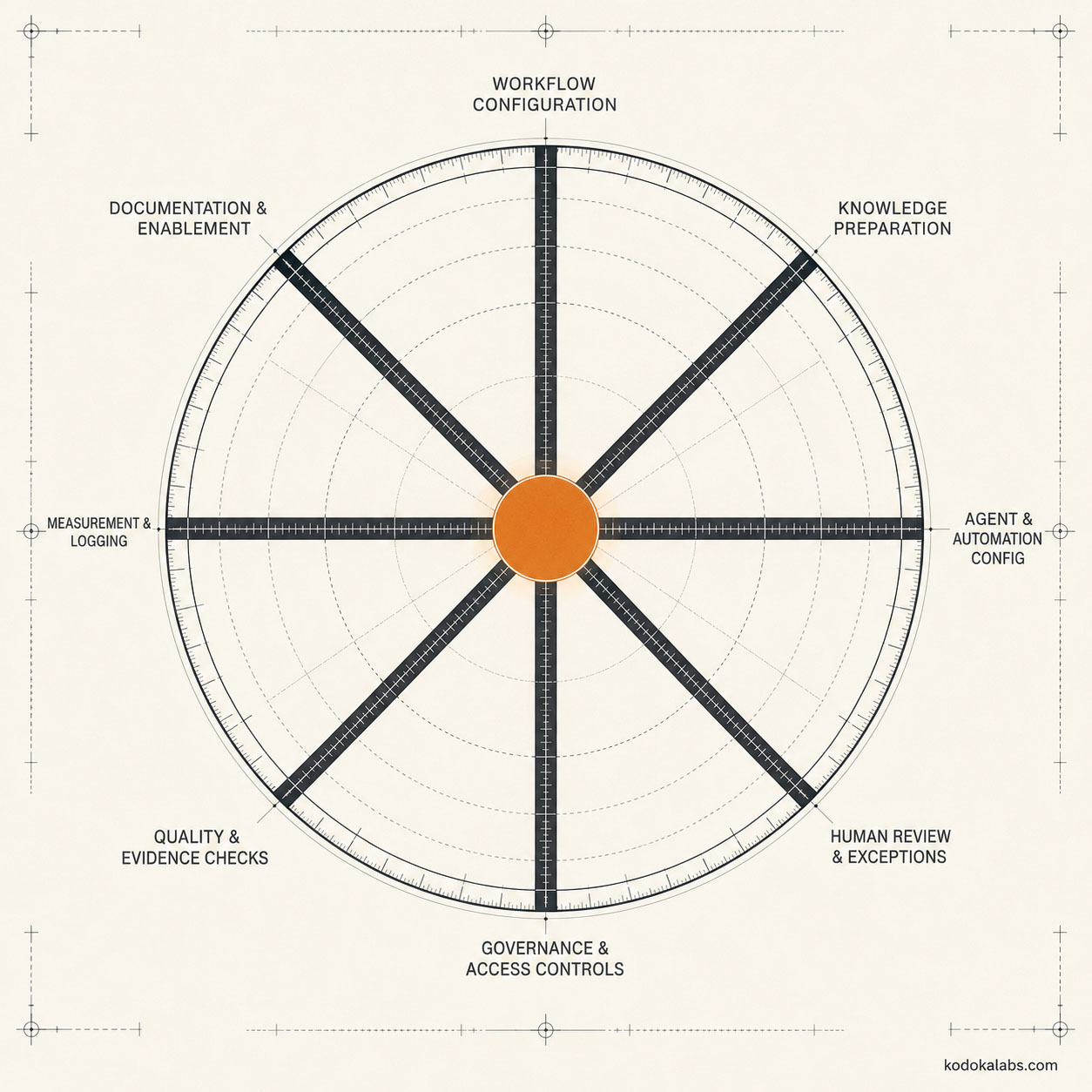
kōdōkalabs’ Build Package defines eight implementation components required for every workflow moving through Build.
Workflow configuration
Knowledge and context preparation
Agent, automation, and integration configuration
Human review and exception handling
Governance, access, privacy, and security controls
Quality and evidence checks
Measurement and logging
Documentation and enablement materials
How a Workflow Moves from Sandbox to Production
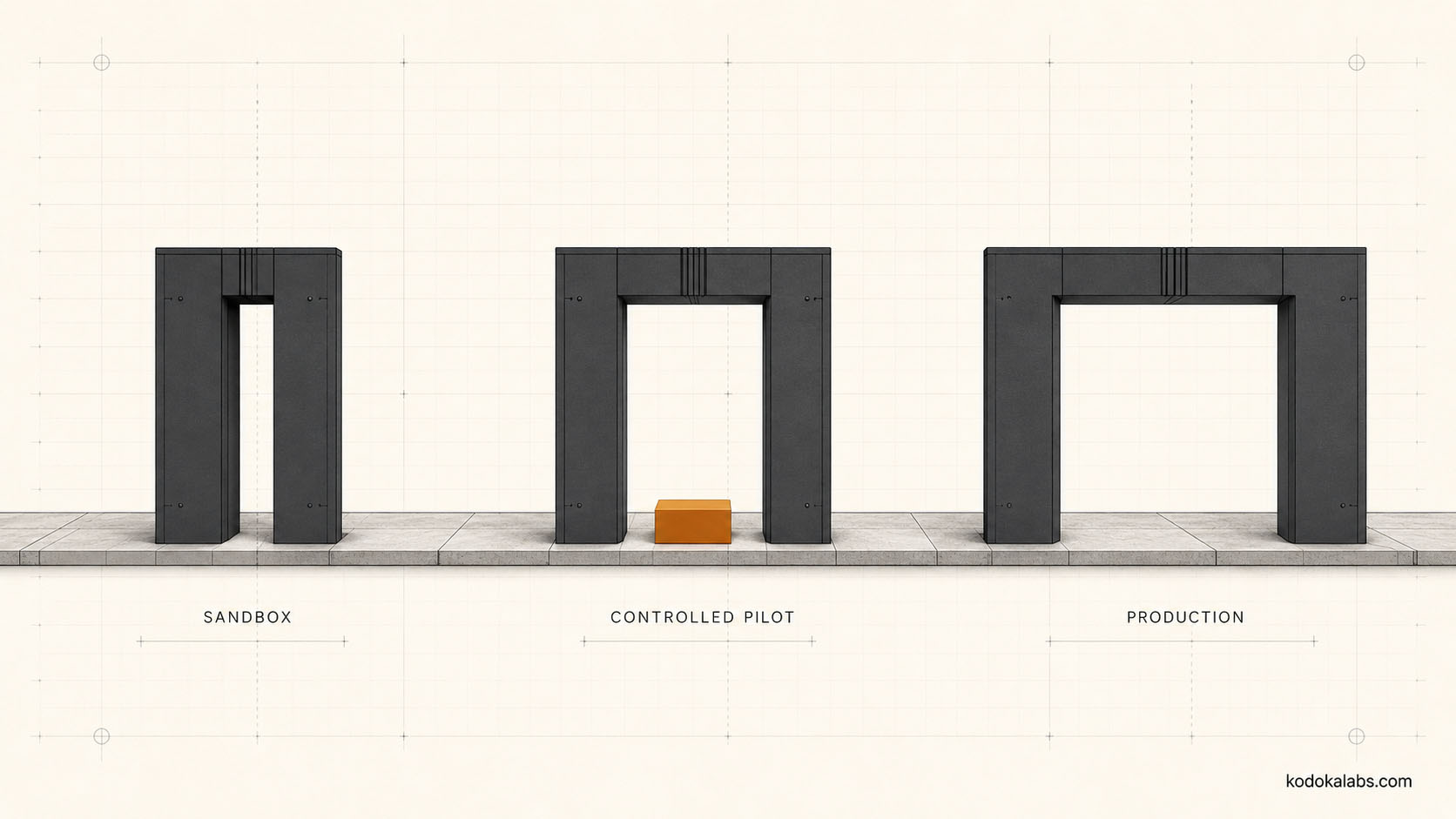
kōdōkalabs’ Pilot Readiness Levels define three environments a workflow moves through, each with different permitted data, audience exposure, human approval, monitoring, and rollback requirements.
| Level | Permitted Data | Audience Exposure | Human Approval | Rollback |
|---|---|---|---|---|
| Sandbox validation | Synthetic or non-sensitive test data | None — internal only | Full review of every output | Immediate, no production impact |
| Controlled pilot | Real data within approved scope | Limited, defined audience | Review at defined checkpoints | Documented rollback plan required |
| Production-ready | Full approved data scope | Full intended audience | Review scaled to risk classification | Tested rollback procedure |
A workflow doesn’t skip levels because it performed well at an earlier one — controlled pilot testing surfaces failure modes sandbox testing with synthetic data structurally cannot, because real data and real exceptions don’t fully resemble a test set designed in advance.
Moving between levels is a deliberate decision with its own evidence requirement, not an automatic progression once a certain amount of time has passed. A workflow graduates from sandbox to controlled pilot when its functional and factual testing pass at the sandbox level; it graduates from controlled pilot to production-ready when the pilot has run long enough, across enough real cases, to produce evidence about how it performs against actual exceptions — not just the cases anticipated in advance. Rushing this progression to meet a deadline is one of the more common ways a workflow reaches production before it’s actually ready.
Human Review and Exception Handling
Knowledge Preparation and Source Control
Agent and Automation Implementation
Models, tools, and specific vendor platforms are implementation choices within the approved architecture — replaceable components, not the operating system itself. This page doesn’t recommend or evaluate specific current tools or model capabilities, since tool-specific claims require verification against current vendor documentation at the time of implementation, not a general assertion here that could go stale. What matters architecturally is that whatever specific tools are chosen fit the responsibility allocation, governance requirements, and knowledge access controls Architect already specified — not which particular vendor happens to be selected.
This distinction has a practical consequence worth naming directly: an organization shouldn’t need to rebuild its entire operating model every time the underlying model or tool landscape changes, which it does with some regularity. A well-built system treats the specific model or automation platform as a configuration detail sitting inside a stable architecture, so that a model change or tool migration is a Build-level implementation task, not an Architect-level redesign.
Testing AI-Assisted Marketing Workflows
Testing an AI-assisted workflow covers more ground than testing whether it runs without crashing. Relevant categories, applied based on the workflow’s risk classification, include: functional testing (does it execute the specified steps correctly), factual testing (is the output accurate and traceable to approved sources), quality testing (does it meet the defined standard for its use), brand testing (does it match required voice and positioning), bias testing (does it produce unfair or skewed output across relevant scenarios), privacy and security testing (does it handle sensitive data appropriately), failure testing (what happens when an input or dependency fails), load testing (does it perform at expected volume), and rollback testing (can a bad deployment actually be reversed cleanly). Not every workflow requires every category at full depth — the workflow’s risk classification from Architect’s governance matrix determines which categories matter most.
Factual testing deserves particular attention for AI-assisted marketing workflows specifically, because generative AI output can be fluent and confident while being wrong in ways that aren’t obvious on a quick read. Factual testing means checking specific claims against their stated sources, not just checking that the output reads plausibly — plausibility and accuracy are different properties, and testing for one doesn’t validate the other. A workflow that passes every functional and quality test while regularly producing confidently-stated factual errors hasn’t actually passed Build’s bar, even though it may look finished.
Measurement and Observability
A workflow ships with the instrumentation Architect’s measurement plan specified already built in, capturing data from first production use rather than being retrofitted once someone asks a question the workflow was never designed to answer. Observability extends beyond the primary performance metric to include the operational signals — error rates, exception frequency, review turnaround — that indicate whether the workflow is actually healthy day to day.
Documentation Required Before Handover
Build Outputs and Acceptance Criteria
Build’s Acceptance Record requires evidence across functionality, output quality, source traceability, risk controls, accessibility where relevant, security and privacy review, measurement, documentation, ownership, and rollback. A workflow doesn’t move to Enable until each of these has documented evidence, not just an informal sense that it seems to be working.
Common Build Failure Modes
- Treating a demo as done – mistaking a workflow that performs well on a curated demonstration for a workflow that’s actually ready for controlled-pilot or production use. Demonstrations are, almost by definition, run against inputs chosen because they work well — this is precisely why the Pilot Readiness Levels require passing through real-data conditions before production, not just a successful showcase.
- Skipping sandbox validation – moving straight to a controlled pilot with real data before basic functional and factual issues have been caught in a lower-risk environment. Skipping this step trades a cheap, contained failure for a more expensive, more visible one later.
- Undocumented knowledge sources – a workflow drawing on knowledge nobody can trace back to an approved source, making factual errors difficult to diagnose or fix. When something goes wrong in production, the first useful question is “what source did this come from” — a workflow that can’t answer that question is far harder to debug and far riskier to trust.
- Review steps without teeth – a human review checkpoint that exists in documentation but has no actual mechanism preventing output from bypassing it. A review step that a busy team can quietly skip under deadline pressure isn’t a control — it’s a suggestion, and it will get skipped exactly when the risk of skipping it is highest.
- Retrofitted measurement – adding instrumentation only after a workflow is already live and someone asks how it’s performing. By the time that question gets asked, the workflow has usually already been running long enough that the earliest, most informative performance data is permanently unavailable.
- No rollback plan – discovering during an actual failure that nobody defined how to revert the workflow to its prior state. A rollback plan that’s never been tested is not meaningfully different from having no rollback plan at all.
- Ownership left with the builder – a workflow that only the person who built it actually understands, undermining the ownership transfer Enable depends on. This is the single most common reason organizations remain dependent on an external implementer indefinitely, even after the workflow itself is technically working well.