
Human-in-the-Loop for AI Marketing: Oversight Framework
Human-in-the-Loop AI for Marketing: Designing Meaningful Oversight
Executive Summary
Key Takeaways:
- Human-in-the-loop for AI Marketing is an operating model with specific requirements, not a synonym for “someone looked at it before it went out.”
- Meaningful review requires five conditions together: competence, context, evidence, authority, and time and attention.
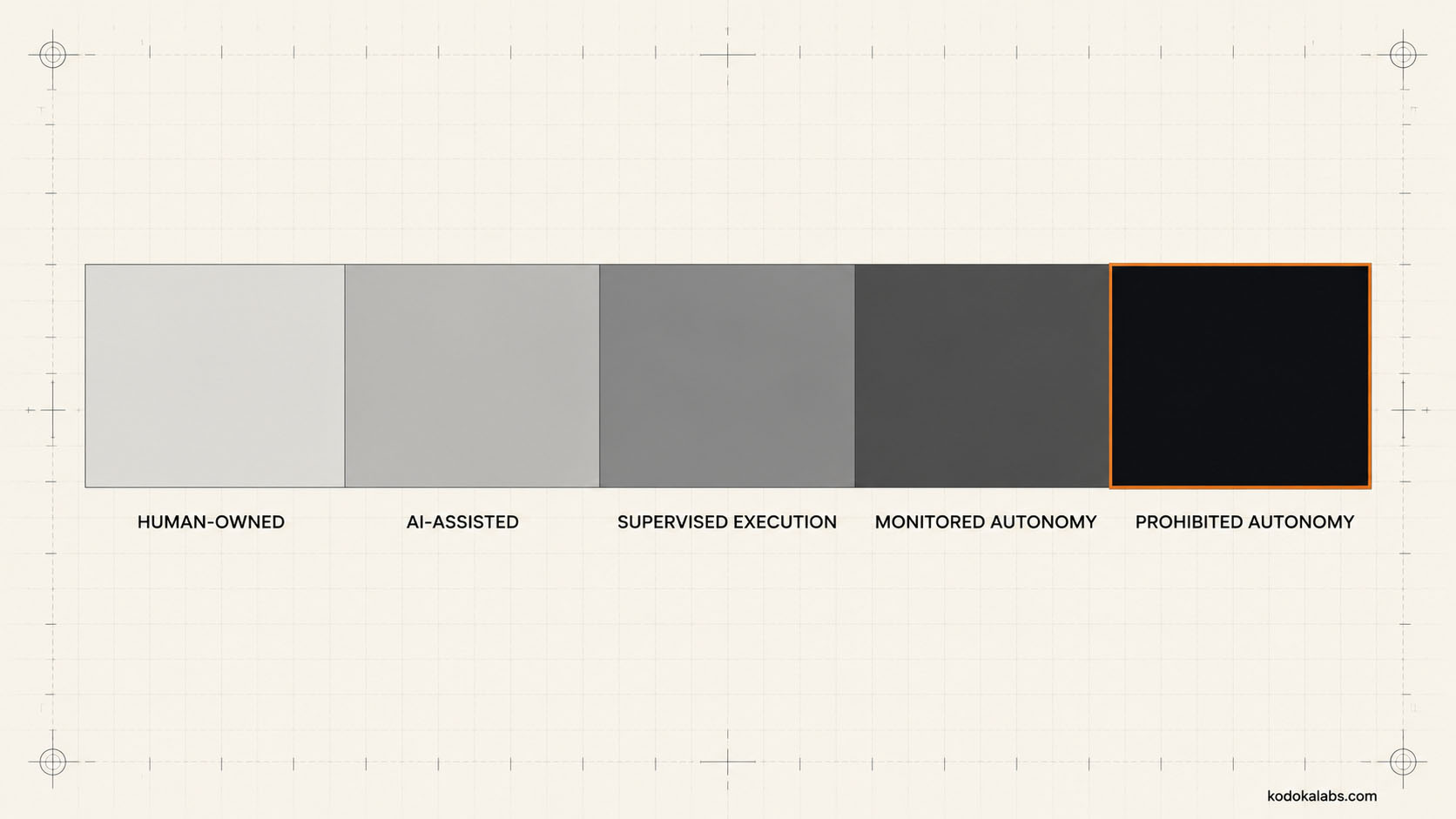
- The Human Control Spectrum defines five operating categories, from human-owned to prohibited autonomy – operating categories, not legal classifications.
- Review depth should scale with factual sensitivity, consequence, reversibility, and public exposure, not apply uniformly to everything.
- Automation bias and reviewer fatigue are predictable failure modes that need to be designed against, not just hoped away.
What Is Human-in-the-Loop AI?
Human-in-the-loop for AI Marketing means a qualified person genuinely has the ability to change the outcome of an AI-supported process before a consequence occurs – not that a person is nominally assigned to the workflow, and not that someone eventually sees the output. The defining test is whether the reviewer’s decision can actually alter what happens next. A reviewer who receives a completed output five minutes before it auto-publishes, with no realistic way to stop that publication, is not meaningfully in the loop, regardless of their job title or how the workflow is described internally.
This distinction matters because organizations frequently describe a workflow as human-in-the-loop based on its intended design rather than its actual operation. A workflow chart might show a review step between generation and publication, satisfying the label on paper, while the practical reality – a reviewer buried in other work, a publishing deadline that makes rejection organizationally costly, or a review interface that makes genuine scrutiny impractical – quietly erodes that step into a formality. The gap between designed oversight and operating oversight is exactly where the risk hides, and it’s usually invisible until an error actually gets through and someone asks how the review process allowed it.
Human-in-the-Loop vs. Human-on-the-Loop vs. Human-in-Command
Term
Relationship
Human-in-the-loop
Human-in-command
Why a Final Proofread Is Not Always Sufficient
Five Conditions of Meaningful Review
kōdōkalabs’ Five Conditions of Meaningful Human Review must be present together for a review step to function as a genuine control rather than a formality.
- Competence – the reviewer has the relevant subject knowledge to actually evaluate what they’re looking at.
- Context – the reviewer understands the purpose, audience, and constraints the output needs to satisfy.
- Evidence – the reviewer has access to the sources and reasoning behind the output, not just the finished result.
- Authority – the reviewer can actually approve, change, reject, or escalate – not merely comment.
- Time and attention – the reviewer has realistic time to review properly, not five minutes before a deadline with twenty other items in queue.
Removing any one of these conditions tends to degrade the review into something that looks like oversight without functioning as oversight – a competent reviewer with no time behaves differently than a rushed one with plenty of time, but both produce unreliable review, just for different reasons.
The Human Control Spectrum
Category
Description
Human-owned
AI-assisted
Supervised execution
Monitored autonomy
Prohibited autonomy
How to Classify Review Risk
Risk Factor
What It Considers
Factual sensitivity
How likely an error is and how consequential it would be if wrong
Data sensitivity
Consequence
Reversibility
Public exposure
Brand risk
Affected persons
An internal draft with low public exposure and high reversibility warrants lighter review than a public claim about product safety with high consequence and low reversibility – applying the same review depth to both wastes reviewer time on the former and under-protects against risk on the latter.
Classifying risk accurately requires looking at the factors together rather than any single one in isolation. A piece of content might involve highly sensitive data but be entirely internal and easily corrected if wrong, which argues for a different review depth than content involving no sensitive data at all but destined for a public, permanent, high-visibility placement. Organizations that build a risk classification around a single dimension – often defaulting to “does this touch personal data” as a proxy for risk generally – end up over-reviewing low-stakes internal work that happens to touch a database field, while under-reviewing genuinely high-stakes public content that doesn’t happen to trip that one criterion. The matrix is deliberately multi-factor so that classification reflects the actual consequence profile of the specific piece of work, not a single convenient proxy for it.
Who Should Review Which Output?
Where Human Gates Belong in Marketing Workflows
Source and evidence approval
Strategic and editorial approval
Publication, deployment, or scale approval
Sampling, Exceptions, and Escalation
Designing Reviewer Interfaces and Evidence Packs

Preventing Automation Bias and Reviewer Fatigue
Automation bias is the well-documented tendency for people to over-trust automated output simply because it came from a system, applying less scrutiny to AI-generated work than they would to the same content from a colleague. Reviewer fatigue compounds this – a reviewer who has approved ninety-eight consistently good outputs in a row is statistically more likely to wave through the ninety-ninth without full scrutiny, even if it contains an error the previous ninety-eight didn’t. Designing against both means varying review cadence and format, deliberately including known-flawed examples in training and calibration exercises, limiting how many high-stakes reviews any one person handles in a sitting, and treating review quality itself as something worth measuring rather than assuming it stays constant over time.
Automation bias is worth naming explicitly rather than treating as a vague concern, because it behaves differently from ordinary carelessness – it specifically affects otherwise diligent, competent reviewers, and it tends to get worse, not better, as a system’s track record improves. A reviewer who has seen a workflow perform reliably for months develops a reasonable, evidence-based trust in it – but that same trust is precisely what makes them less likely to catch the rare case where the system gets something wrong. This is why kōdōkalabs treats periodic recalibration – deliberately reintroducing known problems into the review stream to confirm reviewers are still catching them – as a legitimate part of an oversight program rather than an unnecessary complication, particularly for workflows carrying real consequence.
Recording Decisions Without Creating Unusable Bureaucracy
Measuring Review Quality and Workload
Common Failure Modes
- Symbolic review– a review step that exists on paper without any of the five meaningful-review conditions actually present.
- Uniform review depth– applying the same level of scrutiny to a low-risk internal draft and a high-risk public claim.
- Reviewer mismatch– assigning review to whoever’s available rather than whoever’s qualified for the specific risk involved.
- No escalation path– a reviewer who encounters something outside their authority with nowhere to route it.
- Unmanaged automation bias– assuming a reviewer’s scrutiny stays constant regardless of how consistently good previous outputs have been.
- Overloaded reviewers– assigning more review volume than a person can meaningfully sustain, then treating declining review quality as a personnel problem rather than a workload problem.
- Records as theater– recording that a review happened without the underlying review actually meeting the five conditions.