
AI Marketing Knowledge Base: Architecture and Governance
AI Marketing Knowledge Base: Building the Knowledge Layer for Reliable Workflows
Executive Summary
Key Takeaways:
What Is an AI Marketing Knowledge Base?
An AI marketing knowledge base is governed knowledge, not just stored content – it’s a collection of approved organizational information, structured with metadata that identifies its owner, status, and freshness, protected by access rules that respect confidentiality boundaries, and connected to a retrieval mechanism that lets both people and AI-enabled workflows find and verify what they need. The word “governed” is doing real work in that definition: a folder of documents is not a knowledge base until someone has decided what’s authoritative, who owns keeping it current, and who’s permitted to see what.
Most organizations already have something that resembles the raw material for a knowledge base – a shared drive, a wiki, a CMS, scattered slide decks – without having done the governance work that turns that material into something an AI-assisted workflow can rely on. That gap is often invisible until an AI system confidently cites something from an outdated deck that was superseded eighteen months ago, because nothing in the underlying storage indicated it had been superseded. The technology didn’t fail in that scenario – it retrieved exactly what was there. The organization’s knowledge simply wasn’t governed well enough to support the reliability the workflow needed.
Knowledge Base vs. Document Repository vs. Search Index vs. RAG
Term
What It Provides
What It Lacks Without Governance
Document repository
Search index
RAG (retrieval-augmented generation)
Governed knowledge base
RAG in particular is frequently mistaken for a governance solution – it’s a retrieval mechanism, and a well-implemented one can only retrieve what’s actually there. If the underlying content is contradictory, outdated, or unstructured, RAG retrieves contradictory, outdated, or unstructured content just as efficiently as it would retrieve reliable content – the technology has no independent way to know which is which.
Why Model Quality Cannot Fix Knowledge Disorder
A more capable model can reason more effectively over the information it’s given, but it cannot manufacture organizational knowledge that doesn’t exist, and it cannot reliably determine which of two contradictory internal sources reflects current company policy without being told. Organizations sometimes respond to unreliable AI-assisted output by upgrading to a newer or larger model, when the actual constraint is the quality and governance of the knowledge that model has access to. No model upgrade resolves the underlying question of which source the organization treats as authoritative – that’s a governance decision, not a technical one, and it has to be made explicitly.
This is worth stating plainly because it runs counter to a common and understandable instinct: when AI-assisted output is unreliable, the intuitive response is to look for a technology fix – a better model, a different vendor, a more sophisticated retrieval configuration. Sometimes that’s the right diagnosis. But when the unreliability traces back to conflicting internal sources, missing ownership, or outdated content presented with the same confidence as current content, no technology change addresses the actual cause. Organizations that repeatedly upgrade their AI tooling in response to knowledge-quality problems, without ever doing the underlying governance work, tend to find the same category of error resurfacing with each new tool, because the tool was never the source of the problem.
Knowledge Readiness Model

Dimension
What It Assesses
Authority
Completeness
Structure
Accessibility
Freshness
Permissions
Traceability
Feedback
What Belongs in the Marketing Knowledge Layer
Canonical Source Hierarchy
Rank
Source Class
Description
1
2
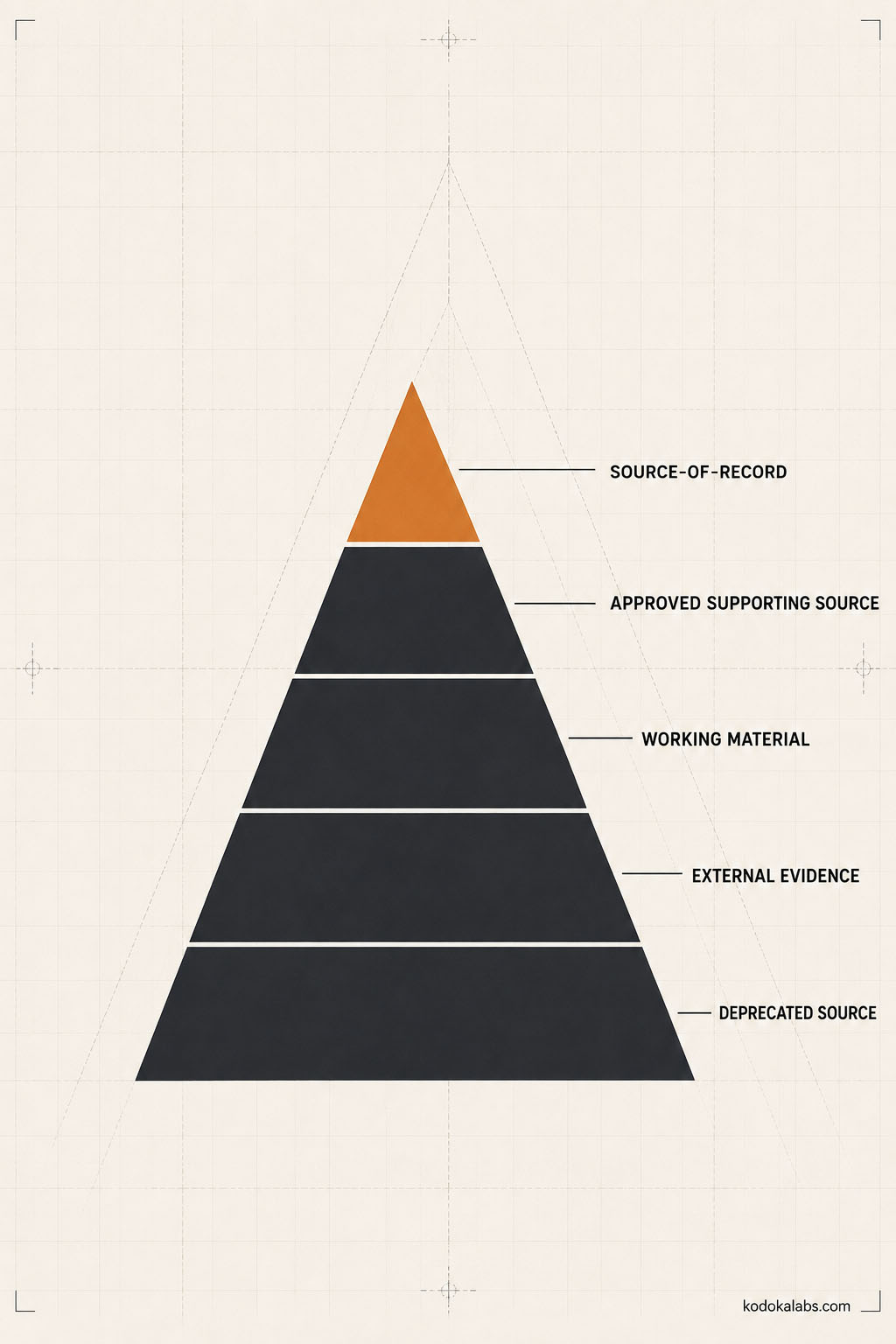
Approved supporting source
Vetted, current material that supports but doesn’t override the source-of-record
3
4
5
Knowledge Objects, Metadata, and Taxonomy
Metadata Field
Purpose
Title and unique ID
Owner
Type
Audience
Source status
Effective date and review date
Geography and product/entity
Permissions
Citations
Dependencies
Version
Retirement state
Ownership, Approval, and Freshness
Access, Confidentiality, and Client Boundaries
Retrieval Design and Source Attribution
Handling Contradictions and Evidence Gaps
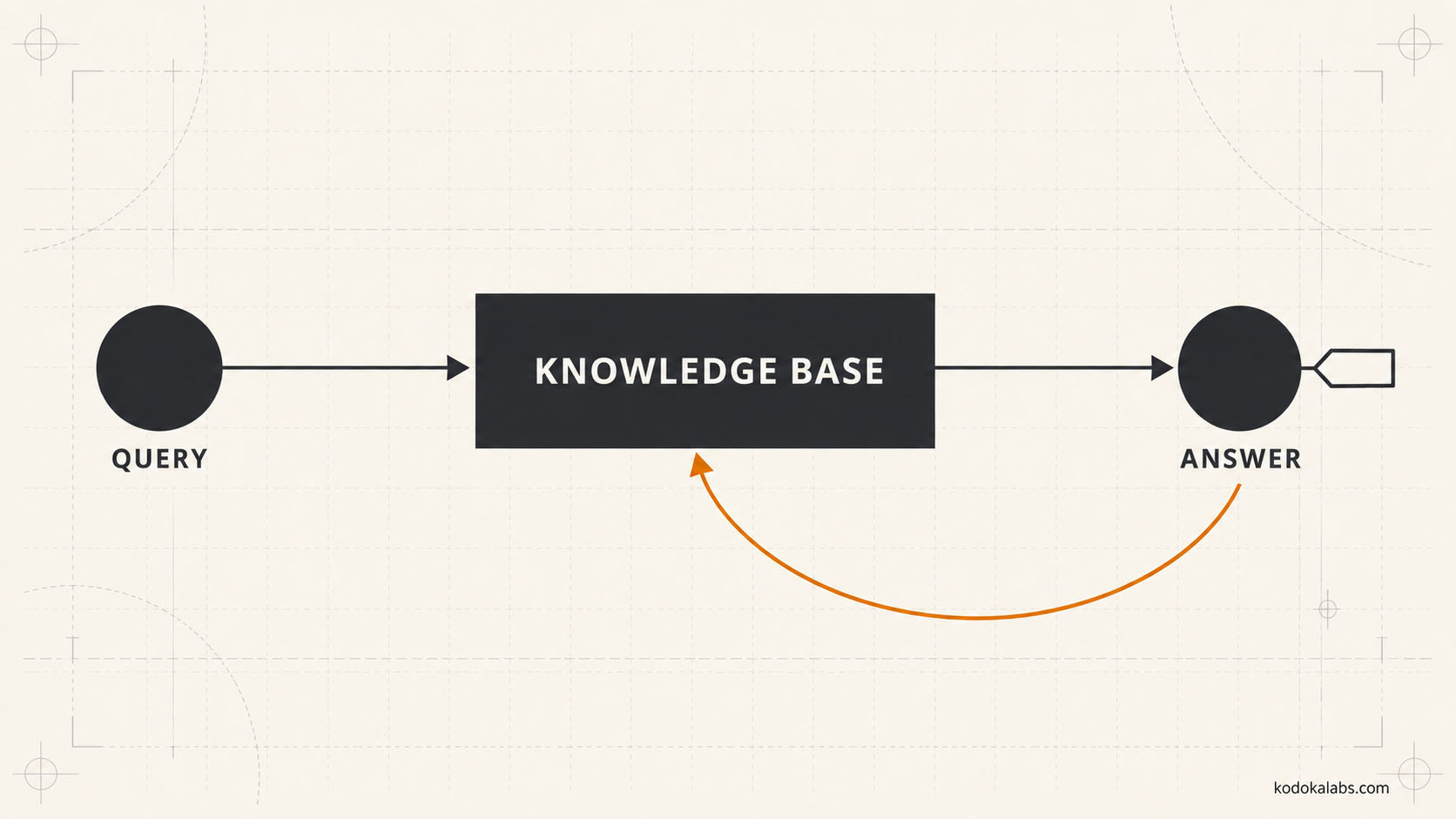
Contradictions between sources and gaps where no approved knowledge exists are both normal discoveries in any real knowledge base – the question is whether the organization has a defined process for handling them or lets them surface as unpredictable AI output instead. A contradiction should route to the object owners for resolution using the Canonical Source Hierarchy; a genuine gap should be logged and flagged rather than silently filled by an AI system’s best guess. Workflows that surface “we don’t have an approved source for this” are providing more real value than workflows that always produce a confident-sounding answer regardless of whether the underlying knowledge actually supports it.
This preference for honest gaps over confident guesses runs against a natural pull in the opposite direction – a workflow that occasionally says “I don’t have a reliable source for this” can feel less impressive than one that always produces a polished, complete-sounding answer, and there’s often organizational pressure to configure systems toward the more impressive-looking behavior. Resisting that pull is one of the more important, and more counterintuitive, governance decisions a knowledge base owner makes. An answer that’s wrong but confident tends to cause more downstream harm than a gap that’s honestly flagged, because the wrong answer gets trusted and acted on, while the flagged gap at least prompts someone to go find the actual answer before proceeding.
Expert Knowledge Capture
A significant portion of an organization’s most valuable knowledge exists only in the heads of specific experienced people – the account manager who knows why a particular client relationship requires careful handling, the product specialist who understands an edge case never written down. Capturing this knowledge deliberately, through structured interviews, review of past decisions, or documentation exercises built into the normal course of work, is what prevents a knowledge base from being limited to whatever happened to already be written down. This capture work should be planned and resourced, not left to happen incidentally whenever someone has spare time.
Feedback, Correction, and Deprecation
Measuring Knowledge-Base Health
Implementation Roadmap
Building a governed knowledge base from scratch is rarely a single project – a practical sequence starts with identifying and ranking existing sources using the Canonical Source Hierarchy, then defining the metadata schema and applying it to the highest-priority knowledge objects first, then establishing ownership and review cadences, then connecting retrieval for a limited pilot workflow, and only then expanding coverage and access as the governance model proves out. Attempting to migrate and structure an organization’s entire knowledge estate before any workflow can use it tends to delay value indefinitely – starting with the knowledge a specific pilot workflow actually needs, done well, tends to build both the governance model and the organizational buy-in to expand from.
Common Failure Modes
- Mistaking retrieval for governance – assuming a RAG implementation solves knowledge quality on its own, without addressing what’s actually being retrieved.
- No authority ranking – content that’s technically searchable but has no way to indicate which version is current when sources conflict.
- Ownerless knowledge – objects with no accountable owner, drifting out of date invisibly.
- Confidentiality leakage – retrieval systems that don’t respect the same access boundaries a human user would.
- Silent gap-filling – an AI system producing a confident answer where no authoritative source actually exists, rather than flagging the gap.
- One-time knowledge projects – treating knowledge-base creation as a project with an end date rather than an ongoing operational discipline.
- Deletion instead of deprecation – removing outdated content without a clear record of what was retired and why.