
Information Gain: How Original Evidence Creates Search and AI Value
What Information Gain Means, And What It Does Not
Information gain, in the editorial and search context this guide addresses, is the useful new value a source contributes beyond what is already readily and reliably available elsewhere. It can take the form of first-party data nobody else has published, an expert’s direct operational experience, an original synthesis that connects existing facts in a genuinely useful new way, or a clearer, more precise explanation of something poorly explained elsewhere. What it is not is a measurable, observable score that any search engine or AI platform has disclosed. No platform publishes an “information gain score,” and any tool or vendor claiming to measure one precisely is presenting an estimate, at best, as a fact.
This guide is not an argument that originality alone guarantees rankings, citations, or any other outcome. It is a practical system for identifying where new information can be created economically and ethically, and then protecting that value once created, through evidence discipline, clear provenance, and deliberate reuse, rather than letting it be a matter of luck or individual effort each time content is produced.
This guide covers forms of original contribution, including first-party data, experiments, expert experience, new synthesis, operational frameworks, comparative analysis, decision tools, illustrative examples, counter-evidence, and clearer definitions. It addresses marginal value, evidence quality, reproducibility, and honest limitations. It connects to, but does not duplicate, the research workflow and editorial quality-assurance processes covered in Content Operations.
Why Derivative Content Fails
Most content published on the web, and an even larger share of content produced quickly at scale, is derivative: it restates, summarizes, or lightly rephrases information that is already available in comparable form elsewhere. Derivative content is not worthless, it can still serve navigational or introductory purposes, but it carries no information gain, and it competes directly with every other derivative treatment of the same underlying facts.
This matters differently, and arguably more, in a generative-answer environment than it did in a purely ranked-results one. When a platform synthesizes an answer from multiple sources, a page that says nothing a dozen other pages do not already say gives that platform little reason to select it specifically, since any of the interchangeable alternatives would serve the synthesis equally well. A page with genuine information gain, a first-party data point, a specific expert judgment, an original framework, gives a system something it cannot get from the interchangeable alternatives. This is a reasonable inference from how retrieval and synthesis systems are described to work, not a disclosed ranking mechanism; no platform has confirmed information gain as a named, weighted ranking factor, and this guide does not claim otherwise.
Forms Of Useful Original Contribution
| Form | Strength | Relative cost | Risk | Suitable use |
|---|---|---|---|---|
| First-party data (surveys, internal benchmarks, usage data) | High, if the sample and methodology are sound and disclosed | High | Requires careful methodology disclosure; risk of overgeneralizing a limited sample | Flagship research content, cornerstone guides with a durable data asset |
| Direct expert experience and operational judgment | Moderate to high, depending on how specific and falsifiable the claims are | Low to moderate | Risk of presenting opinion as established fact without labeling it as practitioner judgment | Practitioner guides, decision frameworks, case-based explanation |
| Original synthesis connecting existing facts in a new, useful way | Moderate | Low to moderate | Risk of overclaiming novelty for what is actually a restatement | Explainer and strategy content, category-defining guides |
| Operational frameworks and decision tools built by the organization | High, when clearly labeled as proprietary methodology, not external consensus | Moderate | Risk of implying independent validation the framework does not have | Cornerstone guides, proprietary methodology pages |
| Comparative analysis across options, tools, or approaches | Moderate | Moderate | Risk of stale comparisons if not maintained | Decision-support and evaluation content |
| Counter-evidence or correction of a common misconception | Moderate to high | Low to moderate | Requires a credible, well-sourced counter-claim, not just contrarian framing | Myth-correcting sections within cornerstone guides |
| Clearer, more precise definitions of poorly explained concepts | Low to moderate on its own; higher combined with other forms | Low | Risk of adding little value if the existing explanations are already adequate | Definitional openings, FAQ sections |
None of these forms is inherently superior in isolation; a guide that combines several, an original framework alongside a clearer definition and a labeled practitioner judgment, tends to carry more cumulative information gain than any single form alone.
The Information Gain Opportunity Matrix
Before committing production resources to a piece of content, evaluate the opportunity across six dimensions: audience value (how much a reader genuinely benefits from this contribution), evidence accessibility (how feasible it is to gather credible evidence for the claim), differentiation (how distinct this would be from what is already published), repeatability (whether this type of contribution can be produced again for future content, or is a one-time effort), risk (the chance of an unsupportable or easily challenged claim), and production cost (the time, expertise, and resources required).
| Dimension | Low | Moderate | High |
|---|---|---|---|
| Audience value | Interesting to a narrow audience only | Useful to most of the target audience | Directly informs a real decision most readers face |
| Evidence accessibility | No credible path to evidence within reasonable effort | Evidence gatherable with moderate effort | Evidence already available or easily captured |
| Differentiation | Widely available elsewhere in comparable form | Somewhat distinct framing or detail | Not available elsewhere in this form |
| Repeatability | One-time effort, not reusable as a method | Reusable with moderate adaptation | Establishes a repeatable production method |
| Risk | High chance of an unsupportable or easily challenged claim | Some risk, manageable with careful sourcing | Low risk, well-supported and falsifiable |
| Production cost | Very high relative to expected value | Moderate, proportionate to expected value | Low relative to expected value |
A strong opportunity scores well on audience value, evidence accessibility, and differentiation, while carrying manageable risk and proportionate cost. An opportunity that scores poorly on evidence accessibility and high on risk, high claimed value but no credible path to support it, should be deprioritized or reframed as clearly labeled practitioner opinion rather than presented as established fact.
Production method: question to reuse
Question. Start from a genuine reader question or decision point, not from a keyword list. What does someone actually need to know or decide that existing published content does not adequately answer?
Source. Identify where credible evidence for that question can come from: internal data, direct practitioner experience, a synthesis of existing credible sources, or original analysis. Be honest at this stage about whether a credible source actually exists; if it does not, the opportunity should be deprioritized or reframed.
Create. Produce the content, applying the appropriate form of original contribution from the table above, and explicitly label which parts are established fact, which are practitioner judgment, and which are proprietary methodology, consistent with the claim-class evidence rules that govern every guide in this pillar.
Validate. Check the content against the evidence and source rules: is every claim traceable to a source, is the source’s limitations disclosed, is the claim appropriately qualified rather than overstated.
Publish. Release the content with its evidentiary basis intact and visible, not stripped out for brevity. A claim that loses its qualification in editing becomes a different, less defensible claim.
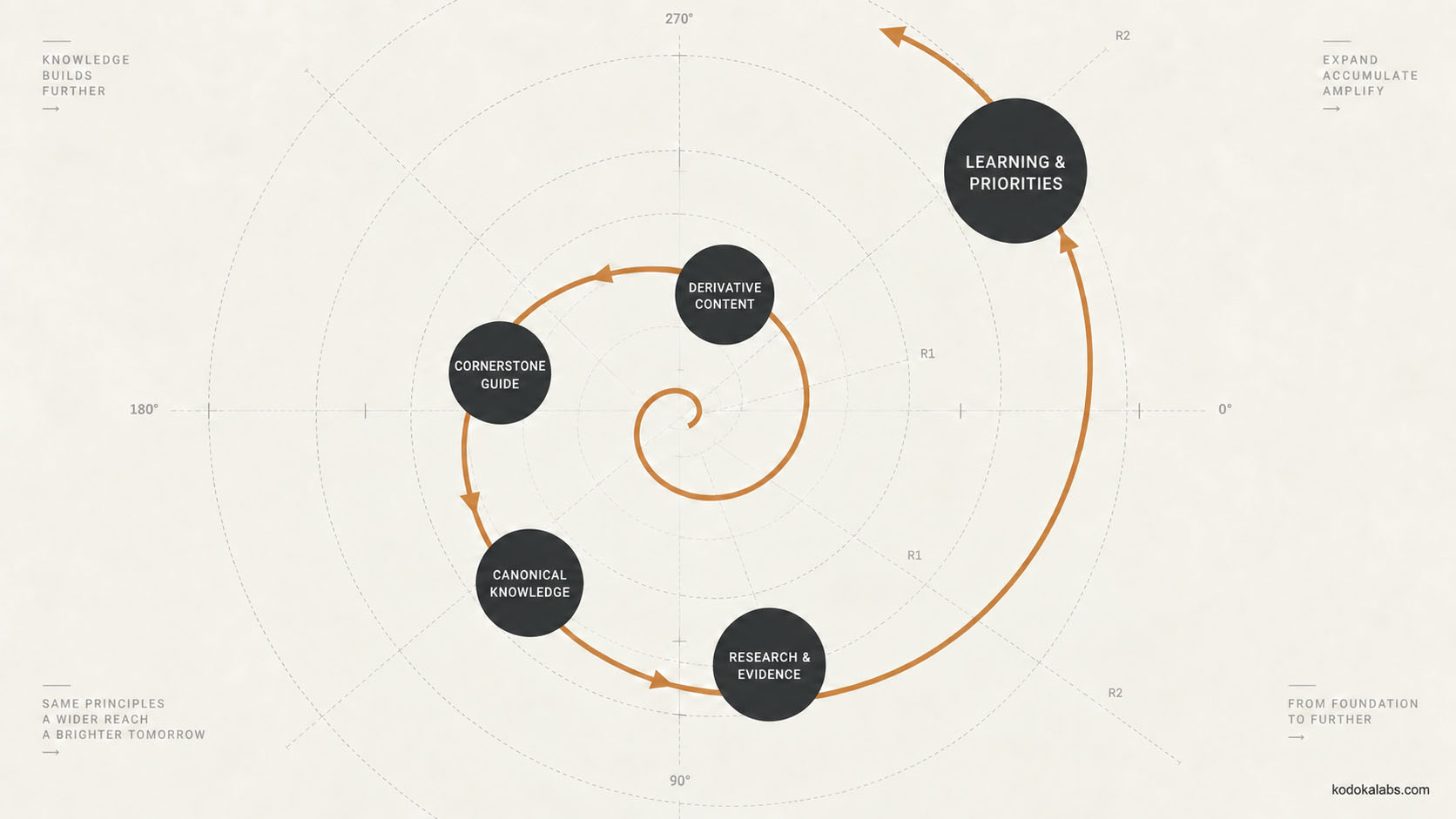
Reuse. Where a piece of original research or a proprietary framework has lasting value, plan for its reuse across other content and forms, rather than treating each piece of content as a one-time, disconnected production. This is what turns an information-gain investment into a compounding asset instead of a single expense.

Evidence And Provenance Controls: The Information Gain Ledger
Original contributions need the same provenance discipline as any other claim in this pillar, formalized here as the Information Gain Ledger, a simple record connecting each proposed contribution to its source, validation method, disclosed limitation, reuse rights, and update trigger.
| Field | Purpose |
|---|---|
| Proposed contribution | What new value the content claims to add |
| Source | Where the evidence for this contribution comes from (internal data, named expert, original analysis) |
| Validation method | How the claim was checked before publication (methodology review, expert verification, cross-reference against existing credible sources) |
| Limitation | What the evidence does not support, stated explicitly rather than left implicit |
| Reuse rights | Whether and how this contribution can be reused across other content, and any constraints on that reuse |
| Update trigger | What event or schedule should prompt a recheck (new data available, methodology becomes outdated, underlying facts change) |
Measurement And Maintenance
Measuring information gain directly is not possible in the way measuring traffic or rankings is, since no platform discloses a score for it. What can be measured is proximate: whether content that incorporates original contributions performs differently, in citation presence, engagement, or backlink acquisition, from comparable derivative content on the same topic, tracked over time rather than assumed from a single before-and-after comparison. This connects to, but is a narrower question than, the full measurement model covered in Search and AI Visibility Measurement.
Original content also requires maintenance. First-party data ages; a framework’s applicability can shift as underlying conditions change. Evergreen maintenance means revisiting content with genuine information gain on a defined schedule or trigger (from the Information Gain Ledger’s update-trigger field) rather than assuming it retains its value indefinitely without review.
Failure Patterns
Frequently Asked Questions
Is there a real, measurable information gain score we should be tracking?
No. No search engine or AI platform has disclosed a measurable information gain score. This guide's Opportunity Matrix and Ledger are planning and governance tools, not proxies for a hidden platform metric.
Does original content guarantee better rankings or AI citations?
No. Original, evidence-backed content increases the likelihood of being a useful, distinct source; it does not guarantee any specific ranking or citation outcome, consistent with the control, influence, observe, and unknown framing set out in Generative Engine Optimization.
What if we do not have first-party data to draw on?
First-party data is one form of information gain, not the only one. Direct expert experience, original synthesis, and clearer explanation of poorly covered topics are all valid, more accessible forms for organizations without a large data asset.
How is this different from Content Operations?
Content Operations covers the editorial production workflow, commissioning, review, approval, and reuse processes. This guide covers the strategic and evidentiary question of what makes a specific piece of content genuinely original and valuable in the first place; the two connect but are distinct.
How do we avoid overclaiming originality?
Label every example and claim honestly as real, hypothetical, or conceptual, and route every substantive claim through the evidence and provenance controls described here before publication.
Where should we start?
With the Opportunity Matrix, applied to your organization's actual planned content, to identify where genuine, evidence-backed original contribution is realistically achievable before committing production resources.