
AI Editorial Operating System: From Research to Compounding Knowledge
Key Takeaways for the AI Editorial Operating System
- AI accelerates drafting. It does not remove the need for research, judgment, review, or accountability, and an AI editorial operating system that treats drafting speed as the whole problem will optimize the wrong stage.
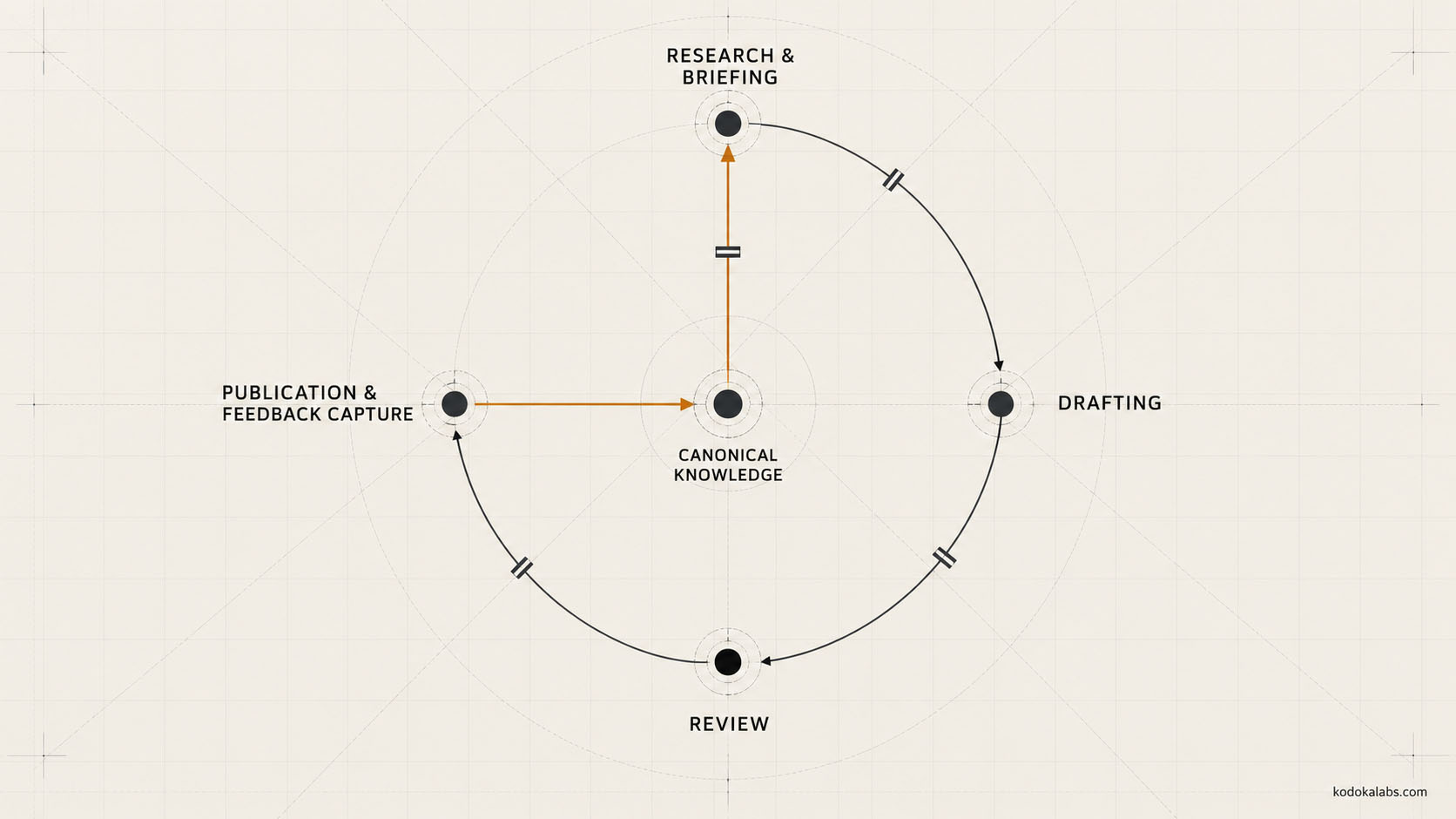
- The four stages, Research & Briefing, Drafting, Review, and Publication & Feedback Capture, are a fixed sequence with explicit entry and exit criteria at each boundary, not a loose set of suggested activities.
- Every stage has a named human owner, a defined AI role, and deterministic controls that don’t depend on anyone remembering to apply them manually.
- Feedback Capture is the stage most operating systems skip, and it’s the one that turns a one-off production process into a compounding system that improves with every cycle rather than resetting to zero each time.
- A minimum viable version of this system is achievable quickly; a mature version takes deliberate investment in knowledge infrastructure, measurement, and capability transfer over time.
Direct Definition and Category Role
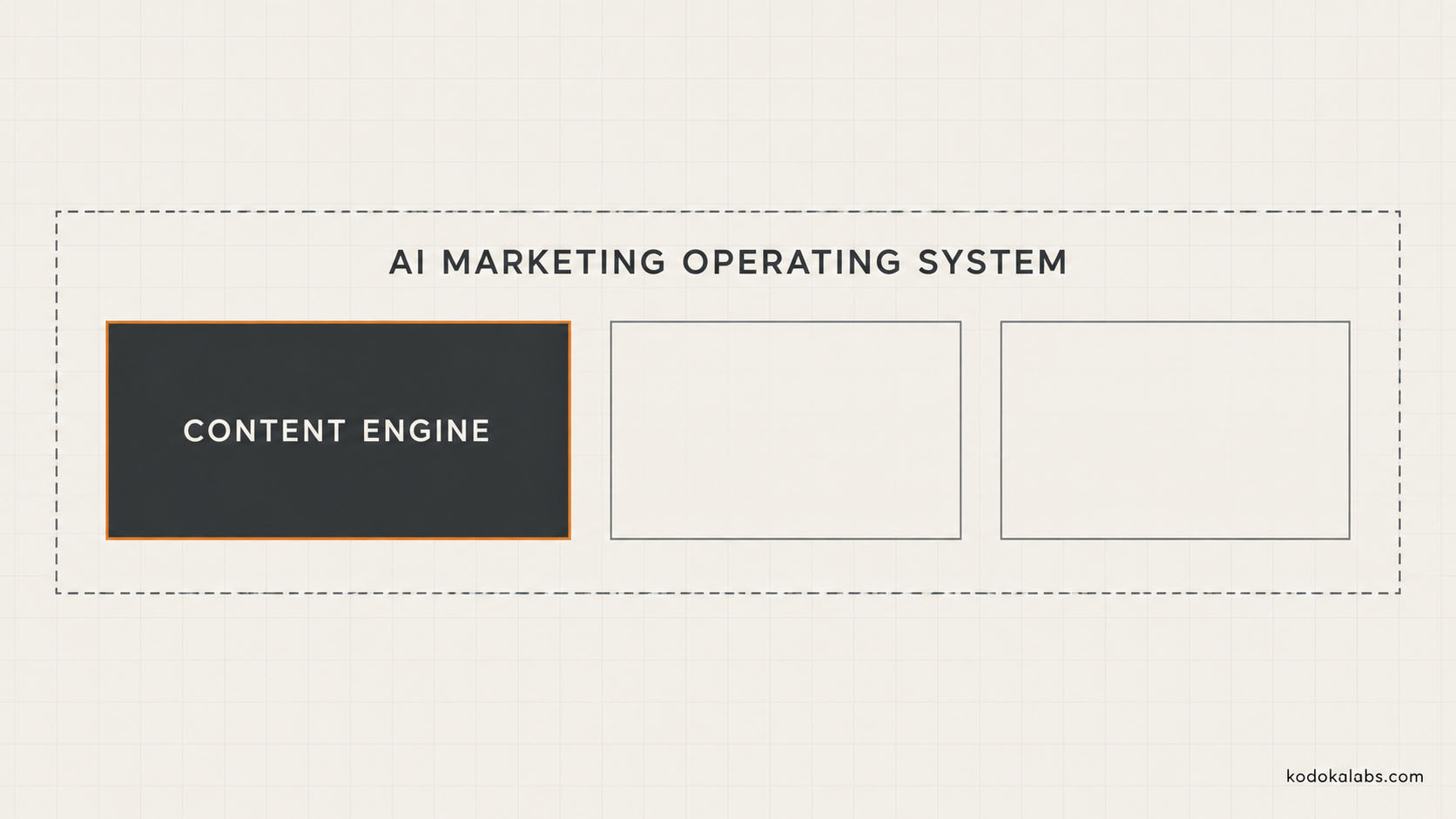
The AI Editorial Operating System is the complete, governed production model that converts an approved content need into a published, measurable asset through four connected stages: Research & Briefing, Drafting, Review, and Publication & Feedback Capture. It is the operational backbone of what we call the Content Engine, the production infrastructure that sits inside a broader AI Marketing Operating System.
Drafting alone is not a system. An organization that has adopted a capable AI drafting tool but has no defined research input, no consistent review gate, and no mechanism for capturing what worked has accelerated one stage of production while leaving the rest unchanged, which is precisely the condition that produces the review bottleneck and brand-dilution failure modes documented across this site’s broader AI Marketing Transformation content. The AI Editorial Operating System exists to prevent that outcome by defining what happens before drafting starts and after a draft is approved, not just during the drafting step itself.
This guide is the canonical deep-dive into that four-stage model. Governance policy, the decision rights and risk tiers that apply across all four stages, is covered in AI Editorial Governance. The specific mechanics of executing a review are covered in Human Review for AI Content. The capacity, queues, and handoffs that connect multiple workflows at scale are covered in Content Supply Chain. This guide shows how a single piece of content moves through the system end to end; those guides go deeper on specific stages and system-level concerns.
Design Principles
Four principles shape how this operating system is designed. Canonical knowledge means that research, approved facts, and brand standards live in a defined, referenceable system of record rather than in individual memory or scattered documents, so that every drafting task pulls from the same verified foundation rather than reconstructing it from scratch. Explicit contracts means that each stage has defined entry criteria, required inputs, expected outputs, and acceptance evidence, so that a handoff between stages is a checkable transition rather than an informal “I think this is ready” judgment call. Human accountability means that AI assistance accelerates specific tasks within each stage, but a named human owns the decision to proceed at every stage boundary; the AI never holds a stage-exit decision. Feedback as compounding value means that what the organization learns from one production cycle, which sources were reliable, which draft patterns required heavy revision, which published pieces performed well, becomes structured input into the next cycle rather than disappearing once a piece ships.
These principles answer a question that comes up early in most conversations about AI-assisted content production: why not just let the AI draft faster and worry about everything else later? The answer is that “everything else,” the research grounding, the review discipline, the feedback loop, is not optional overhead sitting outside the real work. It is the part of the system that determines whether faster drafting produces more value or simply more volume. A system optimized only for drafting speed will, with mathematical certainty, shift its constraint downstream to whichever stage didn’t get faster, almost always review, and the net effect on total cycle time and content quality is frequently negative even though the drafting step itself measurably improved.
Research & Briefing
Research & Briefing is where a content need becomes a specified, evidence-backed assignment. The stage begins with source resolution: identifying what’s already known, what needs fresh research, and what claims will require verification before drafting can safely rely on them. This connects directly to the evidence discipline detailed in AI Research Workflows, which this stage depends on rather than duplicates.
The stage produces a content brief, specifying the intent, audience, required entities and concepts, source material, risk tier (per AI Editorial Governance), and any locked facts the draft must not contradict. AI assistance in this stage is genuinely valuable for discovery and organization, surfacing relevant existing material, summarizing source documents, and drafting a first-pass structure for human review, but the decision about which sources are authoritative, which claims are load-bearing, and what the brief actually commits the drafting stage to, remains a human call.
The exit criterion for this stage is an approved brief with its evidence attached, not merely a topic assignment. A brief that says “write about AI governance” has not actually exited this stage; a brief that specifies the primary claims, their sources, the target audience’s decision context, and the risk tier has. Content that enters drafting without a properly exited brief is the single most common root cause of rework later in the system, because the writer or drafting workflow ends up making research and scope decisions that should have been resolved earlier, usually under worse time pressure and without the same evidence discipline.
A properly exited brief also makes the drafting stage’s AI assistance meaningfully safer, because it narrows the space of claims the drafting workflow is permitted to introduce. This narrowing effect compounds across a content program’s history: an organization with a mature library of approved briefs and their underlying evidence can often satisfy a new request’s research needs largely from what’s already verified, reserving genuinely fresh research effort for the specific gap a new piece actually introduces. A drafting task working from a brief that specifies three verified statistics, two defined entities, and an explicit scope boundary has very little room to introduce an unverified claim without it standing out as an addition beyond the brief, which the Review stage can then specifically check for. A drafting task working from a vague topic assignment has no such boundary, and a model filling that gap with plausible general knowledge is behaving exactly as designed; the absence of a boundary, not a flaw in the model, is the actual cause of the resulting risk.
Research & Briefing also determines how much the organization’s knowledge compounds over time. A brief built entirely from a one-off search session produces a one-off piece of content; a brief built by first checking the organization’s own knowledge base, and only then researching genuine gaps, both produces a faster brief and adds whatever’s newly verified back into that knowledge base for the next piece that needs it. This is the first of several points in the system where the choice between treating research as disposable per-piece work and treating it as a cumulative organizational asset determines whether the system compounds or simply repeats.
Drafting
Drafting converts an approved brief into a structured first version of the content. This is the stage where generative AI assistance delivers the most direct speed benefit, and it’s also the stage most likely to be treated, incorrectly, as the entirety of the production system.
Section-level task decomposition works better than asking a single drafting pass to produce an entire long-form asset at once, because it allows each section’s claims and structure to be checked against the brief’s locked facts and evidence more precisely, and it reduces the risk of a model’s own internal consistency drifting across a very long single-pass output. Context isolation matters for the same reason: a drafting task should receive the specific, approved source material relevant to its section rather than an open-ended instruction to “write what you know” about the topic, which invites the model to fill gaps with plausible but unverified general knowledge.
Allowed claims are bounded by the brief from Research & Briefing; drafting is not a second research pass, and a draft that introduces a new factual claim beyond what the brief specified should flag that claim explicitly for the Review stage rather than presenting it with the same confidence as a pre-verified fact. Versioning should begin at this stage, not retroactively at publication, so that the eventual record of how a piece evolved from brief to published asset is traceable rather than reconstructed from memory after the fact.
Style and voice consistency is a drafting-stage responsibility that’s easy to underweight relative to factual accuracy, but it compounds in its own way: a drafting workflow that consistently produces the organization’s intended voice reduces review time spent on line edits, freeing reviewer attention for the substantive factual and structural checks that actually carry risk. This is one of the clearer cases where investing in the drafting stage’s inputs, a documented style guide, a set of approved voice examples, pays back repeatedly downstream rather than being a one-time setup cost.
It’s worth naming what drafting should not be asked to do. It should not be the stage where scope gets decided, where ambiguous source material gets resolved, or where a reviewer’s eventual judgment call gets anticipated and pre-empted by over-hedging every sentence. A draft that hedges every claim to avoid review pushback is not actually safer; it’s simply shifting the work of deciding what the piece actually asserts onto the reader, which produces vague, unconvincing content even when every individual sentence is technically defensible.
Review
Review tests the draft against the acceptance criteria appropriate to its risk tier, as defined in AI Editorial Governance, and the specific mechanics of executing that review, reviewer assignment, defect taxonomy, evidence packs, are detailed fully in Human Review for AI Content. This guide focuses on how review fits into the overall four-stage sequence rather than duplicating that detail.
A complete review at this stage typically spans several dimensions depending on risk tier: factual accuracy against the brief’s locked claims and sources, brand voice and framework fidelity (does the piece use kōdōkalabs’ exact canonical names correctly, for instance), structural and search/GEO quality, accessibility, and, for sensitive-tier content, specialist legal or compliance sign-off. Automated checks, spell and grammar validation, broken-link detection, basic schema validation, can and should run before a human reviewer ever sees the draft, so that human review time is spent on judgment calls rather than on catching errors a deterministic tool could have caught first. Running these checks earlier in the pipeline, before a draft is even routed to a human reviewer, also shortens overall cycle time, since a draft that fails a basic automated check can be sent back for correction immediately rather than sitting in a reviewer’s queue until they happen to open it.
The exit criterion for this stage is a specific, recorded decision: approved, approved with minor revision, returned for substantive revision, or escalated. A draft that circulates informally with vague feedback and gets published once “nobody objects further” has not actually exited this stage with a real decision attached to it, which means there is no retrievable evidence of what was checked if a question arises later about how the piece was approved.
Review depth should match the risk tier set at Research & Briefing, not drift upward or downward based on how busy the reviewer happens to be that week, and the brief itself, not the reviewer’s own in-the-moment judgment, should be the record of what that depth actually requires. A reviewer under deadline pressure who quietly reduces scrutiny on a sensitive-tier piece has moved that piece’s actual review rigor below what its risk classification requires, even though nothing about the formal process changed; this is why automated pre-checks matter as much as they do, since they apply consistently regardless of reviewer workload or time pressure, catching a baseline of issues before human judgment is even engaged.
A well-functioning Review stage also produces useful signal for the rest of the system, not just a pass/fail outcome for the piece in front of it. A pattern of findings, drafts in a particular content category repeatedly needing the same type of revision, is evidence that something upstream, the brief template, the approved source material, the drafting workflow’s configuration, needs adjustment rather than evidence that review itself needs to work harder on each individual piece. Treating repeated findings as a systems signal rather than a per-piece annoyance is what connects Review to the Feedback Capture stage described next.
Publication & Feedback Capture
Publication is the technical act of releasing approved content into the content management system with its metadata, schema, and internal links correctly configured, following the final sign-off recorded in Review. This stage includes a pre-publication QA pass confirming that what’s about to go live matches what was actually approved, since a last-minute formatting change or an accidentally reverted edit between approval and publication is a real and recurring failure mode in content systems generally.
Feedback Capture is the part of this stage that most content operations skip, and it’s the part responsible for the “compounding” half of this guide’s framing. Once a piece is published, its performance, search visibility, citation frequency in AI answer engines, engagement, conversion contribution, becomes data the system should capture and feed back into future Research & Briefing decisions. Equally important, operational feedback, which sources proved unreliable, which draft patterns consistently required heavy revision, which claims generated the most review friction, should flow back into the organization’s canonical knowledge base and brief templates rather than existing only in the memory of whoever handled that specific piece.
Without this feedback loop, every content cycle restarts close to zero, repeating the same research gaps and the same drafting weaknesses indefinitely. With it, each cycle’s lessons measurably reduce the next cycle’s rework, which is the actual mechanism, not a slogan, behind the claim that a governed system compounds rather than just accelerates.
Two distinct kinds of feedback should be captured, and conflating them loses information. Performance feedback answers whether the published content achieved its intended purpose: did it rank, get cited by an answer engine, generate the engagement or conversion it was commissioned for. Operational feedback answers whether the production process itself worked well: how much revision the draft needed, which sources held up under scrutiny, where reviewers spent unusual time or raised unusual concerns. Performance feedback mainly informs what to create next; operational feedback mainly informs how to create it better. A system that only tracks performance feedback will keep repeating the same inefficient production process indefinitely, even as it gets better at choosing topics.
Roles, Systems, and Exceptions
Each stage needs a named human owner: a research or briefing lead for Research & Briefing, a writer or drafting workflow owner for Drafting, a risk-tier-matched reviewer for Review, and a publishing or content operations owner for Publication & Feedback Capture. Systems of record should be explicit rather than assumed: a knowledge base or source register for approved research, a content management system with version control for drafts, a review and approval log for decisions, and an analytics and citation-monitoring system for feedback data.
Exceptions, a brief that needs updating mid-draft because new information surfaced, a review finding that requires returning all the way to Research & Briefing rather than a simple revision, should have a defined path back to the appropriate stage rather than being patched informally at whatever stage the content currently sits in. A drafting-stage patch applied to cover a research gap discovered during review tends to produce content that looks resolved on the surface while quietly carrying an unverified claim forward.
Role design matters more as volume increases. A single person can plausibly hold all four stage-owner roles for an organization publishing a handful of pieces a month, and in that situation the main risk is simply that the roles exist informally rather than being named. As volume grows, separating these roles, or at minimum ensuring that Review is never held by the same person who drafted the piece, becomes a structural safeguard against the natural human tendency to be less critical of one’s own work than of someone else’s. Organizations scaling expert-led content specifically, where a subject-matter expert’s time is the scarcest resource in the system, need to think carefully about which of these four roles that expert must personally hold and which can be delegated to a trained editorial partner; that specific question is addressed in depth in Scaling Expert-Led Content Without Diluting Expertise.
The table below specifies the operating contract for each of the four stages in full.
| Stage | Purpose | Entry Criteria | Inputs | Human Owner | AI Role | Deterministic Controls | Output | Acceptance Evidence | Exception Path | Exit Criteria |
|---|---|---|---|---|---|---|---|---|---|---|
| Research & Briefing | Convert a content need into a specified, evidence-backed assignment | Approved content need with a named owner | Topic, audience, existing knowledge base, risk-tier guidance | Research or briefing lead | Discovery, summarization, structure drafting | Source-hierarchy check, risk-tier assignment check | Approved content brief with evidence attached | Brief sign-off record | Return to content owner for scope clarification | Brief approved with locked facts and risk tier assigned |
| Drafting | Produce a structured first version within the brief's bounds | Approved brief | Brief, locked facts, approved source material | Writer or drafting workflow owner | Section drafting, structure, style consistency | Claim-boundary check against brief, version logging | Versioned draft | Draft version with claim sources attached | Return to Research & Briefing for a scope or evidence gap | Draft complete and internally consistent with the brief |
| Review | Test the draft against risk-tier acceptance criteria | Complete draft | Draft, brief, risk tier, acceptance criteria | Risk-tier-matched reviewer | Automated checks, drafting assistance for revisions | Automated QA checks, defect logging | Reviewed and decisioned draft | Documented review findings and decision | Return to Drafting for revision, or to Research & Briefing for an evidence gap | Explicit approve, revise, or escalate decision recorded |
| Publication & Feedback Capture | Release approved content and capture performance and operational learning | Approved, decisioned draft | Approved draft, metadata, schema, analytics access | Publishing or content operations owner | Metadata/schema generation support, performance summarization | Pre-publication QA match check, scheduled performance review | Published asset plus feedback record | Publication record and feedback log entry | Post-publication correction path for material errors | Published, monitored, and feedback captured into canonical knowledge |
Maturity and Implementation Roadmap
A minimum viable version of this AI editorial operating system is achievable without a large upfront investment: a shared brief template that forces risk-tier assignment and source citation, a single defined reviewer per risk tier, and a basic log of what got published and when. This alone closes most of the gap between ungoverned AI drafting and a system with real accountability at each boundary.
A mature version adds structured knowledge infrastructure (a real knowledge base rather than a folder of documents), systematic automated QA ahead of human review, a working feedback loop that measurably reduces rework cycle over cycle, and documented capability transfer so the system runs on institutional process rather than one or two people’s personal discipline. The comparison below makes the gap between these two states concrete.
| Dimension | Minimum Viable System | Mature System |
|---|---|---|
| Research input | Ad hoc source gathering per piece | Structured knowledge base with source hierarchy and claim register |
| Briefing | Lightweight brief template with risk tier | Full brief with locked facts, entities, and evidence attached |
| Drafting | Single-pass AI drafting with manual check | Section-level task decomposition with context isolation and versioning |
| Review | One reviewer, informal sign-off | Risk-tier-matched reviewers, automated pre-checks, documented defect evidence |
| Publication | Manual metadata entry | Automated metadata/schema generation with pre-publication QA match check |
| Feedback capture | Occasional informal retrospective | Structured performance and operational feedback feeding future briefs |
| Ownership | Concentrated in one or two people | Documented, trained, and transferable across named role owners |
Most organizations should not attempt to build the mature system in one step. A sequenced rollout, pilot the four-stage structure on a single content category, measure cycle time and rework, then extend knowledge infrastructure and automation once the basic stage discipline is working, tends to produce a system people actually use rather than one that exists on paper and gets bypassed under deadline pressure.
The sequencing choice also affects how quickly the system starts compounding. Teams that pilot on a single, well-bounded content category tend to accumulate a working knowledge base and a calibrated brief template for that category within a handful of cycles, evidence they can then point to when extending the system to a second category. Teams that attempt all content categories simultaneously from day one typically end up with a shallow, generic version of the system applied everywhere, which rarely survives contact with the first genuinely difficult piece of sensitive-tier content. A narrower, deeper pilot is usually the faster path to a system that’s actually trusted enough to extend.
Choosing which category to pilot first deserves its own deliberate thought rather than defaulting to whichever team happens to be most enthusiastic about trying something new. A good first category is high enough in volume that the team will complete several full cycles within a reasonable window, giving the feedback loop a real chance to demonstrate its value, but not so high-risk that an early, expected rough patch in the new process carries outsized consequences. A routine or material-tier category that the organization produces regularly, rather than its highest-stakes sensitive-tier content, is usually the right place to prove the model before extending it to where the stakes are highest.
Failure Modes
The most common failure mode is tool-first design: an organization adopts a capable AI drafting tool and treats that adoption as the AI editorial operating system, without defining the research input or review output around it. This produces faster drafts and, usually within a few cycles, a review backlog that erases the speed gain. A second failure mode is feedback capture that exists in name only, a quarterly retrospective meeting that generates discussion but produces no structured change to the brief template, knowledge base, or review checklist. A third is stage-boundary erosion, where deadline pressure leads to drafting starting before a brief is actually approved, or publication happening before review has formally exited with a decision, which quietly converts a governed system back into an ungoverned one under the same name.
Frequently Asked Questions
Is this the same thing as a general content calendar or editorial workflow tool?
No. A content calendar schedules when things happen; this operating system defines what has to be true, specific inputs, specific human sign-offs, specific evidence, before content can legitimately move from one stage to the next. The two can and should work together, but a calendar alone provides none of the accountability or evidence structure this guide describes.
Does every piece of content need to go through all four stages in full depth?
Yes, in sequence, but the depth within each stage scales with risk tier per AI Editorial Governance. A routine internal update moves through all four stages quickly and lightly; a sensitive-tier public claim moves through the same four stages with substantially more rigor at each one.
What's the difference between this guide and Content Supply Chain?
This guide defines how a single piece of content moves through the four canonical stages. Content Supply Chain addresses what happens when many pieces move through the system simultaneously, capacity, queues, dependencies, service levels, and resilience across the whole production operation.
How long does it take to stand up a minimum viable version of this system?
Most content organizations can implement the minimum viable version described above within a few weeks, since it requires a brief template, a named reviewer per risk tier, and a basic publication log rather than new technology. The mature version is a longer-term capability-building effort, typically measured in months, because it depends on knowledge infrastructure and a working feedback loop that needs several real cycles to mature.
Can AI handle the entire Drafting stage without a human touching the draft before Review?
Yes, for most risk tiers, provided the brief was properly exited with locked facts and evidence, and provided Review remains a mandatory, non-skippable gate before publication. The absence of human involvement during drafting is not the same as the absence of human accountability for the published result.
How does Feedback Capture actually change future briefs in practice?
Operational feedback, which sources were unreliable, which claim types required the most revision, feeds into the knowledge base and brief template directly: a source that repeatedly produced disputed claims gets flagged or removed from the approved source hierarchy, and a claim type that consistently needed heavy review gets an explicit checklist item added to future briefs for that category, so the lesson is encoded in the system rather than remembered informally by whoever happened to be involved.