
Expert Knowledge Capture: Turn Tacit Expertise into Reusable Content Assets
Key Takeaways for the Expert Knowledge Capture
- Tacit knowledge, the judgment an expert applies without necessarily being able to state it as a rule, is the hardest kind of knowledge to capture and the most valuable once it’s actually captured well.
- A meeting recording or an interview transcript is a raw input, not an approved knowledge asset. It needs extraction, structuring, and the expert’s own validation before anyone should rely on it.
- Expert time is the scarcest resource in this entire process, so the elicitation method should be chosen to respect that time, not to maximize how much material gets recorded.
- Consent, confidentiality, and reuse permissions need to be explicit and documented before capture begins, not assumed or negotiated after the fact.
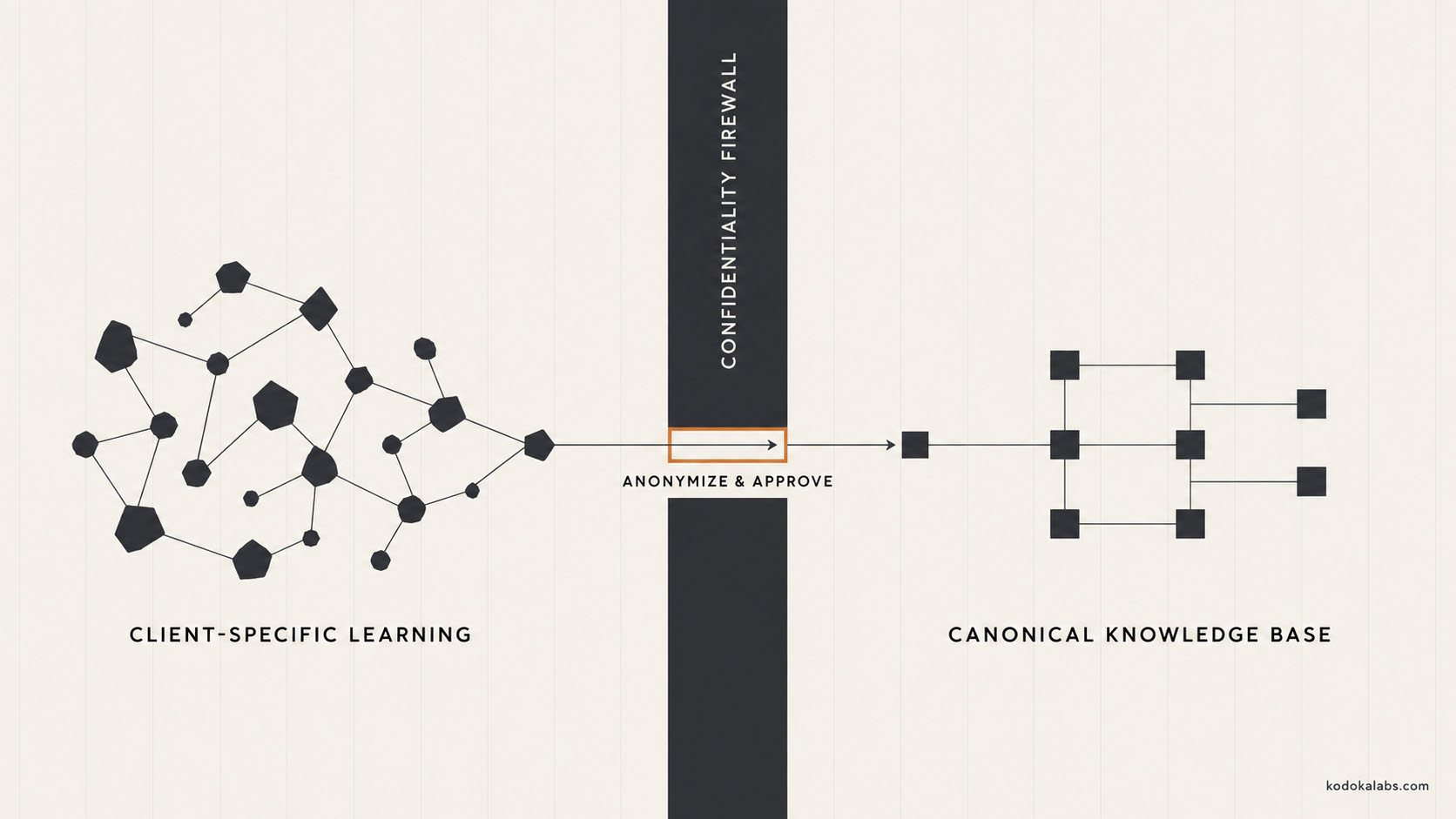
- A confidentiality firewall separates client-specific or sensitive learning from reusable, generalized knowledge; only material that’s been deliberately anonymized and reviewed crosses that firewall into canonical, reusable content.
Definition
The Hidden Knowledge Risk
The hidden risk this guide addresses is treating a transcript or a meeting recording as if it were already a knowledge asset. A recorded conversation with an expert contains real value, but that value is buried in tangents, assumed context, and language the expert used specifically for that conversation’s audience. Handing a raw transcript to a drafting workflow and asking it to “write something based on this” skips the extraction and validation work this guide insists on, and the result is usually content that captures the surface of what the expert said while losing the judgment underneath it, or worse, misattributes a casual remark as if it were a considered, citable position.
The promised outcome of this process is a repeatable elicitation-to-canonicalization workflow with the expert’s own approval, explicit confidentiality controls, documented provenance, and defined reuse rights, so that capturing an expert’s knowledge once can support many future pieces of content rather than requiring the same expert’s time repeatedly for the same underlying material.
Choose the Expert Knowledge Capture Objective
Not every gap in the organization’s content is worth an expert’s time to close. Before scheduling any capture session, the expert knowledge capture objective should be prioritized against two questions: does this gap matter to the audience’s actual decisions, and does closing it have genuine reuse value across multiple future pieces of content, rather than serving a single, narrow purpose.
A well-chosen objective is specific enough to design a focused elicitation around. “Capture everything [the expert] knows about AI governance” is too broad to plan a session for and too broad for the expert to prepare for meaningfully. “Capture the specific decision criteria [the expert] uses to classify a content request as high-risk versus routine, including at least two real examples of each” gives both the interviewer and the expert something concrete to work with, and it maps directly onto a knowledge object the organization can actually use.
Prioritization
Prioritization should weigh a few factors against each other rather than defaulting to whichever gap feels most urgent this week. Reuse potential matters most: a piece of knowledge that will inform many future pieces of content, a recurring decision framework, a frequently asked question only this expert can answer well, justifies the time investment far more than a narrow, one-off fact. Decay risk matters too: knowledge that exists only in one person’s head, with no documentation anywhere, is a priority regardless of how often it comes up, because the organization has no fallback if that person becomes unavailable. And accessibility matters practically: an objective that requires an unusually busy expert’s time should be weighed against objectives that could be captured from a more available colleague with overlapping expertise, when that substitution doesn’t meaningfully compromise the quality of what’s captured.
It helps to maintain a visible backlog of candidate knowledge objectives rather than deciding capture priorities ad hoc each time an expert happens to have availability. A backlog makes the prioritization criteria above something the organization can actually apply consistently, rather than defaulting to whatever gap was most recently and loudly raised in a meeting.
Design the Elicitation
Choosing the right expert and the right method matters as much as choosing the right objective. Some expert knowledge capture objectives are best captured through a structured one-on-one interview, particularly when the goal is understanding a specific decision process in depth. Others suit a workshop format better, particularly when the goal is surfacing how a team collectively handles a type of situation and the disagreements between team members are themselves valuable information. Still others can be captured asynchronously, through a structured written prompt the expert responds to on their own schedule, which respects a very time-constrained expert’s calendar at some cost to the interviewer’s ability to probe and follow up in the moment.
Consent and recording permissions need to be settled before the session starts, not negotiated awkwardly once the recording is already running. The expert should know exactly how the material will be used, whether their name will be attached to resulting content, and what happens if they want to retract or revise something they said after reviewing the extracted material. This isn’t just a courtesy; it’s what makes genuine candor possible, since an expert who’s uncertain about how their words might be used tends to hedge everything, which defeats the purpose of capturing their actual judgment in the first place.
Preparation on the interviewer’s side pays back disproportionately. Reviewing what’s already known about the topic before the session, so the expert isn’t asked to restate common knowledge, and preparing specific, concrete scenario prompts rather than open-ended questions, both make the limited time available far more productive.
| Capture method | Best suited for | Expert burden | Richness of material | Elicitation risk |
|---|---|---|---|---|
| Structured one-on-one interview | A specific decision process or individual judgment in depth | Moderate, scheduled session | High, allows real-time follow-up and probing | Interviewer bias if questions aren't well designed |
| Group workshop | Team-level handling of a situation type, surfacing disagreement | High across multiple experts' time | High, surfaces genuine disagreement and range of judgment | Groupthink can suppress a dissenting but valuable view |
| Asynchronous written prompt | A time-constrained expert, a well-defined, narrow question | Low, flexible scheduling | Lower, no real-time follow-up | Answers can be shallow without a skilled follow-up round |
| Shadowing or observed work session | Procedural knowledge the expert may not be able to narrate directly | Moderate to high, requires real work time | Very high for process detail, lower for underlying reasoning | Observer interpretation risk without expert validation after |
Capture Tacit Judgment
The actual elicitation should target the specific kinds of material that don’t show up in documentation: decisions and the reasoning behind them, trade-offs the expert weighs when a situation doesn’t have an obvious answer, failures and what the expert learned from them, concrete examples that illustrate an abstract principle in action, and exceptions, the edge cases where the usual rule doesn’t apply and the expert has to use judgment instead.
A critical-incident technique works well for this: asking the expert to walk through a specific, real situation in detail, what happened, what they noticed, what they decided, why, rather than asking them to state their general philosophy in the abstract. Experts are often far better at narrating a specific example than at articulating the underlying principle directly, and a skilled interviewer can draw the generalizable principle out of several concrete examples more reliably than by asking for the principle up front.
Follow-up questions that probe disagreement and exception are particularly valuable, because they’re exactly the material most likely to be missing from existing documentation. “Is there a case where you’d handle this differently than the general rule you just described” tends to surface the genuinely tacit part of an expert’s judgment, the part that isn’t written down anywhere because it’s context-dependent in a way a simple rule can’t capture.
It’s worth preparing the interviewer, not just the expert, for the specific texture of this kind of conversation. Experts describing their own judgment often undersell how much genuine skill is involved, because a decision that required years of accumulated pattern recognition to make quickly can feel, to the person making it, like “just common sense.” A skilled interviewer notices when an expert glosses over a step that isn’t actually obvious and gently asks them to slow down and unpack it, rather than accepting the expert’s own, sometimes inaccurate, assessment of what was easy versus what actually required real judgment.
Extract and Structure
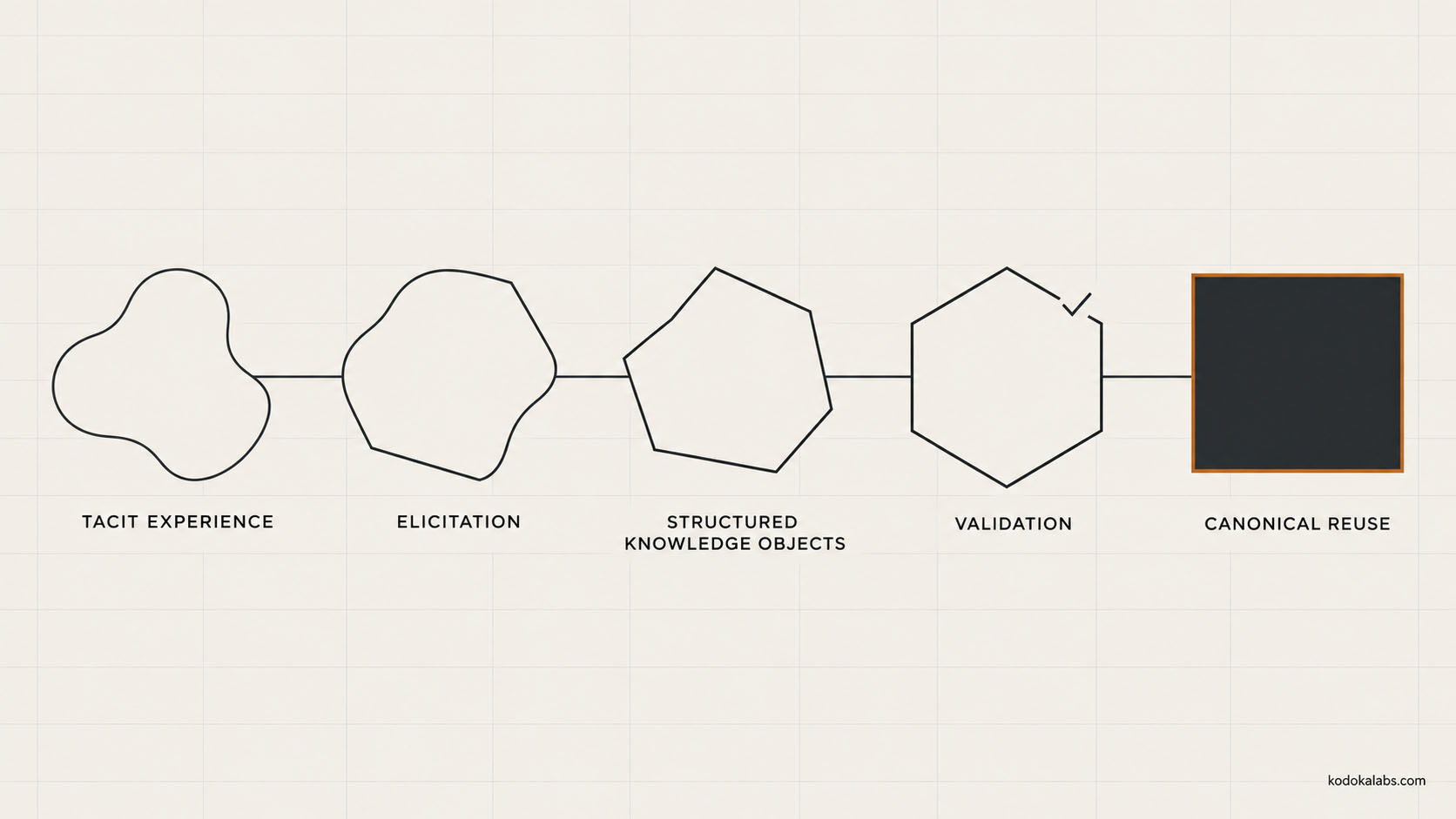
Raw material, whether a transcript, workshop notes, or an asynchronous written response, needs deliberate extraction into typed knowledge objects before it’s usable. This means identifying the distinct decisions, principles, processes, examples, claims, open questions, and exceptions embedded in the raw material and separating them out individually, rather than leaving them bundled together in narrative form.
This extraction step is where AI assistance is genuinely useful: identifying candidate knowledge objects within a long transcript, drafting an initial structured version of each one, and flagging passages that seem contradictory or unclear for human attention. The extraction output is a draft, not a finished knowledge asset, and it still requires the validation step below before anyone treats it as canonical.
Separating these object types matters because they carry different reuse implications and different confidence requirements. A principle is meant to generalize across many future situations, so it’s worth extra scrutiny before canonicalization, since an overstated or misremembered principle will propagate its error into everything that later relies on it. A single example, by contrast, carries less generalization risk on its own, it’s simply one data point, provided it’s labeled clearly as an example rather than implied to be a universal rule. Claims extracted from an expert’s own statement deserve the same external verification discipline described in AI Research Workflows when they’re factual assertions that could, in principle, be checked against outside evidence, rather than being accepted purely on the expert’s authority.
| Field | Decision object | Principle object | Process object | Example object | Claim object | Exception object |
|---|---|---|---|---|---|---|
| Statement | The specific decision made | The generalizable rule | The repeatable steps | A concrete illustrative case | A factual assertion | When the principle doesn't apply |
| Provenance | Named expert, session date | Named expert, session date | Named expert, session date | Named expert, session date | Named expert, session date | Named expert, session date |
| Confidence | High (directly stated) or inferred | High (directly stated) or inferred | High (directly stated) or inferred | High (directly observed example) | Verify against external evidence if checkable | High (directly stated) or inferred |
| Sensitivity | Public, internal, or confidential | Public, internal, or confidential | Public, internal, or confidential | Public, internal, or confidential | Public, internal, or confidential | Public, internal, or confidential |
| Owner | Named maintenance owner | Named maintenance owner | Named maintenance owner | Named maintenance owner | Named maintenance owner | Named maintenance owner |
| Review date | Scheduled revalidation date | Scheduled revalidation date | Scheduled revalidation date | Scheduled revalidation date | Scheduled revalidation date | Scheduled revalidation date |
Validate and Canonicalize
Every extracted knowledge object needs the expert’s own validation before it becomes canonical. This step exists because extraction, even careful human extraction, can subtly misstate what an expert actually meant, and an expert reviewing the structured version gets the chance to correct, sharpen, or withdraw something before it’s treated as an approved asset. This is not a formality; experts regularly find that an extracted version of their own words, while technically accurate, loses an important qualifier or oversimplifies a nuance they consider essential.
Sensitivity review happens alongside validation. A knowledge object that references a specific client, a specific commercial figure, or anything the expert said in confidence needs an explicit decision about whether and how it can be generalized into something reusable. This is the confidentiality firewall in practice: client-specific learning stays behind it unless it’s deliberately extracted, anonymized, and approved for reuse, while genuinely generalizable principles and examples can cross into the organization’s canonical knowledge base. Once validated and cleared, each object gets a canonical destination, which knowledge base or content system it lives in, and the metadata, confidence, sensitivity, owner, review date, that lets future users of that object know how much to trust it and when it needs to be checked again.
The anonymization step deserves more care than simply removing a client’s name. A sufficiently specific example can still be identifiable to anyone familiar with the situation even with names removed, a particular combination of industry, timing, and outcome, for instance. Genuine anonymization for reuse usually means generalizing the specific scenario into a representative pattern, “a mid-market B2B client facing this specific operational constraint,” rather than scrubbing names from an account detailed enough that the client would still recognize themselves, and likely object to seeing their situation published even without being named directly.
Validation also surfaces a second, quieter benefit beyond accuracy: it gives the expert a sense of ownership over the resulting knowledge object, which tends to make them considerably more willing to participate in future capture sessions. An expert who feels their words were extracted, published, and used without a meaningful review step understandably becomes a reluctant participant the next time their knowledge is needed, which makes validation a relationship-maintenance practice as much as an accuracy safeguard.
Reuse and Maintenance
A validated, canonicalized knowledge object should be usable well beyond the single piece of content that originally motivated capturing it. The same decision object, principle, or example can support a cornerstone guide, a shorter derivative piece under Content Repurposing, a training module for the AI Capability Academy, or a future AI-assisted drafting workflow that needs grounded, verified material to draw on rather than generating from general knowledge alone.
This reuse value depends entirely on maintenance. A knowledge object with no owner and no review date will eventually go stale, the market changes, the expert’s own thinking evolves, a regulation shifts, without anyone noticing that the canonical version no longer reflects current reality. Assigning a named maintenance owner and a realistic review cadence at the moment of canonicalization, rather than leaving it as an afterthought, is what keeps a knowledge base trustworthy rather than slowly accumulating outdated material nobody has flagged.
There’s also a reciprocal incentive worth building into this process deliberately. Experts are considerably more willing to invest time in capture sessions when they can see the resulting knowledge actually being used, cited in a published guide, referenced in training material, credited to them by name where appropriate, rather than disappearing into an internal system they never see again. Closing that loop, showing an expert where and how their captured knowledge ended up being used, costs very little and measurably improves participation in future capture work, which matters because this entire process depends on experts continuing to be willing to give up scarce time for it.
This reuse value also scales differently than the initial capture cost does, which is worth making explicit when asking an expert for their time. A single well-run capture session, properly extracted and validated, can support a cornerstone guide, a training module, and several derivative pieces through Content Repurposing, all from one scheduled conversation. Framing the ask this way, as a single investment that pays out across multiple future assets rather than a one-off favor for a single piece of content, tends to land better with a busy expert than asking them to repeat the same kind of conversation every time a new piece of content needs their input.
Failure Modes for Expert Knowledge Capture
The most common failure is extraction without nuance: compressing a carefully qualified expert judgment into an unqualified general rule, because the qualifier was inconvenient to preserve in a short knowledge object. The second is expert burden: scheduling repeated, poorly planned sessions that consume disproportionate time relative to the knowledge actually captured, which erodes the expert’s willingness to participate in future capture work. The third is treating raw transcripts as already-canonical, skipping extraction and validation entirely because the recording itself feels like enough documentation.
A fourth, subtler failure is incentive mismatch: an organization that only ever asks an expert for their time without ever showing them the value of what was captured will see participation decline over successive requests, even if no single request was unreasonable on its own. Treating expert knowledge capture as a one-time project rather than an ongoing relationship, with visible reciprocity built in, tends to produce diminishing returns exactly when the organization most needs continued access to that expert’s judgment.
A fifth failure worth naming is skipping validation under time pressure, publishing extracted material on a deadline before the expert has actually reviewed it, on the assumption that it’s probably close enough. This is a specific and avoidable risk, because the whole value of the validation step is catching the cases where “probably close enough” turns out to be wrong, and an organization that skips it to hit a publishing deadline has traded a schedule risk for a trust and accuracy risk that tends to be considerably more expensive to repair after the fact.
Frequently Asked Questions
Is a recorded interview enough, on its own, to count as expert knowledge capture?
No. A recording is a raw input. It needs extraction into structured knowledge objects and the expert's own validation of that extracted version before it becomes a canonical, reusable asset.
How much of an expert's time does this process typically require?
It depends on the knowledge objective's scope, but a well-prepared, tightly scoped session is almost always shorter than an unscoped, open-ended conversation, because the interviewer isn't spending the expert's time figuring out what to ask. Respecting expert time is a design goal of this process, not an afterthought.
What happens to knowledge that's too client-specific to reuse?
It stays behind the confidentiality firewall as internal, non-canonical material, used only for the specific purpose it was captured for, unless someone deliberately extracts and anonymizes a generalizable principle from it with explicit sensitivity review and approval.
Who maintains a knowledge object after it's canonicalized?
A named maintenance owner, assigned at the time of canonicalization, with a scheduled review date. Without this, knowledge objects accumulate silently and become unreliable without anyone noticing.
How does this connect to Authority Engineering?
Captured, validated expert knowledge is frequently the raw material behind an organization's strongest authority assets, original frameworks, proprietary perspectives, concrete examples nobody else has access to. Authority Engineering covers how that material gets built into a durable, compounding system of published authority over time.
Does AI assistance replace the interviewer in an elicitation session?
No. AI assistance is useful for extraction after the session and for surfacing follow-up questions during preparation, but the actual elicitation, building the rapport and judgment needed to draw out tacit knowledge in real time, remains a human-to-human process.