
Human Review for AI Content: A Risk-Based Quality System
Key Takeaways from the Human Review for AI Content topic
- Review quality depends on four conditions being present at once: the reviewer has relevant expertise, sufficient independence from the work being reviewed, enough context to judge it properly, and the explicit authority to reject or require revision.
- Risk-based review means depth scales with consequence. The same review process applied uniformly to everything either under-protects high-risk content or wastes reviewer time on low-risk content; both are common failures.
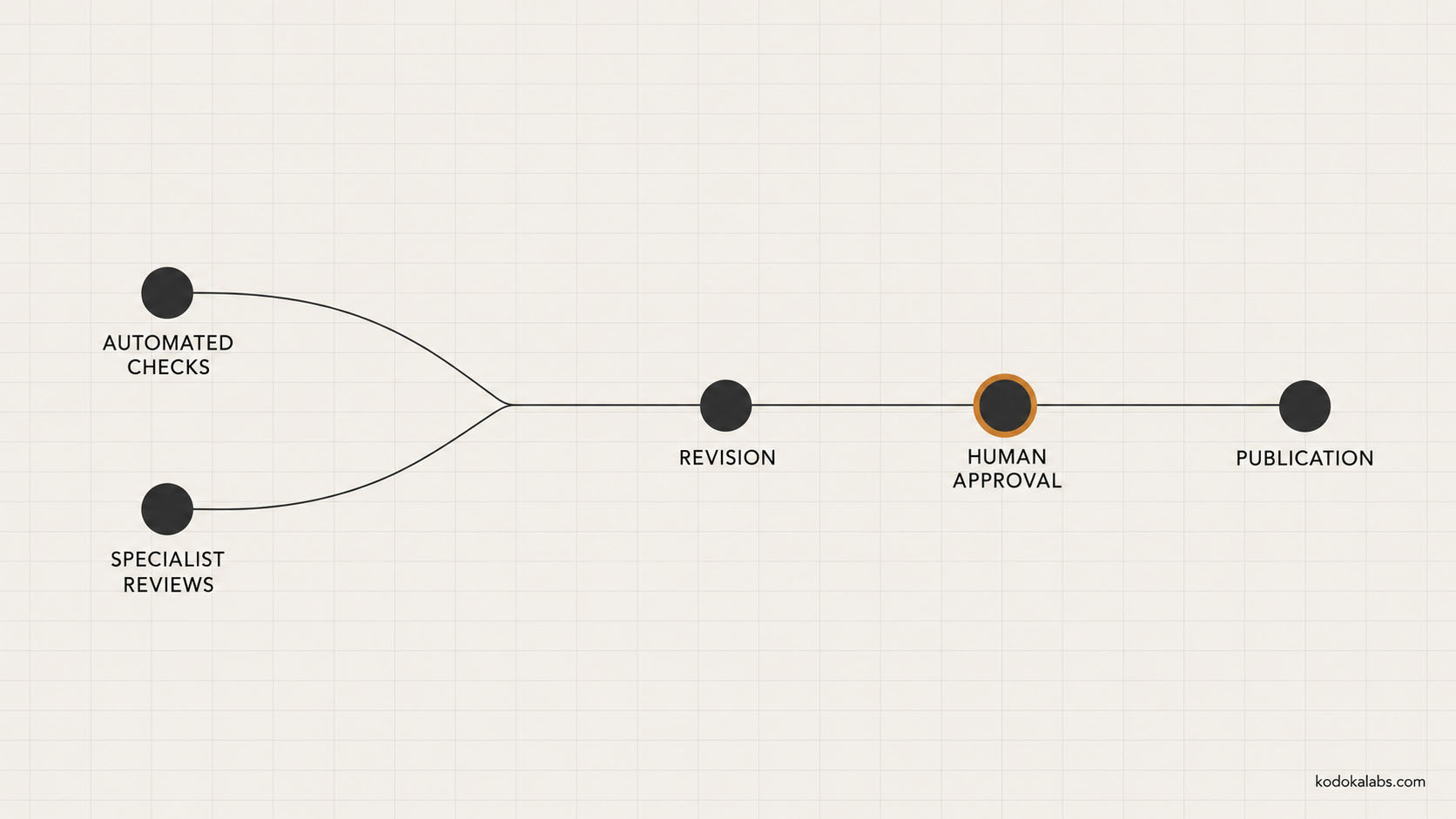
- Automated checks should run before a human reviewer sees a draft, catching mechanical issues so human attention goes to judgment calls a deterministic system can’t make.
- Review evidence, what was checked, what was found, what was decided, needs to be retained, not just the final approve/reject outcome, because evidence is what makes a review defensible after the fact.
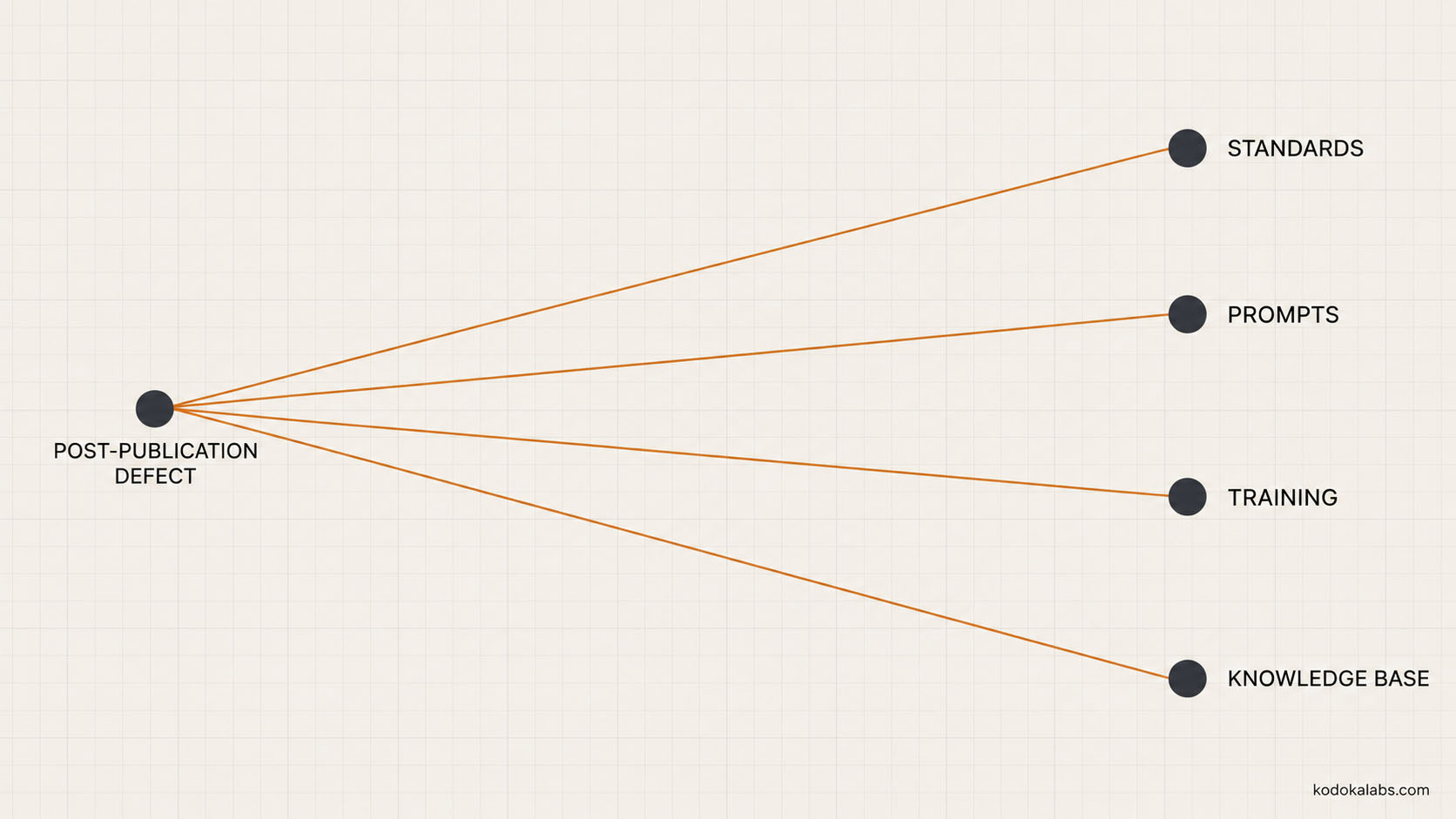
- Post-publication defects are information, not just incidents to close out. Feeding them back into standards, prompts, and training is what prevents the same defect from recurring indefinitely.
Definition
The Control Failure This Guide Corrects
This guide corrects a specific and common failure: review that exists procedurally but not substantively. A workflow that routes every draft through a named reviewer, where that reviewer skims the piece, finds nothing alarming, and clicks approve without checking a single claim against its source, has satisfied the letter of “human-in-the-loop” while providing none of its actual protective value. The promised outcome of this guide is a review system calibrated to risk that strengthens quality without routing every asset through the same slow, uniform process regardless of stakes.
Four conditions need to be present together for a review to function as a genuine control rather than a formality: competence, the reviewer actually understands the subject matter well enough to evaluate it; independence, the reviewer has enough distance from the work to scrutinize it honestly; context, the reviewer knows what the content is supposed to achieve and for whom, so they can judge fit, not just correctness in isolation; and authority, the reviewer can actually reject or require revision, and that decision will hold. Remove any one of these four conditions and the review that remains, however well-intentioned, stops functioning as a real safeguard. A highly competent, independent reviewer with no authority to block publication is providing an opinion, not a control. An authoritative reviewer with no real context for the content’s purpose will catch surface errors while missing whether the piece actually serves its intended reader.
Risk-Classify the Content
Review depth should be calibrated to content risk, using the same risk tiers established in AI Editorial Governance, rather than applying one uniform review process regardless of what’s actually at stake. Calibration happens once, at intake, and should carry through consistently rather than being silently renegotiated at the review stage based on how much time a reviewer happens to have that day. Calibration should weigh harm potential (what happens if this content is wrong), sensitivity (does it touch legal, financial, health, or safety topics), visibility (how widely will this be seen, and by whom), and reversibility (how quickly and cleanly can an error be corrected once published).
A piece of content can score differently on these dimensions in ways that aren’t always intuitive. A short social post might have very high visibility but low harm potential if it contains no material factual claim; a lightly trafficked technical page might have low visibility but extremely high harm potential if it contains an incorrect compliance instruction a reader might actually follow. Calibration needs to consider the actual content, not just its format or its expected audience size, and when in doubt, the conservative move is to classify toward the higher-risk tier rather than the lower one.
Risk classification for review purposes should inherit from, not duplicate, the tier already assigned at the Research & Briefing stage under AI Editorial Governance. A content organization that re-derives risk independently at the review stage, using its own separate logic, risks arriving at a different answer than the one that shaped how the content was researched and drafted in the first place, which defeats the purpose of calibrating effort consistently across the whole production cycle. Review’s job at this stage is to confirm the assigned tier still fits the content as actually written, since drafting can sometimes introduce a claim or framing that pushes a piece into a higher tier than its original brief anticipated, not to re-litigate the classification from scratch.
Review Dimensions
A complete review spans several distinct dimensions, and which ones apply, and how deeply, depends on the content’s risk tier. Factual accuracy checks every material claim against its source, following the verification discipline detailed in AI Research Workflows; this is the dimension most AI-assisted content actually needs and the one most often shortchanged under time pressure. Reasoning checks whether the content’s logic actually holds, whether a conclusion follows from the evidence presented rather than overreaching past it. Evidence sufficiency checks whether claims are supported at the strength their phrasing implies, a claim stated with high confidence needs correspondingly strong evidence behind it. Voice and framework fidelity checks whether the content matches the organization’s brand voice and uses canonical proprietary names correctly and consistently, per the glossary of established frameworks.
Originality checks that the content isn’t an unattributed restatement of someone else’s specific framing or analysis. Search and GEO intent checks whether the content actually serves the query and intent it’s meant to address, structurally and substantively. Accessibility checks headings, alt text, table structure, and reading order. Privacy and security checks confirm no confidential or improperly sourced data has leaked into the draft.
Intellectual property checks confirm proper attribution and that no third-party material has been reproduced without right. Disclosure checks confirm AI involvement is handled per the organization’s approved transparency policy. And legal escalation applies whenever a claim touches regulated territory, routing to qualified counsel rather than being resolved by an editorial reviewer alone.
| Risk tier | Required review dimensions | Reviewer role |
|---|---|---|
| Routine | Factual accuracy (light), voice fidelity | Single qualified editorial reviewer |
| Material | Factual accuracy, evidence sufficiency, voice/framework fidelity, search/GEO intent, accessibility | Senior editor or subject-matter reviewer |
| Sensitive | All material-tier dimensions plus reasoning, IP, privacy/security, disclosure, and legal escalation where applicable | Senior editor plus specialist (legal, compliance, or subject-matter) reviewer |
| Prohibited / exceptional | Not published without a documented, approved exception under AI Editorial Governance | Governance owner approval required before any review proceeds |
Not every dimension applies with equal weight to every piece of content; a routine internal status update doesn’t need an intellectual property check in most cases, while a cornerstone guide referencing external research needs factual accuracy and evidence sufficiency checked thoroughly.
Voice and framework fidelity deserves specific attention in an organization like this one, where a growing catalog of precisely named proprietary instruments needs to be referenced consistently. A reviewer checking this dimension should confirm that every named framework appears under its exact canonical name, that it links to its canonical home on first mention where the publishing platform supports that, and that no new, competing name for an existing concept has been introduced casually during drafting. This is a small, mechanical-feeling check compared to factual verification, but it protects something that compounds in value over many pieces of content: a reader’s and an AI answer engine’s ability to recognize the organization’s proprietary IP as a consistent, recognizable body of work rather than a shifting vocabulary. The table above sets a floor for each tier, not an exhaustive, identical checklist applied mechanically regardless of content type.
Reasoning review deserves particular attention because it’s the dimension most likely to be skipped when a reviewer is focused primarily on fact-checking individual claims. A piece of content can contain only verified, individually accurate claims and still reach an unsupported conclusion, because the argument connecting those claims doesn’t actually hold together, a correlation presented as causation, a narrow finding generalized past what it supports, a conclusion that would require additional evidence the content doesn’t actually have. Checking that the content’s overall argument is sound, not just that each individual sentence is factually defensible, is a distinct review task that a claim-by-claim fact-check alone won’t catch.
Assign Competent Reviewers
A reviewer’s competence should match the content’s specific risk, not just their general seniority within the organization, and seniority is, on its own, a poor proxy for the specific subject-matter depth a given piece of content actually requires. A highly experienced generalist editor may not be the right reviewer for a legal claim, a technical specification, or a regulated-industry statement, regardless of how capable they are at the editorial dimensions of review. The right question when assigning a reviewer isn’t “who’s available” but “who has the specific expertise this content’s risk actually requires.”
Independence matters as much as expertise. A reviewer should not be the same person who drafted the content, and ideally should not report to that person in a way that creates pressure to approve rather than push back. This isn’t a statement of distrust in any individual; it’s a recognition that everyone, including skilled and well-intentioned people, is naturally less critical of their own work, or work they feel invested in through a close reporting relationship, than of work with genuine distance from them.
Workload is a competence factor too, in a less obvious way. A reviewer handling an unsustainable volume of review requests will, predictably, start finding ways to move faster, which usually means scrutinizing less carefully, regardless of how skilled or conscientious they are individually. Monitoring reviewer workload and distributing it sustainably across qualified reviewers is a governance responsibility, not just a scheduling convenience, because an overloaded reviewer is a degraded control even when nothing about their individual competence has changed.
Authority is the final condition, and it’s often assumed rather than explicitly granted. A reviewer needs clear standing to reject or require revision on a piece of content, including content from a senior stakeholder or a commercially important initiative, without that rejection being quietly overridden by someone further up the organization who wants the piece published on schedule. A review function whose decisions can be routinely overridden by sufficient organizational pressure is not actually a control, regardless of how rigorously the reviewer applies their checklist, because the final decision no longer rests with the person accountable for having checked the work.
Execute and Document Review
A review in progress should check the version actually being reviewed against the brief and locked facts it’s supposed to satisfy, note findings as they’re discovered rather than relying on memory to compile them afterward, and produce a specific, recorded decision: approved, approved with minor revision, returned for substantive revision, or escalated.
The Review Evidence Pack captures this decision with enough detail to be useful later: the version reviewed, the risk level assigned, which automated checks ran and what they found, the status of each material claim (verified, flagged, or unresolved), any defects found and their severity, the specific revisions required, the approvals obtained, any residual risk the approver is knowingly accepting, and the final publication authorization. This record matters most precisely when nobody expects to need it, during an audit, a legal inquiry, or an investigation into how a published error made it through review.
Documenting review findings in real time, as they’re discovered, rather than reconstructing them from memory at the end of a review session, matters more than it might initially seem. A reviewer who finds three issues early in a long piece and defers noting them until finishing the whole read-through is relying on memory to carry forward details that are easy to lose or blur together, particularly the specific wording of a concern that seemed clear in the moment but becomes vague by the time it’s written down an hour later. A review checklist or template that prompts documentation at the point of discovery, rather than as a single summary at the end, produces a more accurate and more useful record with very little additional effort.
The decision itself should also be unambiguous about what happens next, not just what was found. “Returned for substantive revision” is a different outcome than “approved with minor revision,” and conflating the two, treating every finding as a small fix the writer can address without a second review pass, is a common way for a genuinely substantive problem to slip through on the assumption that it was already handled. A clear decision taxonomy, with a defined re-review requirement attached to each outcome, closes this gap.
| Field | Purpose |
|---|---|
| Version reviewed | Confirms exactly which draft the review findings apply to |
| Risk level | Confirms the review depth applied matches the content's assigned tier |
| Automated check results | Records what deterministic tools caught before human review began |
| Claim status | Tracks each material claim as verified, flagged, or unresolved |
| Defects found | Lists specific issues with severity and disposition |
| Revisions required | Specifies exactly what must change before re-review or approval |
| Approvals obtained | Names who signed off, at what stage |
| Residual risk | Documents any known, accepted risk the approver is aware of |
| Publication authorization | The final, specific go/no-go decision with date and approver |
Automate Supporting Checks
Deterministic, automated checks should run before a human reviewer ever sees a draft, since there’s no reason to spend scarce human attention catching errors a rules-based system can catch reliably and instantly. Spelling and grammar validation, broken-link detection, basic schema and markup validation, and a check that the draft includes every locked fact and entity the brief specified are all well suited to automation.
AI-assisted critique, a model flagging passages that seem unsupported, inconsistent, or structurally weak, can also support the human reviewer’s work, surfacing candidate issues for a human to confirm or dismiss. The critical boundary is that this kind of AI-assisted check supports review; it never substitutes for the human approval decision itself. A model flagging zero issues is not the same as a human confirming the content is actually ready to publish, and a review workflow that treats a clean automated pass as sufficient on its own has quietly removed the human accountability this entire guide is built around.
Automated checks also have an important secondary function beyond catching mechanical errors: they create a consistent, timestamped baseline against which human review can be measured. If an automated check reliably catches a certain defect type and a published piece later turns out to contain exactly that defect, that’s a strong signal the automated check wasn’t actually run, or its output was ignored, rather than a signal that the defect was somehow undetectable. This kind of traceability is part of why the Review Evidence Pack specifically records which automated checks ran and what they found, rather than simply noting that “automated checks passed” as an unexamined box to tick.
| Defect severity | Example | Disposition | Escalation |
|---|---|---|---|
| Critical | Fabricated statistic or unverifiable legal claim | Blocks publication until resolved | Immediate escalation to governance owner |
| Material | Misattributed source, incorrect framework name | Requires revision before approval | Returned to drafting stage |
| Moderate | Awkward phrasing affecting clarity, minor structural issue | Requires revision, lower urgency | Handled within standard review cycle |
| Minor | Typo, formatting inconsistency | Fixed at reviewer's discretion, logged | No escalation required |
Calibrate and Sample
Even a well-designed review system needs periodic calibration, because individual reviewer standards tend to drift over time, usually without the reviewer noticing it themselves. Sampling a share of already-approved content for a second, independent quality audit, and comparing findings across different reviewers on similar content, surfaces exactly this kind of drift before it becomes a pattern of under-scrutinized approvals.
Inter-reviewer agreement is a particularly useful signal. If two qualified reviewers consistently reach different conclusions about similar content, that’s evidence the acceptance criteria themselves are ambiguous, not just that one reviewer is being too strict or too lenient. Correction learning closes the loop: a defect discovered after publication should feed back into the brief template, the drafting workflow’s configuration, or the review checklist for that content category, so the same defect type becomes less likely in future cycles rather than recurring indefinitely as an isolated incident each time.
Calibration works best as a scheduled practice rather than a reactive one triggered only after something visibly goes wrong. An organization that only calibrates its review standards in response to an incident is, by definition, finding out about drift after it has already allowed a defect through, which is a more expensive way to learn the same lesson a routine sampling program would have surfaced earlier and without a public failure attached to it. A practical starting cadence is a quarterly sample of a small percentage of already-approved content across each risk tier, reviewed independently by someone other than the original reviewer, with the specific goal of checking whether the original review’s depth actually matched what the risk tier required.
The output of calibration work should feed two different audiences. Individual reviewers benefit from specific, example-based feedback about where their own judgment diverged from the calibration review, since generic feedback about “being more thorough” rarely changes behavior as effectively as a concrete example does. The governance owner benefits from aggregate findings across all reviewers, since a pattern that shows up across multiple people, rather than one individual’s drift, is usually evidence that the acceptance criteria or the training behind them need to change, not that any one reviewer needs correcting.
Failure Modes within Human Review for AI Content
Rubber-stamping is the most common failure: a review step that exists procedurally but involves no substantive scrutiny, usually driven by reviewer overload or unclear acceptance criteria. Automation bias is a subtler failure, where a reviewer defers to an automated check’s clean result as if it were sufficient, rather than treating it as one input among several. Reviewer overload, covered above, degrades review quality even when individual competence hasn’t changed. And calibration drift, where standards quietly loosen or tighten over time without anyone deciding that should happen, erodes consistency across a content program even when each individual review looks reasonable in isolation.
A less obvious failure mode is review theater aimed outward rather than inward, designing a review process that looks rigorous to an external auditor or client while doing little to actually catch defects in practice, because the documentation requirements were satisfied without the underlying scrutiny being real. This is distinguishable from genuine rigor mainly by outcome: a review system that consistently catches defects before publication is doing its job; one that consistently produces clean-looking evidence packs alongside a steady stream of post-publication corrections is producing paperwork, not quality control.
A final, easy-to-miss failure mode is treating review as a single pass/fail gate rather than as a process that can legitimately iterate. Some content genuinely needs two or three review cycles, a first pass that surfaces substantive issues, a revision, a second pass that confirms they’re resolved and checks for anything the revision might have introduced, particularly for sensitive-tier content where getting it right matters more than getting it done in one pass. A review system designed around the assumption that everything should clear on the first attempt tends to pressure reviewers to either rubber-stamp a flawed piece to avoid the appearance of a failed review, or to under-document legitimate, multi-round back-and-forth as if it reflected poorly on the process rather than being exactly what a careful review of complex content should look like.
Frequently Asked Questions
What's the difference between this guide and AI Editorial Governance?
AI Editorial Governance defines the risk tiers, decision rights, and policies that determine what review a given piece of content requires. This guide covers how a reviewer actually executes that review: what dimensions to check, how to document findings, how to calibrate quality over time.
Can automated checks replace a human reviewer for low-risk content?
Automated checks can substantially reduce what a human reviewer needs to check manually, but a human approval decision is still required at every risk tier, including routine content, because the decision to publish, and the accountability for that decision, belongs to a named human, never to an automated system alone.
How much time should review realistically take?
It depends entirely on risk tier and content complexity, but a useful principle is that review time should scale with risk, not with how long drafting took. A quickly drafted but high-risk piece of content still needs full review depth; a slowly drafted but low-risk piece doesn't need review to match that pace.
What happens when a reviewer and a writer disagree about a finding?
The disagreement should be documented and, if unresolved, escalated to a more senior or more specialized reviewer rather than settled by seniority or persistence alone. A documented disagreement is itself useful evidence if the same question comes up again.
How does post-publication correction feed back into the system?
A defect discovered after publication should be logged with its severity and root cause, corrected in the published asset, and used to update whichever upstream element, brief template, source list, review checklist, allowed the defect through in the first place, so the same category of error becomes measurably less likely in future content.
Does every risk tier require a specialist reviewer?
No. Routine and most material-tier content can be reviewed competently by a qualified editorial reviewer. Specialist review, legal, compliance, or deep subject-matter expertise, is reserved for sensitive-tier content where that specific expertise is actually required to assess the risk.
Should review capacity be planned as a fixed headcount or scaled with content volume?
Neither extreme works well in practice. A fixed reviewer headcount set once and left alone tends to become a bottleneck as content volume grows, forcing either rubber-stamping under deadline pressure or a growing backlog of unpublished drafts, both of which defeat the purpose of having a review system at all. Scaling reviewer capacity in direct proportion to raw content volume is also wrong, because not all content carries equal review cost: a routine-tier piece with strong automated-check coverage might need only a few minutes of human attention, while a sensitive-tier piece can reasonably require specialist review measured in hours. The more durable approach is to plan review capacity against risk-weighted volume, the number of pieces at each tier multiplied by that tier's typical review time, and to revisit the plan whenever the content program's tier mix shifts meaningfully, such as when a new content category launches that skews toward higher-risk subject matter than the organization's existing catalog.