
Content Repurposing: Build a Governed Source-to-Derivative System
Key Takeaways for Content Repurposing
“Copy everywhere” is not repurposing. A derivative that doesn’t adapt to its destination’s audience, format, and purpose fails the channel it’s published to, even if it technically reuses approved material.
Every derivative needs a traceable link back to its canonical source and version, so that a correction to the source can propagate to everything built from it rather than leaving stale derivatives behind.
Claims should be locked at the source and preserved exactly through every transformation. A derivative is free to change framing, length, and tone; it is not free to change what the source actually asserts.
Human review of derivatives should focus on meaning preservation, not just surface polish, since a derivative can read fluently while subtly misrepresenting what the source said.
A derivative earns its place in the content portfolio by doing a real job for its specific channel and audience, not merely by existing as another touchpoint.
Definition
The Anti-Pattern
Choose the Source Asset
Not every piece of content is a good repurposing source. A strong candidate is authoritative (it’s been through the full review process and carries genuine evidentiary weight), complete (it covers its topic thoroughly enough to support multiple derivative angles rather than a single narrow point), rights-clear (the organization has full ownership or clear permission for every element, including any third-party material it references), and has a reasonable remaining lifecycle (it’s not about to become outdated by a known upcoming change).
A cornerstone guide that passed through rigorous research and review, of the kind detailed in AI Research Workflows and Human Review for AI Content, is typically an excellent repurposing source precisely because that rigor has already happened once and doesn’t need to be redone for every derivative. A quickly drafted internal note, by contrast, usually isn’t a good source for external-facing derivatives, since its claims haven’t been through the verification depth external audiences implicitly expect.
Source eligibility also has a lifecycle dimension worth checking before committing to a repurposing plan. A source that’s accurate today but tied to a near-term change, a pending product update, an evolving regulatory position, a framework the organization is actively refining, is a weaker candidate than it looks, because any derivative built from it inherits the same expiration date, and a portfolio of derivatives that all need near-simultaneous correction when the source changes creates exactly the kind of coordinated update burden this guide’s provenance controls are designed to make manageable rather than overwhelming. Checking a candidate source’s expected shelf life before investing repurposing effort in it is a small amount of diligence that prevents a disproportionate amount of later rework.
Breadth of coverage matters as much as depth when assessing a candidate source. A source that argues a single narrow point well is a poor repurposing candidate even if that point is well-supported, simply because it can’t sustain more than one or two derivatives before every derivative starts repeating the same idea in slightly different words. A source that covers a topic from multiple angles, a problem, several approaches to it, evidence for each, common objections, gives a repurposing effort much more to work with, since each angle can reasonably support its own distinct derivative without the portfolio feeling repetitive to an audience that encounters more than one of them.
Model Reusable Atoms and Claims
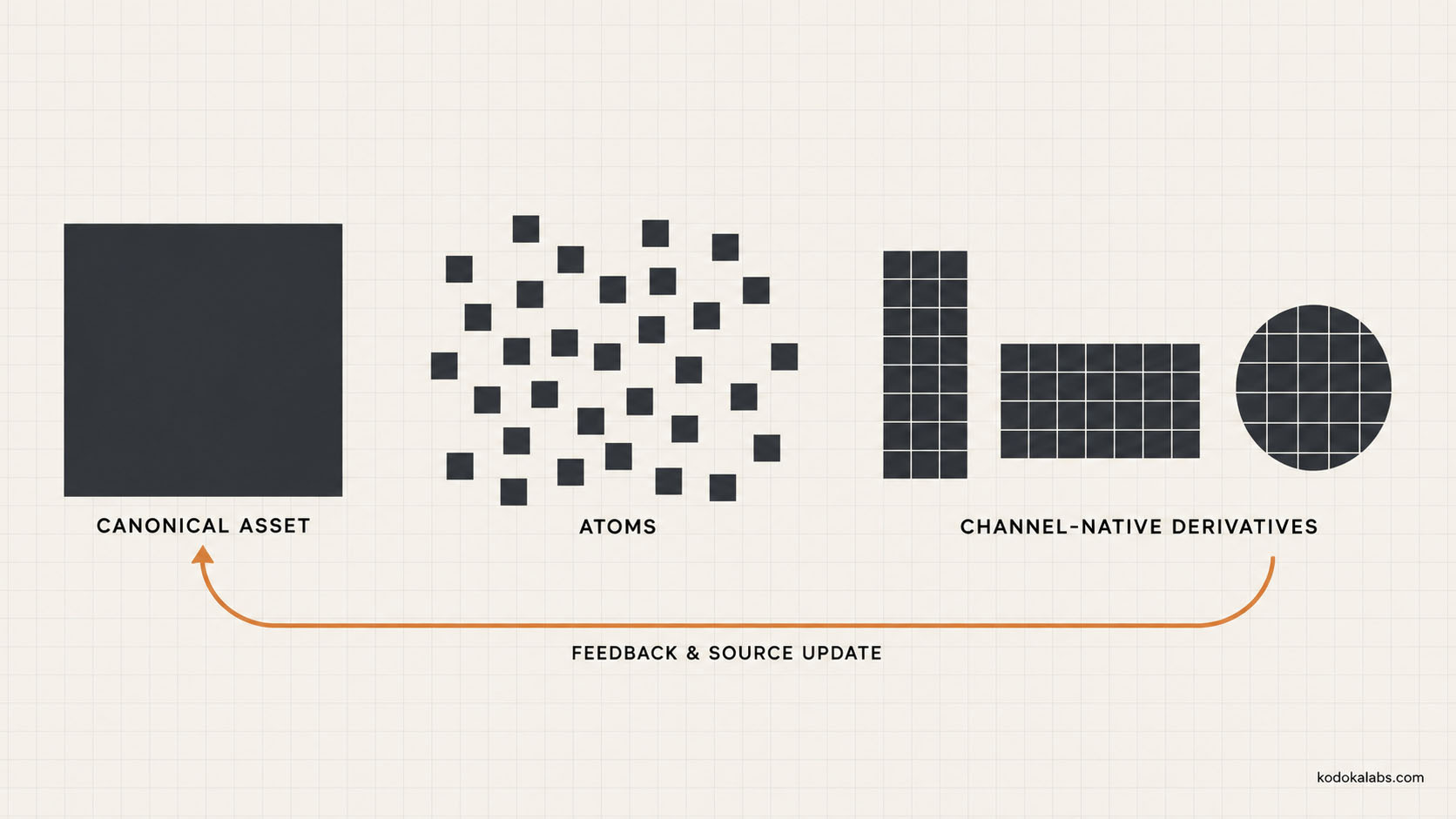
Flow metrics and quality metrics need to be tracked together, never in isolation from each other. Cycle time measures total elapsed time from a content request’s intake to its publication. Queue time measures how long work waits before someone starts actively processing it, separate from touch time, the time actually spent working on it. Throughput measures how much content completes per period. Work in progress measures how much content is active across the pipeline at once, a useful early-warning signal since rising work in progress with flat throughput usually indicates a developing bottleneck before it becomes visible as a deaBefore generating any derivative, the source needs to be broken down into reusable atoms: discrete ideas, specific pieces of evidence, concrete examples, visuals, and locked facts that a derivative can draw on individually rather than requiring the whole source to be re-read and re-interpreted each time. This atomization step is what makes repurposing systematic rather than ad hoc, since a well-modeled set of atoms can support many different derivatives without anyone having to reconstruct the source’s meaning from scratch for each one.
Claim locking is the discipline that protects factual integrity through this process. Each claim derived from the source gets explicitly marked as locked, meaning no derivative may restate it in a way that changes its substance, even while freely changing its wording, length, or framing. A statistic, a specific finding, a named framework’s definition, these are exactly the kind of claims that need to survive every transformation intact, because a derivative that subtly drifts from the source’s actual claim, even unintentionally through successive paraphrasing, has introduced an inconsistency the organization will eventually have to explain.
Drift tends to accumulate specifically through successive repurposing rather than through any single transformation. A derivative built directly from the source is likely to preserve a claim faithfully; a second derivative built from that first derivative, rather than from the original source, inherits whatever small simplification the first derivative introduced, and a third derivative built from the second compounds it further. This is why every derivative should be modeled from the source’s own locked atoms directly, not from a previous derivative treated as a convenient shortcut, even when the previous derivative happens to be close to what a new channel needs. Treating derivatives as a chain, each one building on the last, is the specific mechanism by which a well-verified original claim can end up meaningfully distorted a few repurposing cycles downstream, with no single step along the way looking like an obvious error.livery delay. First-pass yield measures what share of content clears review without requiring substantive revision, a strong proxy for how well upstream stages, briefing, drafting, are actually working. Defect and rework rates measure how often content needs to be sent back, and for what reason, which points directly at where quality problems originate rather than just where they’re caught.
Every one of these metrics needs an explicit guardrail attached to it, because a flow metric tracked in isolation will eventually get gamed, often unintentionally, in a way that damages whatever it wasn’t designed to measure. Cycle time improvement with no quality guardrail will eventually get achieved by cutting review depth. Throughput improvement with no value guardrail will eventually get achieved by producing more low-value content rather than better-targeted content.
This isn’t a hypothetical risk; it’s close to an inevitability whenever a single metric becomes the primary thing a team is evaluated against. A reviewer whose performance is measured mainly on how many pieces they clear per week will, understandably and without any bad intent, start finding ways to clear pieces faster, and the easiest way to do that is almost always to look less closely. Pairing every speed-oriented metric with an explicit, equally visible quality or value metric, and making clear that both are evaluated together rather than one being a secondary afterthought, is what keeps this dynamic from playing out.
The same dynamic applies to drafting, not only to review. A writer evaluated mainly on drafts produced per week, with no quality-adjusted counterpart metric visible alongside it, will rationally gravitate toward whichever content is fastest to draft rather than whichever content is most valuable to produce, even when nobody involved intends that outcome. This is a structural consequence of how the metric is built, not a judgment about anyone’s professionalism or effort, and it recurs reliably across different teams and different organizations precisely because it follows from incentive structure rather than from individual character. The fix is the same one that applies at the review stage: never let a speed metric stand alone as the thing a role is measured against.
| Transformation type | Suitable source material | Channel use | Semantic risk | Review level |
|---|---|---|---|---|
| Extract | A specific statistic, quotation, or definition | Social post, pull quote, slide | Low if extracted verbatim; moderate if paraphrased | Light editorial check against source |
| Summarize | A full section or the complete source asset | Executive summary, newsletter blurb | Moderate; compression can drop a critical qualifier | Editorial check for meaning preservation |
| Reframe | A general finding applied to a specific scenario | Industry-specific or role-specific derivative | Moderate to high; reframing can overstate applicability | Subject-matter review for fit and accuracy |
| Illustrate | A concept or process described in the source | Diagram, infographic, short video | Moderate; visual simplification can lose nuance | Design plus editorial review together |
| Compare | Two or more findings or options from the source | Comparison table, decision tool | Moderate; comparison framing can introduce unintended bias | Editorial and, where relevant, specialist review |
| Teach | A process or framework from the source | Training module, how-to guide | Low to moderate depending on complexity | Editorial check against source and training standards |
| Activate | A finding paired with a specific call to action | Campaign asset, landing page | Low semantically, higher on claims paired with an offer | Editorial plus marketing/legal review where an offer is involved |
Channel Adaptation
Every channel has its own job to do, and a derivative built for that channel should be designed around that job rather than treated as a smaller version of the source. A social post’s job is usually to earn attention and drive a click, not to fully explain a concept; a training module’s job is to teach a process reliably, which requires more structure and repetition than a social post would tolerate; a comparison tool’s job is to support a specific decision, which requires precision over breadth.
This means the audience’s actual intent at that specific destination needs to shape format, length, tone, interaction model, and call to action deliberately, not just the source’s original framing scaled up or down. A derivative that simply shortens a cornerstone guide’s introduction for a social caption has adapted length without adapting intent, and it usually shows: the resulting post reads like an excerpt rather than something built for the platform it’s actually appearing on.
A useful discipline for channel adaptation is to state the channel’s job explicitly before drafting the derivative, in a single sentence, rather than assuming it’s obvious from the channel’s name alone. “This post’s job is to earn a click from someone scanning quickly, not to explain the full argument” produces a meaningfully different derivative than “this post’s job is to establish credibility with someone who already knows the topic and is deciding whether to trust this source,” even though both might plausibly be derived from the same cornerstone guide and published through the same channel. Naming the job explicitly also gives the human reviewer a concrete standard to check the derivative against beyond a general sense of whether it “feels right” for the platform.
Format constraints specific to a channel, a character limit, a required aspect ratio, a maximum video length, should be treated as creative constraints to design within rather than obstacles to work around after the fact. A derivative drafted first at full length and then cut down mechanically to fit a channel’s limit tends to read as truncated rather than purpose-built, because whatever got cut was rarely the least important part of the original framing, just the part that happened to fall after the length limit. Drafting with the constraint in view from the start, choosing which single idea the derivative will carry before writing a word of it, produces a noticeably more coherent result than editing down after the fact.
Human and AI Workflow
AI assistance is genuinely useful for generating candidate derivative options quickly once the source atoms and locked claims are modeled: several possible framings for a given channel, several possible lengths, several possible visual concepts to brief a designer against. Generating options at this stage accelerates exploration without compromising the claim-locking discipline, provided the options are generated from the approved atoms rather than from a fresh, unconstrained read of the source each time.
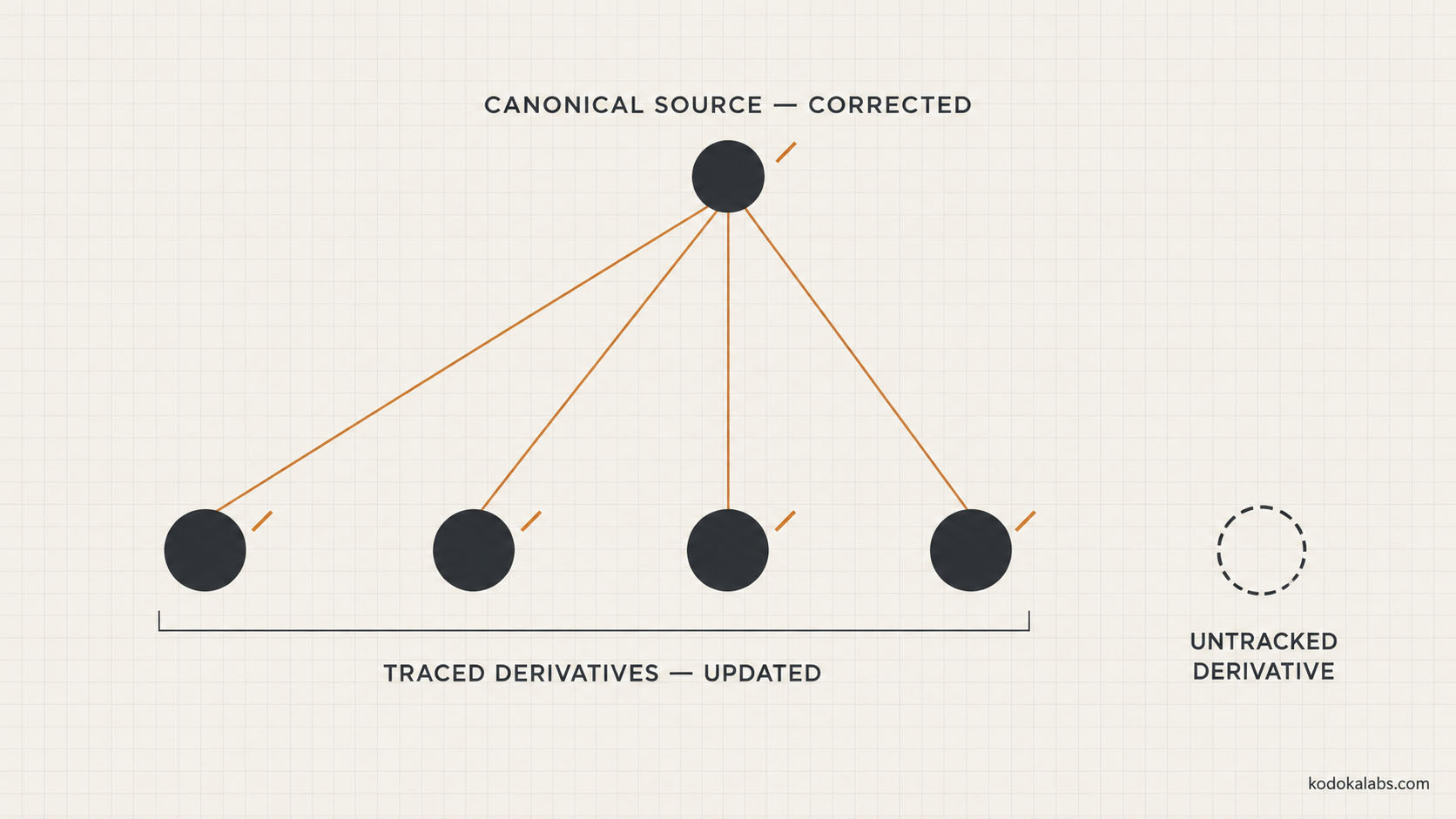
Human review remains essential at two specific points: confirming the derivative’s meaning actually matches the source’s locked claims, not just that it reads smoothly, and approving the final version before it enters the publishing workflow described in the AI Editorial Operating System. Versioning should track which source version and which specific atoms a derivative was built from, so that if the source is later corrected, every derivative built from the outdated version can be identified rather than discovered one at a time as problems surface.
The specific check a human reviewer performs on a derivative is different from the check performed on an original piece of content, and conflating the two leads reviewers to focus on the wrong thing. An original piece of content is reviewed for whether its claims are accurate and well-supported in the first place. A derivative’s claims have already been through that check at the source; the derivative review instead asks whether the transformation preserved what the source actually established, which is a narrower, more specific question that can usually be answered faster than a full original review, provided the reviewer understands that’s the actual task in front of them rather than re-litigating the source’s underlying accuracy from scratch each time.
Provenance and Update Control
Every derivative needs a traceable link back to its canonical source and the specific version of that source it was built from. This traceability is what makes correction propagation possible: when a source asset is corrected, every derivative built from the version containing the error can be identified and updated, rather than the correction applying only to the source while a dozen scattered derivatives continue circulating the outdated claim indefinitely.
| Field | Specification |
|---|---|
| Source ID and version | The canonical source asset and the specific version a derivative was built from |
| Approved claims | The locked claims from the source this derivative is permitted to use |
| Prohibited changes | Explicit note of what must not be altered during transformation |
| Audience | The specific audience this derivative targets |
| Channel job | What this derivative is actually supposed to accomplish on its destination channel |
| Format | The derivative's specific format and length |
| Transformation type | Extract, summarize, reframe, illustrate, compare, teach, or activate |
| Call to action | The specific action this derivative asks its audience to take, if any |
| Reviewer | The named human who confirmed meaning preservation and approved the derivative |
| Disclosure | Any required AI-involvement disclosure for this specific derivative |
| Publication record | Where and when this derivative was published |
| Measurement | What this derivative's performance is tracked against |
| Update dependency | What happens to this derivative if its source is later corrected or retired |
Disclosure should follow the organization’s approved transparency policy consistently across every derivative, not vary informally by channel or by whoever happened to produce a given piece. Accessibility requirements, alt text, caption structure, reading order, apply to every derivative format just as they apply to the source, and a derivative shouldn’t be treated as exempt from these standards simply because it’s shorter or more visual than the original.
Measurement and Learning
A derivative’s success should be judged against its specific channel job, not against the source’s own performance metrics. A social post derived from a cornerstone guide succeeds if it earns the engagement and clicks appropriate to its platform and purpose, not if it replicates the cornerstone guide’s own search ranking or time-on-page figures, which were never what it was designed to achieve.
Performance feedback from derivatives should flow back to inform future repurposing decisions and, where a derivative surfaces a genuinely better framing of an idea than the source used, occasionally back to the source itself. A derivative that consistently outperforms expectations on a specific angle is useful evidence about what resonates with a particular audience, evidence the organization should capture and apply to future content decisions rather than letting it disappear into a channel-specific analytics dashboard nobody connects back to the broader content strategy.
Portfolio-level measurement, looking across all derivatives from a given source rather than at any single one in isolation, surfaces a different and useful question: is this source actually earning its repurposing investment. A source that reliably generates several well-performing derivatives across multiple channels has proven itself as a strong repurposing asset, worth the effort of maintaining its accuracy and currency over time. A source whose derivatives consistently underperform, despite reasonable channel adaptation effort, may indicate the underlying idea doesn’t travel well outside its original format, which is itself useful information for deciding where to invest future repurposing effort rather than continuing to force derivatives from material that isn’t suited to it.
This portfolio view also helps distinguish a channel problem from a source problem when a given derivative underperforms, a distinction that matters because the two point to completely different fixes. If every derivative from a given source performs reasonably well except for the ones on a specific channel, the channel adaptation for that channel is probably the issue, not the source. If derivatives from a given source underperform fairly consistently across several different channels, the issue more likely sits with the source material itself, or with how its atoms were modeled, rather than with any individual channel’s execution. Without the portfolio view, a team is more likely to misdiagnose a channel-specific problem as a source-quality problem, or vice versa, and apply an improvement effort to the wrong part of the system.
Failure Modes for Content Repurposing
Frequently Asked Questions
How is content repurposing different from just reformatting content for different platforms?
Reformatting changes presentation without necessarily reconsidering purpose. Repurposing, as this guide defines it, starts from the destination channel's actual audience and job before deciding what to adapt, which usually produces a meaningfully different derivative than a straightforward reformat would.
Who approves a derivative before it's published?
A named human reviewer confirms meaning preservation against the source's locked claims, consistent with the risk tier the derivative's content warrants under AI Editorial Governance, before it enters the publication stage of the AI Editorial Operating System.
What happens when a correction is made to the source asset?
Every derivative traceable to the corrected version, via the Source-to-Derivative Contract's source ID and version field, should be identified and evaluated for whether it also needs correction, rather than assuming the fix at the source automatically resolves every downstream copy.
Can AI generate an entire derivative without human involvement?
AI can generate strong candidate derivatives from the approved atoms and locked claims, but human review for meaning preservation and final approval remain required before publication, consistent with the Human + AI Execution Model's allocation of judgment to human reviewers for anything with real brand or factual exposure. This holds regardless of how low-risk a given channel might otherwise seem, since even a brief social caption carries the organization's name and can misstate a locked claim just as a longer derivative can.
How does this guide connect to Authority Engineering?
Authority Engineering covers how an organization's strongest assets, often the same cornerstone guides that make good repurposing sources, compound into durable authority over time. This guide covers the mechanics of turning those assets into channel-native derivatives without losing what made the original authoritative.
How many derivatives is reasonable to build from a single source?
There's no fixed number; it depends on how many distinct audience-and-channel jobs the source can genuinely support without repeating itself. A source with several strong angles and broad channel reach might reasonably support six or eight well-differentiated derivatives, while a narrower source might only support two or three before additional derivatives would start feeling redundant. The portfolio-level measurement described above is the practical way to tell when a source has been fully, rather than excessively, repurposed.
Should repurposing be planned before the source is published, or only after?
Planning repurposing candidates at the same time the source is briefed, rather than treating repurposing as an afterthought once the source is already live, tends to produce better derivatives. A source drafted with its likely derivatives in mind is more likely to contain clearly extractable atoms and well-bounded claims than one drafted without any thought given to how it might later be reused, which otherwise forces the atomization step to work harder to find clean boundaries that were never deliberately built into the original.
Build the Reuse System, Not Just the Derivatives
A governed repurposing system compounds the value of every piece of approved, canonical content the organization produces, rather than treating each derivative as a one-off task. Authority Engineering shows how this reuse connects to building durable authority over time, and the AI Capability Academy offers the training needed to run this workflow reliably across a team. Organizations ready to install this system can start with a kōdōkalabs Executive AI Marketing Assessment.