
Marketing Team Redesign for AI: Roles and Skills
 Ben
BenMarketing Team Redesign for AI: Roles, Responsibilities, and Skills
Executive Summary
Key Takeaways:
- Redesign work at the task, workflow, decision, and accountability level — not at the job-title level.
- Strategy, ethical accountability, final approval, and exception decisions remain human-led regardless of AI capability.
- New roles are emerging (AI workflow owner, context architect, AI quality lead) but rarely require a full-time hire per role at smaller organizations.
- Junior career paths need deliberate redesign, not passive erosion, as AI absorbs early-career tasks.
- Role elimination is an organization-specific decision requiring evidence and legal and employee considerations — not a default outcome of this framework.
What Marketing Team Redesign for AI Means
Marketing team redesign for AI is the deliberate process of reassigning tasks, workflows, decisions, and accountability across human and AI capability, based on evidence about what each does well, rather than reorganizing around which software tools were recently purchased. It’s distinct from headcount planning, which asks “how many people do we need,” and from tool rollout, which asks “who uses which software.” Redesign asks a more structural question: given that some tasks can now be AI-assisted or AI-executed under supervision, what should each role’s actual work consist of, and who is accountable for the outcome.
This matters because the two most common failure patterns in AI-era team planning both skip this structural question. The first preserves every existing responsibility and adds AI-related work on top, producing busier teams with no real capacity gain. The second removes roles based on which tasks look automatable in isolation, without accounting for the judgment, coordination, and accountability those roles also carried — work that doesn’t disappear just because a task was removed, but becomes invisible and unowned.
A useful test for any proposed redesign is whether it can name, specifically, which layer of work is changing — task, workflow, decision, or accountability — for each affected role. A redesign proposal that only says “this role will use AI more” hasn’t actually done the structural work yet; it’s restated the premise rather than answered the question of what changes and who remains responsible for the outcome.
Why Job Titles Are the Wrong Starting Point
Job titles bundle together many different kinds of work: routine production tasks, cross-functional coordination, strategic judgment, stakeholder management, and accountability for outcomes. AI capability doesn’t map cleanly onto any single job title, because a “content strategist” and a “performance marketer” both contain a mix of highly automatable tasks (first-draft production, data aggregation, formatting) and tasks that remain firmly human (positioning judgment, client relationship management, ethical review).
Starting redesign at the job-title level produces two specific errors. It overstates automation potential when a title’s most visible task looks automatable, ignoring the coordination and judgment work bundled into the same role. And it understates automation potential when a title’s overall function feels strategic, even though specific tasks inside it — first-draft production, routine reporting, competitive research — are genuinely ready for AI assistance today. Decomposing work below the job-title level avoids both errors.
Decompose Work Before Redesigning Roles
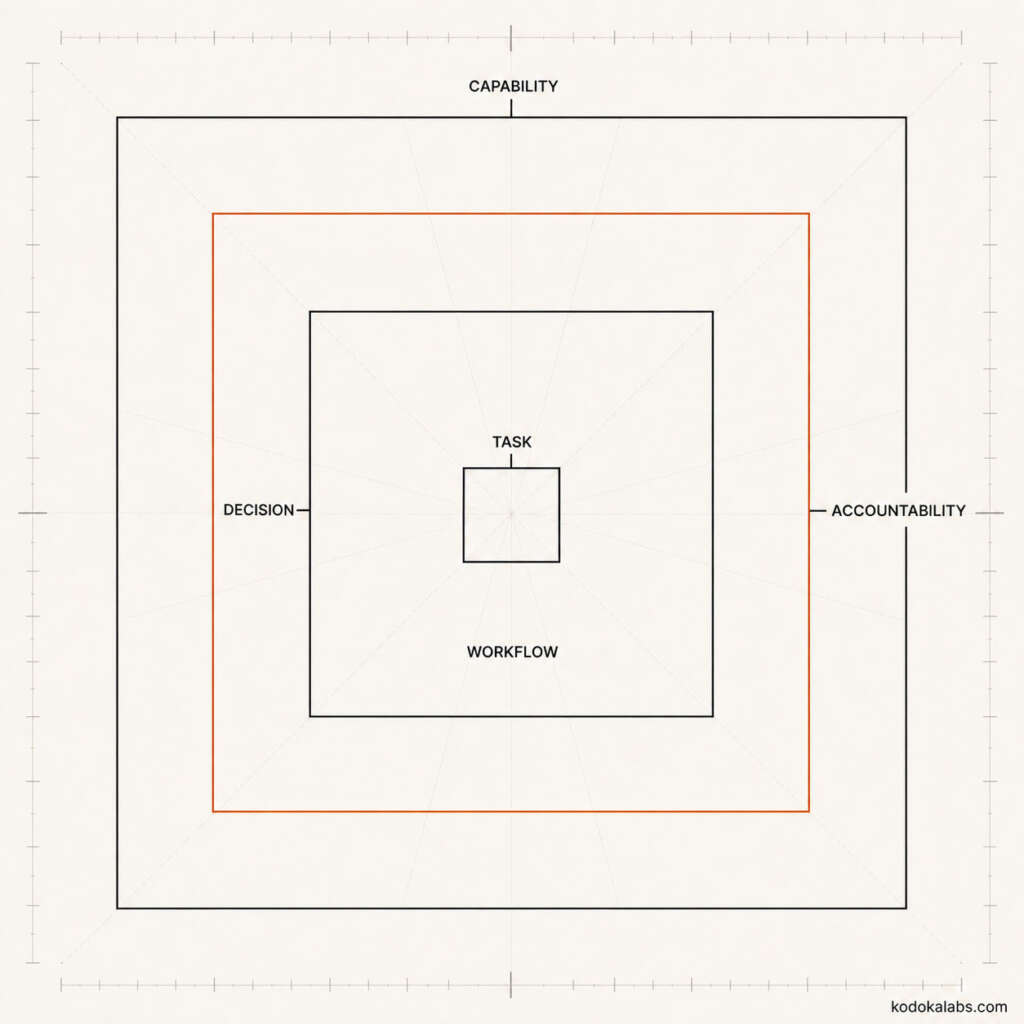
kōdōkalabs’ Work Decomposition Model assesses work across five layers instead of at the job-title level:
- Task – the individual unit of work (drafting a paragraph, pulling a report, tagging a campaign).
- Workflow – the sequence of tasks that produces a deliverable (a campaign brief moving through drafting, review, and approval).
- Decision – the judgment calls embedded in a workflow (what to prioritize, what to approve, what to escalate).
- Accountability – who is answerable for the outcome, regardless of who performed the underlying tasks.
- Capability – the skill and knowledge required to perform the task, workflow, or decision competently, which determines whether reskilling or hiring is the right response to a gap.
Layer
What It Answers
Typical AI Role
Typical Human Role
Task
Decision
Accountability
Capability
N/A — informs reskill vs. hire decisions
Which Responsibilities Should Remain Human-Led?
Certain categories of responsibility remain human-led regardless of how AI capability advances, because they depend on accountability, judgment under ambiguity, or relationship trust that AI systems cannot hold:
- Strategy – setting direction based on incomplete information and organizational context AI systems don’t have full access to.
- Ethical accountability – owning the consequences of a decision, which by definition cannot be delegated to a system.
- Final approval – the last human check before something reaches a customer, market, or regulator.
- Stakeholder management – relationship-based trust-building with executives, clients, and partners.
- Customer judgment – reading nuance, tone, and context in a specific customer situation.
- Sensitive communication – messages involving reputational, legal, or emotional sensitivity.
- Original expert interpretation – new synthesis or judgment that goes beyond restating existing knowledge.
- Exception decisions – situations that fall outside documented workflows and require judgment about how to proceed.
Which Responsibilities Can Be AI-Assisted?
AI-assisted work means AI produces a draft, analysis, or recommendation that a human reviews, edits, and approves before it’s used. Examples across major marketing functions:
- Content – first-draft articles, meta descriptions, content briefs, and outline generation, all reviewed before publication.
- SEO/GEO – keyword and topic research, competitive content gap analysis, and structured data drafting.
- Paid media – ad copy variation generation and budget-allocation recommendations reviewed before execution.
- Analytics – first-pass performance summaries and anomaly flagging, reviewed for interpretation accuracy.
- Sales enablement – draft one-pagers, battlecards, and objection-handling content reviewed by a subject-matter expert.
- Marketing operations – workflow documentation drafts and SOP first passes, reviewed for accuracy and completeness.
In each case, the defining characteristic of AI-assisted work is that a human reviews the output before it’s used — the human, not the AI system, remains accountable for what happens next.
Which Responsibilities Can Be AI-Executed Under Supervision?
AI-executed-under-supervision work means AI completes and deploys the work directly, within defined guardrails, with human oversight applied through spot-checks, monitoring, or exception escalation rather than pre-publication review of every instance. This tier requires specific controls before it’s appropriate:
- A documented, validated workflow (not a first-time use case).
- Defined boundaries for what the AI system is and isn’t permitted to do without escalation.
- A monitoring or spot-check process, not a one-time approval that’s assumed to hold indefinitely.
- A clear escalation path for edge cases the workflow wasn’t designed to handle.
- Periodic quality review against a documented baseline, not just initial validation.
Content categories with low reversibility, high factual sensitivity, or significant brand exposure should not move to AI-executed-under-supervision status without governance sign-off — see the AI Governance for Marketing guide for how risk classification determines the appropriate oversight level.
Category
Human-Led
AI-Assisted
AI-Executed Under Supervision
Strategic positioning
Blog and guide drafting
Routine performance reporting
Ad copy variations
Customer-facing sensitive communication
Internal documentation
Social listening triage
How to Score Your Organization
Scoring requires more than a single self-assessment session. A credible score depends on:
- Evidence collection – scores should be backed by documentation, workflow observation, or system data, not impression alone.
- Scoring scale – a consistent scale applied uniformly across all seven dimensions (kōdōkalabs’ assessment methodology defines the specific scale used in the Executive AI Marketing Assessment).
- Stakeholder input – scores drawn from multiple roles (leadership, marketing operations, individual practitioners) rather than one person’s perspective alone.
- Variance between teams – scoring separately by function where meaningful differences exist, rather than forcing one score across a diverse organization.
- Maturity ceilings – recognizing that a dimension can’t credibly score above what the evidence supports, even if leadership’s aspiration is higher.
- Risk of self-assessment bias – self-scored assessments tend to run optimistic, particularly on governance and knowledge quality, which is why external validation (such as a structured Executive AI Marketing Assessment) often produces a more accurate baseline than an internal-only exercise.
How Existing Marketing Roles May Evolve
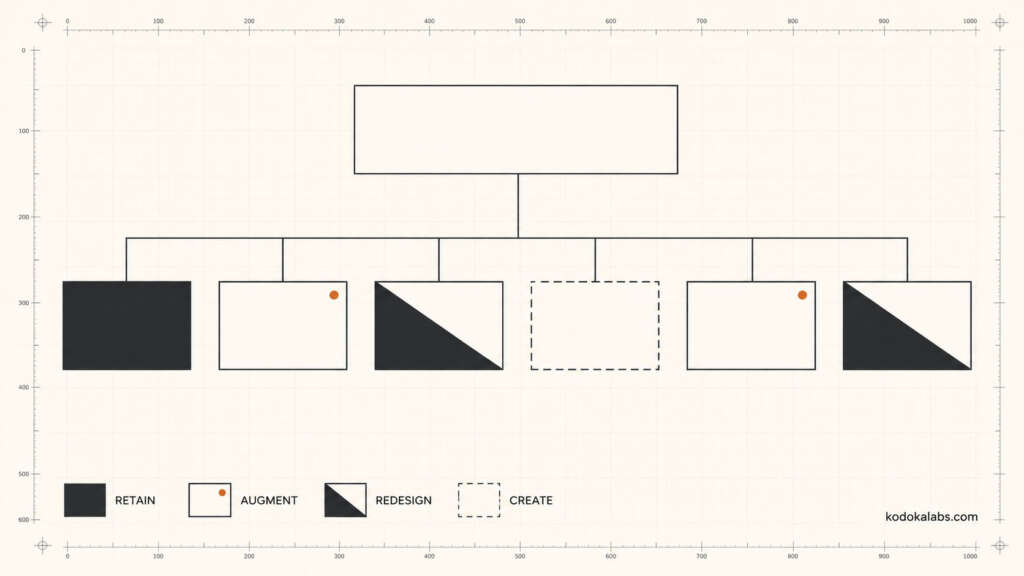
Role
Likely Transition
What Changes
CMO
Marketing director
Marketing operations
SEO/GEO strategist
Content strategist
Writer/editor
Performance marketer
Analyst
Augment
Designer
Augment
Account manager
Sales enablement
Subject-matter expert
Emerging Roles and Responsibilities
- AI workflow owner – designs, documents, and maintains AI-assisted workflows and their guardrails.
- Context or knowledge architect – owns the structured knowledge base AI systems draw on for accuracy.
- AI quality lead – owns quality review and error-pattern tracking across AI-assisted output.
- Marketing systems architect – designs how marketing technology and AI tools integrate across the stack.
- Governance owner – owns the risk classification and review process defined in the organization’s AI governance framework.
- Agent operations specialist – manages and monitors AI agents running semi-autonomous workflows.
These are responsibilities, not necessarily separate full-time positions — at a smaller organization, one person may hold two or three of these responsibilities alongside an existing role, while a larger organization may formalize each into a dedicated position as AI-assisted volume grows.
The Future Marketing Capability Matrix
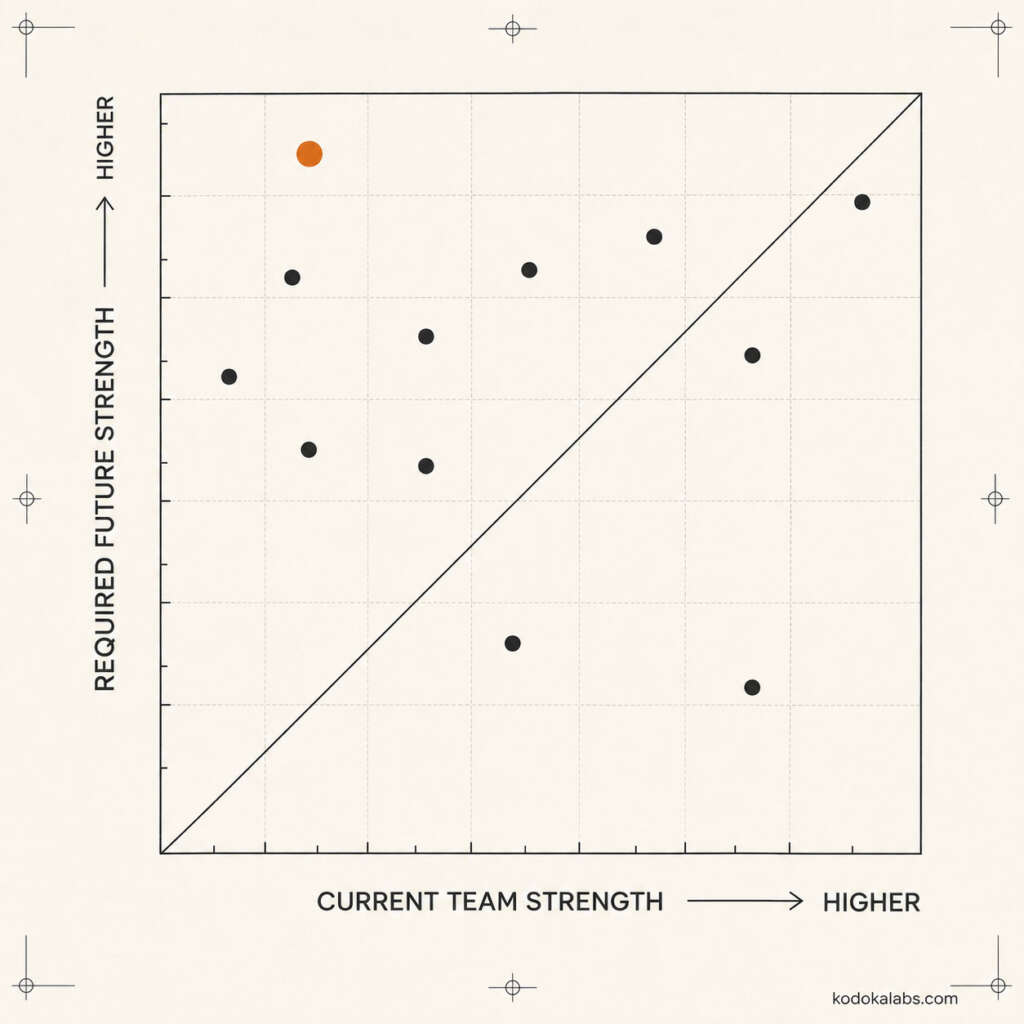
kōdōkalabs’ Future Marketing Capability Matrix maps the skills that matter most in an AI-native marketing organization:
Capability
Why It Matters More, Not Less
Domain expertise
Strategic judgment
Systems thinking
Data literacy
AI orchestration
Evidence evaluation
Creative direction
Customer empathy
Governance
Change leadership
Documentation
Commercial acumen
Reskilling vs. Hiring
Factor
Favors Reskilling
Favors Hiring
Strategic importance
Scarcity of the skill
Learning curve
Existing institutional knowledge
Urgency
Governance risk
Long-term ownership
Neither path is inherently superior; the right choice depends on how many of these factors point the same direction for a specific capability gap, not on a blanket policy applied across the whole organization.
How to Redesign Junior Career Paths
AI capability often absorbs exactly the tasks — research aggregation, first-draft production, basic reporting — that traditionally gave junior marketers their early repetitions and learning curve. Left unaddressed, this risks quietly eliminating the developmental pathway that produces future senior judgment, not just entry-level output. Redesigning junior career paths deliberately requires:
- Supervised practice – junior staff still perform some tasks manually, even when AI could do them faster, specifically to build judgment.
- Quality evaluation – junior staff review and evaluate AI-assisted output, building critical judgment rather than just producing it themselves.
- Reasoning exposure – juniors are shown senior reasoning and decision logic, not just final outputs, so they learn the “why” alongside the “what.”
- Rotations – structured exposure across functions to build systems thinking earlier in a career.
- Apprenticeship – pairing junior staff directly with senior practitioners on judgment-heavy work.
- Feedback – frequent, specific feedback on both AI-assisted output quality and independent judgment.
- Progressive responsibility – a defined path from AI-assisted task review toward independent strategic judgment over time.
Employee Participation and Change Management
Team redesign succeeds or fails based on how it’s implemented, not just how it’s designed on paper. Co-design — involving the people whose roles are changing in defining the new workflows, rather than presenting a finished redesign — surfaces practical issues a top-down process misses and builds the buy-in needed for adoption. Transparency about what is and isn’t changing, communicated early and specifically rather than left to speculation, reduces the anxiety that otherwise undermines cooperation. Role clarity — a documented, specific description of what each redesigned role now covers — replaces ambiguity that would otherwise be filled by worst-case assumptions. Practical training, delivered close to the point of actual use rather than as a one-time general session, determines whether new workflows are actually adopted or quietly abandoned once initial attention fades.
A Phased Team Redesign Process
Phase
Focus
Primary Output
1. Map work
2. Identify risk and value
3. Define future responsibilities
4. Pilot workflows
5. Train teams
6. Revise roles
7. Measure outcomes
Common Mistakes
- Redesigning around tools – reorganizing based on which software was purchased rather than which work actually changed.
- Assuming task automation equals role elimination – ignoring the accountability and coordination work bundled into a role alongside its automatable tasks.
- Ignoring invisible coordination work – removing a role without accounting for the cross-functional coordination it quietly performed.
- Underinvesting in managers – expecting managers to lead AI-era teams without dedicated support or training themselves.
- Removing junior development – allowing AI to absorb entry-level tasks without redesigning how junior staff build judgment.
- Creating specialist bottlenecks – concentrating all AI-related capability in one or two people who become single points of failure.
- Failing to document new responsibilities – leaving redesigned roles undocumented, so clarity erodes as soon as the person who designed them moves on.
Frequently Asked Questions
01 Will AI replace marketing teams?
02 Which marketing roles will change most?
03 Should companies hire AI specialists?
04 Which skills become more valuable?
05 How should junior roles change?
06 How should performance management change?
Performance management should evaluate judgment quality and AI-output review skill, not just output volume, since AI assistance can inflate volume without necessarily improving quality.
07 Who owns AI workflows?
08 How should external partners support the redesign?
External partners are most useful for capability transfer — building internal skill and documented workflows — rather than for indefinite execution dependency, which recreates the same capability gap the redesign was meant to close.
09 How long does role redesign take?
Timelines vary by organization size and scope, but a phased approach — mapping work, piloting redesigned workflows, then training and revising roles — typically spans several months rather than a single planning cycle.