
AI Governance for Marketing: Policy and Workflow Controls
AI Governance for Marketing: Policy, Workflow Controls, and Accountability
This guide is provided for general informational purposes and does not constitute legal advice. Organizations should consult qualified legal, privacy, security, and compliance counsel before finalizing AI governance policy, particularly where regulated data, intellectual property, or industry-specific compliance requirements are involved.
Executive Summary
Key Takeaways:
- A written policy alone is not governance – governance connects policy to enforceable, monitored workflow controls.
- Oversight should be proportional to risk, not uniform across every use case.
- Governance requires named decision rights, not just documented rules.
- No governance framework replaces legal, privacy, security, or compliance review.
- Governance is a continuous monitoring and revision practice, not a one-time policy document.
What Is AI Governance for Marketing?
AI governance for marketing is the system of principles, policy, risk classification, workflow controls, accountability, and monitoring that determines how AI is used responsibly across a marketing organization. It’s broader than an acceptable-use document: governance includes who decides what’s allowed, how risk is classified, what technical and procedural controls apply at each risk level, who is accountable when something goes wrong, and how the whole system improves over time as tools and use cases change.
Governance maturity tends to track organizational AI maturity more broadly – see the AI Marketing Maturity Model guide for how governance and risk are scored as one of seven maturity dimensions. An organization at an early experimentation stage typically needs lightweight interim guardrails rather than a fully built control stack; the roadmap later in this guide is designed to scale governance investment to match where an organization actually is, not to demand full maturity on day one.
Why an AI Policy Alone Is Not Governance
A policy document states rules. Governance makes those rules operational – enforceable through workflow design, auditable through documentation, and adaptable through monitoring. An organization can have a well-written acceptable-use policy and still have no real governance, because the policy exists separately from daily workflows: nobody checks whether confidential information is actually being entered into unapproved tools, nobody logs whether factual claims were actually verified before publication, and nobody owns the decision when a new use case doesn’t clearly fit the existing rules.
This gap is common precisely because policy is easier to produce than governance. Writing a document takes a working session; building the risk classification, review workflows, documentation habits, and monitoring practice that make the document real takes sustained operational effort. The Marketing AI Governance Control Stack below is designed to make that operational effort concrete rather than abstract.
The Marketing AI Governance Control Stack
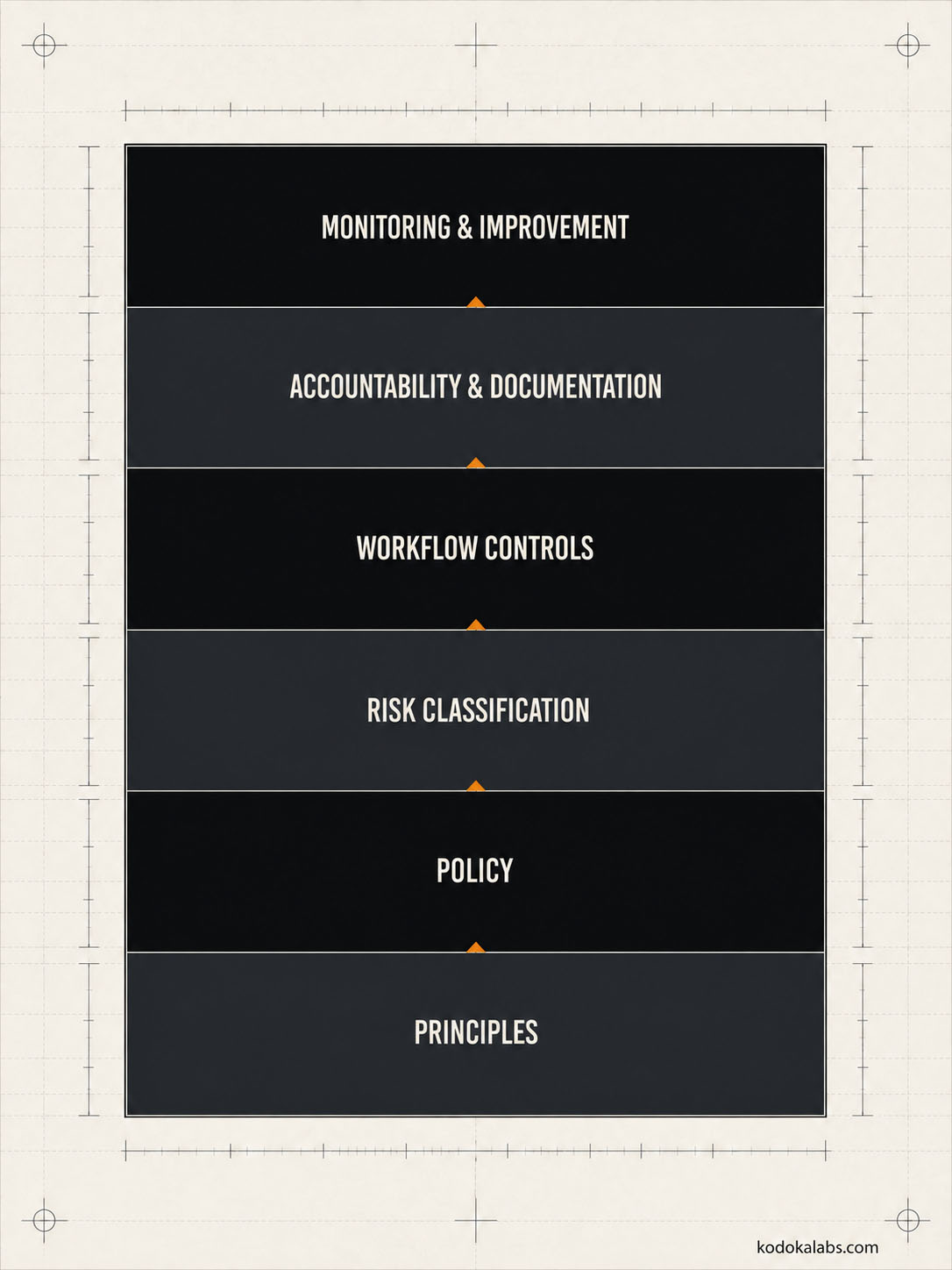
kōdōkalabs’ Marketing AI Governance Control Stack organizes governance into six layers:
Layer
What It Establishes
1. Principles
3. Risk classification
4. Workflow controls
5. Accountability and documentation
6. Monitoring and improvement
Each layer depends on the one below it. Policy without principles is arbitrary; risk classification without policy has nothing to calibrate; workflow controls without risk classification apply uniform oversight regardless of actual risk; accountability without workflow controls has nothing concrete to hold people accountable for; and monitoring without accountability has no clear owner to act on what it finds. The AI Governance Matrix – the tactical, content-category-level instrument used on the AI Marketing Operating System – is the practical expression of layers 3 and 4 for a specific organization’s content categories.
Governance Principles
- Human accountability – a named human, not an AI system, is always answerable for outcomes.
- Proportional oversight – the level of review scales with the risk of the use case, not a flat rule applied everywhere.
- Data protection – confidential, personal, and regulated data is handled according to defined classification rules.
- Evidence and traceability – decisions and outputs can be reconstructed after the fact.
- Transparency – AI involvement is disclosed where relevant to audience trust or regulatory expectation.
- Fairness – AI-assisted work is reviewed for bias and unintended discriminatory impact where relevant.
- Intellectual-property awareness – sourcing, licensing, and ownership questions are considered before use, not after.
- Security – access to AI tools and the data they touch is controlled and logged.
- Continuous review – the governance system itself is revised as tools, use cases, and risk understanding evolve.
Acceptable and Restricted Uses
Acceptable and restricted uses should be defined by an organization’s own risk classification and legal guidance rather than a universal list, but illustrative examples help calibrate judgment. Lower-risk, generally acceptable uses include first-draft generation for internal review, research aggregation, and formatting assistance. Higher-risk uses requiring explicit approval typically include anything involving personal or regulated data, definitive claims about health, safety, or financial outcomes, and content representing the organization in a legally or contractually binding way. Restricted uses – those an organization may choose to prohibit outright – often include entering client confidential information into unapproved public tools and generating content that impersonates a real, named individual without consent. This is illustrative, not exhaustive, and should not be read as legal guidance for a specific organization’s circumstances.
A useful working test, short of a full legal review, is whether a specific use case would be comfortable to explain plainly to the person or organization it affects – a client, a regulator, or an individual named in the content. Use cases that require careful framing to sound acceptable are usually the ones that belong in the “requires explicit approval” or “restricted” category rather than the default-acceptable one, and are a signal to route the decision to the appropriate governance role rather than proceed on individual judgment alone.
AI Risk Classification for Marketing Use Cases
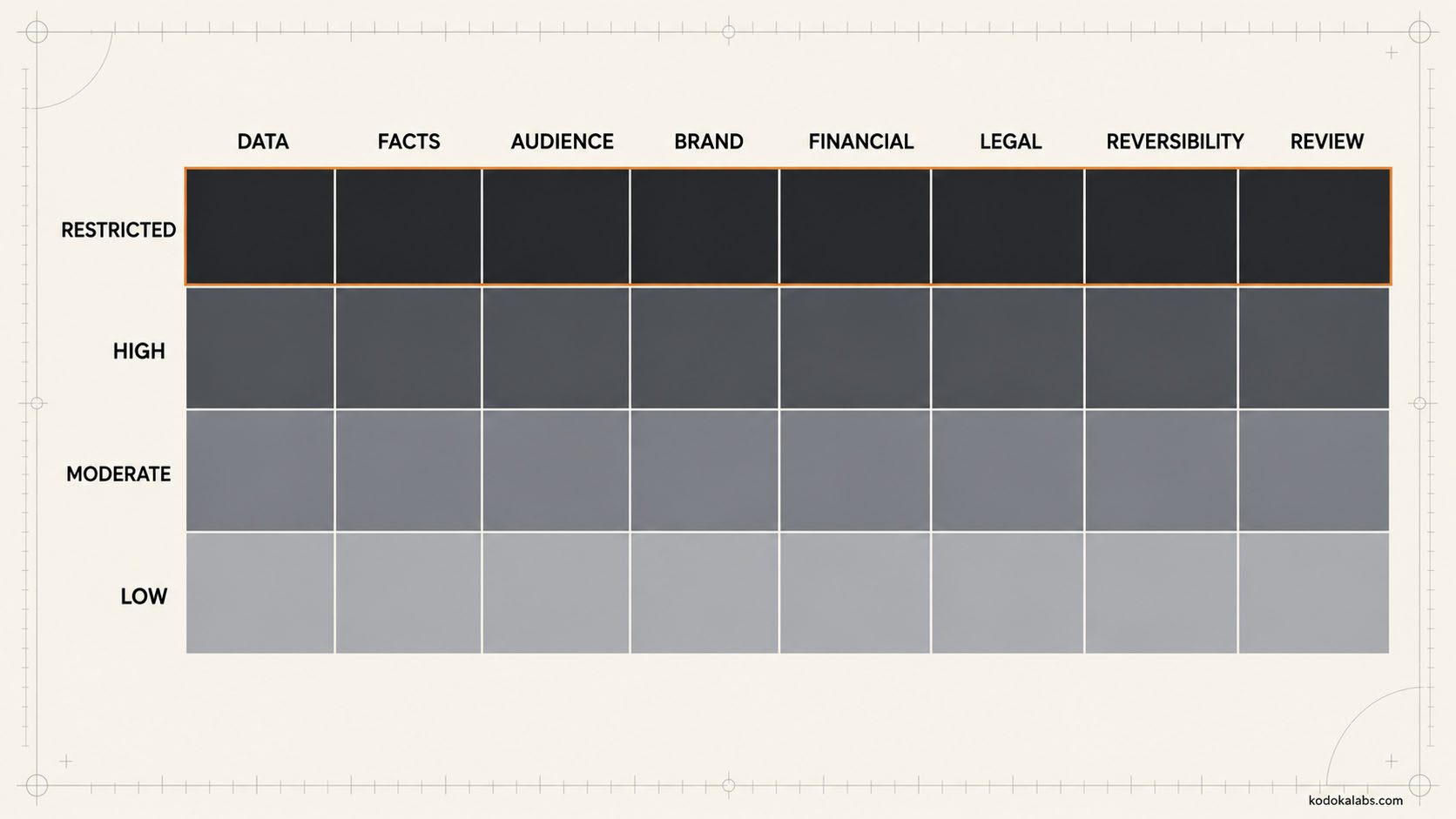
kōdōkalabs’ Risk Classification Matrix classifies AI use cases across eight factors – data sensitivity, factual sensitivity, audience exposure, brand impact, financial consequence, legal or regulatory relevance, reversibility, and required level of human review – placed into four illustrative tiers. This matrix does not replace legal, privacy, security, or compliance review; it’s a starting structure for calibrating internal workflow oversight.
Risk Tier
Data Sensitivity
Audience Exposure
Reversibility
Example Use Case
Low
Moderate
High
Restricted
Data and Confidentiality Controls
Data Category
Definition
Permitted AI Use
Public
Internal
Confidential
Personal or regulated
Client data
Human Review Requirements
Risk Tier
Minimum Review Requirement
Low
Moderate
High
Restricted
Factual Accuracy and Source Validation
- Source requirements – factual claims should trace to an identifiable, credible source, not AI-generated assertion alone.
- Claim verification – specific statistics, dates, and quotations require independent verification before publication.
- Evidence logging – the source used to verify a claim should be recorded, not just the claim itself.
- Handling conflicts – where sources disagree, the conflict should be resolved or disclosed, not silently averaged.
- Current-information checks – claims about pricing, regulation, or fast-changing topics require a recency check before publication.
- Expert validation – subject-matter experts should review claims within their domain before high-risk content is published.
Intellectual Property and Brand Controls
Organizations should establish clear positions on source material and licensing for any AI tool that trains on or references external content, on ownership of AI-generated outputs (both internally and in contracts with external partners), on approved use of brand assets within AI-assisted workflows, on disclosure practices where relevant, and on ownership terms specifically negotiated with agencies or vendors using AI on the organization’s behalf. These are genuinely unsettled areas in some jurisdictions and industries; this guide does not offer definitive legal conclusions on IP ownership or licensing questions, which should be directed to qualified legal counsel.
Brand asset controls deserve particular attention because they’re easy to overlook relative to text-content governance. Logos, brand voice guidelines, proprietary imagery, and trademarked terminology used as inputs to AI-assisted creative work carry the same governance weight as written content – arguably more, given how visible and hard to walk back a brand-asset misuse can be once published. Organizations building AI-assisted creative workflows should extend the same risk classification and review requirements used for written content to visual and brand-asset use specifically, rather than assuming visual work falls outside the governance framework by default.
Tool and Model Governance
- Approval – new AI tools go through a defined approval process before broad use, not ad hoc individual adoption.
- Vendor review – vendor data handling, security, and retention practices are reviewed before approval.
- Model changes – significant underlying model changes at an approved vendor trigger a re-review, since behavior and risk profile can shift.
- Access – tool access is provisioned and revoked deliberately, tied to role and need.
- Logging – usage is logged sufficiently to support audit and incident investigation.
- Deprecation – a defined process exists for retiring a tool, including migrating dependent workflows.
- Fallback – critical workflows have a defined fallback if an approved tool becomes unavailable.
- Business continuity – dependency on any single AI vendor is assessed as a continuity risk, not just a cost or feature decision.
Roles and Decision Rights
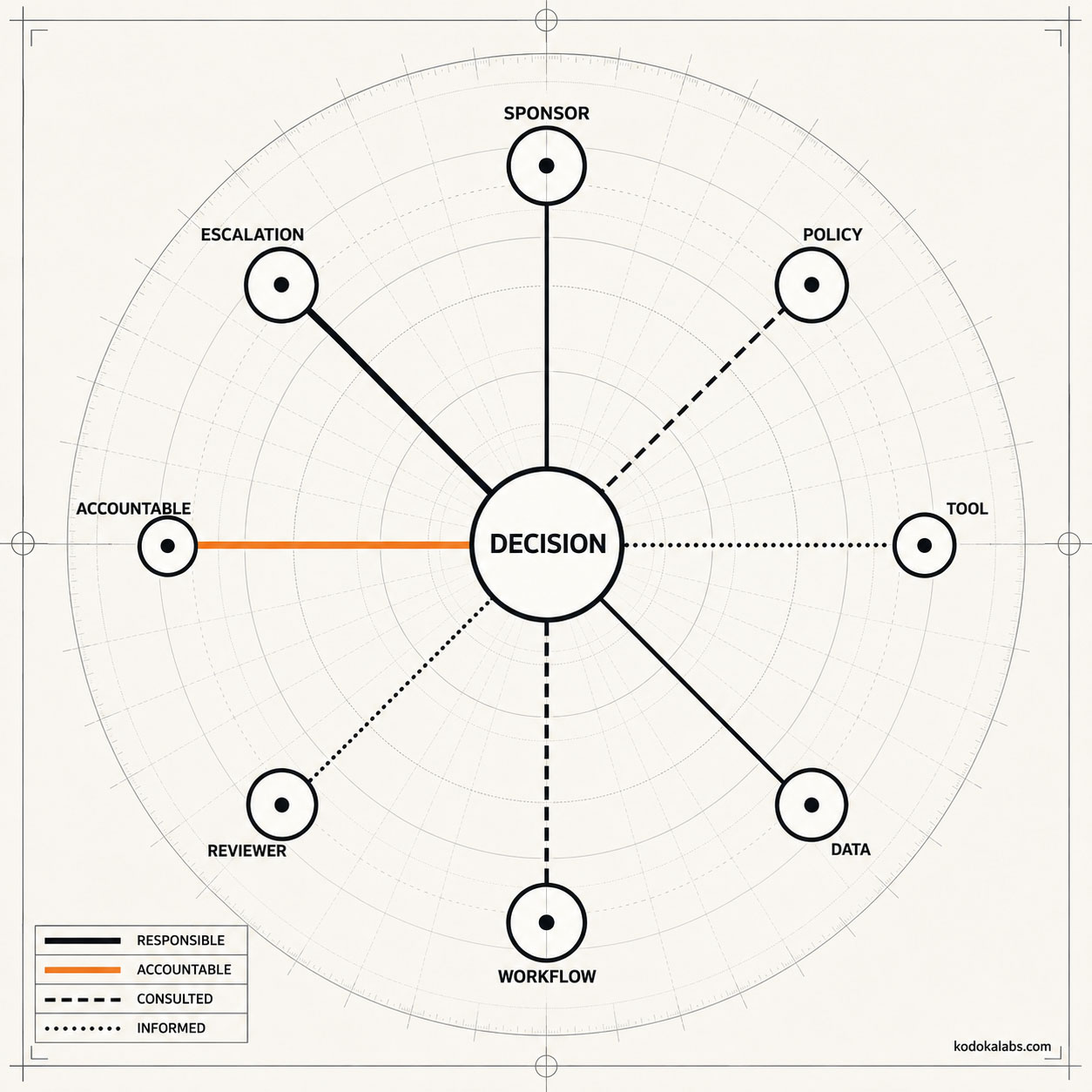
kōdōkalabs’ Governance Decision Rights model assigns eight roles:
Role
Responsibility
Executive sponsor
Policy owner
Tool approver
Data owner
Workflow owner
Reviewer
Final accountable person
Escalation owner
Workflow Documentation and Auditability
Monitoring and Incident Response
Incident Type
Example
Response Step
Quality incident
Data incident
Harmful or misleading output
Escalated edge case
Centralized, Distributed, and Federated Governance
Model
How It Works
Best Fit
Centralized
Distributed
Federated
Implementation Roadmap
- Inventory – catalog current AI tool usage and use cases across marketing.
- Prioritize – identify highest-risk, highest-volume use cases first.
- Establish interim rules – put lightweight guardrails in place before full governance is built.
- Classify use cases – apply the Risk Classification Matrix to prioritized use cases.
- Design workflow controls – build the specific review, logging, and approval steps for each risk tier.
- Train teams – ensure everyone understands the controls relevant to their workflows.
- Monitor – track quality, data, and escalation incidents against the new controls.
- Revise – update policy, classification, and controls based on monitoring evidence.
Common Mistakes
- Treating a written policy as complete governance without building the workflow controls behind it.
- Applying uniform oversight regardless of actual risk, which either over-controls low-risk work or under-controls high-risk work.
- Leaving decision rights undefined, so nobody is clearly accountable when an edge case arises.
- Failing to document AI-assisted workflows, leaving no audit trail when a question or incident occurs.
- Treating governance as a one-time project rather than a continuously monitored and revised practice.
- Assuming this or any general framework replaces legal, privacy, security, or compliance review specific to the organization.
Governance Checklist
[ ] Governance principles are documented and communicated.
[ ] Policy translates principles into specific rules.
[ ] Risk classification is applied to actual use cases, not just discussed in theory.
[ ] Workflow controls exist for each risk tier.
[ ] Decision rights are named for every governance role.
[ ] Workflows are documented sufficiently to support an audit.
[ ] A monitoring and incident-response process is active.
[ ] Legal, privacy, security, and compliance counsel have reviewed the framework as applied to the organization’s specific circumstances.
Frequently Asked Questions
01 What is AI governance in marketing?
AI governance in marketing is the system of principles, policy, risk classification, workflow controls, accountability, and monitoring that determines how AI is used responsibly across a marketing organization - broader than a written policy alone.
02 Who should own AI governance?
Typically an executive sponsor holds overall accountability, with a policy owner, tool approver, data owner, and workflow owners each responsible for a specific part of the system, per the Governance Decision Rights model.
03 Does every AI output require human review?
No - review requirements should scale with risk. Low-risk internal drafts may need only spot-checking, while high-risk, externally published, or regulated content requires expert and often legal review before use.
04 Can employees use public AI tools?
This depends on the organization's tool approval and data classification policy - public tools are often appropriate for low-sensitivity work, but confidential, personal, regulated, or client data generally should not be entered into unapproved public tools.
05 What data should never be entered into AI tools?
As a general practice, confidential business information, personal or regulated data, and client data should only be used with tools specifically approved for that data category - not entered into general-purpose public tools without that approval.