
ChatGPT Ads: How Agencies and Marketing Teams Should Organize
Key Takeaways
- ChatGPT Ads sit inside a conversation, not beside a results page or inside a feed. That changes what intent, creative, and conversion mean for the team running them.
- Assigning ChatGPT Ads to an existing PPC team as one more task is unlikely to work. The surface spans intent research, creative systems, conversion experience, data engineering, and increasingly agent design.
- The channel-based agency org chart (SEO, paid search, paid social, programmatic, creative, analytics) cuts against how conversational advertising actually operates.
- A capability-based structure, organized around intelligence, strategy, experience, distribution, measurement, and optimization, fits AI-native advertising better than a channel-based one.
- Existing agency roles do not disappear. They converge and expand into broader, more cross-functional versions of themselves.
Executive Summary
Every time a new advertising surface has appeared, marketing organizations have responded the same way: they added a department. Google Ads created search marketing teams. Meta created paid social teams. Programmatic buying created specialist media desks built around auctions and real-time bidding.
ChatGPT Ads, and the wider category of advertising inside conversational AI products, may not follow that same pattern. Not because the underlying discipline of buying attention and converting it into revenue has changed. It is because the surface itself behaves differently from anything that came before it.
A search results page is a list. A social feed is a stream. A conversation is neither. It is one continuous exchange in which a user states an intention, refines it, asks follow-up questions, and expects a coherent thread of understanding to carry through the whole interaction. Advertising that sits inside that exchange has to behave less like a placement and more like a genuinely relevant contribution to the conversation itself.
That distinction is the reason we do not think ChatGPT Ads should be treated as another line item bolted onto an existing paid media department. The opportunity increasingly touches conversational intent, contextual matching, creative variation, conversion optimization, measurement infrastructure, programmatic campaign management, and early forms of agent-mediated commerce, often within the same interaction. Few existing team structures are built to move fluidly across all of those disciplines at once.
This guide sets out what actually changes when advertising moves into a conversational interface, why the traditional agency org chart starts to break under that shift, and what a practical, cross-functional team structure for ChatGPT Ads and AI-native advertising more broadly can look like.
What ChatGPT Ads Actually Change
Before getting into organizational design, it helps to be specific about what changes mechanically when advertising happens inside a chat interface rather than beside a results page.
The starting point is intent. Traditional keyword targeting infers what someone wants from the words they typed into a search box, often just two or three words carrying a lot of ambiguity. A conversational interface has access to something richer: the stated goal itself, the context already shared, and the follow-up questions that reveal what the person still needs to know before deciding.
Audience targeting shifts in a similar direction, moving from a segment defined by demographics or past behavior toward the conversational context of one specific session. Ad creative stops competing for attention in a feed. It starts functioning more like a contextual response, something that has to feel like a useful answer rather than an interruption.
Landing pages may increasingly need to support a conversational continuation of the interaction, rather than presenting one generic page to every visitor. Campaign management itself starts to look less like a set of manually configured settings and more like an AI-assisted operating system that adjusts bidding, creative selection, and targeting in response to signals arriving in real time.
Underneath all of this sits a wider set of mechanics that any team working in this space eventually needs to understand:
- Conversational context and intent signals, used to interpret what a user actually wants mid-conversation.
- Context hints, which shape when and how an ad might be eligible to appear.
- Advertiser landing pages and creative assets, structured for a conversational handoff.
- Cost-per-click and impression-based buying models.
- Conversion optimization and conversion APIs, connecting an in-conversation event to what happens afterward.
- Advertiser APIs, which allow campaigns to be created and managed programmatically.
- Campaign automation and, increasingly, sponsored agents.
- CRM and ecommerce integrations that close the loop back to revenue.
The advertising system increasingly spans the entire journey, from the moment intent is recognized through to the infrastructure that records a conversion. That is a wide span of responsibility to hand to a single specialist who has historically managed keyword bids and cost per acquisition. Assigning ChatGPT Ads to the existing PPC team as one more task on their list is likely to under-serve the opportunity, not because the people involved lack skill, but because the scope of the work has genuinely outgrown what one role was ever designed to cover.
Why the Traditional Agency Org Chart Starts to Break
Most agencies, and most internal marketing teams, are still organized around channels. SEO sits in one group. Paid search sits in another. Paid social, programmatic, content, analytics, and creative each have their own reporting lines and their own client conversations.
This structure made sense when each channel had a distinct toolset, a distinct buying mechanism, and relatively little overlap in the skills required to run it well. Conversational advertising does not respect those boundaries.
Understanding when an ad should even be eligible to appear in a given conversation may require several inputs at once:
- Search-query intelligence and customer research.
- Product positioning and semantic or entity-level understanding of the brand.
- Paid media expertise in auction dynamics.
- CRM data about who has already engaged.
- Conversion data on what has actually worked before.
Building the experience itself pulls in an equally wide set of capabilities:
- Copywriting and imagery.
- Landing page design and product feed management.
- Tracking implementation and API integration work.
- Increasingly, the design of an actual conversational agent experience.
A team organized strictly by channel will find that almost every meaningful decision about a ChatGPT Ads campaign requires input from people who do not report to the same manager and may not have worked together before. The department boundaries that used to provide useful specialization start to function as friction instead.
From Channel Teams to Capability Teams
The organizing principle we think will serve marketing teams better is to stop structuring primarily around individual platforms, Google, Meta, SEO, display, and to structure instead around the capabilities that AI-native advertising actually requires: intelligence, strategy, experience, distribution, measurement, and optimization.
This is not a relabeling exercise. It changes how work gets planned and staffed. Instead of a paid social team and a paid search team each independently deciding how to approach a launch, an intelligence function gathers and interprets demand signals across every channel at once. A strategy function decides where and how to compete for that demand.
An experience function builds what the customer actually sees and interacts with. A distribution function manages the mechanics of getting that experience in front of the right people, across whichever channels make sense. A measurement function tracks what happened, and an optimization function feeds what was learned back into the next cycle.
Channels become an output of this system. They stop being the organizing principle behind it.
The ChatGPT Ads Pod: A Practical Team Structure
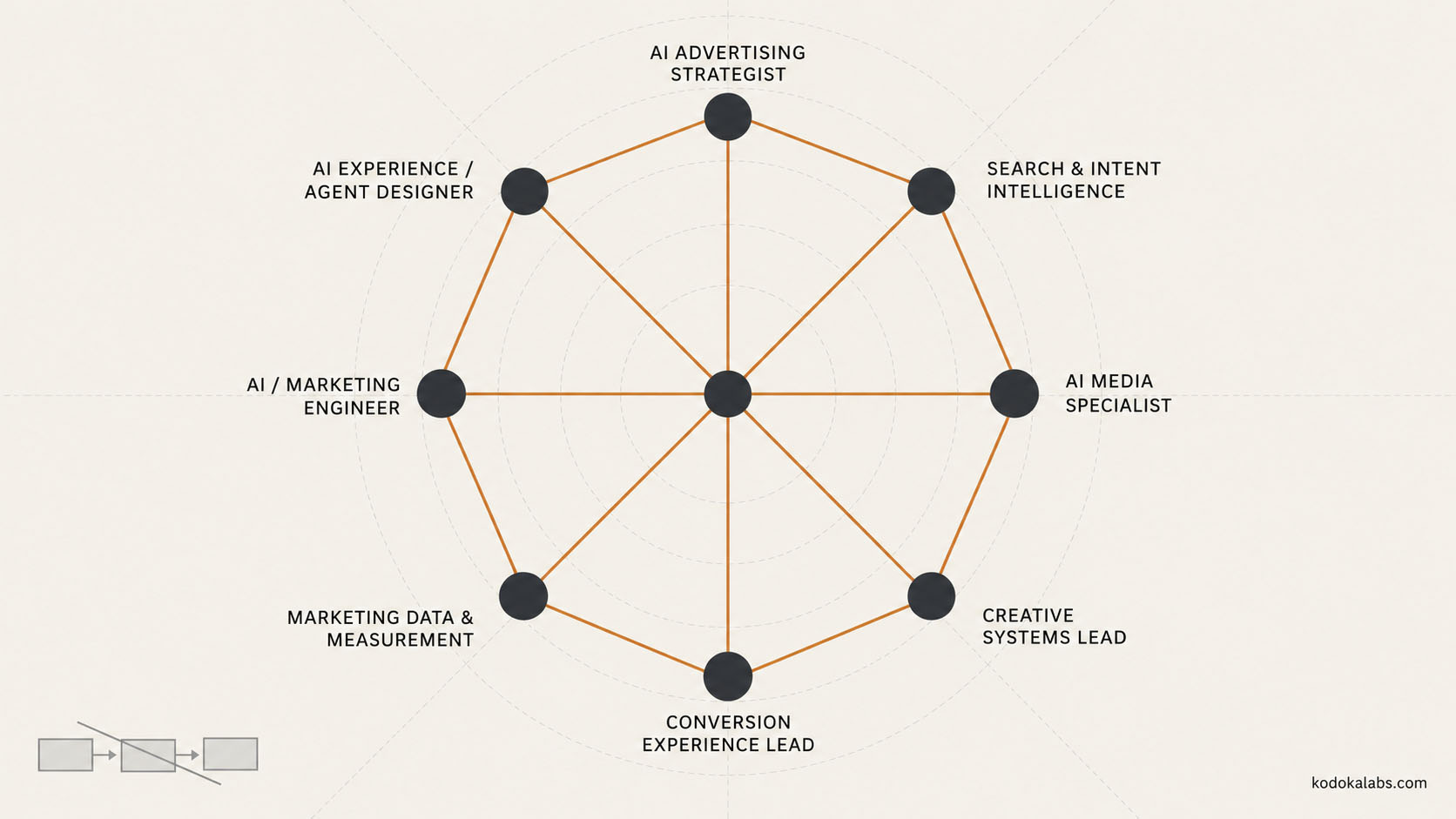
Rather than leaving this as an abstract principle, it helps to describe what a working team built around this logic might actually look like. We think of it as a pod: a small, cross-functional group that owns a commercial outcome together, rather than a chain of specialists handing work off to one another.
| Role | Owns | How it differs from today's version |
|---|---|---|
| AI Advertising Strategist | Commercial objectives, campaign architecture, offer strategy, prioritization, experimentation roadmap | Bridges client strategy and execution across every discipline in the pod, not just media |
| Search & Intent Intelligence Lead | Conversational demand research, query data, customer questions, entity relationships, context-hint development | The keyword researcher evolves into an intent intelligence specialist |
| AI Media Specialist | Campaign setup, ad groups, budgets, bidding, context hints, performance analysis | Closest to today's paid search specialist, but working inside a broader intelligence system |
| Creative Systems Lead | Headline systems, message variants, imagery, AI-supported creative production, testing | Builds reusable creative systems, not isolated one-off assets |
| Conversion Experience Lead | Landing pages, product pages, conversion journeys, message continuity after the click | Owns the conversational continuity of the experience, not just page-level CRO |
| Marketing Data & Measurement Lead | Pixel and event tracking, conversion APIs, attribution, CRM integration, incrementality | Builds a connected data layer rather than a channel-by-channel report |
| AI / Marketing Engineer | Advertiser APIs, automated campaign creation, product feeds, data pipelines, automated QA | Increasingly central as campaign management becomes programmable |
| AI Experience / Agent Designer | Sponsored-agent experiences, conversational flows, escalation logic, agent knowledge | An emerging role connecting advertising to the conversational product experience |
Not every organization needs eight dedicated people. Smaller teams will combine several of these responsibilities into fewer roles. Naming the capabilities explicitly, rather than leaving them implicit inside a single overloaded PPC role, makes it easier to staff deliberately and to notice gaps before they become a problem.
Operating as a Pod, Not a Handoff Chain
The traditional agency workflow moves in a fairly linear sequence: strategy hands off to media, media hands off to creative, creative results get analyzed, and a report eventually goes back to the client. Each handoff is a place where context gets lost and decisions get made by people who were not in the room when the original intent was set.
The model we are describing instead starts from a shared intelligence layer that every function draws from. It feeds into a genuinely cross-functional pod, where strategy, media, creative, data, and engineering work the same problem at the same time rather than in sequence, and treats experimentation as continuous rather than something that happens at the end of a campaign cycle.
The same group works toward one commercial outcome together. That tends to produce faster iteration and fewer moments where important customer or performance context fails to reach the person who needed it.
The New Agency Operating System
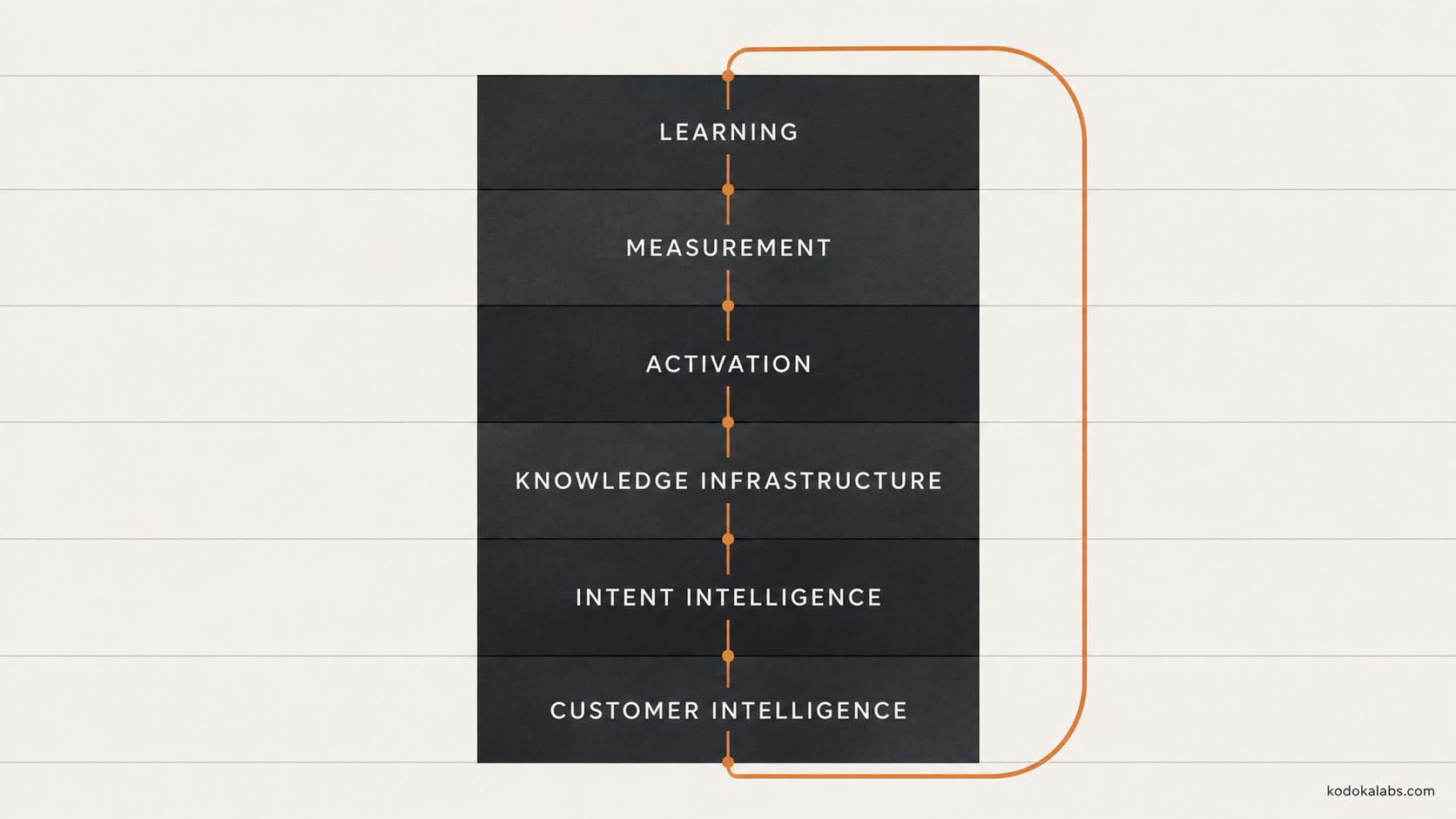
Zooming out from the team structure itself, it helps to think about the broader operating system a ChatGPT Ads pod needs to run inside. We organize this around six connected layers.
Layer 1, Customer Intelligence. Draws from CRM data, sales call notes, support tickets, Search Console, paid search query data, site search behavior, product analytics, and market research.
Layer 2, Intent Intelligence. Translates those raw signals into problems, use cases, decisions, comparison situations, objections, and buying stage.
Layer 3, Knowledge Infrastructure. Centralizes product information, current pricing, approved positioning language, customer evidence, FAQs, compliance rules, and brand guidelines, so every channel draws from the same source of truth.
Layer 4, Activation. Deploys that intelligence across ChatGPT Ads, Google Ads, Meta, organic search, broader AI visibility efforts, email, CRM outreach, and agent experiences.
Layer 5, Measurement. Functions as a central conversion architecture rather than a set of separate channel dashboards.
Layer 6, Learning. Feeds insights from every campaign back into the intelligence layer, so the system gets smarter over time instead of each campaign starting from scratch.
Why Paid Media and SEO Should Not Sit in Separate Departments
One of the stronger arguments for restructuring around capabilities becomes clear when you look at what SEO and paid advertising are actually trying to accomplish. Both disciplines, at their core, are answering the same question: what does this person want, and what information or offer best satisfies that need?
SEO approaches that question through query intelligence, entity understanding, content, landing-page relevance, and information architecture. Paid media approaches it through auction data, creative testing, conversion feedback, and a direct read on commercial intent. AI visibility work, tracking how a brand shows up in the questions people ask AI systems and the sources those systems cite, contributes yet another angle on the same underlying question.
Keeping these as separate research silos means each team is independently answering a version of the same question with only part of the available evidence. Bringing them together into a single search and AI intelligence function, rather than maintaining a walled-off SEO team and a walled-off PPC team, gives the organization a fuller, more consistent picture of what customers want, one it can act on consistently across every surface where that demand shows up. Our own Search Intelligence work is built around exactly this logic.
Creative Production Becomes a System
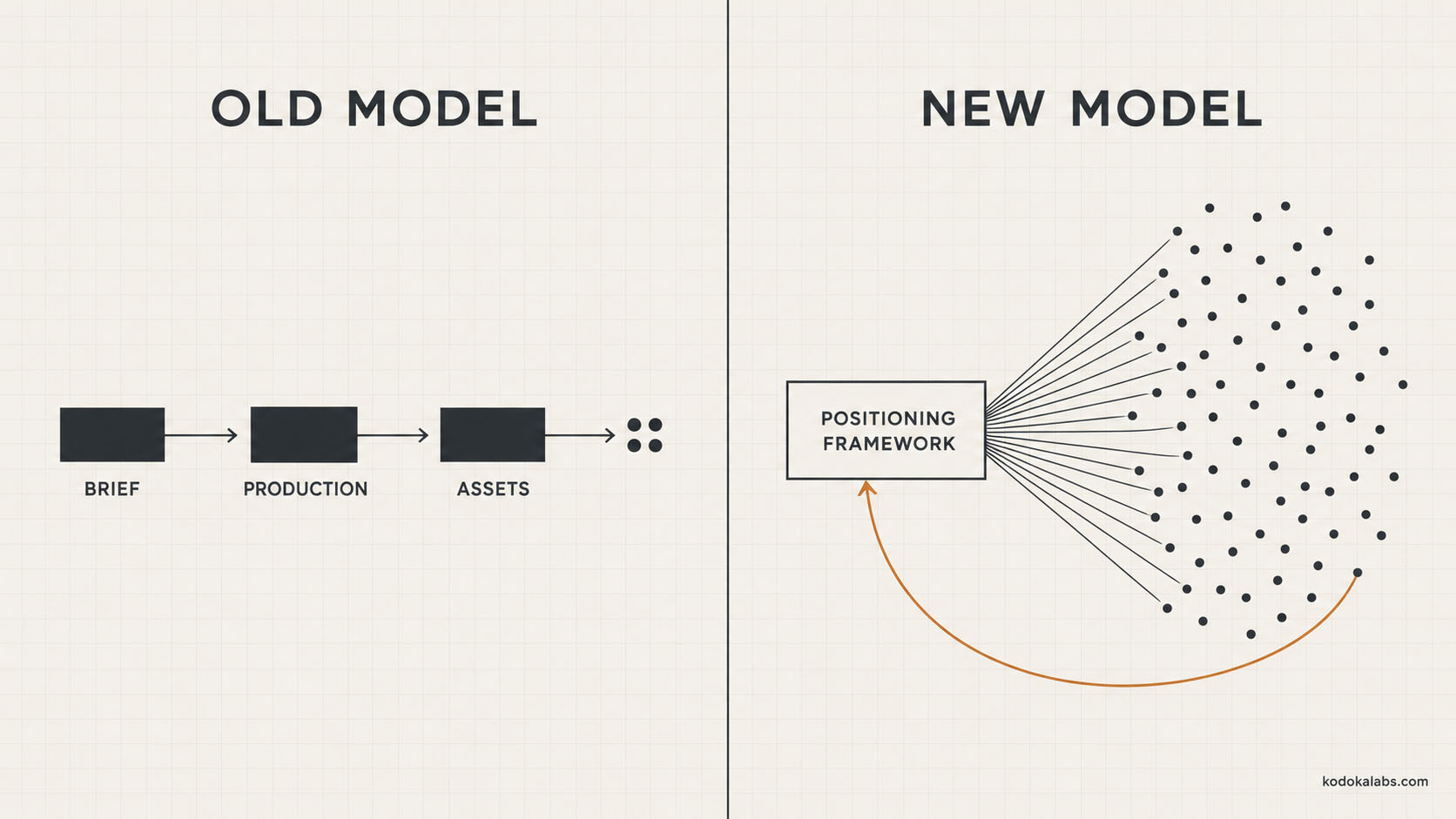
The old creative workflow was fairly linear: a campaign brief goes to a designer and a copywriter, who produce a set of assets for that specific campaign. That model made sense when producing each asset was expensive and slow, and the number of variations any team could realistically test was small.
AI has changed the economics of producing creative variants. The scarce resource is no longer the ability to write another headline or generate another image. It has shifted toward positioning judgment, originality, brand consistency, and governance over what gets approved for use.
| Old model | New model |
|---|---|
| Campaign brief → designer → copywriter → assets | Positioning framework → approved claims → creative system → large variation set → performance feedback |
| Production is the bottleneck | Judgment and governance are the bottleneck |
| A handful of assets tested per campaign | Many variations generated and tested continuously |
The work that matters most moves upstream, into deciding what the brand should credibly say and staying disciplined about it, rather than downstream into producing individual assets one at a time.
The Landing Page Is Part of the ChatGPT Ads System
Landing pages are commonly treated as a web production deliverable, handed off to a separate team once the media plan is locked. We think that separation does not serve organizations well in a conversational advertising context.
The following need to be treated as core parts of the advertising system, not downstream concerns owned by a different team with different priorities:
- Semantic relevance to the conversation that led someone there.
- Clear, accurate product information and well-structured content.
- Page speed and deliberate crawler access decisions.
- Consistency between what the ad promised and what the page delivers.
- A genuinely well-designed conversion experience.
- Continuity with the conversational context that brought the visitor there.
SEO, conversion optimization, content, and paid media need to be looking at the same destination experience together, not negotiating over it after the fact.
Measurement Has to Move Beyond the Media Dashboard
A media dashboard that only shows impressions, clicks, and cost per click is not sufficient for an environment where the path from ad exposure to revenue runs through several more steps: exposure, click, on-site behavior, conversion, entry into a CRM, and eventual revenue recognition.
Getting a clear view of that full path requires connected infrastructure: tracking pixels, conversion APIs, a CRM that talks to the rest of the stack, an analytics platform, potentially a data warehouse, and an attribution layer that can make sense of the whole journey rather than just the first or last touch.
As campaign management becomes more programmable, driven by APIs rather than manual dashboard adjustments, reporting and optimization need to become part of that same unified data layer instead of living in a separate reporting tool that gets checked once a week.
What Happens to Existing Agency Roles
A natural worry when describing this kind of shift is that it sounds like a list of job losses. We do not think that is the right way to read it. The more accurate description is convergence and expansion, not disappearance.
| Current role | Emerging role |
|---|---|
| PPC Specialist | AI Media Specialist |
| Keyword Researcher | Intent Intelligence Analyst |
| SEO Specialist | Search & AI Intelligence Specialist |
| Copywriter | Creative Systems Strategist |
| Media Planner | Growth Systems Strategist |
| Web Analyst | Marketing Intelligence Engineer |
| Marketing Technologist | AI Marketing Engineer |
| CRO Specialist | Conversational Experience Lead |
| Account Director | Transformation / Growth Partner |
What the Agency of 2030 May Look Like
If this trajectory continues, we expect the agency structure of the next several years to look meaningfully different from today’s channel-based org chart.
A client growth partner sits at the top of the relationship, supported by an AI growth pod containing strategy, intelligence, media, creative, experience, data, and engineering working together rather than in sequence. That pod draws on centralized AI infrastructure, governance frameworks, shared knowledge systems, automation, and research capability that do not need to be rebuilt for every client engagement.
The result is an organization with far fewer channel silos and far more reusable systems, where the value an agency provides comes from the strength of its underlying infrastructure and judgment rather than the size of its execution headcount.
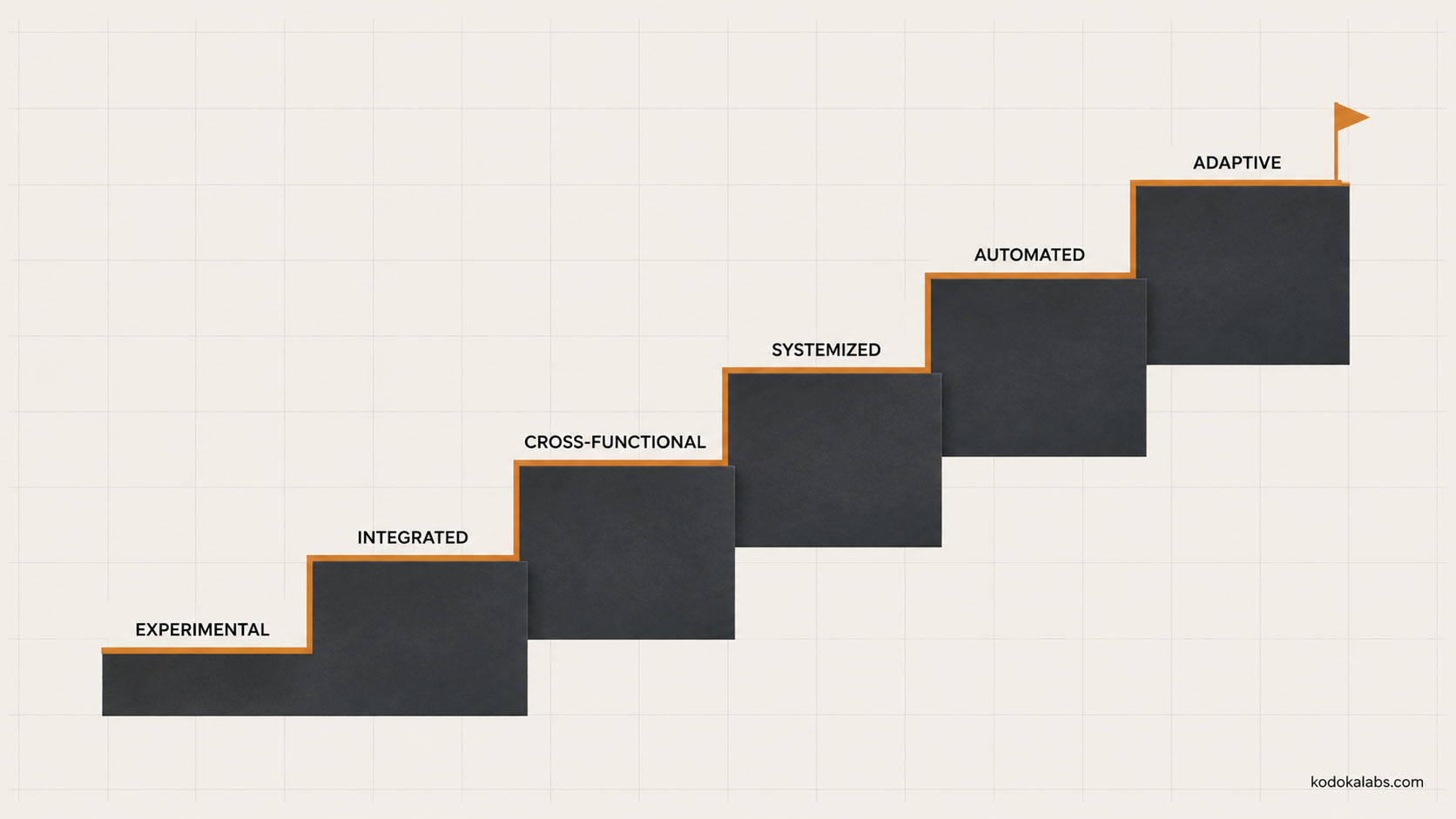
A simple maturity model helps place where a given organization sits today:
| Current role | Emerging role |
|---|---|
| PPC Specialist | AI Media Specialist |
| Keyword Researcher | Intent Intelligence Analyst |
| SEO Specialist | Search & AI Intelligence Specialist |
| Copywriter | Creative Systems Strategist |
| Media Planner | Growth Systems Strategist |
| Web Analyst | Marketing Intelligence Engineer |
| Marketing Technologist | AI Marketing Engineer |
| CRO Specialist | Conversational Experience Lead |
| Account Director | Transformation / Growth Partner |
The Economics of the Agency Model Are Changing Too
AI is reducing the cost of reporting, campaign construction, creative variant production, research, analysis, quality assurance, and a good share of routine optimization work. That has a direct implication for how agencies justify their fees.
A model built primarily around hours and execution volume becomes harder to defend when a meaningful share of that execution can be done faster and more cheaply with AI assistance. The value that remains scarce, and that clients will pay for, shifts toward proprietary intelligence, strategic judgment, system architecture, disciplined experimentation, technology integration, governance, and demonstrated business outcomes rather than hours logged.
This connects to a broader argument we make across our own work: a good engagement should build durable capability inside a client’s organization, not create permanent dependence on an external team to execute forever. That is the same principle behind our AI Marketing Operating System and AI Capability Academy work.
What Agencies and Marketing Teams Should Build Now
A practical roadmap is more useful than abstract principle.
- Combine SEO and paid-search intelligence into one shared demand and intent dataset, rather than two separate research efforts drawing different conclusions.
- Establish a real customer knowledge layer that connects research, CRM data, and product information in one place.
- Build reusable creative systems, moving away from individual ads toward genuine message architecture.
- Invest in conversion infrastructure, tracking, CRM integration, and analytics that actually connect to one another.
- Add real engineering capability. APIs and automation will only become more central to how campaigns are built and managed.
- Build a cross-functional AI advertising pod, rather than standing up another isolated department.
- Run controlled ChatGPT Ads experiments, documenting a clear hypothesis, audience intent, message, experience, outcome, and learning for each one.
- Feed what is learned back into SEO, content, and product strategy, treating advertising as a continuous source of intelligence rather than a self-contained activity that ends when the campaign does.
The Bigger Change Underneath All of This
The future agency, and the future internal marketing team, may increasingly stop selling people multiplied by hours multiplied by channels, and start providing intelligence, systems, technology, and human judgment working together.
ChatGPT Ads are interesting not simply because they represent another source of ad inventory to buy. They are an early, visible signal of what happens when advertising itself becomes AI-native, when targeting, creative, measurement, and optimization are increasingly mediated by AI systems rather than manually configured inside one platform’s interface.
The organizations that adapt well to this shift are unlikely to be defined by the size of their paid media department. They are more likely to be the ones that build the strongest connected system across customer intelligence, AI, creative, data, and execution, and that take organizational design as seriously as they take media strategy itself.
Frequently Asked Questions
Should ChatGPT Ads be run by our existing PPC team?
A PPC team can run the media mechanics, but ChatGPT Ads span intent research, creative systems, conversion experience, and data engineering as well. The most reliable approach is a small cross-functional pod, not a single specialist absorbing the whole scope.
Do we need to hire eight new people to run ChatGPT Ads well?
No. The eight roles in the ChatGPT Ads pod describe capabilities, not headcount. Smaller teams combine several of these responsibilities into fewer people; the important step is naming the capabilities explicitly so nothing gets silently dropped.
Will ChatGPT Ads replace SEO or traditional paid search?
No. This guide treats ChatGPT Ads as an additional, structurally different surface that benefits from the same underlying intent and entity intelligence that SEO and paid search already rely on, not a replacement for either.
What is the single most important first step for a team starting from a channel-based structure?
Combine SEO and paid-search intelligence into one shared demand and intent dataset first. Most of the other changes described in this guide become easier once that shared foundation exists.
How does this connect to kōdōkalabs' own approach?
This is the same operating logic behind our AI Marketing Operating System and Search Intelligence work: connect intelligence, activation, and measurement into one governed system rather than treating each channel as an island.
Is this guide describing a confirmed product roadmap for ChatGPT Ads?
No. This guide is a strategic and organizational perspective on how conversational advertising is likely to change team structure, based on how the surface behaves and how comparable shifts have played out before. Treat platform-specific mechanics as subject to change and verify current details directly with the platform before making binding commitments.
Contextual Solution Pathways
kōdōkalabs helps marketing organizations redesign the workflows, knowledge infrastructure, and AI systems required to operate across search, content, advertising, and emerging AI channels as one connected system, through the AI Marketing Operating System.