
AI Marketing Transformation Roadmap for Mid-Market Companies
AI Marketing Transformation Roadmap for Mid-Market Companies
Executive Summary
An AI marketing transformation roadmap is a phased plan that connects business priorities, workflow redesign, governance, technology, capability development, and measurement. Mid-market companies typically start in the wrong place — buying tools or launching disconnected pilots — because they lack a sequence for what to do first. This guide lays out a six-phase model, a practical first-90-days plan, and a method for prioritizing which AI use cases to pilot first. It does not promise a universal timeline or ROI figure; the right pace depends on organizational complexity, but the sequence — diagnose, architect, build, enable, measure, scale — holds regardless of size.
What Is an AI Marketing Transformation Roadmap?
An AI marketing transformation roadmap is a phased plan that connects business priorities, workflow redesign, governance, technology, capability development, and measurement. It is not the same thing as a list of AI tools to purchase, an innovation backlog of experimental ideas, a technology implementation plan owned by IT, an AI acceptable-use policy, or a company restructuring plan. Each of those may be a component or output of a roadmap, but none of them, on its own, sequences the work required to get from fragmented experimentation to a governed, measurable operating model.
The distinction matters in practice. A tool list answers “what should we buy.” An innovation backlog answers “what could we try.” A technology implementation plan answers “how do we deploy this system.” A policy answers “what’s allowed.” None of these answer the question a roadmap has to answer: in what order should a marketing organization move from where it is today to a governed, measurable AI-native operating model, and what has to be true at each step before the next one can succeed. A roadmap is the connective sequence, not any single deliverable inside it.
Why Mid-Market Companies Need a Different Roadmap
Enterprise transformation playbooks generally assume dedicated transformation teams, large specialist budgets, and multi-year timelines. Mid-market companies operate under different constraints:
- Limited transformation capacity – few or no employees whose full-time job is managing this transition.
- Complex enough operations for transformation to matter – multiple products, markets, or business units, unlike a very small company where informal coordination still works.
- Fewer specialist resources than enterprises – less in-house AI, data science, or change-management expertise to draw on.
- Faster decision cycles – leadership can typically approve and redirect a roadmap in weeks, not the quarters an enterprise governance process might require.
- High dependence on agencies and individual employees – institutional knowledge is more concentrated in fewer people and outside vendors, raising both opportunity and risk.
- Fragmented data and technology stacks – often accumulated through years of ad hoc purchasing rather than a deliberate architecture.
A mid-market roadmap needs to be leaner and faster to show value than an enterprise playbook, while still not skipping the foundational work that makes later phases succeed. This creates a real tension: move too slowly and the roadmap loses executive attention and budget before it produces evidence; move too quickly and skip Diagnose or governance design, and the resulting workflows repeat the same fragmentation the roadmap was meant to fix, just faster. The six-phase sequence below is designed specifically to resolve that tension — fast enough to show evidence within a single quarter, thorough enough that each phase’s output is trustworthy.
What Must Be Defined Before the Roadmap Begins
Before sequencing specific activities, leadership should have clarity on:
- Business priorities – which commercial goals the transformation is meant to serve.
- ICP and customer journey – who the organization is trying to reach and influence, and how.
- Strategic constraints – budget, timeline, and organizational appetite for change.
- Executive sponsorship – a named, accountable senior sponsor, not a diffuse initiative.
- Existing processes – a realistic view of how work currently gets done, not the idealized version.
- Data and knowledge sources – what’s available, and in what condition, to inform AI-assisted workflows.
- Acceptable risk – the organization’s tolerance for experimentation versus caution, particularly in regulated categories.
- Available capability – what skills currently exist internally versus what needs to be built or brought in.
- Baseline metrics – a documented starting point, without which progress can’t be demonstrated later.
The Six-Phase Roadmap
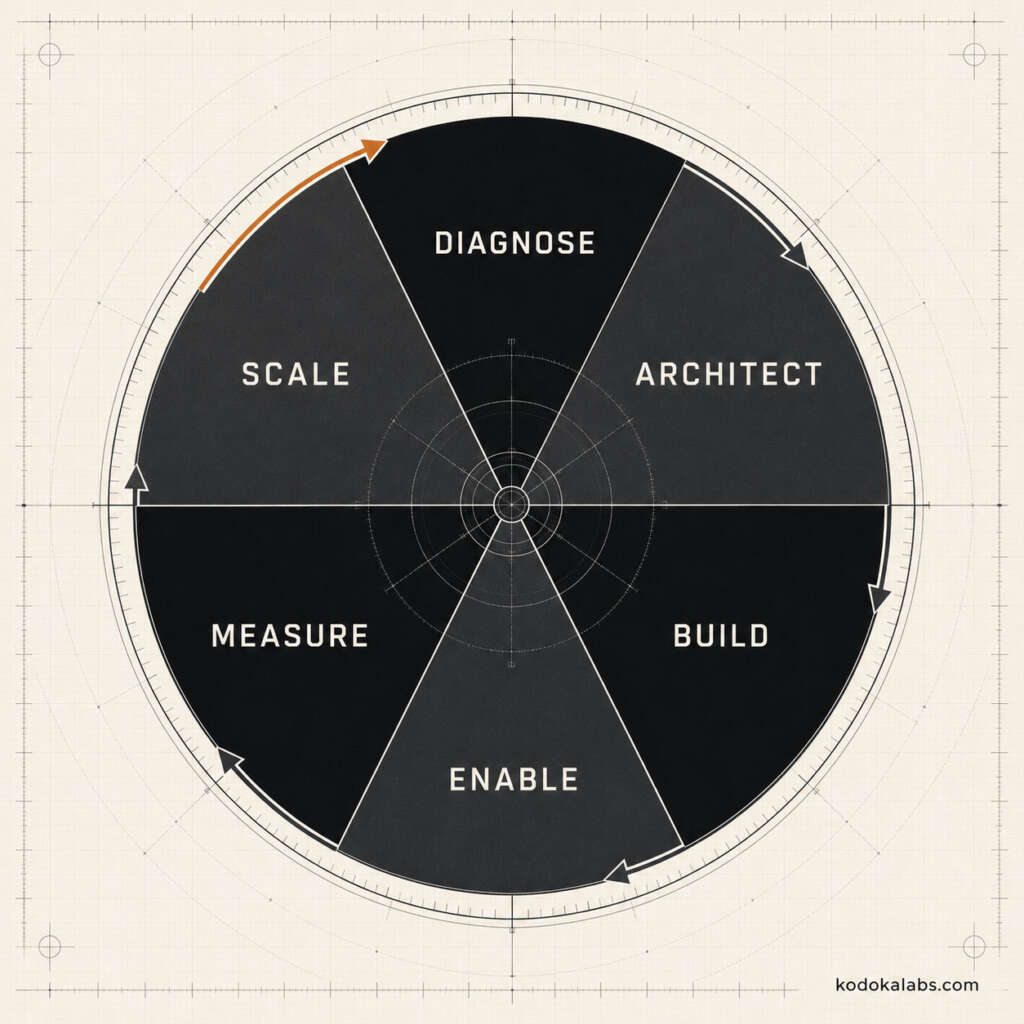
Phase 1: Diagnose
Include a maturity assessment, workflow inventory, tool and data audit, governance review, capability analysis, and commercial opportunity mapping. Output: a prioritized transformation baseline.
This phase exists to replace assumption with evidence before any resourcing decision gets made. A workflow inventory alone often surprises leadership — the gap between how a process is documented (if it’s documented at all) and how it’s actually performed day to day is usually larger than expected, and that gap is precisely what later phases need to design around.
Phase 2: Architect
Define the future-state operating model, select specific use cases, specify workflows, design the knowledge architecture and human-review points, and define governance and KPIs. Output: an implementation blueprint.
Architect is where the roadmap moves from analysis to design. The use cases selected here should come directly from the prioritization method described later in this guide, not from whichever idea generated the most internal enthusiasm — enthusiasm is a poor predictor of which pilot will actually produce fast, measurable evidence.
Phase 3: Build
Build a prototype, integrations, prompt specifications, and any agents required; define validation criteria; document the workflow; run it in a controlled environment. Output: a production-ready pilot.
Build should happen in a controlled environment specifically so that early quality issues surface on a small, contained scope rather than in front of a broader audience. Documentation written during this phase becomes the foundation for Enable — a workflow that isn’t documented as it’s built has to be redocumented later, usually less accurately.
Phase 4: Enable
Deliver role-based training, manager enablement, usage standards, and operating manuals; transfer ownership to the internal team; capture employee feedback. Output: a capable internal operating team.
Enable works best when the people being trained were already involved in Build, piloting the workflow rather than encountering it for the first time in a training session. Employee feedback captured here should feed directly back into workflow refinement, not just be logged and set aside.
Phase 5: Measure
Track efficiency, quality, reliability, adoption, commercial contribution, risk, and qualitative feedback. Output: an evidence-based decision on whether to scale.
The decision at the end of this phase should be explicit: scale, adjust and re-test, or stop. Treating every pilot as automatically successful because it was completed, rather than evaluating it honestly against the baseline, is one of the fastest ways a roadmap loses credibility with leadership.
Phase 6: Scale
Replicate proven workflows, build shared infrastructure, extend standards and governance, consolidate vendors, and manage the growing portfolio of AI-assisted workflows. Output: a repeatable transformation system.
Scaling should extend what Measure actually proved worked, into new scope that gets its own lightweight diagnosis rather than an assumption that the original design transfers automatically. A workflow proven in one market or product line doesn’t necessarily transfer cleanly to another without adjustment.
Phase
Executive Question
Required Inputs
Key Risk
Suitable KPI
Diagnose
Architect
Build
Enable
Measure
Scale
The First 90 Days
Days
Focus
Key Activities
1–30
31–60
61–90
How to Prioritize AI Marketing Use Cases
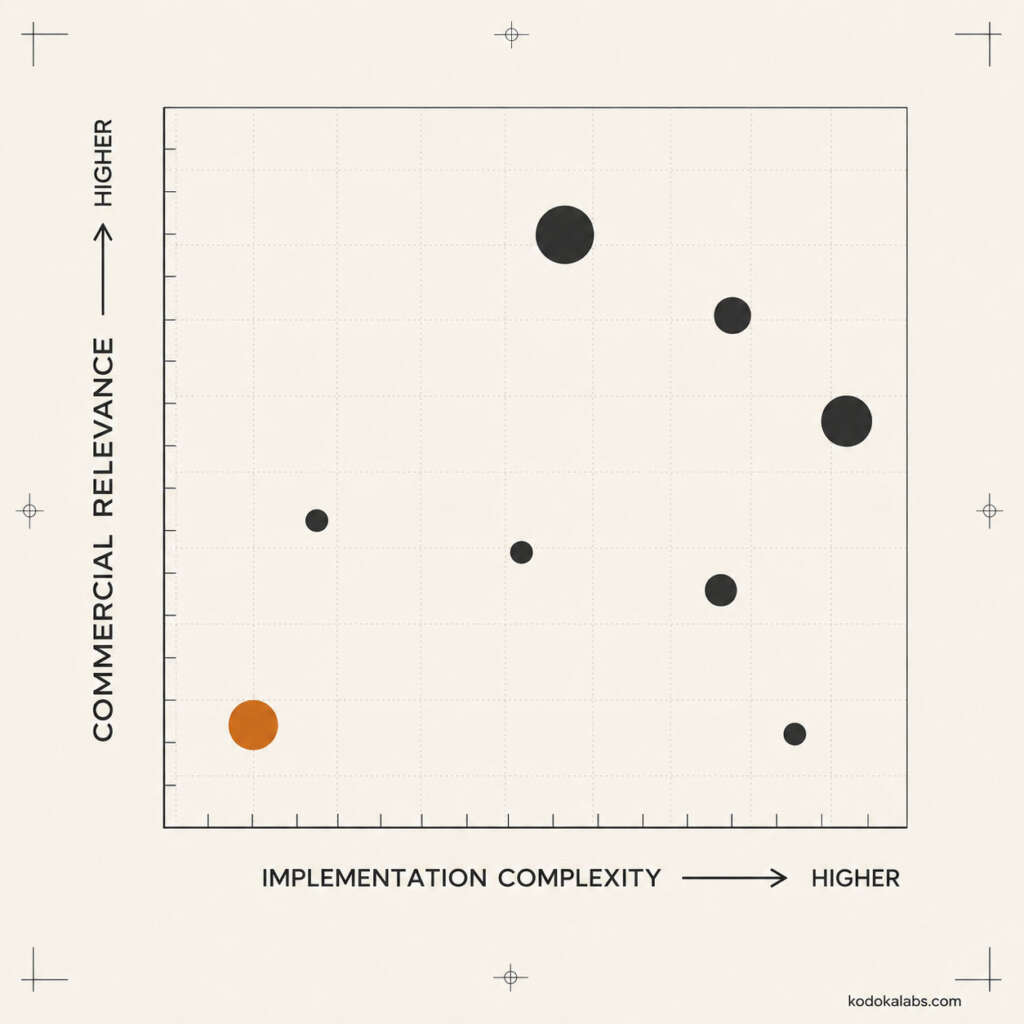
Common early-stage use case candidates include: research synthesis, content briefing, editorial QA, SEO issue triage, sales meeting preparation, campaign reporting, customer feedback analysis, and knowledge retrieval. These tend to score well because they’re high-frequency, well-understood, low-risk to reverse, and produce measurable evidence quickly – the combination that makes a strong first pilot, rather than necessarily being the highest-commercial-value use case available.
This last point is worth emphasizing because it runs counter to how many organizations naturally want to prioritize. The instinct is often to point AI at the highest-value, highest-visibility problem first, to prove impact quickly. In practice, high-value use cases are frequently also high-complexity and high-risk, which means they take longer to validate and carry more downside if the pilot goes wrong. Starting with a lower-risk, faster-to-validate use case builds the evidence, governance muscle, and organizational confidence needed to tackle the higher-value, higher-risk use cases later, with a track record behind the request rather than a leap of faith.
Governance Across the Roadmap
Governance shouldn’t appear only once, at the end, as a compliance checkbox. It should evolve deliberately across the roadmap: interim, lightweight guardrails during Diagnose and early Architect (to allow safe experimentation), a formal governance design during Architect, real-world testing of that governance during Build, training on it during Enable, ongoing monitoring during Measure, and expansion of governance scope during Scale. Full detail on the governance structure itself is covered in the AI Governance for Marketing guide.
Interim guardrails matter more than they might seem at first glance. Without them, the period between “leadership has decided to pursue AI transformation” and “formal governance is designed” becomes a window of ungoverned experimentation, often the exact period when employees are most enthusiastic about trying new AI-assisted approaches. A short, simple set of interim rules — what data can’t be entered into which tools, what still requires human review regardless of category — closes that window without waiting for the full governance design to be finished.
Roadmap Roles and Decision Rights
Role
Responsibility
Executive sponsor
Transformation owner
Marketing operations
Domain experts
IT and data
Legal or compliance
External partner
Workflow owner
Not every organization has, or wants, a full-time transformation owner. Where that’s the case, a Fractional AI Growth Director can hold this role on an ongoing basis, providing the senior judgment a roadmap needs — particularly for the Measure and Scale phases, which continue indefinitely rather than ending at a delivery date — without the cost or hiring risk of a full-time executive search.
Budgeting the Roadmap
Budget should be planned across categories rather than as a single lump sum, without assuming specific prices, which vary widely by scope and vendor:
- Diagnosis – the initial assessment and baseline.
- Architecture – operating-model and workflow design.
- Implementation – building and testing pilot workflows.
- Software – AI tools and platform licensing.
- Integration – connecting AI workflows to existing systems.
- Training – enablement and certification.
- Maintenance – ongoing workflow and governance upkeep.
- Measurement – analytics and reporting infrastructure.
- Change management – communication and adoption support.
Under-budgeting change management is one of the most common mistakes across these categories. Organizations readily allocate budget for software and implementation, since those are visible and easy to scope, and then treat communication and training as something that happens informally, on top of everyone’s existing workload. This is a large part of why technically successful pilots often fail to achieve broad adoption – the workflow works, but nobody outside the pilot team was given the time or context to adopt it.
Maintenance is a similarly overlooked category. A workflow that isn’t revisited after go-live tends to drift – the underlying AI models change, the organization’s content needs evolve, and small quality issues accumulate unnoticed if nobody has explicit time budgeted to keep it current.
How to Measure Roadmap Progress
Roadmap progress should be tracked across five distinct categories, kept separate rather than blended into one number: activity (what’s been done), adoption (who’s using the new workflows), operational performance (quality and efficiency of output), business outcomes (commercial impact), and capability growth (internal team’s independent ownership). Conflating these categories is one of the most common ways roadmap reporting becomes misleading — high activity with low adoption, for example, usually means a workflow was built but never actually integrated into daily work.
Common Roadmap Failures
- Selecting tools before defining any specific use case. This forces workflows to bend around whatever the tool assumes, rather than choosing technology to fit a clearly defined process.
- Attempting too many pilots simultaneously. Spreading limited transformation capacity across five pilots usually produces five mediocre results instead of one or two that actually prove the model works.
- Skipping the Diagnose phase and designing against assumptions. Assumptions about maturity tend to be optimistic exactly where the real gaps are, particularly around governance and knowledge quality.
- Treating the first 90 days as the entire transformation rather than a foundation period, which sets unrealistic expectations and makes normal, ongoing work in Measure and Scale look like failure by comparison.
- No defined decision gate for whether a pilot should scale, stall, or stop. Without one, pilots tend to continue indefinitely regardless of whether they’re actually working, because nobody has explicit authority to end them.
- Governance introduced only after a problem occurs, rather than designed in from Architect onward — reactive governance is both more disruptive to implement and less trusted by the team than governance built in from the start.
- No budget category for change management, leaving adoption entirely to chance, as covered above.
- Leaving ownership with an external partner indefinitely, with no capability-transfer plan, recreating the dependency the roadmap was meant to reduce.
Roadmap Readiness Checklist
- [ ] Do we have a named, accountable executive sponsor?
- [ ] Have we run a structured maturity diagnosis, or are we estimating informally?
- [ ] Have we selected our first use cases using a defined prioritization method?
- [ ] Do we have interim governance guardrails in place before piloting?
- [ ] Is our first-90-days plan realistic given our current capacity?
- [ ] Have we defined a decision gate for each phase?
- [ ] Do we have baseline metrics documented before starting?
- [ ] Have we allocated budget across all nine categories, not just software?
- [ ] Is there a named transformation owner responsible for day-to-day coordination?
- [ ] Have IT, legal, and compliance stakeholders been looped in appropriately?
- [ ] Do we have a plan for training and certifying the internal team?
- [ ] Have we defined how external partners will transfer ownership over time?
- [ ] Do we have a reporting cadence that separates activity from outcomes?
- [ ] Have we planned for Scale, or are we only thinking about the first pilot?
- [ ] Have we asked the team who will actually run these workflows for their input?
Frequently Asked Questions
01 How long does AI marketing transformation take?
02 What should be implemented first?
03 Should a company choose tools before creating the roadmap?
04 Who should own the roadmap?
05 How many use cases should be piloted?
06 How should pilot value be measured?
07 When should a pilot be stopped?
08 How should governance be included?
As interim guardrails from day one, formalized during Architect, tested during Build, and taught during Enable — not introduced only after a problem has already occurred.
09 Does transformation require new hires?
Not necessarily at the outset. Many organizations start by reallocating and training existing marketing operations capacity, adding specialized roles later as scale and complexity justify them.