
AI Marketing Maturity Model for Readiness and Transformation
AI Marketing Maturity Model: How to Assess Readiness and Progress
Executive Summary
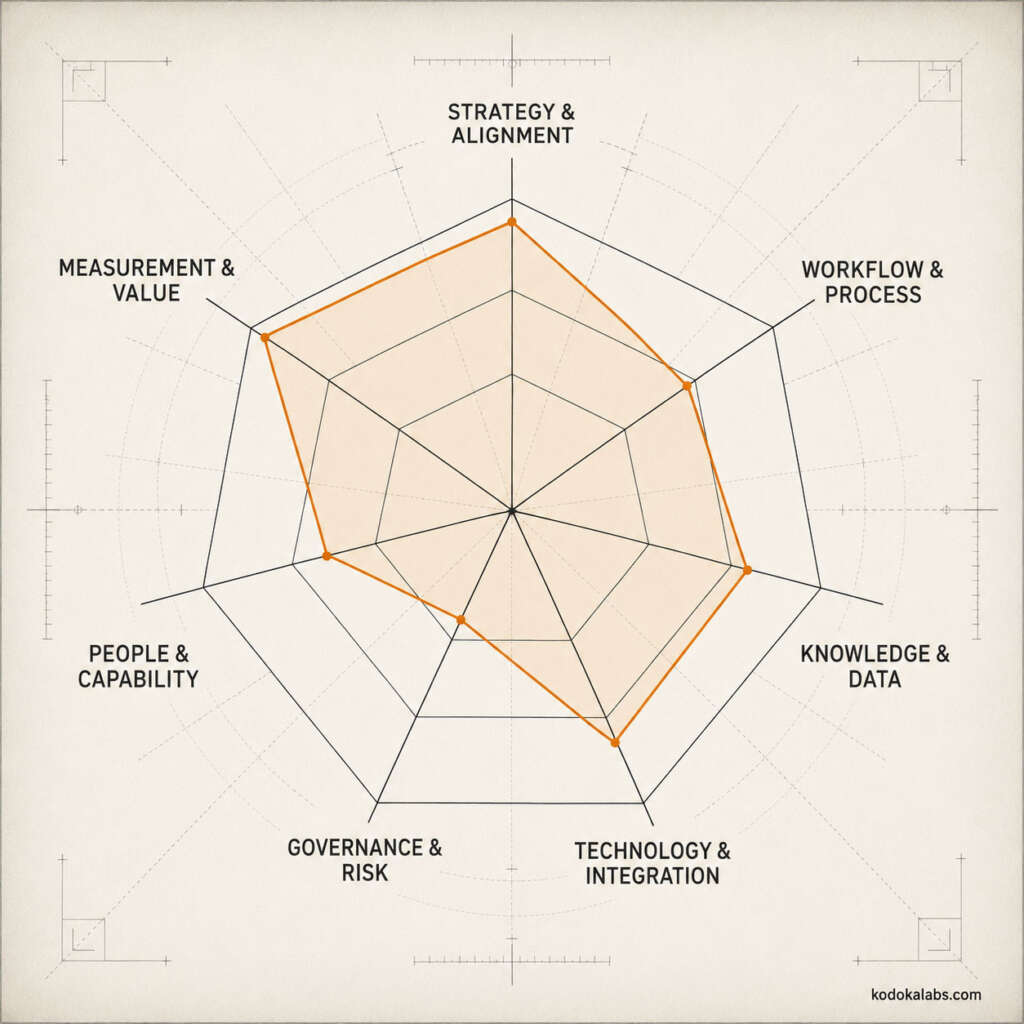
An AI marketing maturity model is a structured framework for assessing how far a marketing organization has progressed from ad hoc AI tool usage toward a governed, measurable, AI-native operating model. Tool usage alone is a poor proxy for maturity – two organizations with identical AI adoption rates can sit at very different maturity levels once workflow design, governance, knowledge quality, and measurement are accounted for. kōdōkalabs’ model scores organizations across seven dimensions — strategy, workflow, knowledge, technology, governance, people, and measurement — and places them on a seven-stage progression from Unstructured Awareness to Adaptive AI-Native Organization. Maturity is rarely even: most organizations score higher on some dimensions than others, and understanding that imbalance is often more useful than a single composite score.
Key Takeaways:
- Maturity is not the same as AI tool usage or technology spend.
- Seven dimensions must be scored independently, not averaged into one number.
- Seven stages describe the progression from unstructured activity to an adaptive, AI-native organization.
- Maturity commonly varies across functions and teams within the same organization.
- Scoring should be evidence-based, not a self-reported impression.
What Is an AI Marketing Maturity Model?
An AI marketing maturity model is a structured framework for assessing how far a marketing organization has progressed from unstructured, individual AI tool usage toward a governed, measurable, AI-native operating model. It exists because organizations consistently overestimate their own maturity when the only evidence available is “our people use AI tools” — a true statement that says almost nothing about whether that usage is governed, consistent, or connected to measurable business value.
kōdōkalabs’ AI Marketing Maturity Model is a proprietary assessment methodology, not a universal industry standard. It’s designed to function both as a standalone diagnostic guide and as the conceptual foundation for an interactive assessment tool, so an organization can move from reading about the model to receiving a scored, personalized result.
The model exists to answer a specific, recurring question from marketing leaders: “are we behind?” That question is usually unanswerable in the abstract, because “behind” implies a benchmark, and public AI-adoption benchmarks tend to measure activity — how many employees have used a generative AI tool at least once — rather than the structural conditions that determine whether that activity compounds into a durable capability. A maturity model reframes the question from “are we behind on adoption” to “which of the seven underlying conditions are missing, and in what order should we address them.” That reframing is what makes the model actionable rather than merely descriptive.
Why Tool Usage Is Not the Same as Maturity
Tool usage measures whether employees have access to AI and choose to use it. Maturity measures whether that usage sits inside a governed, documented, measured system. An organization can have high tool usage and low maturity — every employee using a generative AI assistant daily, with no shared prompt standards, no governance, and no way to know whether output quality is improving. The reverse is also possible: an organization with a smaller number of tightly governed, well-documented AI-assisted workflows can be meaningfully more mature than one where usage is broader but entirely ungoverned.
This is precisely why the model scores seven separate dimensions rather than producing a single “AI adoption” percentage. A single number would hide exactly the imbalance — high technology adoption paired with low governance, for example — that tends to create the greatest organizational risk.
The Seven Dimensions of AI Marketing Maturity
- Strategy and executive alignment – whether AI initiatives connect to defined business priorities with clear executive ownership.
- Workflow and process design – whether AI-assisted work happens through documented, repeatable processes or ad hoc individual effort.
- Knowledge and data readiness – whether the organization’s brand, product, and performance knowledge is structured and accessible enough for AI systems to draw on accurately.
- Technology and integration – whether AI tools are integrated into existing systems and workflows, or used as disconnected point solutions.
- Governance and risk – whether AI usage is governed by defined risk classification and review requirements.
- People and capability – whether the team has the skills to direct, review, and improve AI-assisted work, and whether that capability is documented and transferable.
- Measurement and value realization – whether the organization can demonstrate, with evidence, that AI-assisted work is producing better outcomes than what it replaced.
The Seven Stages of AI Marketing Maturity
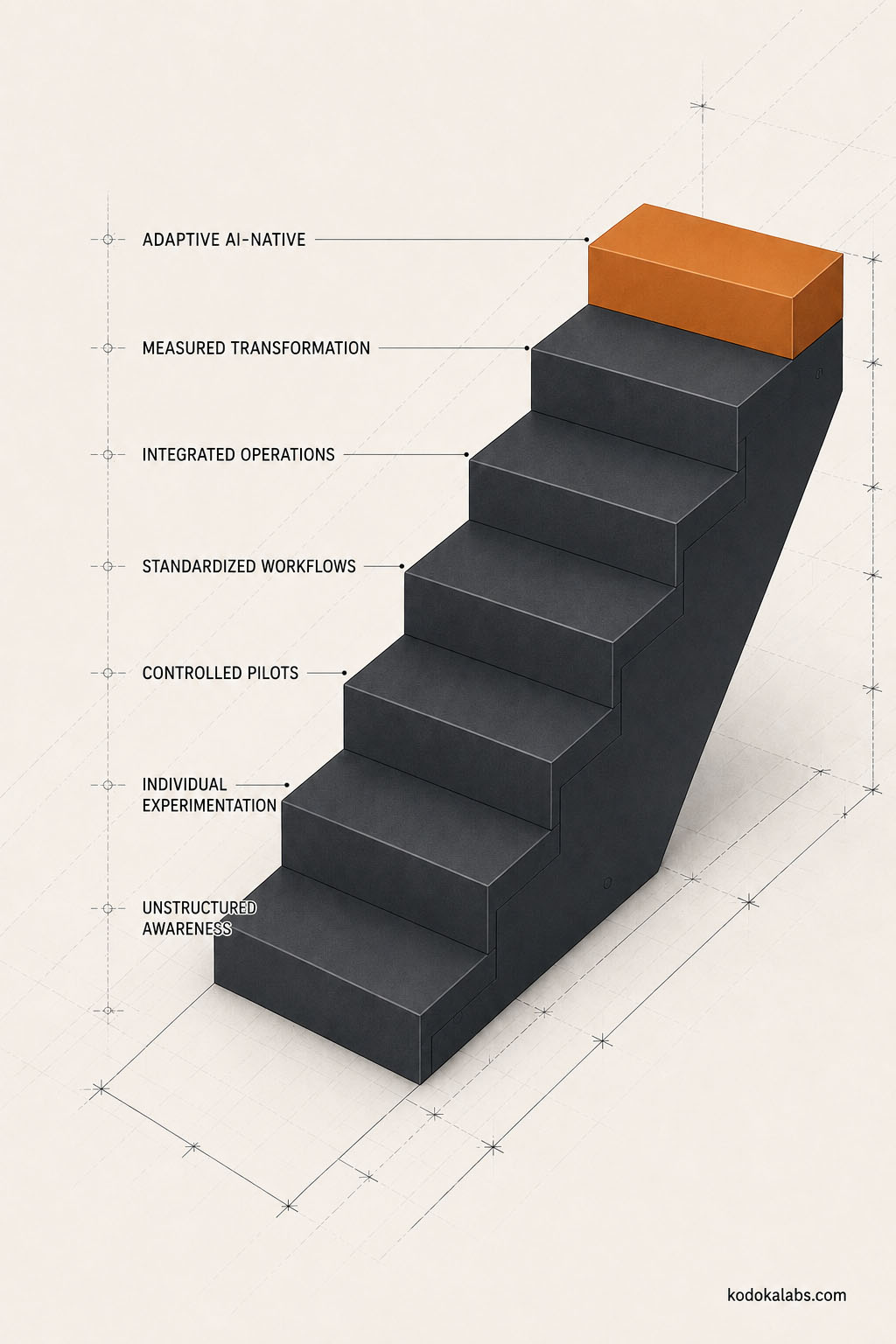
Stage 1: Unstructured Awareness
Stage 2: Individual Experimentation
Stage 3: Controlled Pilots
Stage 4: Standardized Workflows
Stage 5: Integrated Operations
Stage 6: Measured Transformation
Stage 7: Adaptive AI-Native Organization
AI Marketing Maturity Matrix
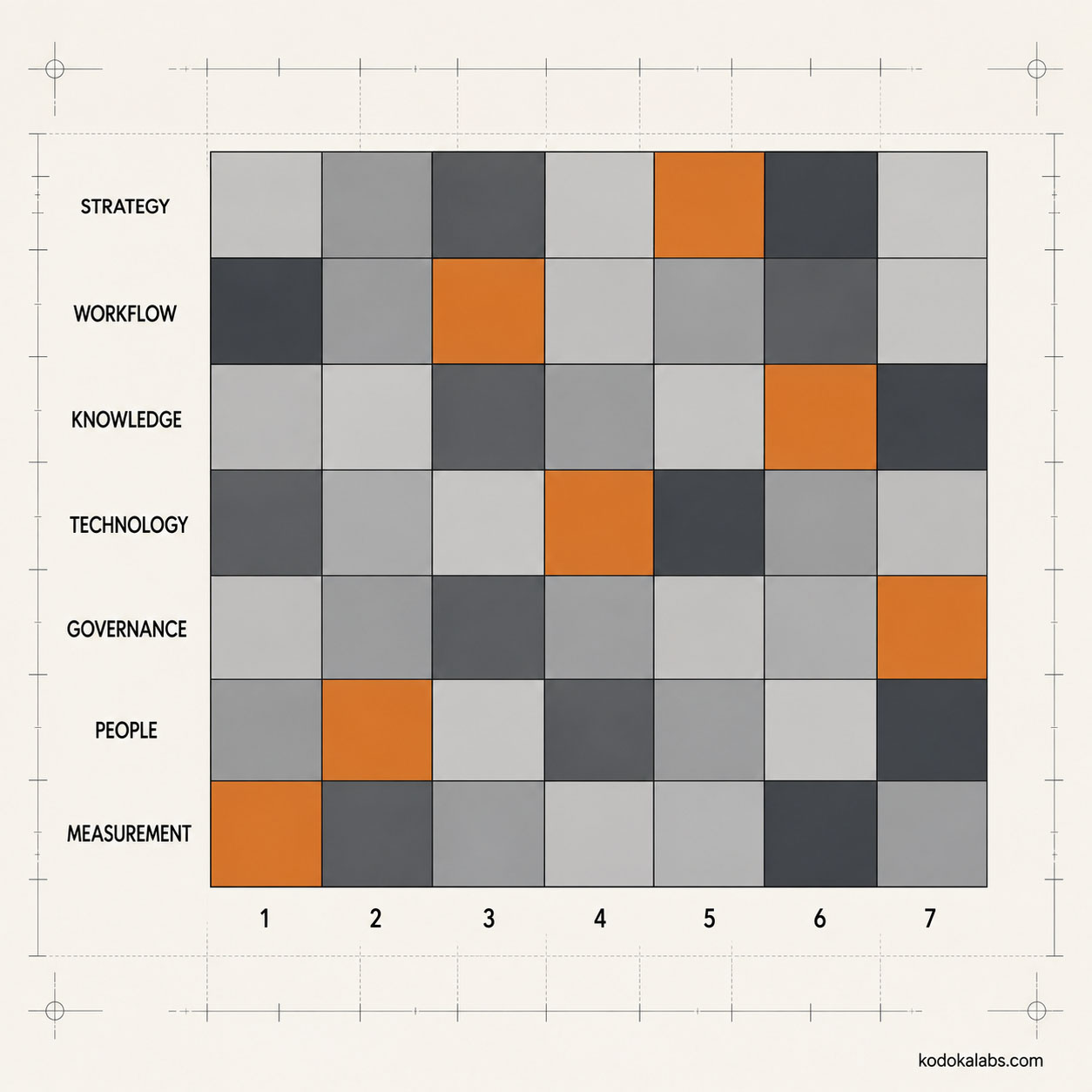
Dimension
Stage 1–2
Stage 3–4
Stage 5–6
Stage 7
Strategy & executive alignment
Workflow & process design
Knowledge & data readiness
Disconnected, tacit
Technology & integration
Governance & risk
People & capability
Measurement & value realization
How to Score Your Organization
Scoring requires more than a single self-assessment session. A credible score depends on:
- Evidence collection – scores should be backed by documentation, workflow observation, or system data, not impression alone.
- Scoring scale – a consistent scale applied uniformly across all seven dimensions (kōdōkalabs’ assessment methodology defines the specific scale used in the Executive AI Marketing Assessment).
- Stakeholder input – scores drawn from multiple roles (leadership, marketing operations, individual practitioners) rather than one person’s perspective alone.
- Variance between teams – scoring separately by function where meaningful differences exist, rather than forcing one score across a diverse organization.
- Maturity ceilings – recognizing that a dimension can’t credibly score above what the evidence supports, even if leadership’s aspiration is higher.
- Risk of self-assessment bias – self-scored assessments tend to run optimistic, particularly on governance and knowledge quality, which is why external validation (such as a structured Executive AI Marketing Assessment) often produces a more accurate baseline than an internal-only exercise.
How Maturity Differs Across Functions
Maturity is rarely uniform across a marketing organization. Content teams may have relatively mature, documented AI-assisted workflows, while marketing operations lags on governance, or paid media has strong technology integration but weak measurement connecting spend to outcomes. This variation is common and expected across:
- Content – often an early adopter of AI-assisted drafting, sometimes without matching governance.
- SEO/GEO – increasingly reliant on AI for research and structure, requiring new measurement approaches for AI-answer-engine visibility specifically.
- Paid media – frequently has mature AI-driven optimization technology but weaker connection to broader marketing knowledge and governance.
- Demand generation – maturity here often depends heavily on how well marketing and sales data are integrated.
- Marketing operations – typically the function best positioned to lead governance and workflow standardization, but not always resourced to do so.
- Sales enablement – maturity often lags marketing-proper, since AI-assisted content for sales use is a newer, less standardized practice.
- Analytics – critical for the measurement dimension across every other function, but sometimes itself under-resourced relative to its importance.
- Brand and creative – often the most cautious function on AI-assisted execution, appropriately so given brand-voice and trademark risk, which can make its maturity progression look slower even when its governance discipline is genuinely stronger than other functions’.
This unevenness is not a flaw to correct by forcing every function to the same stage on the same timeline. A more realistic goal is a coordinated roadmap in which each function progresses at a pace appropriate to its risk profile and current baseline, with marketing operations or a designated AI governance owner tracking the pattern across functions so gaps don’t compound silently. Trying to force uniform maturity across functions with very different risk profiles — brand and creative versus, say, internal reporting — usually produces either unsafe acceleration in sensitive functions or unnecessary friction in lower-risk ones.
What to Do at Each Stage
Governance shouldn’t appear only once, at the end, as a compliance checkbox. It should evolve deliberately across the roadmap: interim, lightweight guardrails during Diagnose and early Architect (to allow safe experimentation), a formal governance design during Architect, real-world testing of that governance during Build, training on it during Enable, ongoing monitoring during Measure, and expansion of governance scope during Scale. Full detail on the governance structure itself is covered in the AI Governance for Marketing guide.
Interim guardrails matter more than they might seem at first glance. Without them, the period between “leadership has decided to pursue AI transformation” and “formal governance is designed” becomes a window of ungoverned experimentation, often the exact period when employees are most enthusiastic about trying new AI-assisted approaches. A short, simple set of interim rules — what data can’t be entered into which tools, what still requires human review regardless of category — closes that window without waiting for the full governance design to be finished.
Stage
Priority
Do Not Scale
Governance Requirement
Capability Focus
1. Unstructured Awareness
2. Individual Experimentation
3. Controlled Pilots
4. Standardized Workflows
5. Integrated Operations
6. Measured Transformation
7. Adaptive AI-Native Organization
Maturity Gaps That Create Risk
Specific imbalances between dimensions create disproportionate risk:
- High technology maturity with low governance – the organization can execute AI-assisted work at scale with no defined control over quality or compliance risk.
- High experimentation with low process clarity – activity outpaces the organization’s ability to evaluate whether that activity is actually working.
- High automation with low knowledge quality – automating workflows that draw on outdated or inaccurate knowledge scales the inaccuracy, not just the output.
- High adoption with no value measurement – the organization can’t demonstrate whether widespread AI usage is actually improving outcomes.
- Strong external capability with weak internal ownership – an agency or vendor is more mature than the internal team, recreating dependency risk.
- High measurement maturity in one function with none in adjacent functions – a demand generation team with rigorous AI-assisted attribution can mask the fact that content or creative has no comparable evidence trail, making organization-wide “AI is working” claims difficult to defend under scrutiny.
- Fast stage progression without stage-appropriate governance – an organization that moves from Stage 2 to Stage 5 quickly, without building the interim governance layer Stage 3 and 4 require, tends to carry unresolved risk forward rather than actually skipping it.
None of these gap patterns are visible from a single composite maturity score — they only become visible when the seven dimensions are scored and reviewed independently, which is the core reason the model is deliberately structured as a profile rather than a single index number.
How to Use the Model in Annual Planning
The maturity model becomes most useful when it’s connected directly to planning decisions:
- Budget – allocating investment toward the dimensions scoring lowest relative to strategic priority, not just toward the most visible technology purchases.
- Workforce planning – identifying where capability gaps require training versus new hiring.
- Technology decisions – evaluating new tools against the organization’s actual governance and integration maturity, not just feature lists.
- Transformation portfolio – sequencing which use cases and workflows to pursue next, based on the current stage and biggest dimensional gaps.
- Vendor selection – assessing whether a prospective agency or vendor partner will raise or lower internal capability maturity over time.
- Board reporting – communicating AI maturity progress in the same structured terms used internally, rather than an informal narrative.
AI Marketing Maturity Self-Assessment
Rate your organization 1 (Stage 1) to 7 (Stage 7) on each question, then compare your pattern across dimensions rather than relying on a single average.
Strategy and executive alignment: Do our AI initiatives connect to named business priorities? Is there a single accountable executive sponsor? Can leadership articulate our current AI maturity honestly?
Workflow and process design: Are our core AI-assisted workflows documented? Is it clear where AI drafts and where a human reviews? Do different team members produce comparably consistent results using the same workflow?
Knowledge and data readiness: Is our brand and product knowledge centralized and structured? Can AI systems access current, accurate information? Is there a defined process for keeping that knowledge fresh?
Technology and integration: Are our AI tools integrated with existing marketing systems? Is our technology stack coordinated across teams, or fragmented? Do we have visibility into which tools are actually being used effectively?
Governance and risk: Do we have a defined risk classification for AI use cases? Is there a documented review process tied to that classification? Can we reconstruct how a specific AI-assisted output was produced and approved?
People and capability: Can our team direct and evaluate AI-assisted work, not just use AI tools casually? Is critical workflow knowledge documented, or does it depend on specific individuals? Do we have a plan for training new team members on our AI-assisted workflows?
Measurement and value realization: Can we demonstrate, with evidence, that a specific AI-assisted workflow outperforms what it replaced? Do we track outcomes beyond activity and hours saved? Is our measurement tied to a documented baseline?