
AI Tools Without Strategy: Why Transformation Fails
Why Buying AI Tools Does Not Create AI Transformation
Executive Summary
Key Takeaways:
- AI tool sprawl is a symptom of missing operating-model design, not a technology problem that better tools will solve on their own.
- Tools are necessary components of transformation, not evidence of transformation by themselves; the distinction matters more as AI tool adoption accelerates.
- Total cost of tool sprawl extends well beyond licensing: integration, data, security review, training, context switching, administration, and vendor risk all add up.
- Use case should be defined before tool selection, not after, following a defined use-case-before-tool sequence.
- Consolidation should protect legitimate experimentation through sandboxes and a defined exception process, not shut it down entirely.
What Is AI Tool Sprawl?
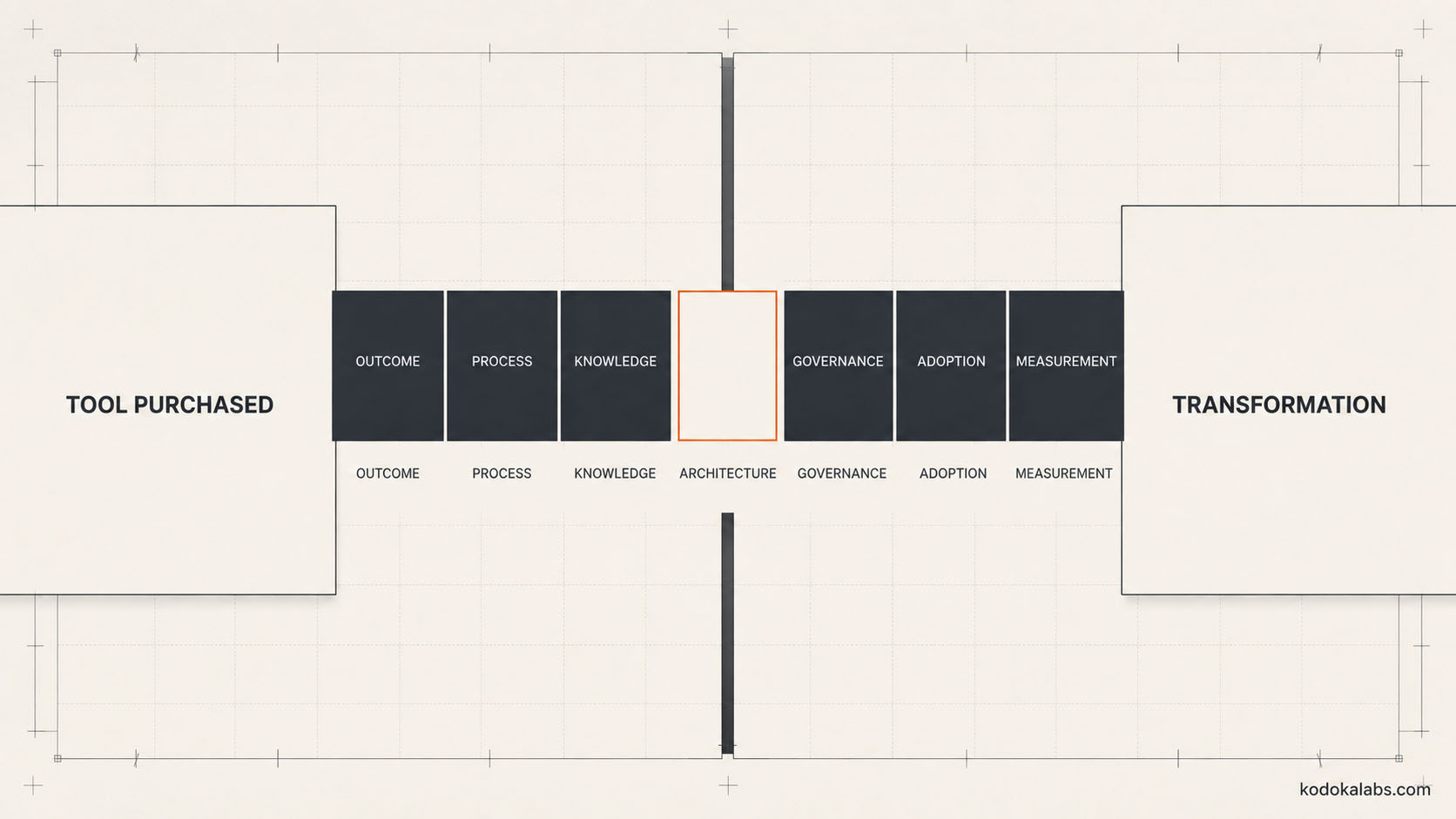
AI tool sprawl is the uncontrolled accumulation of overlapping AI applications, models, and workflow components without shared use-case priorities, architecture standards, ownership, governance, or value measurement. It is distinct from experimentation, which is a deliberate, bounded activity, and from a genuinely diverse toolset serving genuinely distinct purposes. Tools themselves are necessary components of transformation, not evidence of transformation by themselves; the number of tools an organization has adopted says nothing about whether those tools are creating coordinated value.
The distinction between sprawl and a genuinely diverse toolset is worth drawing carefully, because it’s easy to misapply the sprawl label to any organization using more than a handful of tools. A marketing function with fifteen tools, each serving a distinct, defined use case, each governed to an appropriate standard, each measured for value, is not experiencing sprawl even though the count looks similar to a genuinely sprawling stack. The defining characteristic of sprawl isn’t the number of tools; it’s the absence of the coordinating layer, shared priorities, standards, ownership, governance, and measurement, that would let those tools work as a coherent system rather than a pile of disconnected point solutions.
Why Tool Adoption Is Mistaken for Transformation
The Tool-to-Transformation Gap
Common Causes of AI Tool Sprawl
Decentralized purchasing where individual teams or managers buy tools independently, employee experimentation that goes unmanaged and unconsolidated, vendor sales pressure exploiting fear of falling behind competitors, unclear ownership of the AI tool decision within the organization, absence of a use-case prioritization process, and the lack of any architecture standard new purchases are expected to meet, all combine to produce sprawl over a relatively short period, often without any single decision that looks unreasonable in isolation.
This is worth emphasizing because organizations reviewing how they ended up with a sprawling stack often look for a single bad decision to explain it, and rarely find one. A content team adopts a writing assistant because it solves an immediate deadline problem. A separate analytics team adopts a different AI-assisted reporting tool because it was recommended at a conference. A regional office signs up for a localization tool independently because head office procurement felt too slow. Each decision, evaluated on its own, was a reasonable response to a real problem. The sprawl emerges from the absence of any mechanism connecting these decisions to each other, not from any individual decision being obviously wrong at the time it was made.
The Hidden Costs of Tool Sprawl
Why Tools Fail Without Defined Workflows
A tool introduced into an undefined workflow tends to get used inconsistently across the team, since without a defined process each person effectively improvises their own way of incorporating it. That inconsistency shows up as unpredictable output quality, unclear accountability when something goes wrong, and difficulty measuring whether the tool is actually improving anything, since there’s no consistent baseline process to compare it against.
This is a recurring pattern worth naming directly: an organization evaluates a tool, finds the results inconsistent, and concludes the tool itself is the problem, when the actual issue is that the tool was deployed into an undefined workflow where five different people were using it five different ways. Redesigning the workflow first, defining what the tool is meant to do, where it fits in the sequence of work, what inputs it receives, and what human review follows it, often resolves quality problems that look like they call for a different or better tool but are really calling for a defined process the existing tool could have served well all along.
Why Company Knowledge Matters
Governance Before Scale
Scaling a tool’s usage before governance is in place multiplies whatever risk exposure that tool carries, rather than multiplying its value in isolation. A tool with weak controls used by five people is a contained risk; the same tool used by five hundred people, without governance having caught up, is a materially different and larger exposure. Governance should be established proportional to a tool’s intended scale before that scale is reached, not retrofitted after problems surface.
Retrofitting governance after scale is reached is possible but considerably more disruptive than establishing it beforehand, because it typically means pausing or restricting a workflow people have already come to rely on, which creates internal friction that early governance design avoids entirely. It also tends to surface exactly the risks governance was meant to prevent, an inconsistency in output quality, a factual error that reached a customer, a data-handling question no one had answered, at the point they’ve already caused some degree of harm rather than being caught in advance. The Marketing AI Governance Control Stack’s risk classification step exists specifically to make this proportionality decision explicit before scale happens, rather than leaving it to be discovered under pressure afterward.
Adoption and Capability
How to Audit the AI Tool Stack
The AI Tool Rationalization Matrix
Criterion
What It Assesses
Business relevance
Unique capability
Overlap
Integration
Data control
Governance
Adoption
Switching cost
Measurable value
Strategic fit
Use Case Before Tool Selection
Build, Buy, Configure, or Outsource?
Option
Best Fit When
Off-the-shelf tool
Configured platform
Workflow automation
Custom agent
Internal capability
External service
How to Consolidate Without Slowing Innovation
What an AI Marketing Architecture Should Include
A coherent AI marketing architecture includes systems of record for core business data, a governed knowledge layer, a model layer defining which AI capabilities are approved for which purposes, an orchestration layer connecting tools and workflows, defined interfaces for how humans interact with the system, governance controls appropriate to risk, logging sufficient to support audit and troubleshooting, and measurement that connects tool usage back to actual business outcomes. Tool selection decisions made against this architecture, rather than in isolation, are what keep the stack coherent as it grows.
Common Procurement Mistakes
Purchasing based on a vendor demo rather than a defined use case, skipping data and security review under time pressure, failing to check for overlap with tools already in use, signing multi-year contracts before confirming genuine adoption, and neglecting to define what evidence would justify renewal versus cancellation, are among the most common and costly procurement mistakes organizations make when acquiring AI tools.
The vendor-demo mistake deserves particular attention because it’s easy to fall into even with good intentions. A well-run demo is specifically designed to show a tool performing at its best, on curated examples, without the messiness of an organization’s actual data, existing workflows, or edge cases. Procurement decisions made primarily on the strength of that demo experience, rather than on a defined use case tested against the organization’s own real conditions, tend to discover the gap between demo performance and production performance only after the contract is signed and the tool is already being rolled out, at which point walking back the decision is considerably more expensive than it would have been to test properly beforehand.
Readiness Checklist
[ ] A defined use case exists before tool evaluation begins.
[ ] The tool has been scored against the AI Tool Rationalization Matrix.
[ ] Overlap with existing tools has been explicitly checked.
[ ] Data control, security, and governance requirements have been confirmed.
[ ] A build, buy, configure, or outsource decision has been made deliberately, not by default.
[ ] Adoption will be tracked honestly, not measured by license count alone.
[ ] A measurement plan exists for assessing the tool’s actual value.
[ ] The tool fits within the organization’s defined AI marketing architecture.
[ ] Renewal versus cancellation criteria are defined before the contract is signed.