
Future Role of the CMO in
AI-Native Marketing
Future Role of the CMO in an AI-Native Marketing Organization
Executive Summary
Key Takeaways:
- AI expands CMO responsibility rather than simplifying it, adding governance, capability allocation, and intelligence synthesis to an already broad mandate.
- The Five Future CMO Mandates are Market Intelligence, Operating Model, Capability and Talent, Governance and Trust, and Commercial Value.
- CMO metrics should shift from activity measures toward market position, demand quality, growth efficiency, execution health, capability, and risk.
- AI governance is a co-owned responsibility, not something the CMO owns alone or hands off entirely to IT and legal.
- Fractional executive leadership is a legitimate answer for organizations that need this capability without a full-time permanent hire.
How Is the Role of the CMO Changing?
The CMO’s role is shifting from primarily overseeing channels and campaigns toward architecting the marketing operating model itself: allocating capability across people, agencies, and automation; governing how AI is used across the function; and translating market and customer understanding into commercial decisions the rest of the executive team can act on. This is a change in scope, not just emphasis. A CMO measured on channel performance and campaign output can succeed by that measure while the underlying operating model, the workflows, decision rights, and governance structures around AI adoption, quietly fall behind what the organization actually needs.
This shift is not unique to marketing; similar transitions have played out in finance as CFOs took on broader capital-allocation and risk responsibilities, and in technology as CIOs moved from infrastructure management toward digital-strategy leadership. What makes the marketing version of this shift distinctive is the speed at which AI is compressing the timeline. A CFO’s expanded mandate developed over roughly a generation of gradually increasing financial complexity and regulatory scrutiny. The CMO’s expanded mandate is developing over a period closer to a few years, as generative AI capability, adoption pressure, and regulatory attention (including disclosure obligations like Article 50 of the EU AI Act) have all accelerated in parallel. Organizations that treat this as a gradual, optional evolution risk finding their operating model, governance, and capability allocation meaningfully behind where AI adoption has already taken the function.
Why AI Expands Rather Than Simplifies CMO Responsibility
A common assumption is that AI simplifies marketing leadership by automating execution and freeing the CMO to focus purely on strategy. In practice, AI adds responsibility rather than removing it: someone now has to govern how AI is used across content, campaigns, and customer interactions; someone has to allocate capability across an expanding set of tools, agencies, and internal skills; and someone has to maintain trust in AI-assisted output at a moment when audiences and regulators are actively scrutinizing exactly that. These are new executive responsibilities layered on top of existing ones, not a net reduction in what the CMO has to own.
There’s a version of this assumption worth naming directly, because it recurs often enough to be worth correcting explicitly: the idea that AI reduces headcount and therefore reduces management complexity. Even where AI genuinely reduces the number of people executing a given task, it typically increases the complexity of what remains to be managed, since someone still has to design the workflow the AI operates within, define the boundaries of what it’s permitted to do, review its output at an appropriate depth, and maintain the governance record that lets the organization demonstrate control if a regulator, customer, or journalist asks how a piece of AI-assisted content was produced. None of that work disappears when AI takes on more of the execution; it simply changes shape, from doing the work to designing and governing the system that does it.
The Five Future CMO Mandates
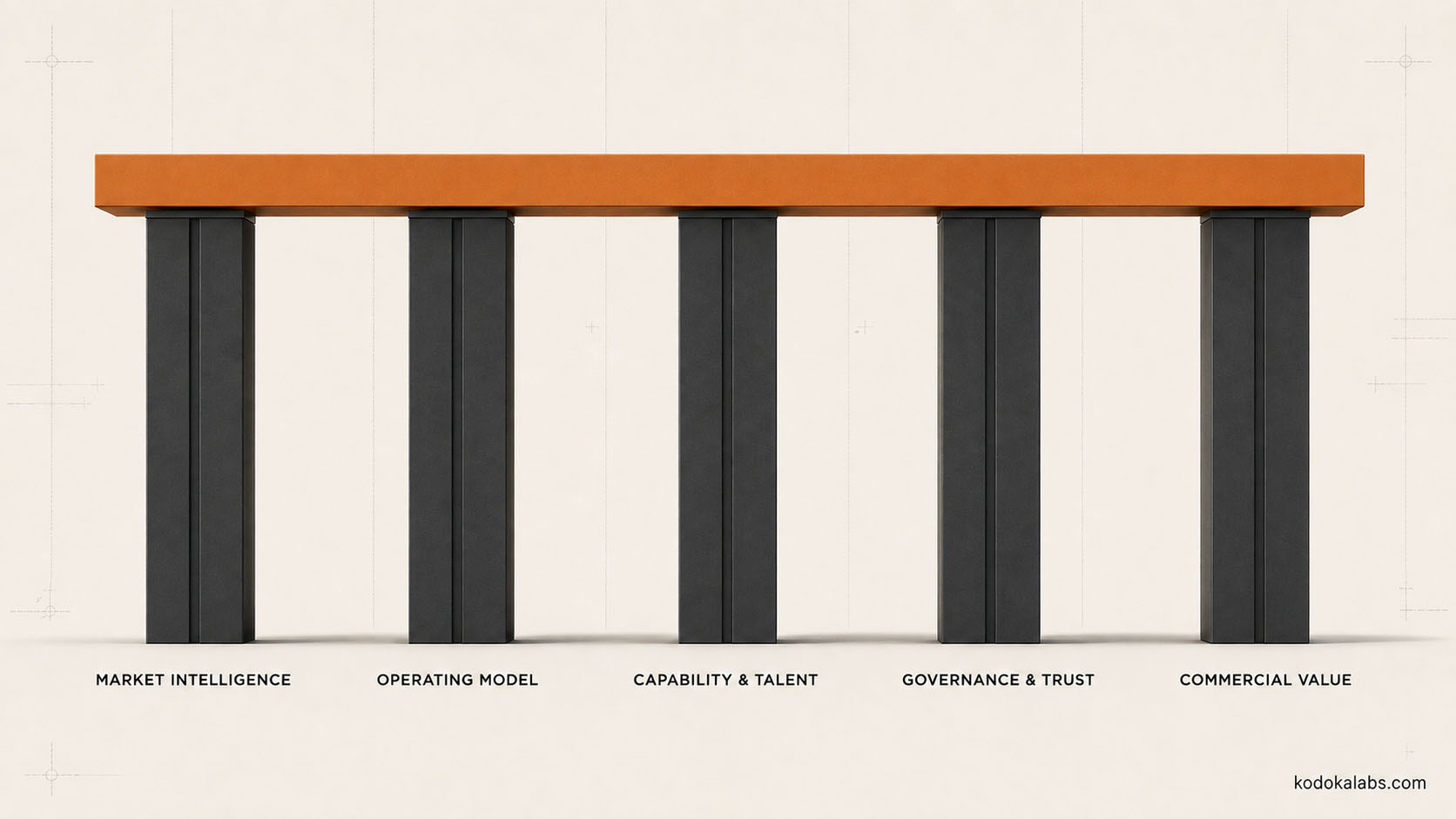
Market Intelligence
Owning the organization’s synthesized understanding of customers, competitors, and market shifts, informed by AI-assisted analysis but grounded in verified evidence rather than synthesis alone.
Operating Model
Capability and Talent
Governance and Trust
Commercial Value
From Channel Leader to Operating-Model Architect
Operating as a channel leader means optimizing performance within existing structures. Operating as an operating-model architect means being responsible for the structures themselves: organizational design, decision rights, workflow structure, the shared infrastructure teams depend on, the role external partners play, and the governance that holds the whole system together. This shift matters because a CMO who only optimizes within existing structures has no lever to pull when the structure itself is what’s limiting AI’s value, a state many organizations are already in without fully recognizing it.
A practical way to tell which mode a CMO is actually operating in is to look at what happens when an AI-enabled workflow underperforms. A channel leader’s response tends to focus on the workflow itself: adjust the prompt, retrain the team, switch tools. An operating-model architect asks a broader question first: does this workflow sit inside a structure, clear ownership, defined data sources, an appropriate review gate, a sensible decision-rights map, that actually supports it, or is the workflow failing because the structure around it was never designed for what it’s now being asked to do. The second question is harder to answer and usually points to a bigger fix, which is exactly why it gets skipped by leaders who are, understandably, under pressure to show quick improvement.
The CMO as Chief Market Intelligence Officer
Capability allocation decisions span people, agencies, automation, technology, data, training, and proprietary IP, and the CMO increasingly owns the judgment calls about which of these to build internally, buy, configure, or outsource, informed by the same build-buy-configure logic described in Why Buying AI Tools Does Not Create AI Transformation. Getting this allocation wrong in either direction, over-relying on external agencies or over-investing in tools without the workflow and governance to use them well, is one of the more common and expensive strategic errors available to a modern CMO.
This allocation work is also where the CMO’s relationship with capability transfer becomes concrete rather than aspirational. Every external engagement, an agency retainer, a platform implementation, a specialist consultancy, represents a choice about how much of the underlying capability stays inside the organization versus outside it, and that choice compounds over time. A CMO who consistently allocates toward engagements structured around genuine capability transfer, of the kind described in Building Internal AI Capability, builds an organization that gets more self-sufficient with each initiative. A CMO who consistently allocates toward engagements optimized purely for fast delivery, with no transfer mechanism built in, builds an organization that stays dependent no matter how many individual projects succeed.
The CMO's Role in AI Governance
AI governance in marketing is a co-owned responsibility rather than something the CMO owns alone or defers entirely to IT and legal. The CMO’s specific contribution is domain judgment: knowing which marketing use cases carry meaningful brand, factual, or customer-trust risk, and ensuring the organization’s broader governance framework, whatever IT, legal, privacy, and security have built, actually gets applied inside marketing’s own workflows rather than existing only as policy on paper.
This co-ownership matters because generic, IT-authored AI policy rarely anticipates marketing-specific risk in enough detail to be actionable. A general policy might say AI-generated content should be reviewed before publication, but it takes marketing domain judgment to specify what that review needs to check for a product claim versus a customer testimonial versus a comparative statement about a competitor, each of which carries a different risk profile and needs a different depth of scrutiny. The CMO who treats governance purely as IT’s or legal’s problem tends to end up with a policy document that’s technically compliant and practically unused, because no one translated it into the specific decision rules marketing teams actually need day to day.
The CMO and Revenue Alignment
Revenue alignment covers pipeline, sales enablement, the customer journey, forecasting, measurement, shared definitions with sales and finance, and functioning feedback loops between marketing and revenue teams. Much of the credibility a CMO needs with the CEO, CFO, and board rests on this alignment working in practice, not just being described in a strategy document, since a marketing function whose numbers don’t reconcile with sales and finance loses standing in exactly the conversations where marketing investment gets decided.
AI adds a specific new pressure point to this alignment work: as marketing’s output volume and speed increase, sales teams receiving that output need confidence that quality and accuracy have kept pace, not just quantity. A sales team that starts encountering inconsistent or unreliable AI-assisted content in what marketing hands them will quietly stop trusting marketing’s output altogether, regardless of how strong the underlying strategy is, and rebuilding that trust after it erodes takes considerably longer than maintaining it would have. Revenue alignment in an AI-native organization therefore includes an implicit quality contract between marketing and sales, one that needs to be made explicit rather than assumed.
How CMO Metrics Should Change
CMO metrics should move from activity measures (impressions, campaigns launched, content volume) toward market position, demand quality, growth efficiency, customer economics, execution health, capability, learning, and risk. This is consistent with the seven-dimension approach described in AI Marketing ROI: no single metric captures whether marketing leadership is actually creating value, and a metrics set built entirely around activity will systematically reward the wrong behavior as AI increases the volume of activity any team can produce.
This shift matters more urgently for the CMO specifically than it does for most other marketing roles, because activity metrics become actively misleading once AI removes the natural constraint that used to keep them honest. When producing more content or launching more campaigns required proportionally more human effort, a rising activity metric was at least a rough proxy for a team working hard and likely creating some value along the way. Once AI removes that proportional relationship between effort and output volume, activity can rise sharply while quality, strategic fit, or actual commercial contribution stays flat or even declines, and a board still being shown activity metrics as the primary evidence of marketing performance has no way to see that gap forming until it shows up somewhere more painful, like a quarter’s commercial results.
What CMOs Should Stop Doing
Skills the Future CMO Needs
When Fractional Leadership Makes Sense
Organizations facing a temporary or permanent gap in transformation leadership, needing stronger marketing leadership without being ready to commit to a full-time permanent executive hire, are a natural fit for fractional leadership. This is particularly true where the immediate need is architecting the operating model and establishing governance rather than running day-to-day campaign operations, since that architectural work has a defined shape and doesn’t necessarily require a permanent full-time seat to complete well.
Fractional leadership tends to fit best in a few recurring situations: a growth-stage company that has outgrown its current marketing leadership but isn’t yet large enough to justify a full executive team; an organization mid-transition between a departing CMO and a permanent replacement that doesn’t want the operating-model work to stall during the search; or a business that needs the specific architectural and governance expertise this role requires for a defined period rather than indefinitely. In each case, the value comes from applying focused senior judgment to the operating-model and governance questions this guide describes, not from filling a generic leadership vacancy, which is why fractional engagements structured around clear architectural deliverables tend to outperform ones structured as an open-ended stand-in for a full-time role.
Common Failure Modes
- Measuring the CMO only on channel and campaign metrics while the operating model behind those metrics goes unmanaged.
- Treating AI governance as someone else’s job entirely, ceding domain judgment about marketing-specific risk to IT and legal alone.
- Allocating capability reactively, tool by tool, without a coherent build-buy-configure strategy behind the decisions.
- Letting revenue definitions diverge from sales and finance, eroding the CMO’s credibility in board and executive conversations.
- Under-investing in systems thinking and organizational design skills relative to campaign and channel expertise.
- Treating fractional leadership as a lesser option rather than a legitimate fit for a defined architectural need.
Checklist
[ ] The CMO’s mandate explicitly includes operating-model architecture, not only channel and campaign performance.
[ ] AI governance responsibilities are co-owned and documented, not assumed to sit entirely with IT or legal.
[ ] Capability allocation decisions follow a defined build-buy-configure logic.
[ ] CMO metrics span market position, demand quality, growth efficiency, execution health, capability, learning, and risk, not activity alone.
[ ] Revenue definitions are shared and reconciled with sales and finance.
[ ] A skills plan addresses systems thinking, data literacy, AI literacy, and governance fluency, not only channel expertise.
[ ] Fractional leadership has been genuinely considered where the need is architectural rather than purely operational.