
LLM Optimization: Make Content Retrievable, Understandable, and Citable
Definition, Scope, And An Honest Uncertainty
LLM optimization, as this guide defines it narrowly, is the practice of improving the accessibility, clarity, provenance, and extractability of authoritative content for systems that retrieve, interpret, and synthesize information using large language models. It is one component within the broader discipline of generative engine optimization, covered fully in the Generative Engine Optimization guide, not a separate category and not a guaranteed method for influencing what any specific model generates in response to any specific query.
The honest uncertainty at the center of this topic: no major LLM provider has published a complete account of how retrieval, ranking, and citation decisions are made within their systems. What is documented, and what this guide draws on, are specific, disclosed mechanics, crawler behavior, indexing eligibility, referral tagging, that organizations can act on with confidence, separated clearly from reasonable practitioner inference about what likely helps, which this guide labels as such rather than presenting as confirmed fact.
This guide covers semantic HTML, accessible rendering, crawl and index controls, clarity at the level of individual content passages, direct definitions, descriptive headings, tables, source attribution, freshness, canonicalization, structured data, passage independence, entity consistency, and testing. It discusses crawler access and emerging conventions only with current, dated evidence and explicit limitations stated. It does not cover prompt engineering, is not a complete AI Overviews implementation guide, covered separately in AI Overviews Strategy, and is not a full restatement of the GEO category, covered in Generative Engine Optimization.
How LLM-Mediated Retrieval Differs
Traditional search indexing and LLM-mediated retrieval share a common foundation, both require content to be crawlable, but they diverge in what happens after a system has access to a page. A traditional search index primarily needs to match a query to a ranked set of documents. A system using retrieval-augmented generation, where a live or recent retrieval step supplies source material that a language model then synthesizes into an answer, needs the retrieved content to be clear enough, at the level of individual passages, for a model to accurately extract and represent specific facts, often without the full surrounding context a human reader would have.
This has a practical implication distinct from traditional SEO: passages need to be reasonably self-contained and accurate when read in isolation, not solely as part of a full-page narrative. A sentence that only makes sense in light of a claim made three paragraphs earlier is a normal and often effective writing technique for a human reader working through a page in order; it is a liability for a system that may retrieve that sentence as an isolated passage without the preceding context. This does not mean writing in short, disconnected fragments, which OpenAI and Google’s own guidance both caution against as an ineffective and reader-hostile tactic; it means writing so that key facts are stated clearly and are not solely dependent on distant context to be understood correctly.
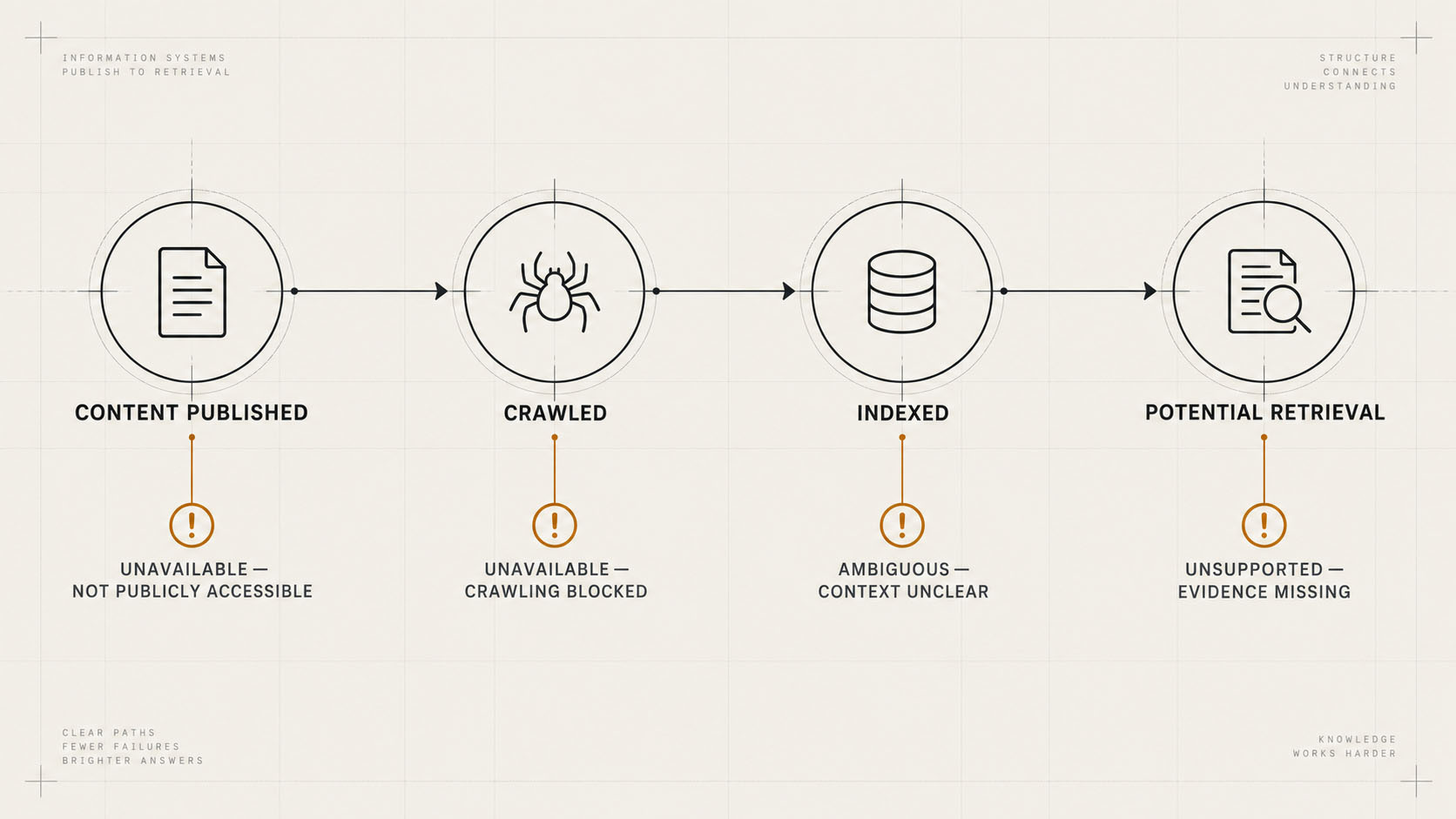
It is also essential to keep several distinct LLM-optimization concepts separate, since they are frequently and incorrectly conflated in less careful GEO commentary: training access (whether a model was trained on content, a decision made at a point in the past and not reversible after the fact), crawling (whether a specific, current crawler can currently access a page), indexing (whether a platform has processed and stored that content for retrieval), live retrieval (whether a system fetches or references current content at the time of a query), grounding (whether a generated answer is based on retrieved source material rather than solely the model’s trained parameters), and citation (whether a source is explicitly credited in a generated answer). A page can be crawled and indexed without ever being retrieved for a specific query, and can be retrieved and used for grounding without ever being explicitly cited. Each of these is a distinct, separately controllable or observable step.
Content-Layer Requirements
At the content layer, several practices consistently support both human comprehension and machine extractability, and are grounded in either official platform guidance or established web-accessibility practice, not speculative AI-specific tactics. Use direct, clearly stated definitions early in a section rather than building to a definition through several paragraphs of buildup. Use descriptive, specific headings that state what a section covers, rather than clever or ambiguous phrasing that requires reading the section to understand its topic. Present comparative or structured information in accessible tables rather than dense prose paragraphs, since tables are both easier for a human to scan and more reliably parseable by machine systems. Attribute sources and data explicitly, stating where a fact or figure comes from, rather than presenting it as an unattributed assertion. Maintain entity consistency, using the same canonical names for people, brands, and concepts established in Entity SEO, so that a system extracting a passage in isolation still correctly identifies what it refers to.
Delivery-Layer Requirements
At the delivery layer, technical implementation determines whether well-written content is actually reachable and correctly parsed in the first place. Ensure content renders in a form that is accessible to the specific, documented crawlers of the platforms an organization has chosen to allow, per the access policy covered in AI Crawler Accessibility and Technical GEO; server-side or pre-rendered content is generally more reliably accessible to automated fetching than content that depends entirely on client-side JavaScript execution behaving correctly for every crawler. Maintain clear, correct canonicalization so that duplicate or near-duplicate versions of a page do not create ambiguity about which is the authoritative version. Apply structured data that accurately describes the visible content, supporting a platform’s own parsing and understanding of the page’s structure and entities, consistent with the shared metadata and schema standard for this pillar. Keep content fresh where freshness is genuinely relevant to the topic, and make the actual publication and modification dates accurate and visible, since stale content presented as current is both a trust risk and, per Google’s own guidance, not a substitute for genuinely useful content.
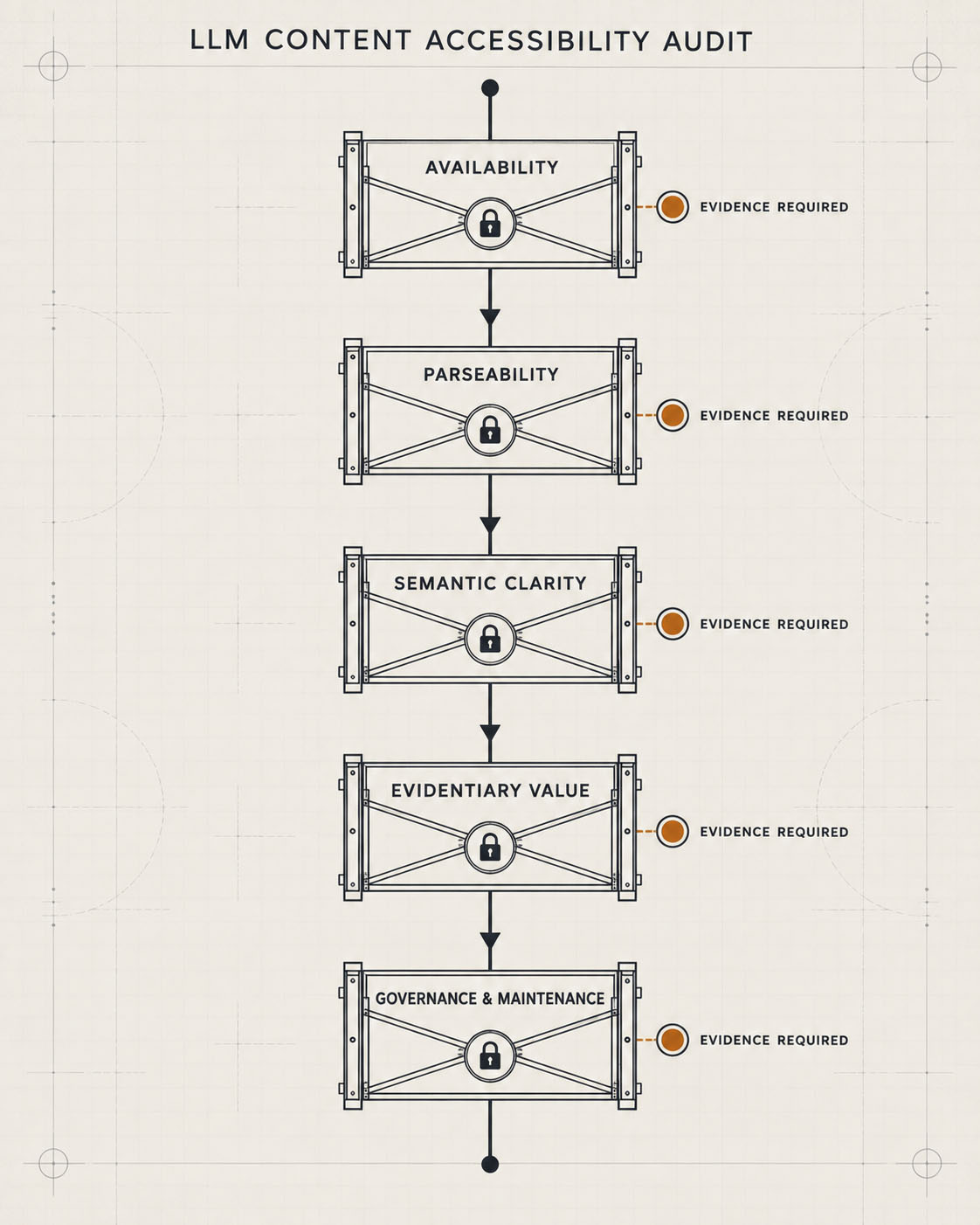
The LLM Content Accessibility Audit
| Layer | What it checks | Evidence required to pass |
|---|---|---|
| Availability | Can the relevant, documented crawlers reach and fetch the content at all? | A documented, current crawler-access test against the platforms the organization has chosen to allow |
| Parseability | Does the content render in a form that can be reliably parsed, independent of client-side JavaScript execution succeeding? | A rendering test comparing what a crawler-equivalent fetch receives against the fully rendered page |
| Semantic clarity | Are key facts stated directly, with descriptive headings and self-contained passages? | An editorial review against the content-layer requirements above |
| Evidentiary value | Does the content carry genuine information gain and attributed sourcing, per the standards in Information Gain? | A check against the Information Gain Ledger for the relevant content |
| Governance and maintenance | Is the content's freshness, canonicalization, and structured data kept current and accurate over time? | A scheduled review cadence with a recorded last-check date |
Experimental Validation
Every recommendation in this guide should be paired with a way to check whether it is actually working, not adopted purely on faith. Practical validation methods include comparing a crawler-equivalent fetch of a page (what an automated system actually receives) against the fully rendered page a human sees, to catch parseability gaps; reviewing whether a platform’s own first-party reporting, where available, such as Bing’s AI Performance view, shows the page appearing in sampled grounding queries; and periodically sampling a defined set of relevant queries across available AI products to observe, qualitatively, whether and how content is represented, understanding this is a sample, not proof of a specific causal mechanism. The Measuring AI Search Visibility and Citation Tracking guide covers this sampling methodology in full detail.
Myths, Risks, And Limitations
Several persistent claims about LLM optimization are not supported by current platform documentation and should be treated skeptically. There is no special file, comparable to a sitemap, that guarantees LLM inclusion or citation; Google has explicitly stated no such requirement exists for its own AI features. There is no confirmed, universal “optimal chunk size” for content passages that guarantees better retrieval across all platforms; this is a reasonable area for organizations to test on their own content, but it is not a documented platform requirement. There is no evidence that invisible or hidden markup intended purely for machine consumption, rather than describing genuinely visible content, improves citation likelihood; structured data guidance from every major search engine is explicit that markup should describe visible content, not add hidden claims.
The honest limitation underlying all of this guide’s recommendations: platform behavior changes, sometimes without notice, and any specific technical claim in this guide has a shelf life. It should be rechecked against current first-party documentation before being treated as still accurate, particularly for any time-sensitive claim about a named platform’s current behavior.
Frequently Asked Questions
Is LLM optimization the same thing as GEO?
No. LLM optimization is one component of the broader generative engine optimization discipline, focused specifically on content and delivery-layer accessibility for LLM-based retrieval and synthesis. See Generative Engine Optimization for the full category.
Does our content need to be trained on a model to appear in that model's answers?
No, and these are separate mechanisms. Training access is a decision made in the past by the model developer and is not something an organization can retroactively influence. Live retrieval and grounding, which many current AI products use, can surface current content regardless of whether it was part of any model's training data, subject to that content being crawlable and accessible now.
Is there an ideal content length or chunk size for LLM retrieval?
No confirmed universal figure exists across platforms. Focus on clarity and self-contained passages rather than a specific word or character count, and treat any specific numeric target as an untested hypothesis to validate on your own content, not a documented requirement.
Should we block AI crawlers to prevent our content being used to train competitor-facing models?
That is a legitimate, deliberate policy decision with real trade-offs, covered in full in AI Crawler Accessibility and Technical GEO; this guide does not make that decision for you, since it depends on the organization's specific competitive and risk posture.
How often should we recheck our LLM accessibility?
On a defined cadence, tied to the Governance and maintenance layer of the audit above, and immediately after any platform announces a documented change to its crawling, indexing, or retrieval behavior relevant to your content.
Where should we start?
With the Availability and Parseability layers of the audit: confirm the platforms you have chosen to allow can actually reach and correctly render your priority content before investing further in content-layer refinement.
Contextual Solution Pathways
Evaluate the content, knowledge, and technical layers that determine whether your expertise is usable by AI systems, as part of a full AI Marketing Operating System engagement.