
AI Editorial Governance: Policies and Controls
Key Takeaways for the AI Editorial Governance
- Governance works only when it is proportionate to risk. A universal heavy approval process blocks routine work just as reliably as no ai editorial governance blocks nothing; both failures are common, and both are avoidable.
- Every AI-assisted content decision should trace to a named accountable human, never to “the AI” or to a policy document that nobody actually consults during production.
- The Editorial Risk and Control Matrix is the operational core of this guide: it maps content categories to impact, sensitivity, required review level, and retained evidence, so reviewers know exactly what a given piece of content requires before it reaches them.
- Exceptions to policy are a normal, expected part of a working governance system, provided they are documented, owned, time-limited, and reviewed. An undocumented workaround is not an exception; it is a governance failure waiting to be discovered.
- Governance connects to, but is distinct from, the full production workflow (see AI Editorial Operating System) and from human review execution itself (see Human Review for AI Content). This guide owns decision rights, policy, and accountability; it does not own the step-by-step production process.
Definition and Executive Stakes
AI editorial governance is the decision rights, policies, risk classifications, evidence requirements, controls, approvals, records, exceptions, and accountability structure through which an organization uses AI in content production without losing factual integrity, brand trust, legal safety, or human ownership of what gets published. It is a production enabler, not a brake applied after the fact. A content organization with clear, proportionate governance can move faster than one without it, because reviewers, writers, and legal stakeholders already know what’s expected of a given piece of content before it reaches them, rather than negotiating the question from scratch every time.
The executive stakes are specific. A single ungoverned piece of AI-assisted content, a fabricated statistic, an unverified legal claim, an unattributed quotation, can damage brand trust in a way that takes far longer to repair than the hours it saved to produce. At the same time, an organization that routes every piece of content, from a routine product update to a regulatory disclosure, through the same exhaustive review process will find its content operation grinding to a halt, with reviewers burned out on low-risk work while genuinely high-risk content waits in the same queue. Both outcomes are governance failures. The first is a failure of control; the second is a failure of proportionality. This guide is built to help an organization avoid both.
Governance Principles and Boundaries
Four principles anchor a workable AI editorial governance system. Human accountability means that every piece of published content has a named human who is accountable for its accuracy, legality, and brand alignment, regardless of how much AI assistance was involved in producing it. An AI system can draft, suggest, flag, and even reject, but it cannot be the accountable party, because accountability requires the capacity to be held responsible, and a model has none.
Proportionality means that the depth of review and the strictness of controls should scale with the actual risk of the content, not with a blanket policy applied uniformly regardless of stakes. A routine internal status update and a public statement about product safety do not belong in the same review lane, even if both happen to involve AI-assisted drafting.
Traceability means that every governance decision, every approval, every exception, leaves a record: what was decided, by whom, on what evidence, and when it should be revisited. A governance system that cannot answer “why was this published” after the fact is not actually governing anything; it is producing the appearance of oversight without the substance.
Capability means that governance should build the organization’s own judgment and documentation over time, not create a permanent dependency on a single gatekeeper or external reviewer. A governance system staffed entirely by one person’s institutional memory is a single point of failure dressed up as a control.
It’s worth being explicit about what this guide does not cover. It does not define the end-to-end editorial production workflow, that belongs to the AI Editorial Operating System, which this guide’s AI editorial governance policies apply across. It does not define how a specific reviewer executes a review, that belongs to Human Review for AI Content. And it is not a substitute for qualified legal review; every statement in this guide that touches on legal exposure is a policy framework, not legal advice, and should be reviewed by qualified counsel before an organization adopts it as binding policy.
Risk Classification
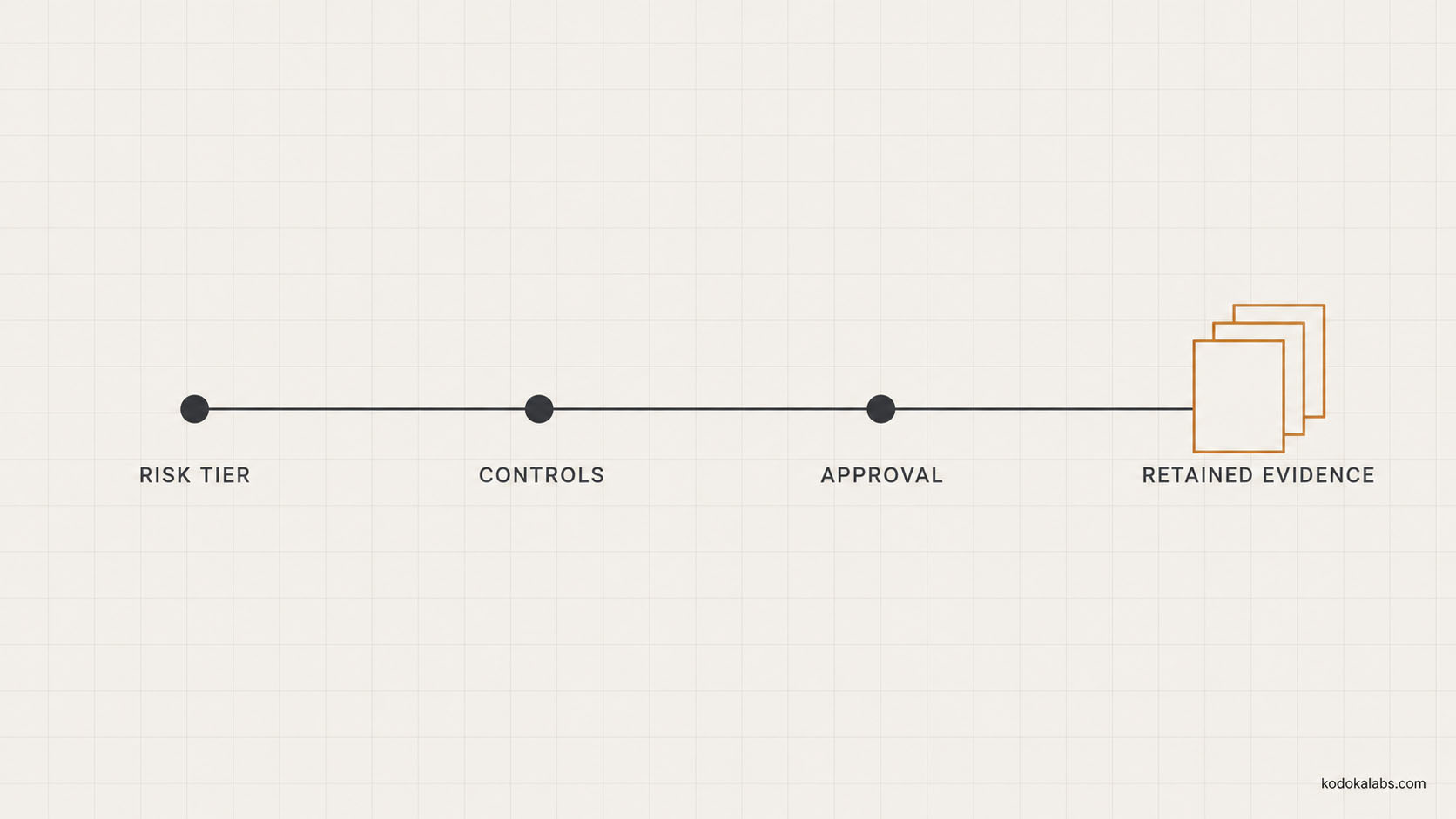
Governance becomes operational the moment content is classified by risk, because risk classification is what tells a reviewer, a writer, or an approver which rules actually apply to the piece of content in front of them. We define four risk tiers.
Routine content covers internal updates, low-stakes social posts, and material with no factual claims beyond readily verifiable, low-consequence information. This tier gets the lightest governance footprint: a single qualified reviewer, lightweight source checks, and no mandatory legal involvement.
Material content covers public-facing marketing and educational content that makes factual or comparative claims but does not touch regulated topics, safety, or financial outcomes. This is the tier most cornerstone guides, blog posts, and case studies occupy. It requires claim verification against the organization’s evidence standard, a named subject-matter or editorial reviewer, and documented source checking.
Sensitive content covers anything touching legal, financial, health, safety, data privacy, or reputation-critical claims, along with any content referencing a specific client, partner, or individual by name. This tier requires specialist review (legal, compliance, privacy, or the relevant subject-matter expert depending on the specific sensitivity), explicit sign-off before publication, and a documented evidence trail sufficient to survive an audit.
Prohibited or exceptional content covers anything the organization has decided AI should never produce or publish without a documented, time-bound exception: autonomous publication with no human checkpoint, legal or regulatory assertions without qualified review, and the use of non-anonymized client or customer data in generation. This tier is deliberately narrow and deliberately absolute; it exists to draw a hard line rather than to be negotiated case by case.
The Editorial Risk and Control Matrix below operationalizes these four tiers against specific content categories an organization is likely to produce.
| Content category | Impact | Factual/legal sensitivity | Data class | Automation permission | Required sources | Review level | Approver | Disclosure rule | Evidence retained |
|---|---|---|---|---|---|---|---|---|---|
| Internal status update | Low | Low | Internal, non-sensitive | AI-assisted drafting permitted | None required beyond internal records | Single reviewer | Team lead | None required | Draft version only |
| Social media post (non-claim) | Low-moderate | Low | Public, non-sensitive | AI-assisted drafting permitted | Brand style guide | Single reviewer | Content lead | Per approved disclosure policy | Final approved version |
| Cornerstone guide or blog post | Moderate | Moderate | Public, non-sensitive | AI-assisted drafting and research support permitted | Claim register with verified sources | Editorial review | Senior editor or subject-matter reviewer | Per approved disclosure policy | Claim register, reviewer sign-off |
| Case study or client reference | Moderate-high | Moderate-high | Client-related, requires permission | AI-assisted drafting with locked client facts | Client-approved facts, written permission | Editorial plus client-approval review | Senior editor and client-relationship owner | Per approved disclosure policy | Permission record, claim register, approval |
| Legal, financial, or regulatory statement | High | High | Sensitive, regulated | AI-assisted drafting with mandatory legal review before any use | Qualified legal source and review | Specialist (legal/compliance) review | Qualified legal reviewer | Per legal requirement | Full evidence file, legal sign-off record |
| Autonomous publication (no human checkpoint) | N/A | N/A | N/A | Prohibited | N/A | N/A | N/A | N/A | N/A |
Two tables support this classification in production: the Editorial Risk and Control Matrix above, used to classify incoming content before work begins, and an Exception Decision Record, described in the Exceptions and Escalation section below, used whenever a specific piece of content needs to depart from its assigned tier’s default rules.
Classification should happen once, early, and visibly, rather than being left to the individual judgment of whoever happens to be drafting a given piece. The person assigning a risk tier is rarely the same person who will later discover that the tier was wrong, which means the assignment needs to be conservative by default: when a piece of content plausibly touches more than one category, for example a case study that is also making a comparative performance claim, it should be classified at the higher of the two applicable tiers rather than the lower. An organization that consistently rounds down on ambiguous classification will eventually publish sensitive-tier content under material-tier controls, and the resulting gap tends to surface only after something has already gone wrong.
It’s also worth naming what risk classification is not. It is not a measure of how important a piece of content is to the business, a flagship pillar page making only well-established, low-stakes claims can sit comfortably in the material tier, while a short internal note referencing an unreleased financial figure belongs in the sensitive tier regardless of its length or visibility. Tying risk tier to content length, format, or publishing channel instead of to actual factual and legal exposure is one of the more common classification mistakes we see, and it tends to under-govern exactly the short, easy-to-produce content that AI assistance makes it easiest to publish quickly.
Decision Rights and Controls
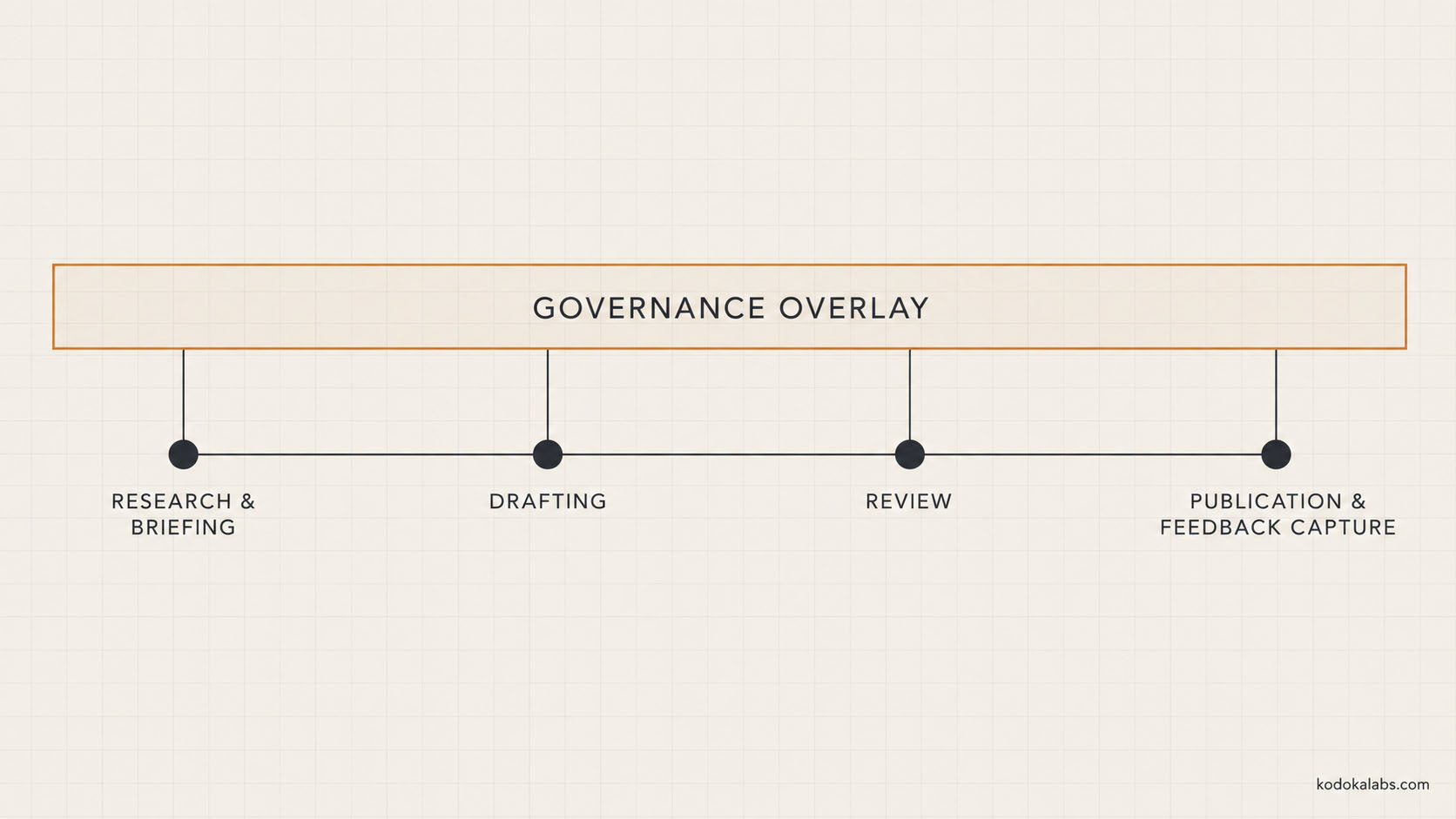
Risk classification only matters if specific people hold specific decision rights at each stage of production. We assign decision rights across the four stages of the Editorial Operating System: Research & Briefing, Drafting, Review, and Publication & Feedback Capture.
At Research & Briefing, the content owner (typically the commissioning editor or strategist) decides what gets researched and at what risk tier, and that risk-tier assignment is the control that determines everything downstream. Getting this decision wrong, classifying sensitive content as routine, is the single most common governance failure we see, because every subsequent control calibrates off this initial call.
At Drafting, the assigned writer or AI-assisted drafting workflow produces the content within the bounds the risk tier permits. The control here is permission scope: a Tier 3 (routine) workflow may draft freely within approved topics, while a Tier 1 (sensitive) workflow requires locked facts and explicit prohibited claims defined before drafting starts, not discovered during review.
At Review, the named reviewer, whose qualifications must match the content’s risk tier, tests the draft against the acceptance criteria for that tier and documents the result. The control here is reviewer-content fit: a generalist editor should not be the final reviewer on a legal claim, regardless of how capable that editor is at routine editorial review.
At Publication & Feedback Capture, the final approver, who holds explicit sign-off authority for that risk tier, authorizes release, and any defects discovered post-publication route back into the governance system as evidence for future classification and policy decisions, not as one-off fixes that disappear once corrected.
A decision right is only meaningful if it’s exclusive and known. If two people both believe they hold final approval authority over sensitive-tier content, the practical result is usually that neither of them exercises it with real rigor, because each assumes the other is the backstop. Naming a single accountable approver per risk tier, with a named backup for continuity rather than a second simultaneous owner, closes this gap. The same principle applies to the content owner’s tier-assignment decision at intake: one person, not a rotating duty roster, should hold that call for a given content program, so that classification judgment accumulates in a specific person rather than resetting with every new rotation.
It’s also worth distinguishing a decision right from a veto. A specialist reviewer’s sign-off on sensitive-tier content is a precondition for publication, not merely one input among several that the final approver can override. Treating specialist review as advisory rather than binding is a quiet way for an organization’s stated governance policy and its actual practice to drift apart, and that drift is exactly the kind of gap an audit, or an incident, tends to surface at the worst possible time.
| Role | Decision right | Required approval evidence | Escalation trigger |
|---|---|---|---|
| Content owner | Assign risk tier at intake | Documented tier assignment with rationale | Ambiguous tier assignment, conflicting stakeholder input |
| Writer / drafting workflow owner | Execute drafting within permitted scope | Draft version with locked facts and claim sources attached | Draft requires a claim or source outside pre-approved scope |
| Reviewer (tier-matched) | Approve, reject, or require revision | Documented review findings against acceptance criteria | Finding outside reviewer's own competence or authority |
| Specialist reviewer (legal, compliance, privacy) | Sign off on sensitive-tier content | Signed legal/compliance review record | Any unresolved legal or regulatory ambiguity |
| Final approver | Authorize publication | Publication authorization record with residual risk noted | Residual risk the approver is not authorized to accept |
| Governance owner | Maintain policy, resolve escalations, approve exceptions | Exception Decision Record | Any exception request, any post-publication incident |
Policy Domains
Governance policy spans several distinct domains, and conflating them is a common source of confusion. Data handling policy governs what information, client data, proprietary research, personal data, may be entered into an AI system, and under what confidentiality terms. Intellectual property policy governs who owns AI-assisted output, how third-party material is attributed, and how the organization’s own proprietary frameworks are protected from both internal misuse and external appropriation. Source and claim policy governs what counts as an acceptable source for a factual claim, consistent with the evidence standards detailed in AI Research Workflows, and what happens when a claim cannot be verified. Authorship and disclosure policy governs when and how AI involvement in content production is disclosed to readers, a decision that should be made deliberately and consistently rather than piece by piece. Review gate policy governs which risk tiers require which reviewers, detailed above in the Editorial Risk and Control Matrix. Incident escalation policy governs what happens when something goes wrong after publication, who gets notified, how quickly, and what corrective action is required. Vendor and model review policy governs how new AI tools and models are evaluated and approved before they enter production workflows, since a model change can silently change output behavior in ways a prior governance review never anticipated.
Each of these domains requires its own specific policy language, and each should be reviewed by the function with actual authority over it: legal counsel for intellectual property and incident escalation with legal exposure, a privacy or security lead for data handling, and the content organization itself for source, claim, authorship, and review gate policy. A governance document that tries to write all seven domains in the same generic voice usually ends up vague in exactly the domains, data handling and legal exposure chief among them, where vagueness is most dangerous.
Data handling policy deserves particular attention because it’s the domain most likely to be violated accidentally rather than deliberately. A writer pasting a client’s draft contract into a general-purpose AI tool to get help rephrasing a paragraph may not realize that action has potentially sent confidential material outside the organization’s control, depending on the tool’s own data-retention and training practices. Policy in this domain needs to be specific about which tools are approved for which data classes, not just a general instruction to “use good judgment,” because good judgment varies enormously across a content team and a single lapse can expose confidential material that no amount of after-the-fact correction can fully retract.
Vendor and model review policy is the domain organizations most often skip entirely, typically because it feels like an engineering concern rather than an editorial one. It isn’t. A model update can change how a drafting tool handles ambiguous claims, how aggressively it fills in gaps with plausible-sounding but unverified detail, or how it responds to instructions about tone and disclosure, often without any announcement the content team would see. A governance system that approved a given AI tool for a given risk tier six months ago should periodically confirm that approval still holds, rather than assuming a tool’s behavior today matches its behavior at the time it was first reviewed.
Exceptions and Escalation
No governance system anticipates every situation, and treating every unanticipated situation as a crisis is itself a design flaw. A workable system distinguishes between an informal bypass, which is always a failure, and a documented exception, which is a normal and expected release valve provided it’s recorded properly.
An Exception Decision Record exists for exactly this purpose. Every exception requires a named owner who requested and is accountable for it, a stated rationale explaining why the default policy doesn’t fit the situation, the evidence supporting that rationale, an explicit expiry date rather than an indefinite waiver, and a scheduled review before that expiry to decide whether the exception should lapse, be formalized into updated policy, or be extended with fresh justification.
Escalation paths should be defined before they’re needed, not improvised during an incident. A reviewer who encounters content that falls outside their competence or authority should have a clear, known next step, not a judgment call about whether to raise a flag. A content owner who discovers that a published piece contains an error serious enough to warrant correction or retraction should know exactly who to notify and within what timeframe. The absence of a defined escalation path doesn’t prevent incidents; it just means the organization improvises its response in the moment of highest pressure, which is reliably the worst time to improvise.
Implementation and Enablement
Rolling out an AI editorial governance system works best in stages rather than as a single company-wide mandate. Start by classifying the organization’s existing content categories against the Editorial Risk and Control Matrix, since most organizations already produce most of these categories, they simply haven’t named and tiered them explicitly. Next, assign named owners to each decision right in the table above, replacing any informal “whoever’s available” assumption with an actual accountable person. Then, train reviewers specifically on the tier-matched competence requirement, since a generalist editor asked to review a legal claim for the first time needs to understand that the correct response is escalation, not a best effort.
Monitoring should include periodic sampling of published content against its assigned risk tier, not just a review of exception requests, because the more common failure mode is content that was never correctly classified in the first place rather than content that deliberately departed from its classification. A governance review cadence, quarterly is a reasonable starting point for most organizations, should revisit the risk classification table itself, since new content categories and new regulatory considerations emerge faster than most governance documents get updated.
Enablement matters as much as the policy document itself. A governance system that lives only in a PDF nobody reopens after onboarding will not change behavior. The decision-rights table, the risk classification matrix, and the escalation path should be embedded directly in the tools the content team actually uses day to day, a content brief template that asks for risk tier up front, a review checklist that lists the specific acceptance criteria for that tier, rather than existing as a separate reference document the team has to remember to consult. Organizations transferring this capability internally, rather than relying indefinitely on an external partner to maintain it, typically build this into the same enablement track covered under the AI Capability Academy, so that the people doing the day-to-day classification and review work are also the people trained to recognize when a classification call is genuinely ambiguous and needs escalation rather than a best guess.
Failure Modes
Governance fails in a few predictable ways. Governance theater happens when a policy document exists, is occasionally referenced in onboarding, and has no actual bearing on day-to-day production decisions; the organization has the appearance of governance without its substance. Overcontrol happens when every piece of content, regardless of risk, routes through the same heavyweight review, which doesn’t make high-risk content safer, it just makes routine content slower while reviewer attention gets diluted across everything equally. Accountability diffusion happens when a published error traces back to “the AI” or to “the process” rather than to a specific named human, which is itself evidence that the decision-rights table above was never actually implemented. And stale classification happens when a content category’s risk tier was set once and never revisited, even as the organization’s regulatory exposure, client relationships, or public profile changed around it.
Frequently Asked Questions
Does AI editorial governance mean every piece of AI-assisted content needs legal review?
No. Legal review is reserved for the sensitive tier, content touching legal, financial, regulatory, health, or safety claims. Routine and material-tier content, the large majority of most organizations' output, requires editorial review calibrated to its own risk level, not legal sign-off.
Who is accountable when an AI-assisted piece of content contains an error?
The named human reviewer and final approver for that content's risk tier, as recorded in the decision-rights structure. AI assistance in drafting does not transfer or dilute that accountability.
How is this guide different from the full content production workflow?
This guide owns the policies, risk tiers, decision rights, and accountability structure that apply across content production. The step-by-step production process itself, research through publication, is covered in AI Editorial Operating System, and the specific mechanics of executing a review are covered in Human Review for AI Content.
What should happen when a reviewer disagrees with a content's assigned risk tier?
The reviewer should escalate to the governance owner rather than unilaterally reclassifying the content themselves or proceeding under the original classification despite disagreement. A documented reclassification, with rationale, is itself a form of governance evidence.
Can governance policy itself be drafted with AI assistance?
The analytical and drafting support can come from AI, but the policy decisions themselves, what the risk tiers are, who holds which decision right, what the escalation path looks like, require human judgment from people with actual organizational authority over those domains, particularly legal and privacy stakeholders for the domains that carry regulatory exposure.
How often should the Editorial Risk and Control Matrix be reviewed?
A quarterly cadence is a reasonable default for most organizations, with an immediate out-of-cycle review triggered by any new regulatory development, a near-miss incident, or the introduction of a new content category the existing matrix doesn't clearly cover.
Is an AI Governance Matrix the same thing as the Editorial Risk and Control Matrix in this guide?
No, and the distinction matters. The AI Governance Matrix is kōdōkalabs' broader governance instrument mapping content category to AI involvement, required review, and accountable owner across the organization's entire marketing AI Governance Control Stack. The Editorial Risk and Control Matrix in this guide is the content-operations-specific application of that same governance discipline, scoped to editorial production rather than every AI-assisted marketing function.
What happens to an exception that's never reviewed before its expiry date?
It should lapse automatically rather than silently continue, which means the underlying workflow reverts to its default policy. An exception that quietly becomes permanent through neglect is functionally identical to an undocumented bypass, the exact failure mode the Exception Decision Record exists to prevent.
From Governance to Operating System
A governance policy only produces safer content if it’s actually embedded in how content gets made, not applied retroactively as a checklist before publication. The AI Editorial Operating System shows how these risk tiers, decision rights, and controls operate across the four production stages in practice, and Human Review for AI Content details exactly how a reviewer executes the review step this guide assigns. Organizations that want an evidence-based read on how mature their current editorial governance actually is, rather than how mature it appears on paper, can start with a kōdōkalabs Executive AI Marketing Assessment.