
Content Supply Chain: Design Reliable Flow from Demand to Learning
Key Takeaways for Content Supply Chain
- A content supply chain connects demand to delivery across many simultaneous pieces of content at once; the AI Editorial Operating System describes how a single piece moves through production, and this guide describes what happens when dozens of pieces move through at the same time.
- Capacity planning must include every function content actually depends on, writers, reviewers, legal, design, and publishing, not just drafting capacity, because the true constraint is rarely the stage that’s easiest to measure.
- Service classes let different types of content move through the system at appropriately different speeds, rather than forcing an urgent, low-risk update to wait behind a long, complex cornerstone guide in the same undifferentiated queue.
- Resilience means removing single points of failure, one expert, one reviewer, one undocumented system, whose unavailability would stall the entire pipeline.
- A supply chain’s real reliability shows up in its lead time variance and its rework rate, not just in its average throughput, since an unpredictable pipeline is harder to plan against than a slower but consistent one.
Definition and a Useful Analogy
The content supply chain is the full network connecting a justified content need to a maintained, published asset: demand signals that trigger content work, the knowledge and expert capacity that work draws on, the production stages it moves through, the systems that support it, the handoffs and approvals between stages, the distribution paths content travels once published, and the feedback loops that capture what happened so the next cycle improves.
Supply-chain language is useful here, borrowed carefully rather than applied mechanically. Content is not a commodity moving through an assembly line; good content depends on expertise, judgment, and originality that a true commodity never requires. What does transfer usefully from supply-chain thinking is the discipline of treating queues, dependencies, bottlenecks, and quality gates as real, measurable operational facts rather than vague impressions. An organization that can describe its content pipeline’s actual capacity, its real bottleneck, and its specific points of fragility is in a fundamentally different position than one that only knows, generally, that things feel slower than they used to.
This guide addresses the system-level view across many simultaneous workflows. For how a single piece of content moves through its four production stages, see the AI Editorial Operating System, which this supply chain’s stages are built around rather than duplicating.
Map Demand and Flow
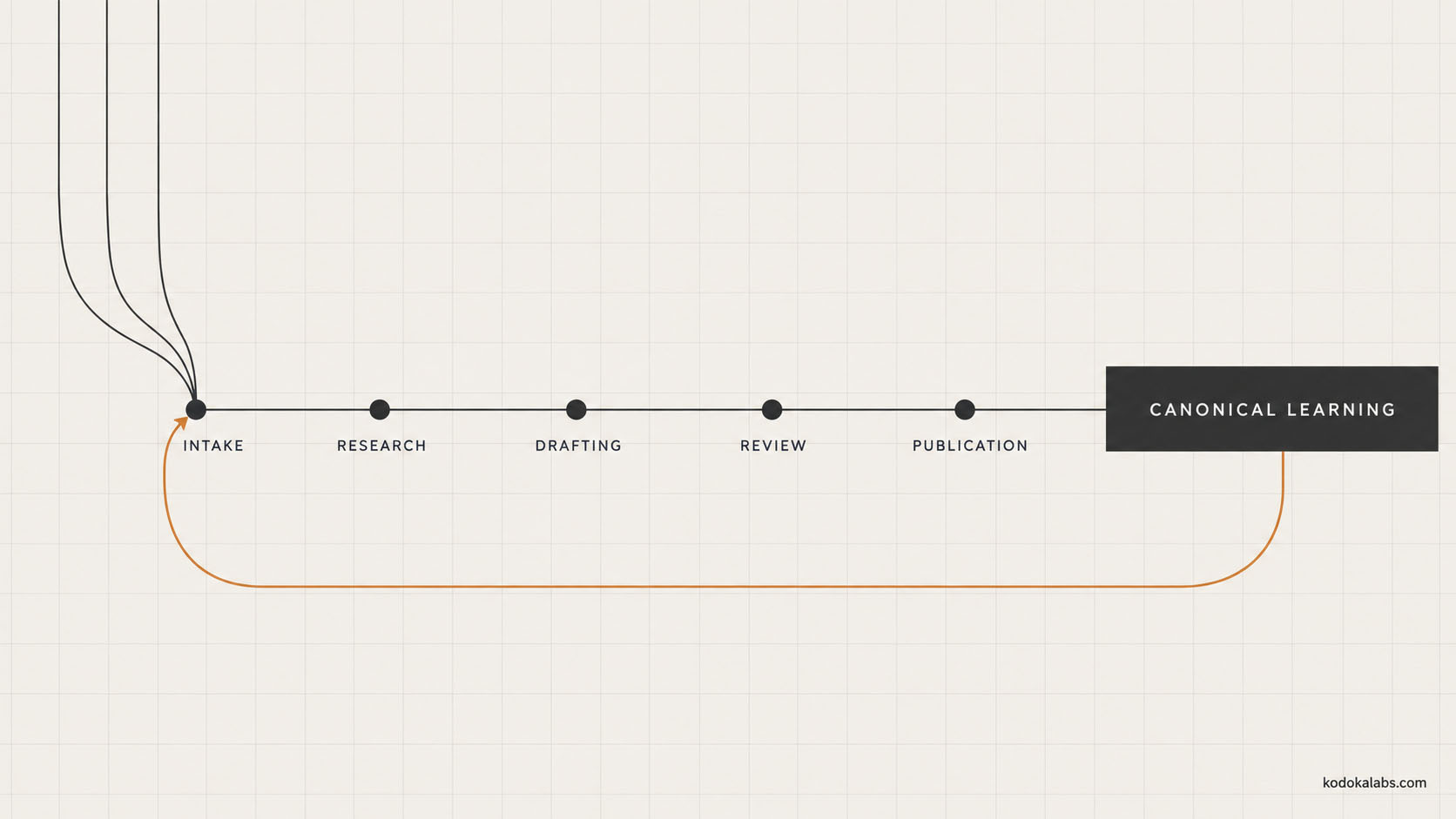
Demand intake is where the supply chain starts, and it needs the same discipline applied to any other kind of organizational prioritization: a defined way for a content need to enter the system, a consistent way to assess its priority and risk tier, and visibility into what’s already queued so a new request isn’t evaluated in isolation from everything else competing for the same capacity.
A content need that enters the system informally, a message to a writer, a verbal request in a meeting, bypasses this visibility and tends to produce two problems at once: the person making the request has no accurate sense of when it will actually be delivered, and the resulting work competes invisibly with everything already queued, silently displacing it without anyone having made that trade-off deliberately. A single, visible intake point, even a simple one, replaces this informal competition for attention with an actual, inspectable queue.
Mapping the full flow from demand to maintained asset also surfaces work that’s easy to overlook when thinking only about drafting and publishing. A piece of content that gets published isn’t finished in any durable sense if nobody maintains it: checking that its claims remain current, that its links still resolve, that its framework references still match the organization’s canonical terminology. Treating maintenance as part of the mapped flow, not an afterthought outside it, prevents a slow accumulation of stale, quietly inaccurate published content that nobody is actively responsible for.
A useful way to validate a demand-and-flow map, once drawn, is to pick a handful of recently published pieces and trace each one backward through the map: where did the request actually originate, how long did it sit before research began, which stage took the longest, and did it actually follow the mapped path or deviate from it informally along the way. Deviations are informative rather than embarrassing; they usually reveal a gap between the organization’s intended process and what people actually do when the intended process doesn’t fit a specific situation well, which is exactly the kind of gap worth closing deliberately rather than leaving as an unspoken workaround that only a few people know about.
This backward tracing exercise is worth repeating on a regular cadence rather than treating it as a one-time mapping effort, because the gap between the documented process and the actual process tends to widen gradually and invisibly as teams grow, tools change, and new categories of content get added without anyone revisiting whether the original map still describes reality. An organization that traces a handful of pieces quarterly will usually catch these drifts while they’re still small, isolated deviations; one that only maps its flow once, at the start of a content program, is more likely to discover the drift only after it has become the de facto process that nobody actually documented or deliberately chose.
The map should also make visible which requests never made it through the pipeline at all, not just the ones that completed successfully. A content need that was logged at intake and then quietly abandoned, because priorities shifted, because nobody picked it up, because the requester lost interest, is a different kind of signal than a request that completed on time, and a supply chain view that only tracks completed work misses this entire category of friction.
Capacity, Queues, and Service Classes
Capacity planning for content needs to account for every function the pipeline actually depends on, not just the function that’s easiest to measure. Writers and drafting workflow capacity get counted almost automatically; reviewer capacity, legal and compliance availability, design and visual asset capacity, and publishing operations capacity are counted far less consistently, and any one of them can be the organization’s true bottleneck regardless of how much drafting capacity exists.
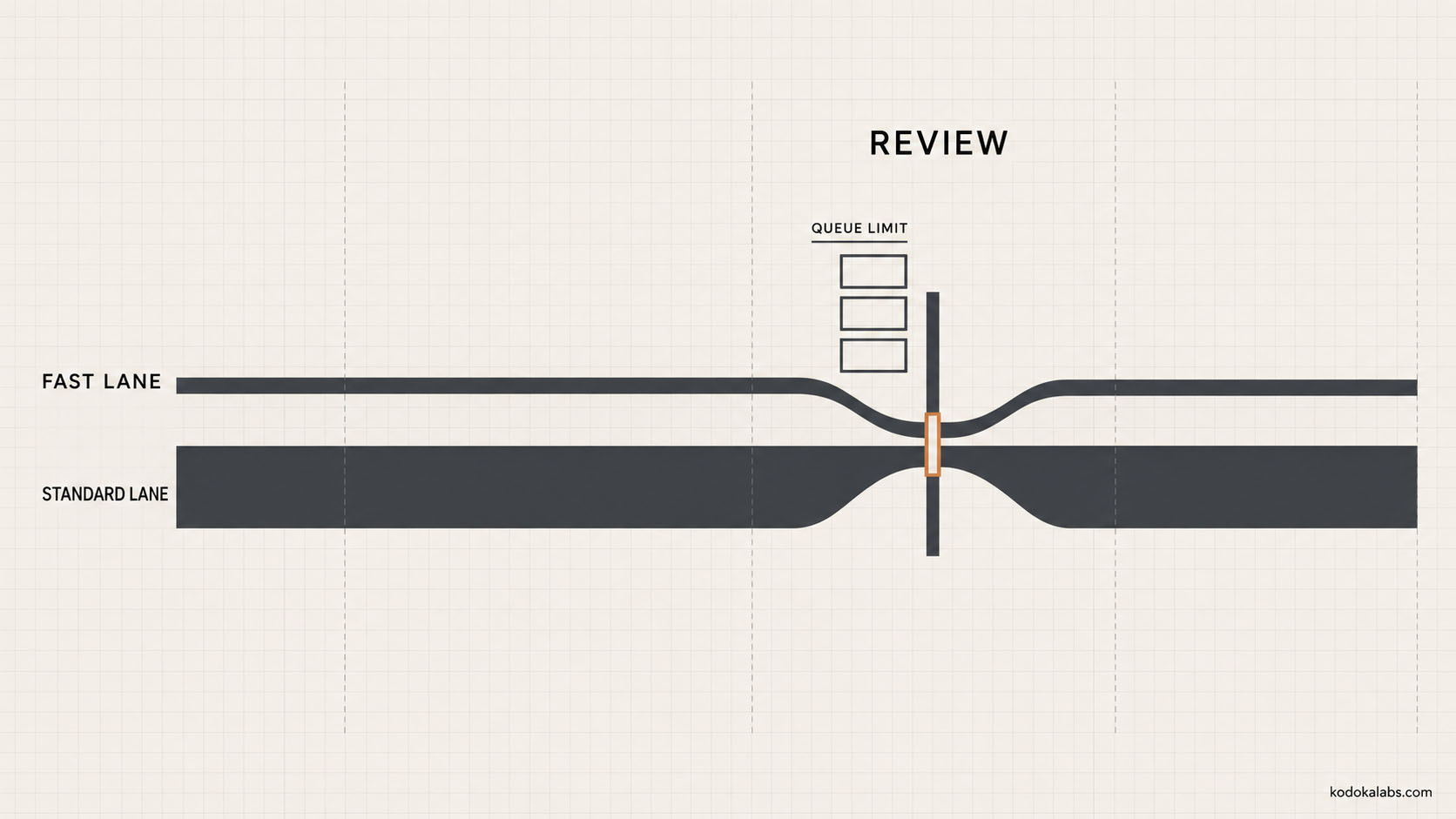
Work-in-progress limits matter because an unbounded queue tends to grow until it reflects demand rather than capacity, which quietly inflates lead times for everything in it. Setting an explicit limit on how much content can be active in a given stage at once, rather than allowing unlimited intake, forces a visible prioritization decision whenever new work would exceed that limit, instead of letting everything proceed in parallel at a pace that degrades as volume grows.
Service classes let different content move through the system at appropriately different speeds. An urgent but low-complexity update shouldn’t wait behind a complex, multi-week cornerstone guide in an undifferentiated single queue; a defined fast-lane service class for genuinely urgent, low-risk work, separate from the standard lane most content runs through, keeps both kinds of work moving at the pace their actual urgency and complexity warrant. Defining service classes explicitly, rather than letting urgency be negotiated informally case by case, also prevents the common failure where everything eventually gets labeled “urgent” and the fast lane stops meaning anything.
Protecting a fast lane’s meaning requires an explicit, enforced definition of what actually qualifies for it, evaluated against the same risk-tier logic used in AI Editorial Governance rather than against how insistently a requester is asking for speed. A fast lane that admits high-risk content simply because someone with sufficient seniority wants it published quickly has stopped being a service class and become a bypass around the review depth that content’s actual risk requires. The discipline here is the same one that governs risk-tier classification generally: urgency is a legitimate scheduling input, but it should never be allowed to quietly substitute for risk assessment.
Capacity planning should also distinguish between capacity that’s genuinely available and capacity that exists on paper but is routinely consumed by unplanned, urgent work. An organization that plans its standard-lane throughput as if 100% of a reviewer’s time were available for scheduled work, when in practice a meaningful share of that time is regularly absorbed by fast-lane interruptions, will consistently overcommit its standard lane and then wonder why delivery dates keep slipping. Reserving a realistic buffer for interruption-driven work, rather than treating it as an unplanned exception each time, produces more honest and more reliably met commitments across the whole pipeline.
Stage Contracts and Handoffs
Every stage in the content supply chain, not just the four canonical editorial stages but also any additional handoffs to design, legal, or distribution, needs a defined contract: what input it requires before starting, what acceptance criteria define a complete and correct output, what evidence proves the work was actually done to that standard, and what the escalation path looks like when the input is incomplete or the output can’t meet its criteria within the available time.
A handoff without a defined contract tends to produce the same quiet failure repeatedly: the receiving stage discovers, partway through its own work, that what it received wasn’t actually complete, and has to either pause and request the missing piece or proceed anyway and produce a compromised result. Both outcomes cost more than catching the gap at the moment of handoff would have, which is exactly what an explicit acceptance criterion at each stage boundary is designed to do.
| Stage | Demand owner | Input | Acceptance criteria | Capacity class | Output | Downstream consumer | Queue limit | Service expectation | Quality evidence | Exception / escalation |
|---|---|---|---|---|---|---|---|---|---|---|
| Demand intake | Content strategy lead | Business need, audience, priority | Named owner, risk tier, priority assigned | Standard | Queued, prioritized content request | Research & Briefing | Defined per planning period | Acknowledged within a set turnaround | Intake record with risk tier | Escalate ambiguous priority to governance owner |
| Research & Briefing | Research/briefing lead | Queued request | Approved brief with evidence attached | Standard or fast-lane | Approved content brief | Drafting | Limited concurrent briefs per owner | Matches assigned service class | Brief sign-off record | Return to requester for scope clarification |
| Drafting | Writer / drafting workflow owner | Approved brief | Complete, internally consistent draft | Standard or fast-lane | Versioned draft | Review | Limited concurrent drafts per writer | Matches assigned service class | Draft version with claim sources | Return to Research & Briefing for evidence gap |
| Review | Risk-tier-matched reviewer | Complete draft | Explicit approve/revise/escalate decision | Standard, specialist, or fast-lane | Reviewed and decisioned draft | Publication | Limited concurrent reviews per reviewer | Matches assigned risk tier and service class | Review Evidence Pack | Escalate to specialist or governance owner |
| Publication & distribution | Publishing / content operations owner | Approved, decisioned draft | Published asset matching approved version | Standard | Published, monitored asset | Maintenance and feedback | Limited concurrent publications per period | Matches assigned service class | Publication and feedback record | Post-publication correction path |
| Maintenance | Assigned maintenance owner | Published asset plus review trigger | Confirmed current or updated accordingly | Low, scheduled | Maintained or updated asset | Canonical knowledge base | Scheduled review cadence per content category | Matches content's staleness risk | Maintenance log entry | Escalate stale high-risk content for urgent review |
Partners, Systems, and Traceability
External partners, freelance writers, specialist agencies, contracted subject-matter reviewers, need to operate under the same evidence, approval, and confidentiality controls as internal staff, not a looser parallel standard applied because the work happens to be outsourced. A content supply chain that holds internal contributors to a documented evidence standard while allowing an external partner’s work through on trust alone has created an inconsistency that will eventually surface, usually at the worst possible moment, as an unverified claim or a confidentiality lapse traced back to a partner nobody was actually governing to the same standard.
Traceability across the whole chain means being able to answer, for any published asset, where its source material came from, who touched it at each stage, what was checked, and when. This is the aggregate, system-level version of the evidence discipline detailed in AI Research Workflows and Human Review for AI Content; this guide’s contribution is ensuring that discipline is consistently enforced across every workflow and every partner in the pipeline, not just within any single piece of content considered in isolation.
Onboarding a new partner into this supply chain should include the same evidence and confidentiality expectations given to a new internal hire, not a lighter abbreviated version delivered informally because the relationship is commercial rather than employment-based. In practice this means a documented briefing on the organization’s risk tiers and evidence standards, explicit confirmation of what data the partner may and may not access, and the same claim-register and review-evidence expectations applied to their output as to anything produced internally. A partner relationship that skips this onboarding tends to discover the gap only when a piece of partner-produced content reaches review and turns out to have been built without the sourcing discipline the rest of the pipeline assumes.
Resilience and Risk
A resilient content supply chain has no single point of failure whose unavailability would stall the entire pipeline. Expert concentration is the most common version of this risk: if only one person can review a particular content category, or only one subject-matter expert can speak credibly to a particular topic, that person’s unavailability doesn’t just slow one piece of content, it can halt an entire category of production. Vendor dependency carries the same risk in a different form: a single external partner or tool that the pipeline depends on without a documented fallback is a fragility the organization may not notice until that dependency actually fails.
Undocumented systems and approvals compound these risks quietly. A workflow that depends on one person’s personal knowledge of how a particular tool or approval process actually works has no resilience if that person is unavailable, regardless of how reliable the workflow has been up to that point. The resilience audit below should be revisited periodically, not treated as a one-time exercise, since new dependencies and new concentrations of risk accumulate as the organization’s content program grows and changes.
Building resilience doesn’t require eliminating every single point of failure immediately, which is rarely realistic given real constraints on budget and expert time. It requires knowing where they are, deciding deliberately which ones the organization accepts as a known, documented risk for now and which ones it actively mitigates, and revisiting that decision as the stakes change. A single-expert dependency on a low-volume, low-risk content category might be a reasonable risk to simply accept; the same dependency on the organization’s highest-visibility, highest-risk content category usually warrants active mitigation, training a second qualified person, documenting the expert’s judgment per Expert Knowledge Capture, well before that dependency actually fails.
The decision to accept a given single point of failure rather than mitigate it should itself be documented and owned, not left as an implicit default that nobody consciously chose. A risk that was deliberately accepted, with a named owner and a stated reason, is meaningfully different from a risk that simply hasn’t been noticed yet, even though both can look identical from the outside on an ordinary day when nothing has gone wrong. The difference becomes visible the moment something does go wrong: an organization that deliberately accepted the risk already has a recovery path in mind and a clear sense of who decides what happens next, while an organization that never noticed the risk at all has to improvise a response under pressure, which is precisely the situation a resilience audit exists to prevent.
Resilience planning also benefits from distinguishing between dependencies that fail suddenly and completely, an expert leaving the organization with no notice, and dependencies that degrade gradually, a vendor’s quality slipping over several months before anyone formally notices. The first kind of risk is addressed primarily through documentation and succession, captured knowledge that lets someone else step in immediately. The second kind requires an ongoing monitoring signal, since there’s no single moment that triggers a response the way a sudden departure does; by the time gradual degradation is obvious without deliberate monitoring, a meaningful amount of substandard content may already have moved through the pipeline undetected.
| Risk | Likelihood | Impact | Control | Owner | Recovery path |
|---|---|---|---|---|---|
| Single reviewer qualified for a content category | Moderate to high in most organizations | High (production halts for that category) | Train and certify a second qualified reviewer | Governance owner | Escalate to an external specialist reviewer on an interim basis |
| Single subject-matter expert for a topic area | High in expert-led content programs | High (content quality and authority depend on this person) | Document captured knowledge per Expert Knowledge Capture; identify a secondary expert | Content operations leader | Rely on canonicalized knowledge objects for routine needs; delay sensitive new claims until the expert returns |
| Single external vendor for a production function | Moderate | Moderate to high depending on function | Maintain a documented, even if unused, fallback vendor relationship | Procurement or content operations leader | Activate fallback vendor; extend timelines transparently |
| Undocumented approval process | Moderate | Moderate (confusion and delay rather than halt) | Document the process and named approver explicitly | Governance owner | Escalate to governance owner for an interim ruling |
| Knowledge concentrated in one system with one administrator | Low to moderate | High if that system becomes inaccessible | Document access and recovery procedures; assign a backup administrator | IT or knowledge management owner | Follow documented recovery procedure |
Measurement and Improvement
Lead time, how long a piece of content takes from demand intake to publication, and its variance, how consistent that lead time is across similar content, both matter more than a single average figure suggests. A pipeline with a fast average lead time but wide variance is harder to plan against than a slightly slower pipeline with tight, predictable variance, because unpredictability forces every downstream commitment, a launch date, a campaign timeline, to build in a buffer against the worst case rather than the typical case.
Work-in-progress levels, rework rates, and blocked time, time a piece of content spends waiting on something rather than actively being worked on, are the metrics most likely to reveal where the real constraint sits. A high blocked-time percentage at a particular stage boundary is usually a more reliable signal of where to focus improvement effort than a general sense that “things feel slow,” because it points to a specific handoff rather than a vague, pipeline-wide impression.
Improvement should proceed from measurement to a specific, bounded change, rather than from a general sense that the whole pipeline needs to move faster. A supply chain that identifies its highest-blocked-time stage boundary, forms a specific hypothesis about why (an unclear acceptance criterion, an under-resourced reviewer role, an informal handoff with no defined contract), and tests a targeted change against that hypothesis will accumulate real, attributable improvement over time. A broad initiative to “speed up content production” without this specificity tends to produce activity without a clear mechanism connecting the activity to the actual constraint, and it’s correspondingly hard to tell afterward whether anything real improved.
A targeted change also needs a defined measurement window before and after, long enough to separate a genuine shift from ordinary week-to-week noise in lead time and rework rate. A single fast week following a process change is not evidence the change worked, and a single slow week following it is not evidence it failed; both are within the range of normal variation that any pipeline produces even with no change at all. Comparing a full measurement period before the change to an equivalent period after, and ideally continuing to watch for several additional cycles, gives a more trustworthy read on whether the targeted change actually moved the metric it was meant to move, or whether the apparent improvement was simply the kind of fluctuation the pipeline would have produced anyway.
Failure Modes for the Content Supply Chain
Overproduction, starting more content than the pipeline’s actual downstream capacity can process, creates a growing backlog of partially finished work that ties up capacity without producing finished, published value. Hidden queues, informal backlogs that exist in someone’s personal task list rather than in the organization’s visible intake system, undermine capacity planning because the true demand on the system is invisible to whoever’s trying to plan around it. And treating every piece of content as equally urgent erodes the value of service classes entirely, since a fast lane that everything qualifies for isn’t actually a fast lane.
Frequently Asked Questions
How is this different from the AI Editorial Operating System?
The Editorial Operating System describes how a single piece of content moves through its four stages. This guide describes what happens when many pieces move through the system simultaneously: capacity, queues, service classes, partner management, and resilience across the whole production operation.
What's the single most common bottleneck in a content supply chain?
It varies by organization, but reviewer and specialist capacity, not drafting capacity, is the most frequent constraint we see once AI assistance has already accelerated the drafting stage. A supply chain redesigned without addressing this tends to simply relocate its visible bottleneck rather than resolving it.
Should external partners be held to a lighter evidence standard than internal staff?
No. The evidence, approval, and confidentiality controls in AI Editorial Governance and AI Research Workflows should apply consistently regardless of whether the work is performed internally or by a contracted partner.
How often should the resilience audit be revisited?
At minimum whenever the content program's scale or scope changes meaningfully, and as a standing practice at least annually, since new concentrations of risk accumulate quietly as teams, tools, and topics change over time.
What's the fastest way to identify the current real bottleneck?
Measure blocked time at each stage boundary rather than relying on general impressions. The stage with the highest proportion of blocked time, work waiting rather than being actively processed, is almost always the actual constraint, even when it doesn't match where attention has informally focused.
Can a content supply chain be redesigned gradually, or does it require a full rebuild?
Gradually, in almost every case. Starting with demand intake and a single capacity-tracked bottleneck stage, then expanding the mapped flow, service classes, and resilience audit outward from there, produces usable improvement sooner and with far less organizational disruption than attempting a complete redesign of every stage simultaneously.
Design the Content Supply Chain Before You Scale It
A content supply chain that’s deliberately designed, rather than assembled by accident, is what lets an organization scale its content output without scaling its risk or its fragility at the same rate. Content Production Efficiency covers the detailed metrics and improvement discipline that build on this supply-chain map; Scaling Expert-Led Content Without Diluting Expertise addresses the specific resilience question of scarce expert capacity in depth. Organizations ready to map their own current supply chain can start with a kōdōkalabs Executive AI Marketing Assessment.