
Agency Retainers vs. Capability Transfer: Building Internal AI Autonomy for Mid-Market B2B
Executive Summary
Mid-market B2B leadership teams face a specific capital allocation decision once generative AI materially changes the cost of producing marketing output: continue paying an external agency a recurring fee for execution, or invest in a bounded engagement that builds the capability internally and ends the organization’s dependence on outside vendors for day-to-day marketing operations. This guide lays out the structural misalignment built into the traditional agency retainer model, defines the Capability Transfer Framework as the alternative, and provides a direct unit-economics comparison between a 24-month agency retainer and a six-month transformation engagement followed by fractional advisory support. It closes with five non-negotiable questions every executive team should ask before signing with any transformation partner.
Key Takeaways for the Agency Retainers vs. Capability Transfer
- Agencies that bill for time or deliverable volume have no commercial incentive to build automated workflows or transfer technical ownership to the client, because doing so reduces the client’s future dependence on the retainer.
- The Capability Transfer Framework treats documentation, runbooks, and internal enablement as primary deliverables of an engagement, not optional add-ons, and follows a scheduled sunset principle rather than an open-ended advisory relationship.
- A direct unit-economics comparison over a 24-month horizon shows materially different outcomes for total cost, intellectual property ownership, and cycle velocity between a traditional retainer and a structured capability transfer engagement.
- A governed AI Marketing Operating System that the organization owns outright behaves as an appreciating asset on the balance sheet of institutional knowledge, unlike a retainer relationship, which produces no residual asset once the contract ends.
- Five specific questions, asked before signing any transformation agreement, surface whether a prospective partner is structured to transfer capability or structured to protect a recurring revenue stream.
The Executive Dilemma: Build, Buy, or Outsource?
Mid-market B2B executive teams are reaching a specific inflection point at roughly the same time, regardless of industry. Generative AI has materially compressed the cost and time required to produce marketing content, research, and campaign assets, which means the economics that justified a traditional agency retainer, paying for scarce execution capacity, no longer hold the way they did three years ago. Paying an hourly or monthly rate for outsourced content execution made clear financial sense when producing a technical blog post or a campaign asset genuinely required a specialized team working for days. It makes considerably less sense once a well-architected AI system can compress much of that production cycle to hours, and the agency’s cost structure has not been redesigned to reflect that change.
This creates a genuine strategic choice rather than an obvious answer. An unguided internal build, attempting to design workflows, governance, and knowledge architecture without outside architectural expertise, carries real execution risk: internal teams frequently lack the specific experience of having designed and deployed an AI Marketing Operating System before, and a first attempt built without that experience tends to replicate the same point-solution sprawl and ungoverned risk exposure that undisciplined agency usage already produces. Continuing to pay an agency retainer avoids that execution risk but carries a different, quieter cost: recurring fees that persist indefinitely, zero institutional learning transferred to the internal team, and continued dependence on an external party for a capability that increasingly sits at the center of commercial performance.
The decision in front of most leadership teams, then, isn’t really build versus buy versus outsource as three equally viable paths. It’s whether the organization structures its next marketing technology investment to end in internal ownership, or whether it structures that investment to continue indefinitely as an operating expense with no residual asset. That framing is what the rest of this guide is built around.
The Structural Agency Misalignment
The traditional marketing agency business model bills for time, for deliverable volume, or for a blended retainer that functions as a proxy for both. That billing structure creates a direct incentive problem once AI enters the picture: an agency that builds fully automated, documented workflows and hands the technical architecture to the client has just reduced the billable hours the client will need from that agency going forward. The agency’s commercial interest runs counter to the client’s long-term interest in exactly the dimension that matters most, technology transfer.
This produces three specific operational risks that are easy to underestimate while an engagement feels like it’s going well. Client context, the accumulated knowledge of what’s worked, what the brand voice actually sounds like in practice, and why certain campaigns succeeded, remains locked inside the external account team’s institutional memory rather than the client’s own systems. Prompt workflows and the technical configuration behind them remain undocumented proprietary assets of the agency rather than transferable intellectual property the client can audit, modify, or move to another provider. And brand knowledge accumulated over the course of the engagement evaporates the moment the relationship ends, because none of it was ever captured in a system the client controls.
There is a fourth risk that boards and audit committees are increasingly asking about directly: governance exposure from unmonitored agency AI tool usage. An agency using generative tools on a client’s behalf, without a documented data-handling policy the client has reviewed, creates a compliance and brand-risk exposure the client often doesn’t discover until something goes wrong, a hallucinated claim in published content, a data-handling practice that wouldn’t survive scrutiny, or a workflow dependency the client only learns about when the agency relationship ends abruptly. An executive team evaluating a retainer renewal should treat the absence of a clear answer to “what AI governance applies to our account specifically” as a material finding, not a minor gap.
This misalignment is structural rather than a matter of any individual agency acting in bad faith. Account teams are typically staffed, evaluated, and compensated against utilization and retainer renewal, not against how quickly they can make themselves operationally unnecessary to the client. Asking an agency to document its workflows in a way the client could run independently is, in effect, asking that agency’s own staff to work against the incentive structure their employer has built around them. Some agencies manage this tension honestly and disclose the limits of what they’ll transfer. Many simply don’t raise the question at all, and a client that doesn’t raise it either defaults into a relationship where the agency’s commercial interest and the client’s long-term capability interest are quietly working against each other for the full life of the contract.
The Capability Transfer Model
The Capability Transfer Framework is the structural alternative to the agency retainer model, and its defining feature is straightforward: documentation, operational runbooks, and internal enablement are treated as primary deliverables of the engagement, with the same contractual weight as the marketing output itself, rather than as an afterthought mentioned in a closing deck.
That framework operates across the kōdō Transformation System’s six phases: Diagnose, Architect, Build, Enable, Measure, and Scale. Diagnose establishes an evidence-based baseline of the organization’s current workflows, knowledge readiness, and governance maturity before any architecture decision is made. Architect designs the operating system, the workflows, decision rights, knowledge structures, and governance gates the organization will actually run on. Build implements that design. Enable is the phase where capability transfer becomes concrete, where the internal team is trained, certified, and given full operational access to the systems the engagement built. Measure validates whether the new operating system is producing the commercial result the organization set out to achieve. Scale extends what’s working to additional workflows and teams.
The AI Capability Academy exists specifically to make the Enable phase rigorous rather than informal. It trains and certifies named internal Workflow Owners, specific individuals accountable for specific marketing workflows, so that operational control sits with people the organization employs rather than with an external account team. Certification here isn’t a token exercise; it means a named internal employee can run, troubleshoot, and modify a given workflow without calling an outside partner to do it for them.
The scheduled sunset principle is what separates a genuine capability transfer engagement from a retainer wearing different branding. A transformation partner operating under this principle works, deliberately and on a published timeline, toward making itself unnecessary for day-to-day execution. That’s a strange thing to build into a commercial relationship at first glance, since most vendors are structured to maximize the length of the relationship, but it’s precisely the feature that aligns the partner’s incentives with the client’s long-term interest instead of against it. A partner unwilling to name a specific sunset timeline for its own day-to-day involvement is, by omission, signaling that its commercial model depends on the client staying dependent.
It’s worth being specific about what “documentation as a primary deliverable” actually means in a signed engagement, because the phrase can sound like a soft commitment rather than a binding one. In practice it means the engagement’s statement of work lists specific artifacts, architecture decision records, workflow runbooks, prompt specifications, access credentials, knowledge graph structures, as deliverables with the same contractual standing as the marketing output itself, each with a named recipient on the client side and a defined acceptance criterion. An engagement that lists “ongoing support” or “collaborative partnership” as its primary deliverable, without naming the specific artifacts the client will hold at the end, has not actually committed to capability transfer, regardless of how the proposal describes its philosophy.
Financial and Operational Unit Economics
The clearest way to evaluate this decision is to compare the two paths directly over a comparable time horizon, using illustrative figures representative of the ranges mid-market B2B organizations typically encounter.
Option A: Traditional Agency Retainer.
Option B: Transformation Engagement Plus Fractional Advisory.
| Dimension | Option A: 24-Month Agency Retainer | Option B: 6-Month Transformation + Fractional Advisory |
|---|---|---|
| Illustrative 24-month total cost | Approximately $360,000-$600,000 (flat monthly retainer) | Front-loaded build cost plus 18 months of lighter fractional advisory cost |
| Intellectual property ownership | Remains with the agency; workflows and prompt configurations undocumented for the client | Transfers to the client; workflows, architecture, and documentation are contractual deliverables |
| Cycle velocity after month 24 | Unchanged; still dependent on agency capacity and responsiveness | Internal team operates independently; velocity set by internal capacity, not vendor availability |
| Institutional learning retained | Minimal; concentrated in the external account team | Substantial; concentrated in named, certified internal Workflow Owners |
| Dependence if the vendor relationship ends | High; production capability may stop with the agency | Low; the operating system continues to run under internal ownership |
| Long-term asset value | None; spend is a pure recurring operating expense | The operating system itself functions as an appreciating internal asset |
The last row is worth dwelling on, because it’s the dimension a pure cost comparison misses. A governed AI Marketing Operating System that the organization owns outright, complete with documented workflows, a certified internal team, and an established governance framework, continues to generate value and continues to improve after the initial engagement ends, in the way a capital asset appreciates rather than depreciates. A retainer relationship, however well executed month to month, produces no equivalent residual value once the payments stop. The organization is comparing a recurring operating expense against an investment that converts into an owned, improving system, and that distinction, not just the raw total-cost figures, is what should drive the capital allocation decision.
There’s also a cycle-velocity dimension that compounds over time in a way the 24-month snapshot understates. Under Option A, every new campaign, every new content format, every new channel still routes through the agency’s queue and the agency’s own internal capacity constraints, which means velocity in month 30 looks essentially identical to velocity in month 6, bounded by how much attention the account receives relative to the agency’s other clients. Under Option B, velocity in month 30 is typically higher than velocity in month 6, because the internal team has spent two years refining workflows it owns, extending the knowledge graph, and applying what it learned from the Measure phase to improve the system rather than waiting for a vendor to prioritize that improvement. The gap between the two paths widens the longer the comparison window runs, which is the opposite of what a simple month-24 total-cost comparison suggests at first glance.
A CFO evaluating this decision should also weigh a less obvious risk: vendor concentration. A 24-month retainer makes the organization’s marketing output structurally dependent on a single external relationship for the full period, with limited recourse if that agency underperforms, raises rates, loses key staff, or is acquired mid-contract. A capability transfer engagement converts that concentration risk into a time-bounded exposure, substantial during the six-month build but materially reduced once the internal team holds operational control, which is a meaningfully different risk profile for a board evaluating operational resilience rather than cost alone.
Evaluating Transformation Partners: The Executive Rubric
Do you deliver a documented, transferable operating system, or simply outsourced campaign execution?
The answer should describe specific deliverables, workflow documentation, architecture decision records, knowledge graphs, not a general assurance of quality output. If the answer focuses entirely on the content or campaigns produced rather than on what the client will own and control afterward, the engagement is structured as execution, not transfer.
What is your scheduled timeline for handing over full operational control to our internal team?
This should be a specific, dated milestone agreed before the engagement begins, not an open-ended “when you’re ready” framing that never actually arrives. A partner should be able to name the month in which internal certification is expected to be complete.
How are governance, brand protection, and verification gates codified within your workflow blueprints?
How do you measure current operational maturity before recommending tools?
Will all workflow specifications, vector knowledge repositories, and documentation belong exclusively to us?
None of these five questions is designed to be answered perfectly on the spot. The value of asking them is in how a prospective partner responds to being asked: a partner genuinely structured around capability transfer will typically have a ready, specific answer, often a standard section of its proposal, because the question reflects exactly what its commercial model is built to deliver. A partner structured around retained execution will more often respond with reassurance about relationship quality or creative output, which answers a different question than the one being asked. That mismatch, not any single red flag in isolation, is usually the clearest signal available before a contract is signed.
Executive leadership ready to apply this rubric directly, rather than evaluating it in the abstract, can begin with a kōdōkalabs Executive AI Marketing Assessment, which establishes the evidence-based baseline the third and fourth questions above depend on before any transformation proposal is drafted.

Frequently Asked Questions
Is a traditional agency retainer always the wrong choice?
Not universally. An organization with a narrow, short-term execution need, a single campaign, a defined project with a clear end date, may reasonably prefer a retainer's flexibility over the upfront commitment a transformation engagement requires. The structural misalignment described in this guide becomes most significant when a retainer continues indefinitely for core, recurring marketing operations that would benefit from durable internal capability rather than ongoing outsourced execution.
How long does a typical capability transfer engagement take?
The specific timeline depends on the scope and current maturity of the organization, but a six-month window for the core Diagnose through Enable phases, followed by a lighter fractional advisory relationship, is a representative structure for a mid-market B2B organization of the scale this guide addresses. The defining feature isn't a fixed universal duration, it's that the timeline is scheduled and disclosed up front rather than open-ended.
What is a Fractional AI Growth Director, and why would an organization want one after capability transfer is complete?
A Fractional AI Growth Director provides ongoing strategic oversight and architectural guidance at a fraction of the cost of a full-time executive hire or a continued agency retainer, supporting an internal team that already holds day-to-day operational control rather than replacing that team's capability. It's a lighter-weight advisory relationship appropriate once the organization owns its own operating system, not a continuation of the dependency the capability transfer engagement was designed to end.
What happens to institutional knowledge if an organization switches agencies under the traditional retainer model?
In most cases, very little of it transfers. Prompt configurations, workflow logic, and accumulated brand knowledge typically remain with the outgoing agency unless the client specifically negotiated for that knowledge to be documented and delivered, which is uncommon in standard retainer agreements. This is precisely the risk the Capability Transfer Framework is designed to eliminate by making documentation a contractual deliverable from the outset.
Can an internal marketing team realistically take over AI-enabled workflows without ongoing outside support at all?
Yes, provided the Enable phase included genuine certification rather than informal training, and provided the organization retains access to the underlying knowledge architecture and governance documentation. Many organizations choose to retain a lighter fractional advisory relationship not because the internal team can't operate independently, but because ongoing architectural perspective on an evolving technology landscape has standalone value, a choice rather than a dependency.
Conclusion and Next Steps
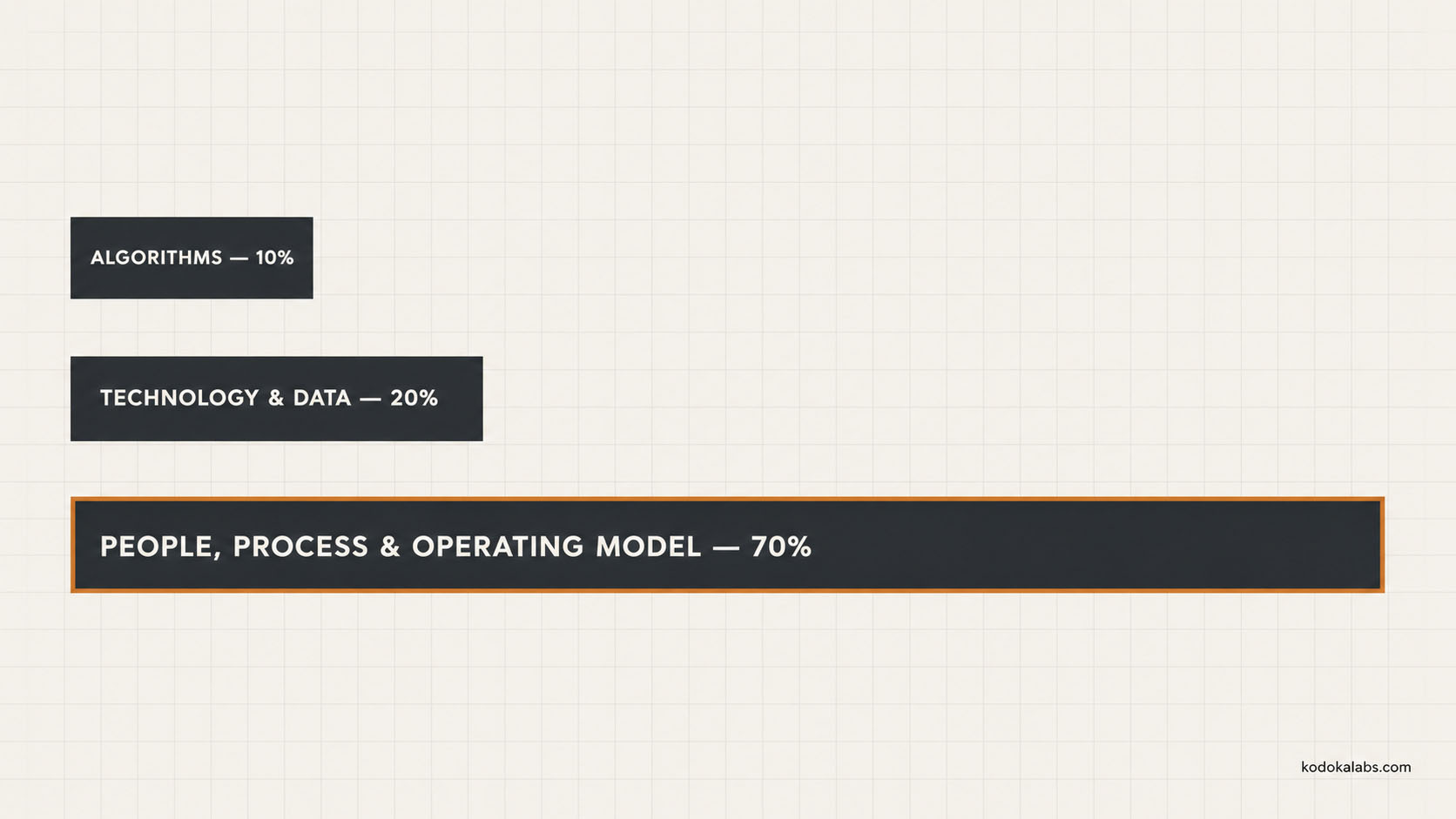
Enterprise AI adoption and enterprise AI value creation are, for the large majority of organizations, two separate stories right now. The research from RAND, Gartner, BCG, and McKinsey points to the same underlying diagnosis from four different angles: the gap is organizational, not algorithmic. Marketing leaders who want a different outcome than the 80%+ failure pattern RAND documents need to treat the next AI decision as an operating-model question before it’s a tool question. The next step for most organizations isn’t a new platform evaluation, it’s an honest, evidence-based look at the eight-layer architecture that turns scattered AI usage into a governed system built to produce a measurable result.